Ferrari 550 Maranello: The Return the Recession Paid For
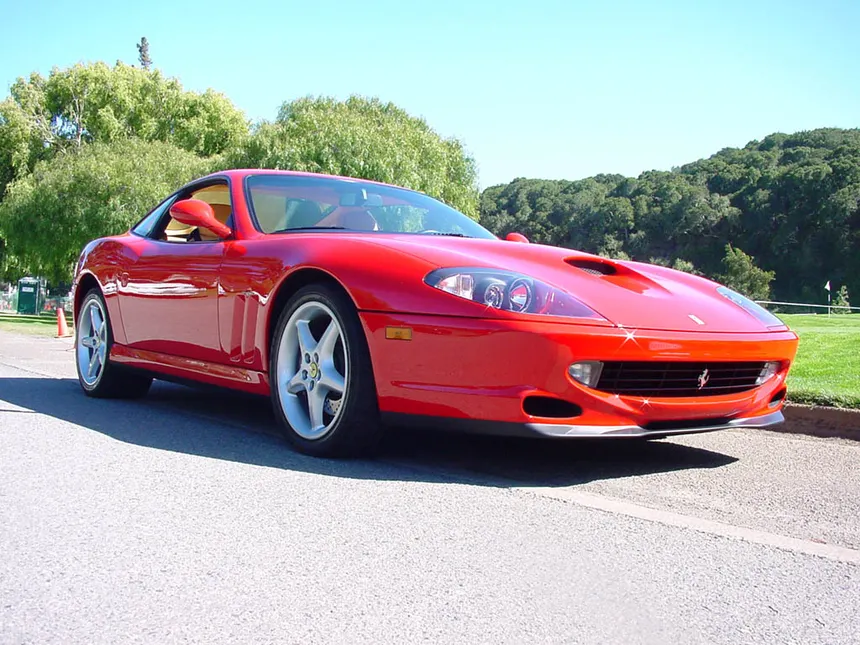
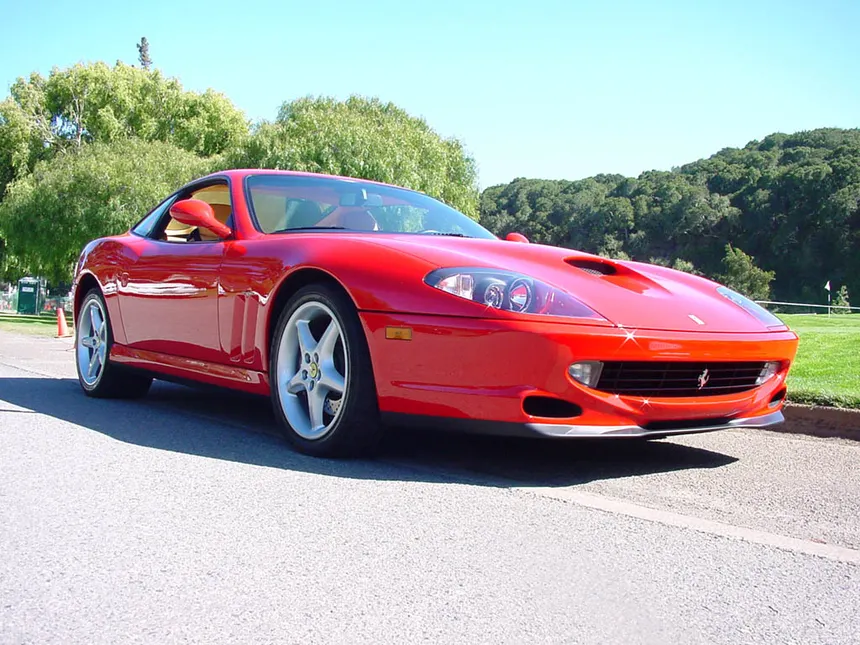
Ferrari has spent thirty years selling this car as a triumphant return to tradition. The twelve-cylinder goes back up front, the grand tourer reclaims its place, Maranello reconnects with its roots.
The part left out of the brochure is that the finance department made a good share of that decision.
Twenty-three years without a front-mounted twelve
Start by measuring the gap, because it explains the impact this car had.
From 1973, when the 365 GTB/4 Daytona gave way to the Berlinetta Boxer, Ferrari’s twelve-cylinder flagship carried its engine behind the driver. First the Boxer, then the Testarossa, then the 512 TR and finally the F512 M of 1994. Twenty-three unbroken years of mid-engine layout.
In July 1996 the 550 Maranello appeared with the V12 up front, and Ferrari framed it as a direct answer: a response to anyone who believed a front-engined car could not beat a mid-engined one on performance.
It is worth remembering where that argument came from. As we covered in our Daytona piece, Enzo kept the engine up front in 1968 against the entire current the Miura had opened. And as we covered in the 512 BB piece, Ferrari surrendered in 1973 and stacked the twelve on top of the gearbox, with the center-of-gravity problem that dragged behind it for two decades. That basic flaw is, according to specialist sources, why a racing version of the Testarossa never existed.
The 550 closes that arc. And it closes it by proving the Enzo of 1968 right, twenty-eight years later.
The reason that does not appear in the official story
Now the unflattering part, which is documented and which Maranello prefers not to underline.
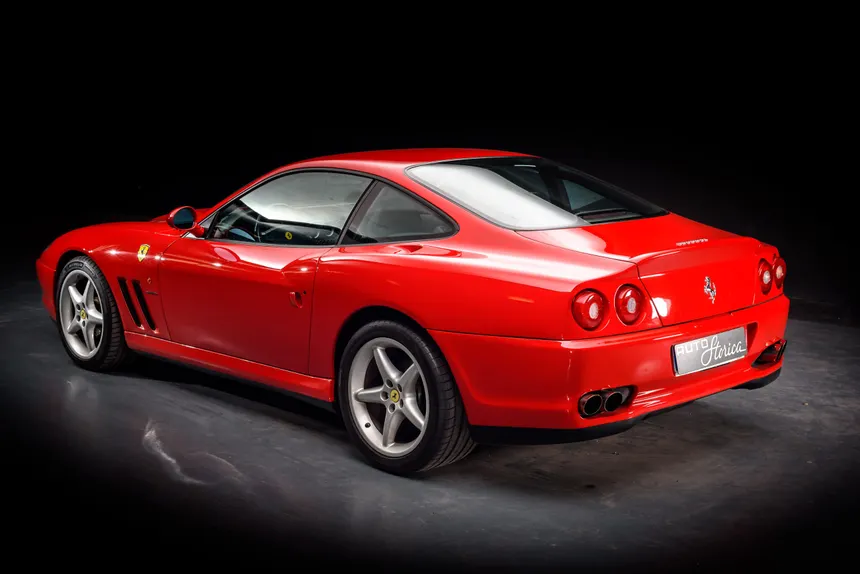
The economic recession of the early 1990s forced Ferrari to share development costs between the 550 and its sibling the 456 GT. A mid-engine proposal was considered at some point in the project and was dropped for budgetary reasons.
Translated: the return to the front engine was not purely a product decision and a reclaiming of heritage. It was also a way to make the numbers work, by leaning on a platform and a development program already paid for.
There is another layer. Under Luca di Montezemolo, who arrived as president in 1991 with the company in the state we described in our F355 article, the priority was selling cars people could actually use. A front-engined grand tourer with a real trunk fits that strategy far better than another mid-engined two-seater.
That the result was magnificent does not change where the decision came from. And knowing the origin does not diminish the car. It adds to it, because doing this on a tight budget is worth more than doing it with an open checkbook.
The name mixes liters and a town
The 550 is the five and a half liters of the engine. Maranello is where Ferrari has its factory.
That is the seventh naming system in this series of articles. The Daytona used single-cylinder displacement. The 512 BB used liters plus cylinder count. The F355 mixed liters and valves. The 360 used total capacity plus a city. The 599 used capacity divided by ten plus a racetrack. The 612 used rounded capacity plus a coachbuilder’s surname. The 400 reverted to the Daytona system. And the 550 uses liters plus a town.
Seven models, seven criteria.
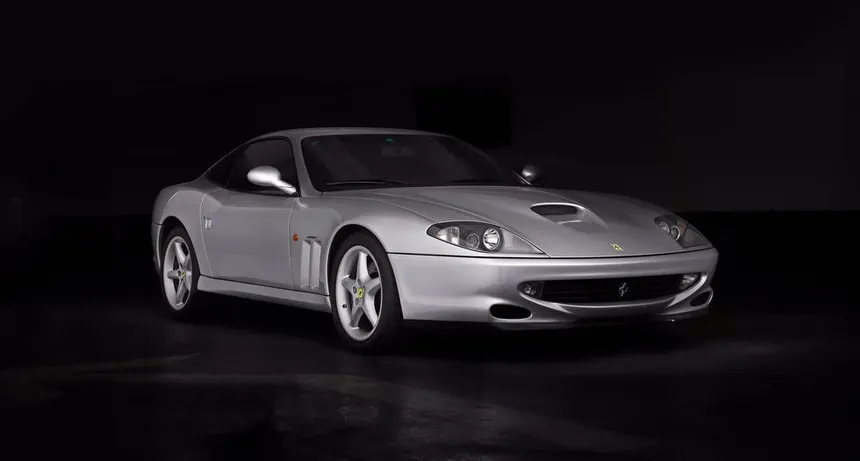
Nürburgring, with Schumacher driving
The press launch took place at the Nürburgring in July 1996, and the men who took the car out on track were the company’s two Formula 1 drivers at the time, Michael Schumacher and Eddie Irvine.
It was not decoration. Ferrari needed to demonstrate in the first minute that the front engine was not a step backward on performance, and staging the launch on that circuit with its two F1 drivers was the most direct way of saying so without saying it.
Where the engine actually sits
Here is the technical decision worth explaining, because the 550 is not a conventional front-engined car.
The V12 sits well behind the front axle, in a layout closer to front-mid than to pure front engine. And the six-speed gearbox is not bolted to it: it sits at the rear, integrated into a transaxle assembly with a limited-slip differential.
The goal is mass distribution, and it works. The 550 comes out at an exact 50/50 split front to rear. It is the precise opposite of the Boxer’s solution, which stacked engine over gearbox at the rear axle and raised the center of gravity, and it is the same approach the Daytona had used thirty years earlier with its rear transaxle.
The rest of the package: independent push-rod suspension with unequal-length wishbones, coil springs, telescopic gas dampers and anti-roll bars, with damping adjustable from the dashboard. A drag coefficient of 0.33 with constant downforce across both axles. And one first that rarely gets mentioned: the 550 was the first production Ferrari with ASR traction control as standard, technology that until then had been almost exclusive to racing.
The engine is rated at 485 hp at 7,000 rpm. Autocar measured 4.6 seconds from 0 to 60 mph and 10.1 seconds from 0 to 100 mph in its November 1996 road test, with a top speed around 199 mph.
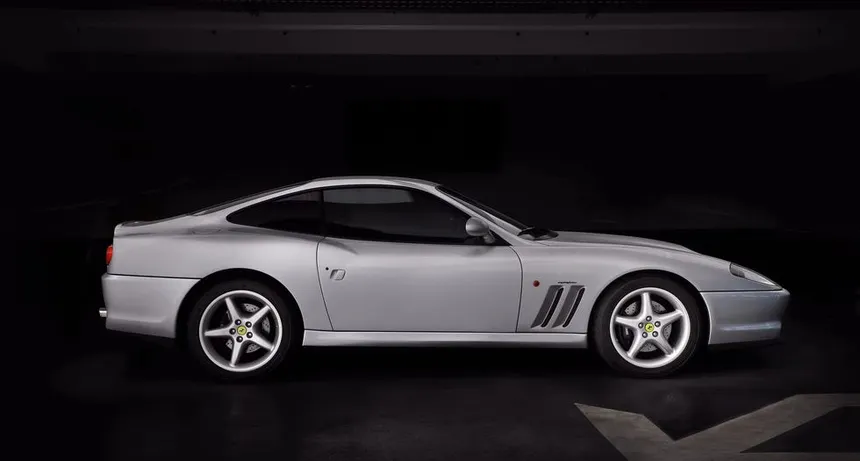
What it was up against
The natural rival in 1996 was the Lamborghini Diablo, which in that year’s SV form claimed 530 hp from its 5,707 cc V12, at a weight around 1,530 kg.
Forty-five horsepower above the Ferrari, mid-engined, and carrying a reputation as a difficult car that the 550 did not have. That is exactly the comparison Maranello wanted to provoke: comparable performance from a car you could drive every day, with luggage space.
Britain’s Evo magazine finished the argument. In 2004, after a comparison test between several prestige models, it named the 550 Maranello the best sports car of the 1994 to 2004 decade.
Ohio, October 12, 1998
To prove it with a stopwatch, Ferrari took a production car to the Transportation Research Center in Marysville, Ohio.
There the 550 covered 100 km at an average of 304.1 km/h and traveled 296.168 km in one hour. It did so while having to stop for fuel during the attempt. Other sources add a third record, 100 miles at an average of 306.3 km/h.
The drivers held the throttle flat in sixth for the entire run, at around 6,000 rpm, with fuel consumption close to 39 liters per hundred kilometers.
One note on precision, because it is funny: Ferrari’s own model page converts that 304.1 km/h into miles per hour two different ways within the same text, giving 188.88 mph in one paragraph and 192.60 mph in another. When the factory cannot agree with itself, quote the metric figure and skip the conversion.
Thirty-three cars to celebrate it
In 1999 Ferrari built a limited run of 33 cars called the World Speed Record edition, specification replicas of the car that had set the marks in Ohio, with a commemorative plaque.
Thirty-three cars. For context, the 550 Barchetta ran to 448 plus prototypes. The WSR is considerably rarer than the convertible and far less known.
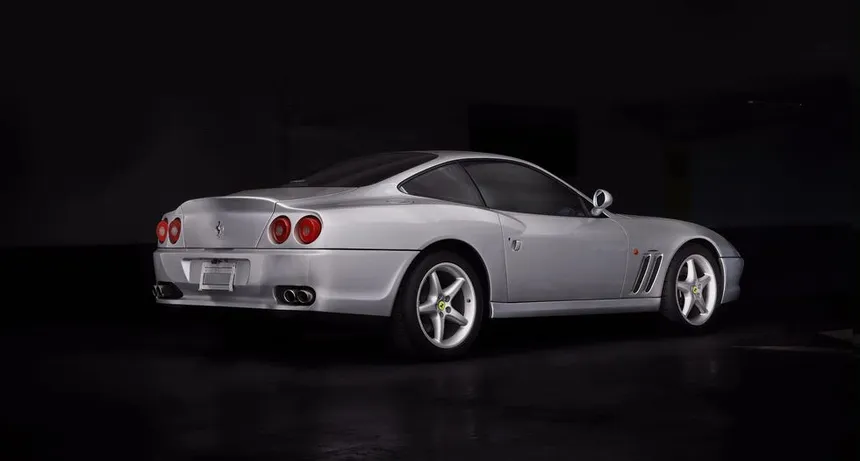
The Barchetta and its token roof
On that subject: the 550 Barchetta Pininfarina was officially shown at the 2000 Paris Salon and built in 2001, 448 cars. Ken Okuyama designed it at Pininfarina, taking inspiration from the 1958 250 Testa Rossa.
Its roof is barely more than a cloth cover fitted by hand. It is not a convertible designed for rain. It is a convertible designed to ignore the possibility.
America’s part in this story, and who actually won Le Mans
The 550 Maranello was never designed with racing in mind. But a French gentleman driver living in Switzerland named Frédéric Dor had a childhood dream: to win the 24 Hours of Le Mans in a Ferrari. He also had the resources and the determination to chase it.
In 2001, through his Care Racing Development operation, he commissioned Britain’s Prodrive to build a racing version of the 550. Ten cars were built over the following years, and here is the key point: they were conceived and completed entirely in-house at Prodrive with no Ferrari involvement whatsoever. The last time anyone in Maranello touched one was when the donor road car rolled out of the factory gates.
Prodrive extracted 600 hp from the V12 from the start, with good reliability. The first season was development. In 2002 a single 550 entered Le Mans, retired on lap 175, and still took class pole and the fastest lap of the race, a clear warning to the Corvettes and Vipers dominating the category.
The year it came together was 2003. A GTS class win at the 24 Hours of Le Mans for Peter Kox, Tomas Enge and Jamie Davies, who also took class pole and finished tenth overall. That same year BMS Scuderia Italia took the FIA GT championship, including the class win at the Spa 24 Hours. In the American Le Mans Series, Prodrive fought the factory Corvette program to the wire and narrowly missed the GTS title.
The Prodrive 550s accumulated forty-nine outright or class victories, including an outright win at the 2004 Spa 24 Hours.
And the fact that crowns it: that Prodrive 550 was the last twelve-cylinder Ferrari to win at Le Mans.
A Frenchman paid for it, a British company built it, and Ferrari supplied nothing beyond the road car they started from. The greatest competition achievement of Maranello’s modern twelve-cylinder belongs to somebody else.
Two points where sources disagree, which I am flagging: most say ten cars were built and at least one source raises it to twelve, and the Le Mans class win is dated to 2003 in most of the literature although one publication places it in 2004.
Ferrari took note. After watching privateers fight for the lead with the 550, it commissioned N-Technology to develop the 575 GTC to supply racing teams. It arrived late and it arrived as a reaction.
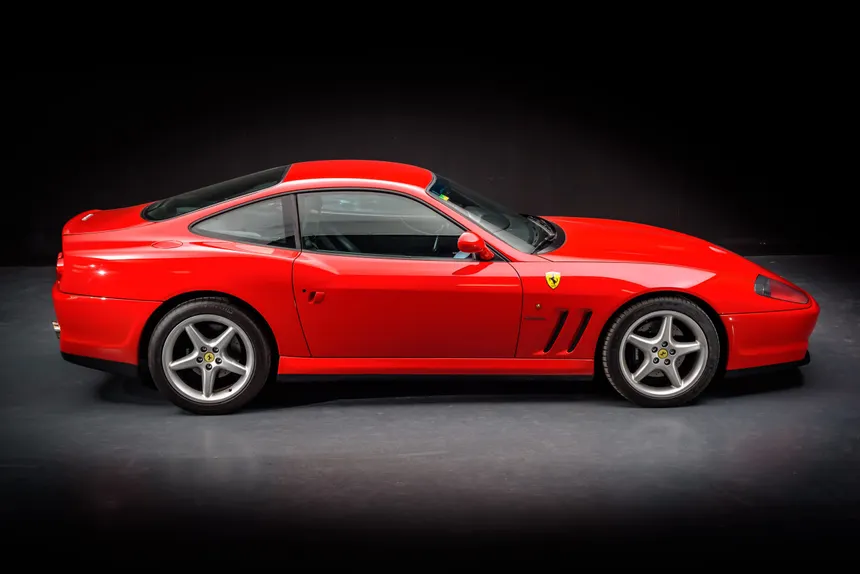
The 575M and the beginning of the end for the lever
The 575M Maranello arrived in 2002, the M standing for Modificata. The engine grew to 5.75 liters and 515 hp at 7,250 rpm, with 588.6 Nm at 5,250 and improved torque between 1,000 and 4,000 rpm compared with the 550. Adaptive suspension and revisions by Pininfarina under Lorenzo Ramaciotti, the same man who had signed the 550.
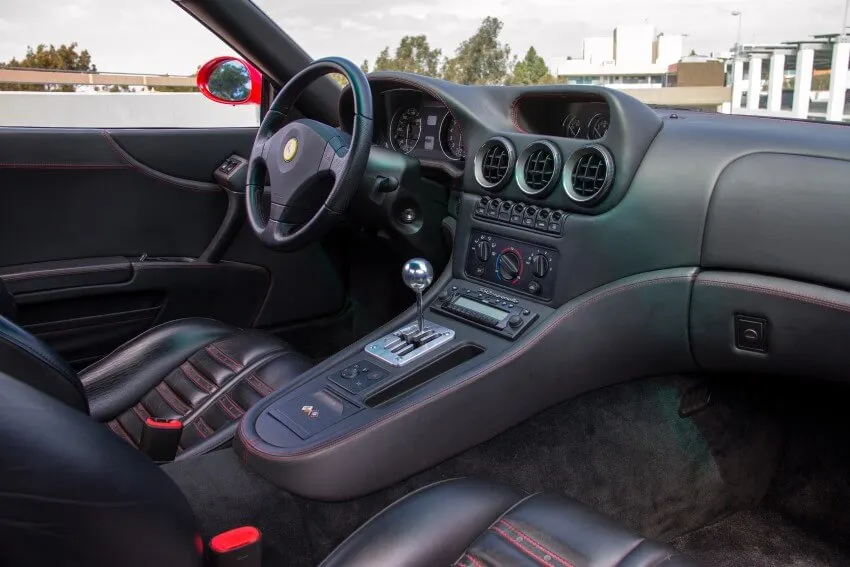
And the change that matters for this series: the 575M was the first production Ferrari twelve-cylinder to offer the F1 gearbox with paddles behind the wheel.
That is where the countdown begins, the one we have already covered in two articles. The 550 was built entirely with the six-speed gated manual, no exceptions: 3,083 cars. The 575M dropped to roughly 246 manuals out of some 2,056 coupes. The 599 got down to 30. And the F12berlinetta did not offer it at all.
On the Superamerica, the open version of the 575M with its rotating electrochromic glass Revocromico roof, only 43 of the 559 cars built had the manual.
Six years from the lever being the only thing on offer to the lever being a double-digit rarity.
The verdict
The 550 Maranello is a better car than its own legend says, and the legend is badly built.
Maranello sells it as the brave return to tradition, when the documentation says the recession of the 1990s forced cost-sharing with the 456 and that a mid-engine proposal fell on budget grounds. That is not a betrayal of the story, it is a better story: a company with cash problems took the cheap option and ended up with what the most demanding magazine in the business called the sports car of the decade.
What does grate is Le Mans. The last twelve-cylinder Ferrari to win there was funded by a Frenchman, built by a British company in Banbury, and Maranello did not assign a single engineer. When it started working, Ferrari reacted by commissioning the 575 GTC from somebody else. The company that built its entire mythology on racing let its best modern grand tourer win the most important race in the world without lifting a finger, and then stood in the photograph.
Thirty years on, the 550 remains the last twelve-cylinder berlinetta Ferrari sold exclusively with three pedals. That sentence will not be written about any new car again.
How many decisions we now celebrate as visionary were simply the option that fit the budget?
Check you’re still alive.