Renault 8 Gordini: The Blue Sedan That Beat Ferraris in Their Own Backyard
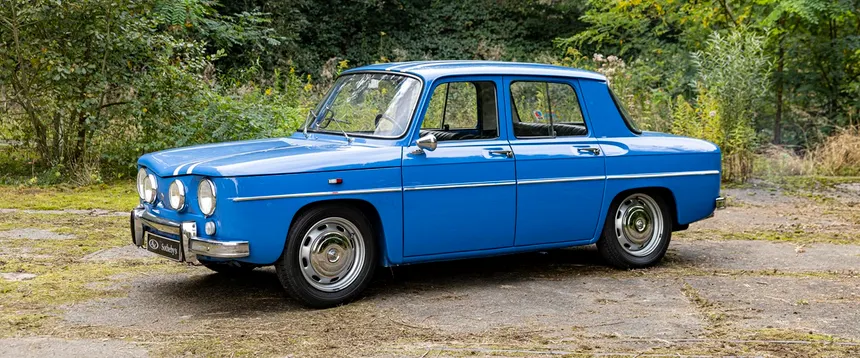
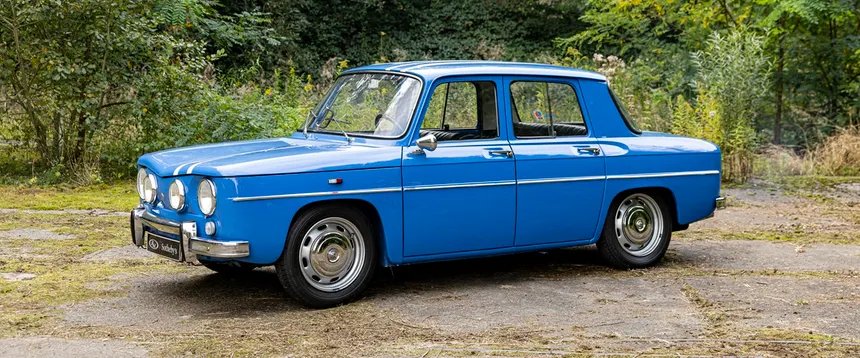
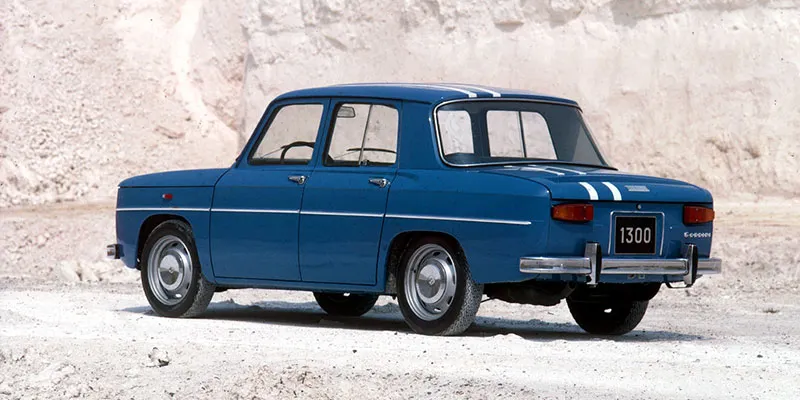
Picture a four-door family sedan. The kind of car a dad drove to the office. Now paint it French Blue, run two white stripes over the roof and hood, bolt four round headlamps to the nose, and hang a one-liter engine out behind the rear axle where physics says an engine has no business being.
That’s the Renault 8 Gordini. And if you’d pulled up next to one at a light in 1966, you’d have had no idea that the little blue economy box was about to leave you staring at its taillights.
Americans never really got this car. It was a European giant-killer, the sort of David-versus-Goliath machine that Detroit’s muscle-car logic couldn’t compute. Too small, too underpowered on paper, wrong engine in the wrong place. And it won anyway. Repeatedly. Against machinery that cost three times as much.
Who Was Gordini?
Before the badge became a Renault trim level, Gordini was a man. Amédée Gordini, an Italian who set up shop in France and spent decades in racing, running his own Formula 1 team along the way. The French called him “le sorcier,” the wizard. When Renault brought him in-house in the 1950s, they weren’t buying a fancy name. They were buying a guy who could squeeze blood from a production engine.
The job came in 1962. While Renault finished developing the standard 8, Gordini was told to build the version that would race. He unveiled it at the 1964 Paris Motor Show and the crowd, especially the young ones, lost their minds.
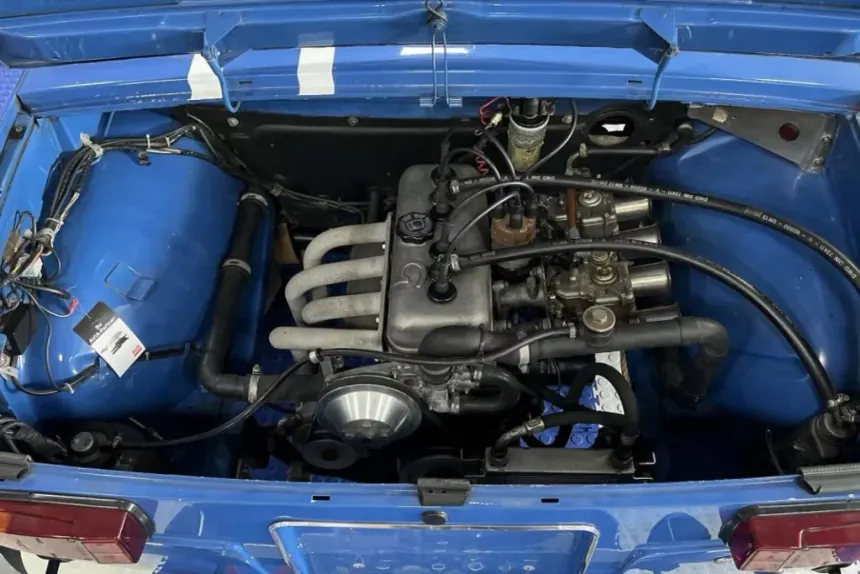
He took the 1,108 cc block, fitted a new cylinder head with hemispherical combustion chambers and valves canted in a V, added twin carburetors, and roughly doubled the output of the standard 8. The base car made 44 horsepower. Gordini’s version was a different animal entirely. And right there is the number that trips people up.
Ninety-Five or Seventy-Seven? The SAE Trick
You’ll see two power figures quoted for the same car. Both are correct.
The 1100 made 77.5 hp DIN. But the era’s advertising shouted 95 hp SAE. No lie in either. Two measuring standards. The American SAE method rated a “naked” engine, no alternator, no air filter, no full exhaust, none of the accessories that eat power in the real world. The German DIN method measured the engine as installed, everything bolted on. SAE always reads fatter. Same engine. Different test bench. Think of it the way American muscle “gross” horsepower ballooned versus the honest “net” figures that came later.
When the 1300 arrived in 1966, with a 1,255 cc block and twin dual-choke Weber carbs, it got serious: 88 hp DIN, 103 hp SAE, at 6,750 rpm. And here’s what most people miss. That bigger engine only lifted top speed by three mph, from 106 to 109. What it transformed was acceleration. In an 1,880-pound car, top speed is never the point. Getting out of the corner is.
Put it in context. A four-door sedan, four real seats, lapping a circuit at 72 mph average, needing a Citroën DS 21 or a Mercedes 250 SE to find a rival with matching lap times. Cars with far bigger engines. The Alfa Romeo Giulia Super, no slouch, couldn’t hang. That’s what made the Gordini special. Not the raw number, but the company that number kept.
The Front Fuel Tank Nobody Talks About
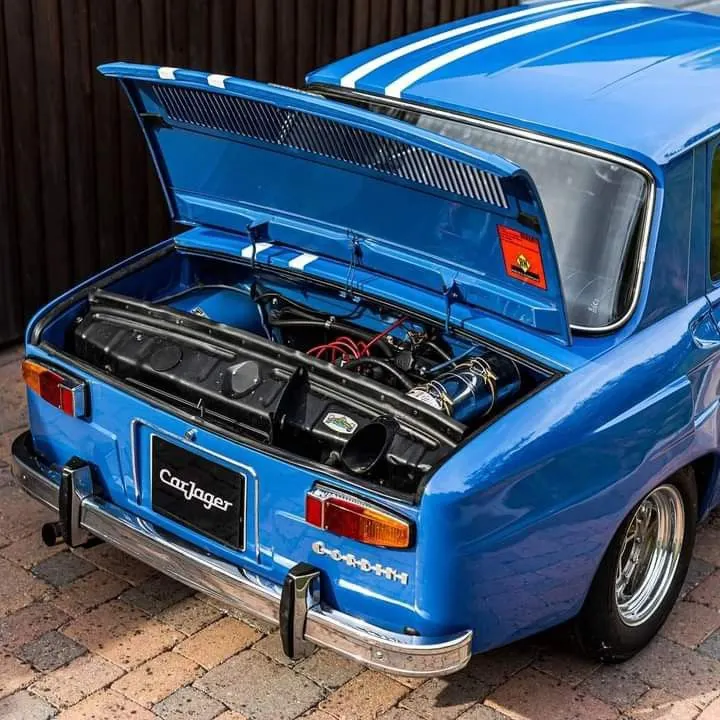
Here’s an angle that gets skipped. The 1300 hid a second 25-liter fuel tank up front, in the space where the trunk normally lived.
Why? Two reasons, both pure engineering. Range first: a car built for rallies and long races needs fuel, and the more it carries between stops, the better. But the second reason is the good one. Weight distribution. A car with its engine slung behind the rear axle carries all its mass out back. It’s like sprinting with a backpack full of bricks. One sharp move and the tail steps out. Stuffing 25 liters of gasoline up front was a counterweight, a way to balance the scales. Not a gimmick. An attempt to tame the physics of a rear-engine layout.
Because tame it needed. The Gordini had a loose rear end and a clear appetite for oversteer. In the wet it would slide, and it demanded a driver who was awake. Heel-and-toe and a well-timed double-clutch weren’t optional if you wanted the best out of it. This car didn’t forgive. It taught.
Tour de Corse: Where the Economy Car Became a Legend
One month after its Paris debut, in November 1964, the Gordini won the Tour de Corse. Not by scraping through: it took four of the top five places.
No fluke. It repeated in 1965, this time with 1300-engined prototypes sweeping the top five. And in 1966 it won again, with a lightweight alloy-bodied example running an engine bored out to 1,440 cc that had the nerve to beat an Alfa Romeo GTA. A prepared Renault economy sedan, beating the Italian weapon of the day on its own turf.
The Tour de Corse wasn’t just any rally. It was the “rally of ten thousand corners,” mountain tarmac, endless broken road where straights don’t matter and only agility, braking, and nerve count. Perfect ground for a light car that slingshots out of bends. Perfect ground for the Gordini. Chris Harris types still talk about cars that reward a driver rather than flatter one. This was the original.
The Father of the One-Make Cup
Now the legacy that outlived the car itself. In 1966, Renault, Dunlop, and the magazine Moteurs launched something new: the Coupe Gordini.
Simple idea, quietly revolutionary. Take a grid of strictly stock R8 Gordinis, all modification banned, every car identical, drop young drivers into them, and let them fight on circuits across France. Since the cars are the same, the best driver wins. No mechanical cheating, no budget buying victories. Just talent.
It launched on April 16, 1966, with the 1100, switched to the 1300 in 1967, and ran until its final race on September 27, 1970. Across those years it staged 111 events and passed more than 250 drivers through its grids. Out came names that became legend: Jean-Claude Andruet, Jean-Pierre Jabouille (who’d later win in Formula 1 for Renault itself), Jean-Luc Thérier, Jean Ragnotti, Jean-Pierre Jarier.
Every time you watch a Porsche Supercup, a Ferrari Challenge, a spec-Miata grid, you’re watching the grandchildren of the Coupe Gordini. The whole “same car for everyone, best driver wins” concept was born with a blue economy sedan wearing two white stripes.
The Sendoff
Production ended in 1970 after just over 11,600 of the 1300s. The Renault 12 Gordini took over, front-wheel drive, a completely different concept. More modern on paper. But ask anyone who lived through that era which one they remember with a spark in their eye, and they won’t say the 12.
The NEC Take
The Renault 8 Gordini is proof that thrill never lived in the horsepower number. It lived in the gap between what a car looked like and what a car did. A family sedan making 88 horsepower beating Alfas and Porsches, with twenty-year-olds learning the craft in identical cars where only talent mattered.
Today we’re sold that a car is fast because a screen reads 500 horsepower. The Gordini reminds us a car was thrilling because it forced you to know how to drive it, because the rear axle tested you in every corner, because you climbed out with your pulse hammering knowing you had tamed it, not a computer.
Have we really come that far, or have we just swapped the driver’s skill for lines of code?
Check you’re still alive.