
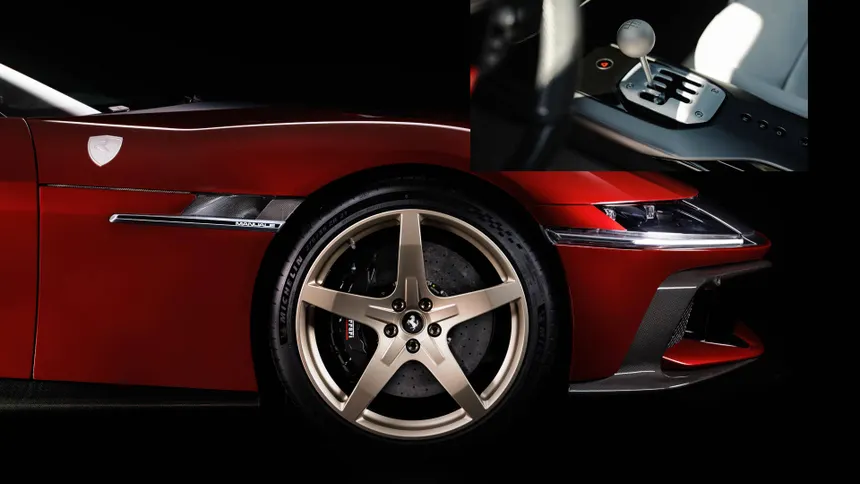
You Can Stall Ferrari’s New Manual. Nothing Underneath It Is Real
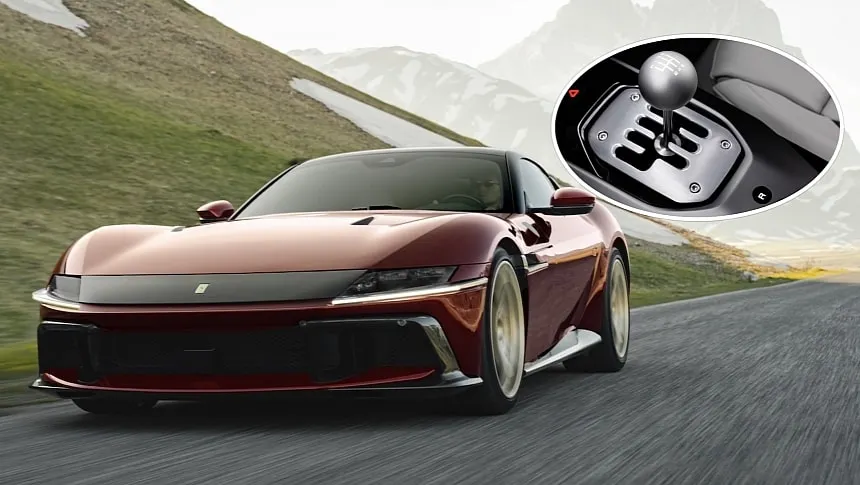
Stall it and it kangaroos. Dump the clutch like a learner and the V12 dies with a lurch, just like it should. The lever snicks, the pedal fights back with a real 15kg of weight, and every nerve in your body signs off on the same verdict: this is a manual.
It isn’t. Move that lever and no linkage moves with it. Press that pedal and no cylinder feels it. It’s theatre. Expensive, brilliant, four years in the making, but theatre.
The car is the Ferrari 12Cilindri Manuale, and it comes with a figure that guts the whole romance, straight from Ferrari itself: in the hands of a skilled driver it does 0-62mph in 2.9 seconds, the identical number to the automatic DCT. Not a tenth slower. Which leaves one question standing. If it’s no quicker, what’s the manual for? Nothing you could call useful. And that is exactly where the strangest business in cars right now begins: charging a fortune for sensations the makers themselves deleted, rebuilt in electronics so you’ll swear they never left.
What Ferrari actually built
Strip the romance away and here’s the machine. Same 6.5-litre naturally aspirated V12, 830 horses, 9,500rpm redline. Same eight-speed dual-clutch gearbox as the standard 12Cilindri, with the paddles hacked off the wheel. On top of that sits a new system Ferrari calls Manuale By-Wire.
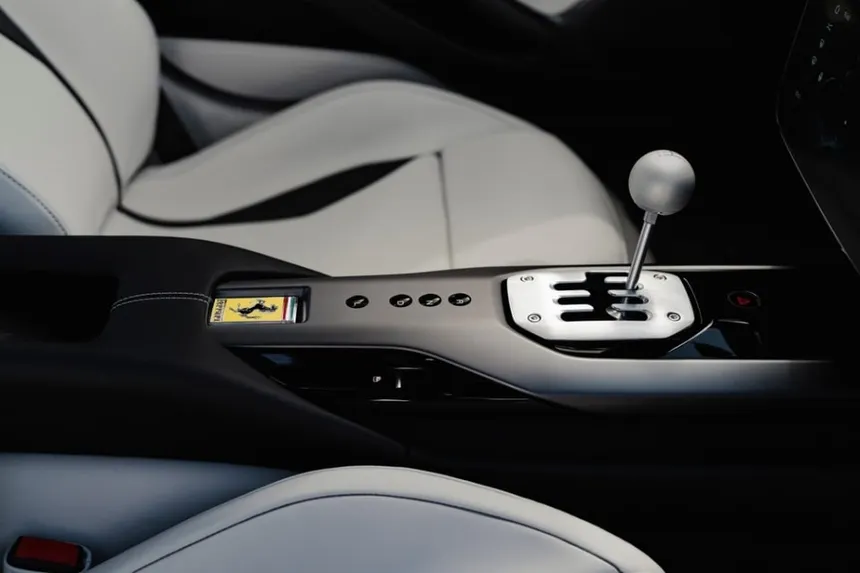
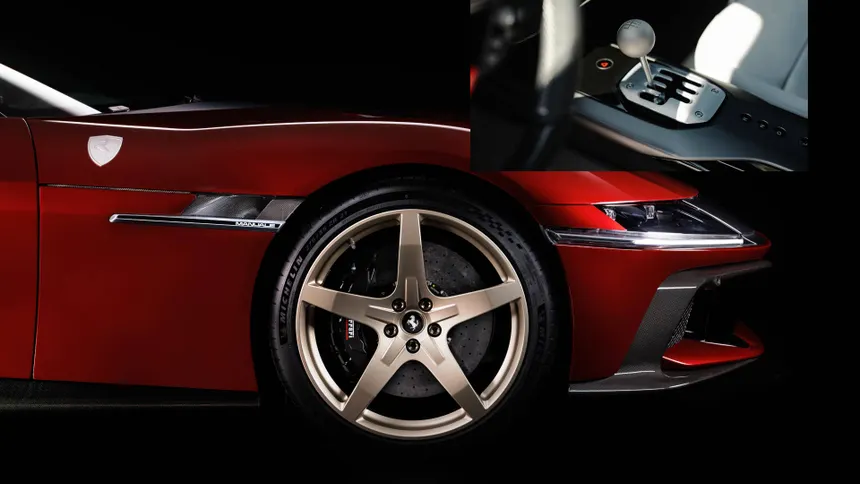
You get the open metal gate. You get the aluminium ball atop the lever, straight out of a 365 GTB/4 Daytona daydream. You get a third pedal. You can stall it. You can heel-and-toe. Everything your muscle memory files under “manual” is present and correct.
None of it is connected to anything.
The lever moves no linkage. The pedal actuates no hydraulic cylinder. Press the clutch and a sensor reads the position, then wires the intent to the control unit. Move the lever and two Hall-effect sensors read it across both axes and send another signal. The engine and the DCT never learn you’re playing at old cars. They just get on with it.
The clicks and weights? A machined drum, surface-treated so the feel won’t fade over the years, generates the tactile “snick” you feel through the knob. An electromagnetic solenoid acts as the lockout that stops you selecting a gear when you shouldn’t. The 15kg clutch weight, identical to the last real manual Ferrari, the 599, comes from a passive mechanical rig mimicking a hydraulic clutch’s load curve. Ferrari even tuned the noise the mechanism makes, so your ears join the con.
It’s a gorgeous piece of engineering. Four years of it. To rebuild in electronics something that came as standard twenty years ago and cost less. Read that twice.
Ferrari didn’t start this. It finished it
Here’s the bit that ruins the misty-eyed headline. Ferrari didn’t blaze a trail. It turned up last, and with the fattest invoice.
The car that taught the industry fake sensations could be convincing, and popular, wasn’t a Ferrari at all. It was the Hyundai Ioniq 5 N. An EV. No combustion engine, no gearbox, nothing mechanical to work with. And they gave it gears.
Top Gear tested it and came away grinning. The system is called N e-Shift, and it simulates an eight-speed dual-clutch box. Upshift and it cuts power for a beat to fake the jolt. Downshift and it blips the throttle. Miss your shift and it bounces off a fuel cut that can’t exist, because there’s no fuel. Layered over that, ten speakers and N Active Sound + piping in the noise of a turbo four, the Elantra N’s engine, so your ears believe there’s a motor where there’s only a silent electric one.
The maddening part is that it works. Testers who go in sneering come out sold. Because the gears and the sound give you reference points. You know your speed by ear. You know when the “engine” is braking for you. The car speaks a language your body already understands, even if every word of it is invented.
And Hyundai has stopped hiding it in the hot N models. It’s in the Ioniq 6 N, with ambient lighting that flashes when to shift. It’s been trialled in the Ioniq 9, the big three-row SUV. Hyundai says it’ll keep filtering down the range wherever there’s enough power to make the act believable. Kia does its own version in the EV6 GT, and theirs adds a tactile kick by tweaking motor torque. A tactile kick. They make you feel a shift that doesn’t happen, in a gearbox that doesn’t exist, for a motor that doesn’t change gear.
The trick is older than the EVs
And petrol cars have been at it far longer. Piping engine noise through the speakers is over a decade old, done in cars with a real engine sitting right there.
BMW’s Active Sound Design has long made a four-cylinder sound like a straight-six, and once made a diesel, the 635d, sound like something it isn’t. On plenty of models it isn’t even your amplified engine, it’s a recording through the speakers, and killing it means coding the car with an app. The kicker: some of this exists to paper over a problem the rules created. The EU treats exterior noise as pollution, cars must be quieter outside, so to stop the buyer feeling like they’re driving a fridge, they pump the noise back in through the doors. Legislated out, speakered back in. Fake.
While we’re on laws: that spaceship hum an EV makes at low speed isn’t a styling choice either. It’s mandatory. It’s called AVAS, and it exists because a silent EV runs over pedestrians who never heard it coming. Here the speaker earns its keep. It saves lives. I flag it because it draws the one clean line through all of this. There’s faking for safety, and there’s faking for feel. They are not the same thing.
We already knew fake feel works. We just called it a game
Here’s a thought that should unsettle anyone who’s ever sneered at simulated feel. A generation of drivers learned car control on a plastic wheel bolted to a desk, with pedals that connect to nothing but a USB cable and force feedback generated entirely by motors reacting to code.
Sim racing works. Real racing drivers train on it. Feed a good rig enough data and the wheel writhes in your hands over a kerb it has never touched, loads up under braking that isn’t happening, goes light when a virtual rear steps out. None of it is real. All of it teaches your hands something true. The body reads the signal, not the source.
So when Ferrari machines a drum to click and a solenoid to lock and a passive rig to weigh 15kg, it’s doing at the top of the market exactly what a €300 wheelbase does in a teenager’s bedroom: manufacturing feedback from first principles because feedback is the product, not the mechanism behind it. The difference is that nobody ever told the kid on the sim that his fake feel was a betrayal of driving. They told him it was practice. Ferrari’s only crime, if it’s a crime at all, is charging half a million and calling the same idea heritage.
That’s the part worth sitting with. The tech was never the argument. The pretence around the tech was. A cheap sim rig is honest about being a recreation. The 12Cilindri Manuale dresses the recreation up as a resurrection, and that costume is what the €590,000 really buys.
What’s really going on
Line the pieces up and the picture is obvious. The industry spent thirty years taking things away in the name of progress. Bin the third pedal, the twin-clutch is quicker. Bin the noise, it’s antisocial and it pollutes. Bin the shift shock, it’s crude. Bin the effort, that’s the past.
And now that it’s all gone, turns out we missed it. Turns out a car that does the job flawlessly and asks nothing of you is a white good with a steering wheel. Turns out the involvement, the noise, the effort, the way it punishes a fluffed shift, was the exact thing that made the act worth calling driving.
So the industry does a U-turn. But it doesn’t give back what it took, because that would cost money, add weight and clash with the modern gearbox. It hands you an impression instead. A theatre of feel bolted onto the same silent, efficient hardware they left you with. And it sells you the ticket as cutting-edge tech.
Ferrari says the quiet part out loud: the 12Cilindri Manuale exists because customers kept asking for a manual. Not because it’s better. Not because it’s faster, you’ve seen the numbers. It exists because nostalgia has a price, and Maranello knows how to write it.
So is it a con?
No. And this is where I have to be straight with myself, because the cheap move is to call the whole thing smoke and walk off pleased with myself.
Physics doesn’t distinguish between a “real” jolt and one recreated to the millimetre, if both land on your body identically. A 15kg clutch that forces you to modulate your foot is a 15kg clutch, whether a linkage moves it or a solenoid does. If the system makes you sweat, makes you think, forces you to line up hand, foot and ear, and punishes you when you get it wrong, then it’s handing you the only thing that ever mattered here: involvement. A conversation between you and the machine. The sense that driving is something you do, not something that happens to you.
The Hyundai proves it better than the Ferrari, precisely because it has nothing mechanical to fake and hooks you anyway. A driver who’s lapped a petrol Elantra N reads the Ioniq 5 N’s fake fuel cut with the same muscle memory. The body doesn’t know it’s a lie. And if the body doesn’t know, is it one?
What stings isn’t the tech. It’s the excuse. For decades they sold us that stripping all this out was progress, evolution, the future. Now they sell us that handing it back in fake form is also progress, evolution, the future. They can’t be right both times. Either the effort was surplus or it wasn’t. And if it takes Hall-effect sensors and solenoids and ten speakers to put it back, maybe it was never surplus, and the only surplus was the rush to bin it.
The 12Cilindri Manuale isn’t the problem. It’s the confession. It’s the industry admitting, with 830 horsepower and a €590,000 invoice, that it got it wrong. That the thing they called dead weight was the soul. That they’ve spent years throwing the baby out with the bathwater and now pay their best engineers to rebuild the baby in plastic.
I’ve had my hands in engines for thirty years. I know exactly what a shift feels like when it goes home right and when it doesn’t. And I’ll tell you this: I’d take a car that asks me for fake effort over one that asks me for nothing real, every single time. But don’t ask me to clap for a novelty when what it really is, underneath, is a very expensive apology.