Renault 5 Turbo 2: How Le Car Grew a Mid-Mounted Turbo and Beat the Audi Quattro at Monte Carlo
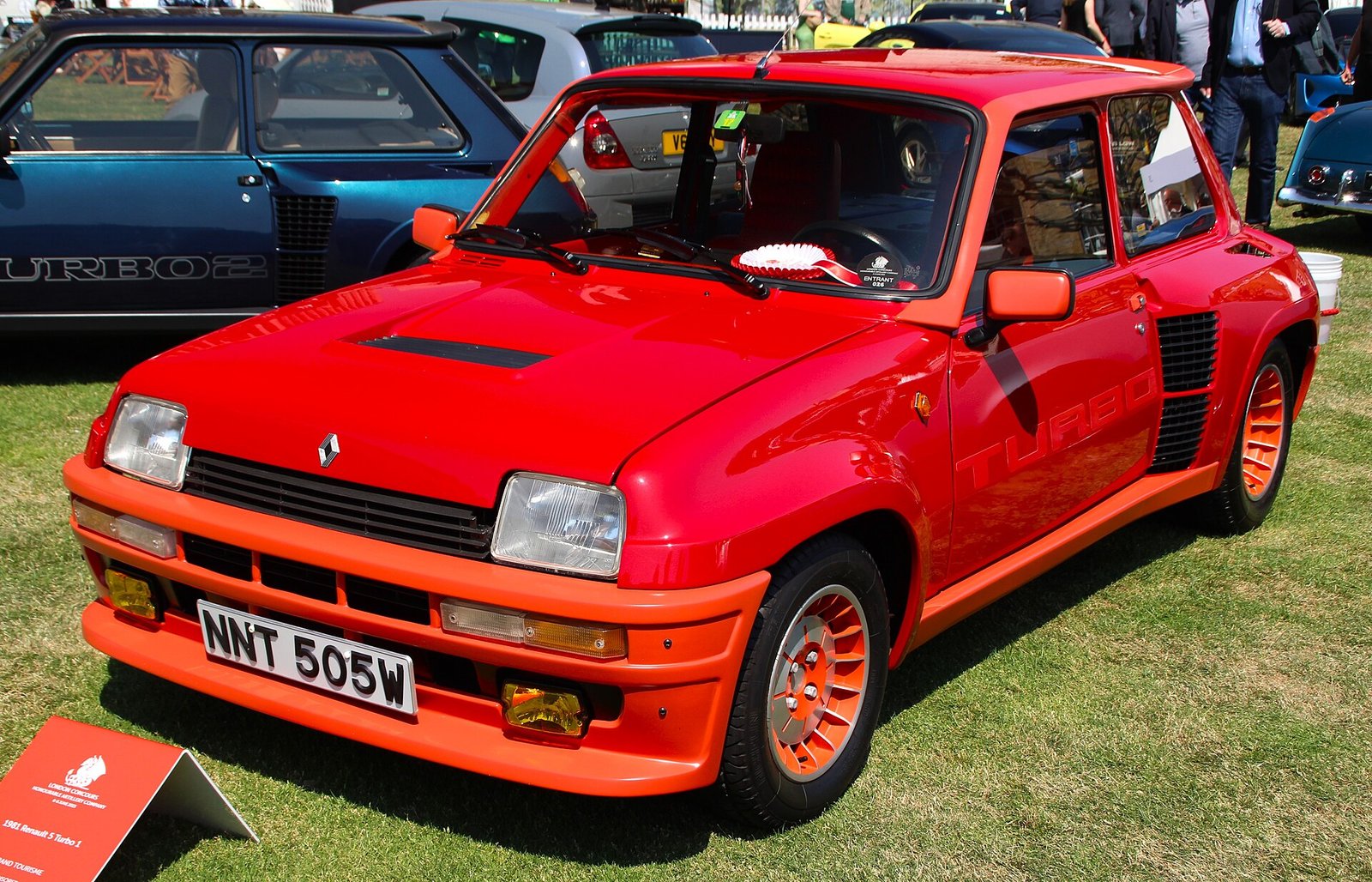
Americans who remember the Renault 5 at all remember it as Le Car. AMC dealers sold it from 1976 as a cheerful, slow French economy box with a canvas sunroof option and an ad campaign built around how cute it was. At the same time, in Normandy, Renault was turning that exact shape into one of the wildest homologation specials ever built: a city car with its engine ripped out of the front and moved behind the seats, a turbocharger and fender flares wide enough to park a scooter under. In January 1981, it won the Monte Carlo Rally against the Audi Quattro. America never officially got it. That’s a pity, because few cars have ever made a bigger joke of what they were supposed to be.
A man with a ridiculous idea
The story usually starts with Jean Terramorsi, a Renault executive who in the mid-1970s pushed a plan that made no practical sense. Take the Renault 5, France’s best seller and the car of students, mothers and retirees. Pull out the front engine. Install it in the middle, behind the driver, with a turbo. Then send the result out to win rallies against Lancia, Fiat, Ford and anyone else with money. Nobody stopped him.
Renault had reasons to say yes. It was pushing turbocharging hard, both in Formula 1, where its yellow cars had brought turbos to Grand Prix racing in 1977, and on the street. A rally car that looked like the family R5 and wore a turbo badge was the perfect advertisement for the whole program. Terramorsi didn’t live to see the finished car, but the project was named for that same daring: internally, it was Project 822.
The Stratos lesson
The idea of a small mid-engine car built purely to win rallies wasn’t Renault’s. Lancia had done it first with the Stratos, a Bertone-designed wedge with a Ferrari Dino V6 behind the driver that won three straight World Championships from 1974 to 1976. The Stratos proved that a short, light car with its engine in the middle could dance through mountain stages better than anything converted from a sedan. What Renault added was the disguise: instead of a dedicated shape that looked like nothing on the road, it put the same recipe under the skin of a car people already knew from the supermarket parking lot.
Built where the Alpines were
Renault’s regular plants couldn’t build anything this radical, so the job went to Alpine, the sports car maker in Dieppe, Normandy, which had built the A110 and A310 and had been part of the Renault group since 1973. Every R5 Turbo came together there, largely by hand, starting from a regular R5 shell that was cut apart and rebuilt.
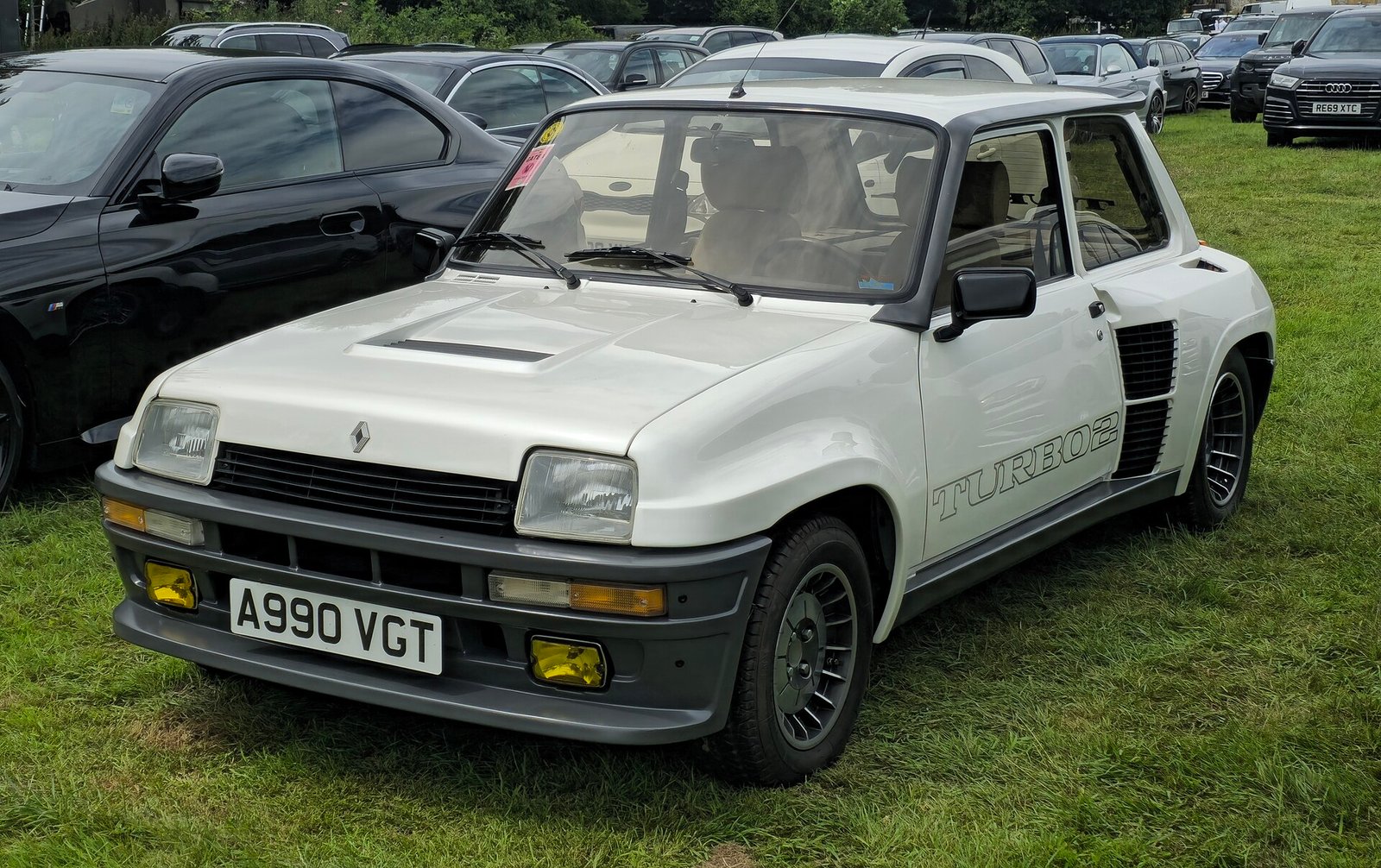
The body design came from Bertone in Turin, where Marc Deschamps shaped the bulging fenders, the side intakes ahead of the rear wheels and the cooling slats. Those fenders weren’t for show. Under them sat a full racing chassis with suspension and track width that had nothing to do with an economy car. The prototype appeared at the Paris Motor Show in 1978, and production started two years later.
Turbo 1: the hand-built one
The first version, now called the Turbo 1, ran from 1980 to 1982, and about 1,820 were built. Its engine was the old Cléon-Fonte four, the cast-iron pushrod 1.4 that Renault had been putting into taxis, R8s and R12s since the early 1960s. Renault fitted a Garrett T3 turbo, an intercooler and Bosch K-Jetronic fuel injection and got 160 hp at 6,000 rpm and 210 Nm, or 155 lb-ft, from 1,397 cc. That’s about 114 hp per liter. Mounted longitudinally right behind the seats, where the back seat and trunk used to be, it drove the rear wheels through a five-speed. The car weighed around 970 kg, about 2,140 pounds, and Renault quoted 0 to 62 mph in 6.9 seconds and a top speed of 130 mph.
To give that some American context: in 1980, a Corvette’s base V8 made 190 hp from 5.7 liters, and a Pontiac Trans Am Turbo made 210 from 4.9 liters, in a car roughly twice as heavy. The French had gotten close to those numbers from a taxi engine smaller than many American motorcycles.
Inside, the Turbo 1 had a unique dashboard with satellite instrument pods that shared nothing with the regular R5, and some of the panels, including the doors and roof, were aluminum. It felt like a race car with license plates, because that’s more or less what it was.
Monte Carlo, 1981
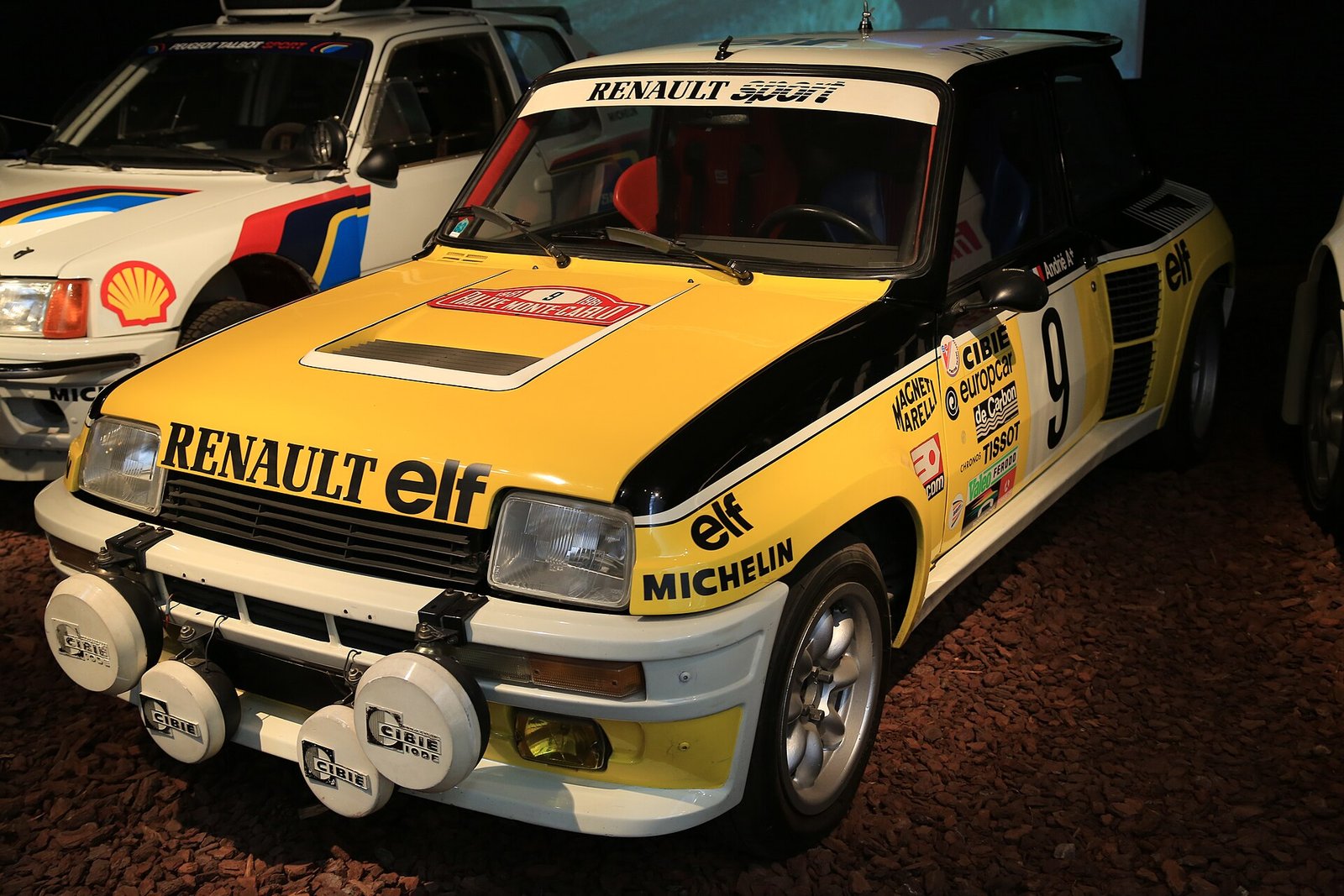
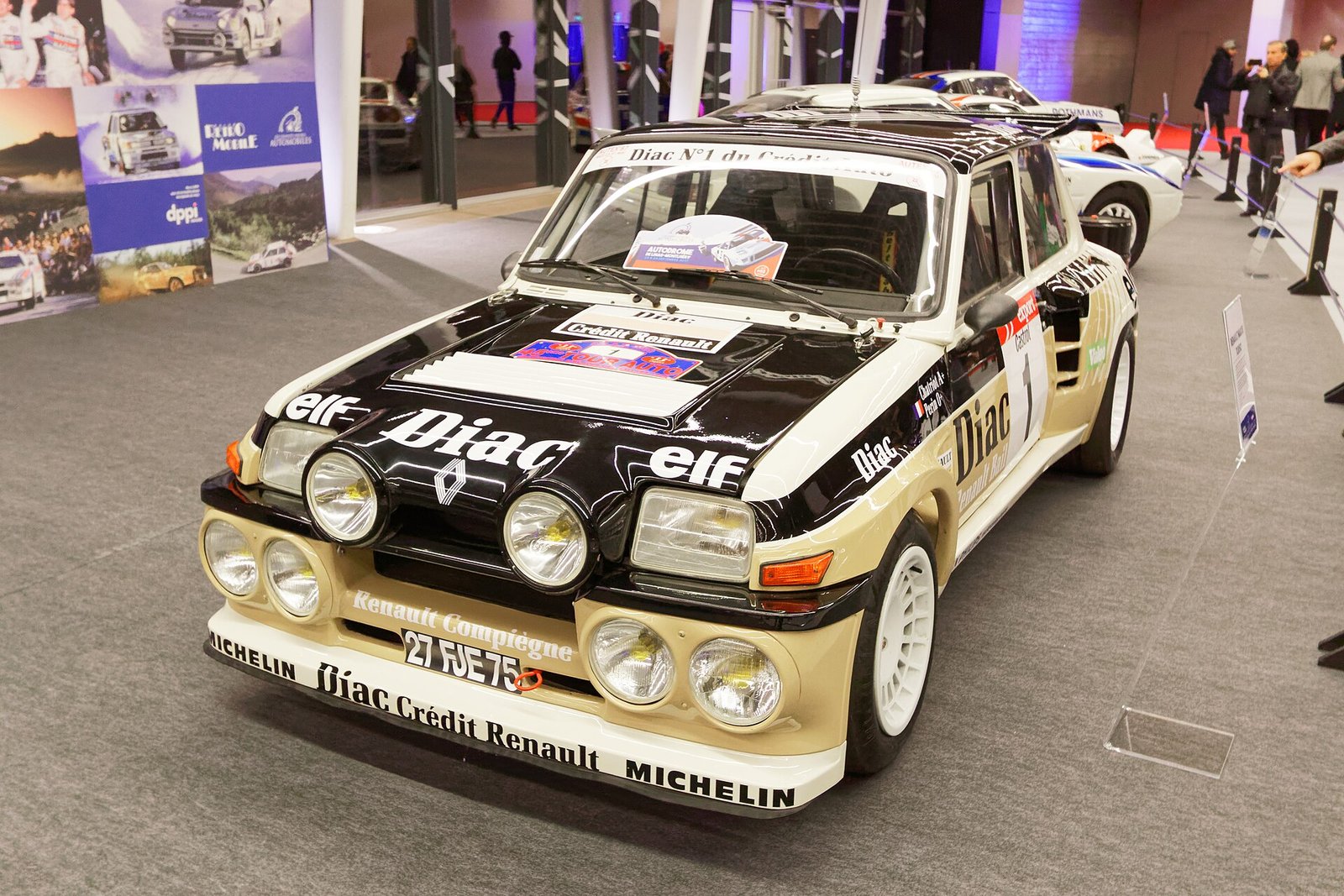
The R5 Turbo was built to win rallies, and it did so almost immediately. In January 1981, Jean Ragnotti and Jean-Marc Andrié took a Group 4 car to the Monte Carlo Rally and won it. That was the season the Audi Quattro arrived with all-wheel drive and changed rallying for good. On the snow and ice of the Alps, in its very first outing, the Quattro went quickly and then went off. The little French car, with only the rear wheels driving, came out on top. It was the kind of win nobody would ever get again once four-wheel drive took over. Second place went to Guy Fréquelin’s Talbot Sunbeam Lotus, another small, rear-drive car, so the 1981 Monte was a last hurrah for a whole way of building rally cars.
The Quattro, of course, had the last laugh over the next few seasons. Its own origin story is just as unlikely: Audi’s engineers discovered what all-wheel drive could do while testing the VW Iltis military jeep in the snow, and the rest of rallying spent the 1980s catching up.
Ragnotti became the face of the car. His style, sideways everywhere and seemingly never in a hurry to straighten up, was perfect for a car with its engine behind the driver and its power going to the rear. The R5 Turbo turned so eagerly it looked designed to drive sideways, and in a sense it was. It went on to win the Tour de Corse in 1982, and Corsica’s endless tight asphalt bends became Renault territory for years.
Turbo 2: cheaper, plainer and built in bigger numbers
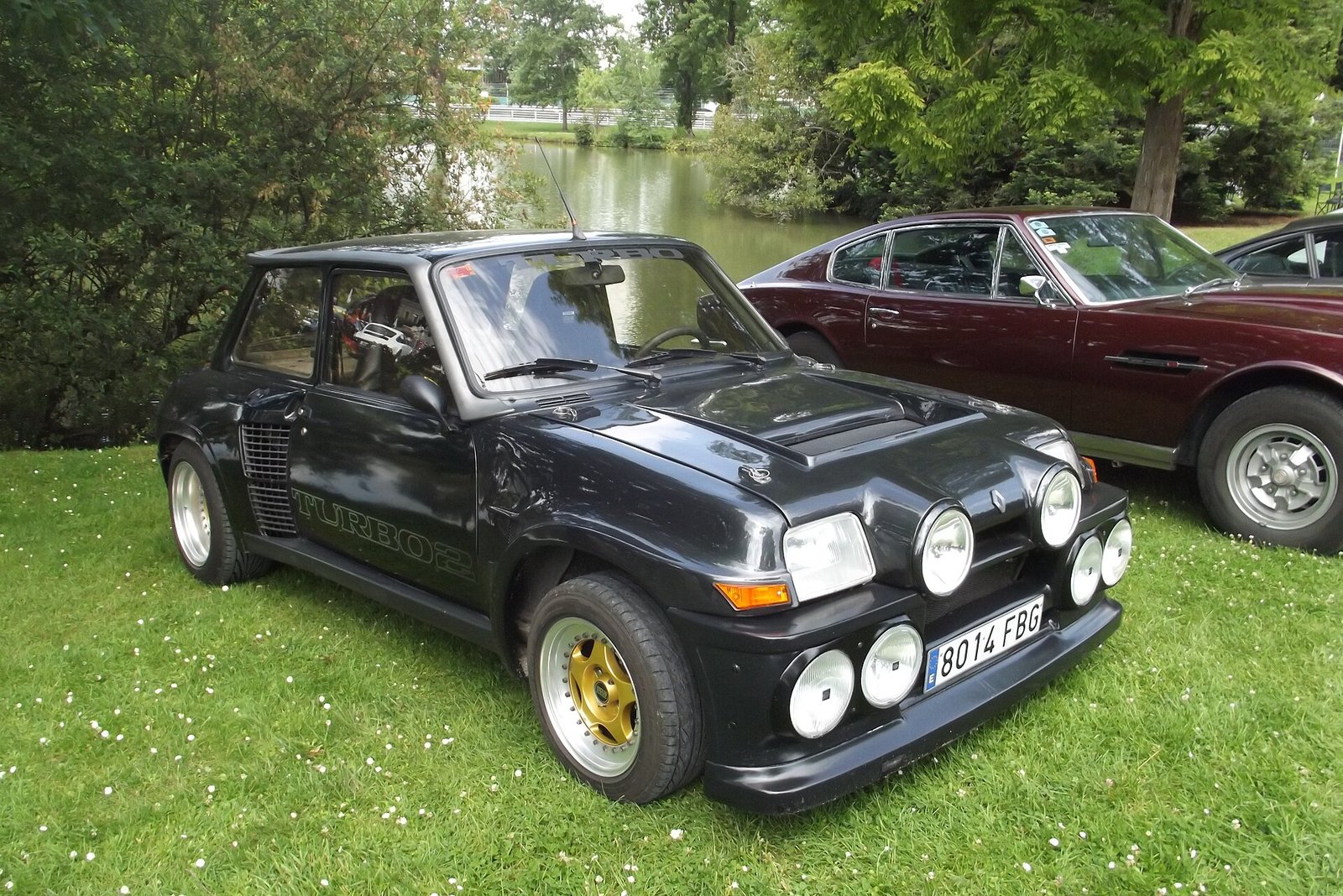
In 1983 Renault launched the Turbo 2, with one clear goal: bring the cost down so it could build more and keep the car eligible in more classes of competition. The aluminum panels gave way to steel, and the unique interior gave way to a dashboard borrowed from the R5 Alpine, the front-drive hot version that Americans never saw either. Output was quoted at 160 hp, and performance was essentially the same. Purists still grumble about the loss of the special cabin. For Renault, it was the difference between building 1,800 cars and building more than 3,000.
About 3,167 Turbo 2s came out of Dieppe between 1983 and 1986, so the mid-engine R5 Turbo totaled roughly 5,000 cars. Today the debate between fans runs both ways. Turbo 1 owners point to the aluminum, the bespoke interior and the rarity. Turbo 2 owners argue that the plainer car is closer to the project’s real purpose: a race car you could buy, not a luxury object. Both sides have a point.
There was also a one-make series, the Europa Cup, run as a support race at Grands Prix and major events around Europe. It put near-stock Turbo 2s with roll cages and harnesses on the grid, and for many young European drivers in the 1980s it was their first real taste of racing. Close fields, mid-engine cars rotating into every corner and lots of contact made it a favorite with the crowds.
A Spanish driving school
The R5 Turbo has a special place in Spain, too, where regular Renault 5s were built in big numbers at the FASA-Renault plant in Valladolid and the badge felt almost local. In the mid-1980s, a young driver from Madrid named Carlos Sainz learned his trade in the Spanish rally championship at the wheel of an R5 Turbo, figuring out how to handle a rear-drive car with its engine behind his back on narrow, dirty asphalt. A few years later he was a two-time world champion with Toyota, and he won the Dakar again in 2024, at 61. Plenty of Spanish fans will tell you that anyone who can tame an R5 Turbo can drive anything.
The Maxi and the end of Group B
The R5 Turbo had one more step to take. In 1985 Renault built the Maxi 5 Turbo for Group B, with the engine taken out to around 1.5 liters and roughly 350 hp, wider bodywork, wings and long-travel suspension. It was the car Terramorsi might have imagined from the start, and Ragnotti won the Tour de Corse with it in 1985. But by then the four-wheel-drive monsters, the Peugeot 205 T16, the Lancia Delta S4 and the Audi Sport Quattro, were taking over, and a rear-drive car could only shine on asphalt. After the fatal crashes of 1986 in Portugal and Corsica, the FIA shut down Group B entirely, and the Maxi’s career ended with it. The crash in Corsica killed Henri Toivonen and his co-driver Sergio Cresto in a Delta S4 on the very roads where the R5 Turbo had built its reputation.
A taxi engine with a turbo
Context makes the numbers more striking. In standard form, without a turbo, versions of the Cléon engine made about 63 hp in a regular Renault 5. A Porsche 911 SC of the same era made 180 hp from 3.0 liters, and a BMW 323i, the yuppie benchmark, about 143 hp from 2.3 liters without a turbo. The street R5 Turbo had to pass inspection and run on any gas station’s fuel, and it still produced specific output that atmospheric engines of the day couldn’t touch. The Group 4 cars ran around 250 hp, and the Maxi got to 350.
The Cléon-Fonte block, cast iron with thick cylinder walls and a two-valve pushrod head, was built to last and could handle boost that would have destroyed lighter, more modern engines. It also gave the R5 Turbo its character. Turbo lag was real. Press the throttle and for a moment not much happened, then the T3 woke up and everything arrived at once. Any modern engineer would call that a defect. Owners call it the best part of the car. Each time the turbo spooled up, it felt like an event.
Living with one
Nobody who has driven one calls it comfortable. The engine sits right behind your shoulders, so the cabin is loud and gets hot, and there’s no rear seat, only a carpeted cover over the motor. The wheelbase is short and the mass is in the middle, which makes the car rotate fast, wonderful on a mountain road and a handful on a wet one if the turbo comes in mid-corner. The steering is unassisted and heavy at parking speeds. None of that has hurt its reputation. If anything, it’s part of the appeal: this was a car built by a rally department that happened to be legal on the street, and it never pretended otherwise.
Le Car itself did reasonably well in the U.S., at least for a while. AMC’s dealers sold it as an economical, fun commuter during the fuel crises, and it had a small, loyal following. But the gap between the Le Car in an American suburb and the R5 Turbo in Monte Carlo was about as wide as the gap between a family station wagon and a NASCAR stocker, and it was the same basic shape.
Why Americans should care
If you grew up in the U.S., the closest relatives of the R5 Turbo you might have seen are later Renaults that never made it to America either, such as the R5 GT Turbo, the front-drive pocket rocket of the late 1980s, and the Clio V6 of the 2000s, which repeated the trick of putting a big engine behind the seats of a supermini. The Clio V6 owes its whole existence to the R5 Turbo.
The same goes for a lot of what Americans now think of as hot hatches. Volkswagen’s GTI is usually credited with the idea of a fast economy car. But the GTI was a tuned commuter. The R5 Turbo was a race car in a commuter’s clothes, which is a different thing entirely. It was Renault’s Shelby Cobra moment, if Shelby had started from a Pinto.
Le Car went home in 1983, when Renault switched the U.S. market to the Alliance it built with AMC in Kenosha. No R5 Turbo was ever officially sold here, and today the few in the U.S. came in privately, many under the 25-year import rule.
What they’re worth now
The R5 Turbo has become one of the most valuable French classics. Good, well-documented Turbo 1s have gone past 150,000 euros at auction, and the best have come close to 200,000. Turbo 2s trade for less, typically between 80,000 and 120,000 euros, but the trend has been up for years. For a car that started as a Renault 5, those are remarkable numbers, and they say the market cares more about engineering, history and scarcity than about the badge.
Renault has noticed. Its new electric R5 revived the shape, and the company has shown a modern electric Turbo 3E with outrageous fender flares and two motors at the back, a deliberate tribute to the car built at Dieppe four decades earlier.
A people’s car that refused to be ordinary
The R5 Turbo stands for something the industry has largely forgotten: nerve sells cars, and an economy car can become a legend if someone decides it should. Terramorsi proposed an absurd idea. Renault approved it, Bertone drew it, Alpine built it and Ragnotti drove it to victory. A few thousand owners took it on roads all over Europe, with the turbo whistling behind their heads.
The specs: 160 hp, 1,397 cc, a Garrett T3, rear-wheel drive, a mid-mounted engine and a weight of under a ton, all in something that still looked from a distance like the car your aunt drove to the bakery. In the U.S., she drove Le Car.
Gandini, the man behind the Renault 5 Turbo, also drew a Diablo that never got built as he meant it; that story is in Gandini’s lost Diablo design.
Group B had its comic side too: the Citroën BX 4TC, three rallies, one sixth place and road cars its own maker sent to the crusher.
Check you’re still alive.
Photos: Renault 5 Turbo, MrWalkr, Handelsgeselschaft, Thesupermat and Calreyn88 (CC BY-SA 4.0); Ragnotti car at Mulhouse, questa_ta (CC BY 2.0). Via Wikimedia Commons.