The Ugly 75-Horsepower Box That Gave Birth to Quattro
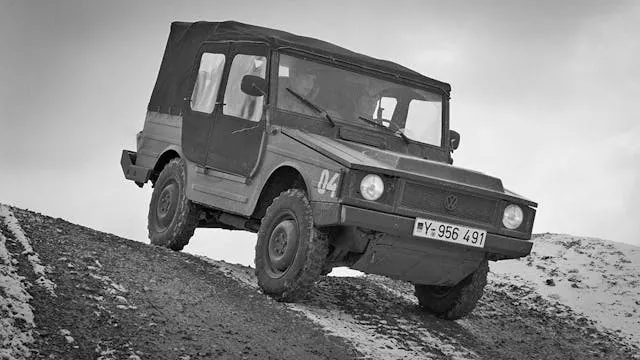
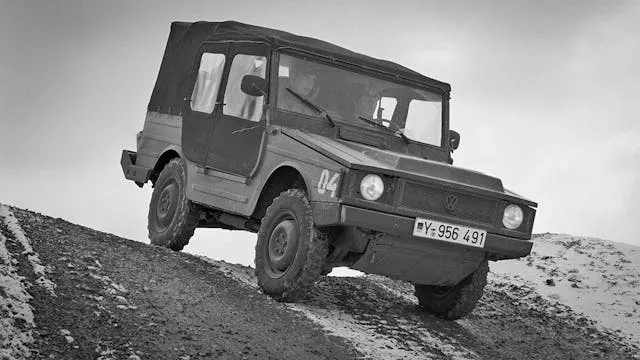
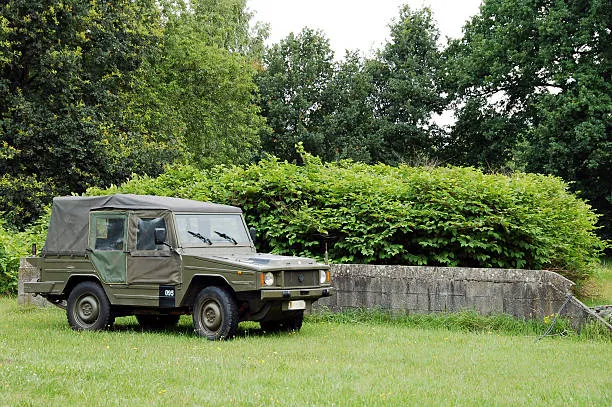
Picture the scene. Frozen Scandinavia, somewhere in the winter of 1976. A team of Audi engineers is out testing prototypes on sheets of ice, and trailing behind them as a support vehicle is a squat, canvas-topped military runabout with all the visual charm of a filing cabinet. Nobody is looking at it. Nobody has any reason to. It makes 75 horsepower and looks like it was designed by a committee that hated joy.
That filing cabinet is the reason the word “quattro” exists. Strip it away from history and Audi’s entire identity — the rally dominance, the badge, the eleven million all-wheel-drive cars — never happens. This is the story of how the least glamorous vehicle in the paddock fathered one of the most famous engineering legends in motoring, and how almost everyone gets the details wrong.
Born from a project that collapsed
The Volkswagen Iltis didn’t arrive because someone had a grand vision. It arrived because a bigger idea fell apart.
Through the early 1970s, several European nations were tangled up in the “Europa Jeep” — a shared military off-roader meant to serve multiple armies at once. Brilliant on paper. A disaster in reality. Costs ballooned, timelines slipped, and by 1979 the whole programme had quietly died the way these joint ventures usually do.
The trouble was that the West German army, the Bundeswehr, had a real and immediate gap to fill. It needed light four-wheel-drive vehicles, and it needed them soon. For years it had leaned on the DKW Munga, a two-stroke-engined utility vehicle that had ceased production back in 1968. With the Europa Jeep dead, the German government did the sensible thing and invited manufacturers to submit prototypes.
Volkswagen answered — but with a sleight of hand worth pausing on. The vehicle was actually developed by Audi, built around a reworked version of the old Munga platform, with modified suspension, a four-wheel-drive setup borrowed from the Audi 100 parts bin, and a 1.7-litre four-cylinder Volkswagen engine producing 75 PS. Yet when it came time to fix a badge to the bonnet, the decision was made to sell it as a Volkswagen rather than an Audi. The logic was pure marketing: VW carried a military heritage stretching back to its earlier designs, and leaning on that lineage gave the bid an edge. The Iltis sailed through the German government’s trials and beat the Puch G — the vehicle that would later become the Mercedes-Benz G-Wagen — which was every bit as capable but considerably more expensive.
So the machine that would change everything entered the world wearing the wrong badge on purpose. Keep that in mind. This whole story runs on disguises and misread first impressions.
A polecat by any other name
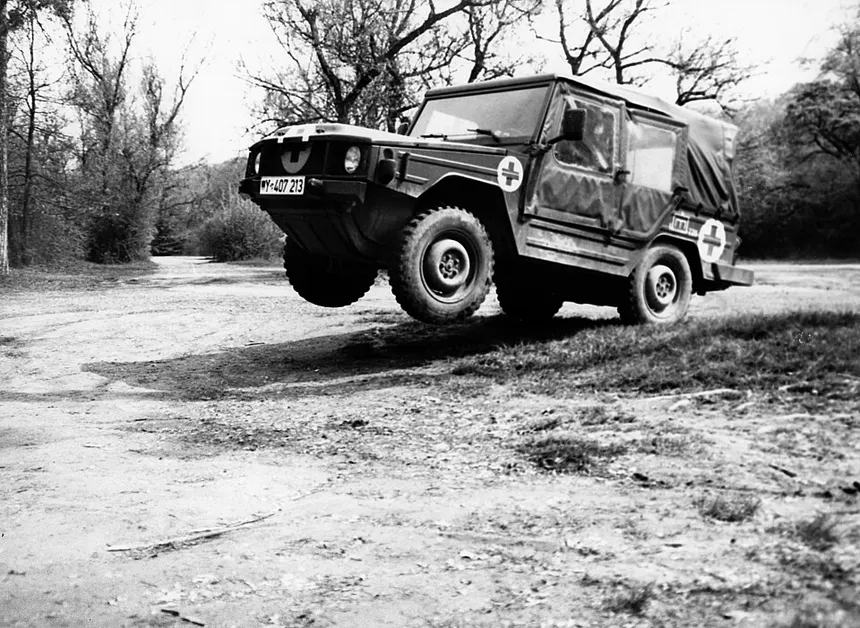
“Iltis” is German for polecat — a small, unassuming member of the weasel family, the sort of creature you’d never fear until it turns up somewhere it shouldn’t and refuses to leave. Volkswagen designated it the Type 183. It ran from 1978 to 1988, with fewer than ten thousand built. Roughly 1,300 kilograms, under four metres long, that modest 1.7-litre four doing the work.
If you’d shown this thing to Jeremy Clarkson in period, he’d have struggled to find a single kind word. It is not fast. It is not pretty. It is not clever in any way that announces itself. And that is exactly why what happened next is so good.
The winter that rewrote everything
Back to the ice. Winter 1976 into 1977, deep in Scandinavia, Audi testing its road-car prototypes — among them the new five-cylinder turbocharged 200. The Iltis was just there, the workhorse, lapping around in the snow while the proper cars did the proper testing.
Among the chassis engineers was a man named Jörg Bensinger. And Bensinger noticed something he couldn’t shake. The Iltis, with its feeble 75 horsepower, was walking away from the front-wheel-drive Audi saloons that had more than double the output. A 75-PS military box was embarrassing 160-plus-horsepower performance cars on a slippery surface, repeatedly, in plain sight.
Bensinger asked himself the question that turned out to be worth a fortune: what’s the point of all that power if you can’t put it down? A monster engine on a surface with no grip is just noise. Nothing reaches the road. And there, watching an ugly truck circle in the snow, he saw the opportunity. A sporting saloon with four driven wheels — the Iltis’s traction married to the Audi’s power — would be unstoppable.
Here’s the crucial bit, the part lazy retellings always butcher. The Iltis did not invent four-wheel drive. Not remotely. Driven-all-wheels technology had existed for decades, in off-roaders, in military trucks, even in the odd road car I’ll come to shortly. The Iltis invented nothing. What it did was serve as living, lapping proof — in front of exactly the right person — that the technology was good for far more than wading through mud. It was good for going quickly. The Iltis wasn’t the invention. It was the spark.
From sketch to mule
In February 1977, Bensinger took the idea to Ferdinand Piëch, Audi’s head of R&D. And Piëch deserves a moment, because without him this stays a doodle on a napkin. Piëch had come from Porsche, where he’d overseen monsters like the 917 programme. He was no pen-pusher. He was an engineer with authority and instinct, and when Bensinger described the sight of a 75-horsepower box outrunning proper Audis on ice, Piëch understood instantly.
Just as well, because nearly everyone else was against it. Volkswagen itself tried to talk Audi out of the whole thing. Bensinger has been blunt about it: at the start, the only genuine backing came from Piëch. Everything else was resistance.
In March 1977 they built the mule. They took a front-wheel-drive Audi 80 and, raiding the VW and Audi parts bins, fitted the Iltis four-wheel-drive system and the roughly 160-horsepower five-cylinder turbo from the 200. A Frankenstein assembled from whatever was lying around. And it worked.
The detail that actually matters: the hollow shaft
This is where a good pub story becomes real engineering. Because if the tale were simply “they lifted the Iltis’s drivetrain and dropped it into a saloon,” it would be charming and half a lie.
The problem with traditional four-wheel drive was bulk and weight. To send power to both axles you needed a transfer case and a second propshaft. All of it heavy, space-hungry and complicated. Fine for a military truck that doesn’t care about an extra thirty kilos. Disastrous for a sporting road car, where it wrecks the balance, the weight and the commercial case. That’s precisely why all-wheel drive had existed for decades without anyone seriously putting it into a light performance car.
Audi’s answer wasn’t to copy the Iltis. It was to rethink how the power was routed. Their engineers designed a hollow secondary shaft — a drilled-out shaft through which power flowed in two directions at once, with a second shaft running inside it. That arrangement split drive front and rear with no transfer case, no bulky second propshaft, no dead weight. Compact, light, elegant. That component — the hollow shaft — is the real invention. It’s what turned off-road technology into something that could sit inside a coupé without ruining it.
And the elegance of that solution is no footnote. A sporting saloon lives or dies by its weight distribution. Every kilo in the wrong place shows up in how it turns in, how it brakes, how it behaves when you really lean on it. Bolting a truck’s drivetrain hardware into a coupé would have doomed it to feel clumsy and heavy — the precise opposite of the goal. The hollow shaft didn’t just save weight; it saved it in the right place, without wrecking the car’s balance. That’s why it succeeded where earlier attempts had fallen by the wayside. It wasn’t merely lighter. It was cleverer.
The Iltis put the idea on the table. The hollow shaft made it possible. Without that single piece, the quattro would have been just another heavy, expensive experiment destined to be forgotten — which is exactly what happened to someone who got there first.

The pioneer who got there first and lost the photo
Here’s the side of the story the British in particular should savour. Audi did not invent the four-wheel-drive road car. A full decade before the Iltis lapped that ice, in 1966, Jensen had already built the FF: the world’s first production road car with four driven wheels. And it went further than that. It also carried Dunlop Maxaret anti-lock braking — ABS before the term ABS existed. A machine two decades ahead of its moment.
So what became of the Jensen FF? It was expensive, strange, gloriously British, and arrived when nobody was ready to understand it. It sold in tiny numbers. The company eventually folded. It had every piece of technology and none of the luck — the classic tragedy of the pioneer who gets everything right except the timing.
That contrast is the real spine of this story. Audi didn’t win by inventing four-wheel drive. It won because it had the moment, the right component, and above all the sense to sell it. Jensen had the technology with no narrative. Audi had the narrative and built an empire on it. The same idea, fourteen years apart, two opposite endings.
The masterstroke: winning Dakar before the launch
And just when you think the story’s wrapped up, the Iltis keeps its best trick for last.
In 1980, an Audi-prepared Iltis entered the Paris-Dakar Rally. And it’s worth pausing on what Dakar actually is. This is no ordinary rally. It’s thousands of kilometres of desert, dunes, rock, heat and breakdowns, an event that chews up cars and crews in equal measure, where simply reaching the finish is an achievement in itself. The same humble military box, fettled and sent across that hell against everything. And it didn’t just survive. It won. Outright victory in the 1980 Dakar.
Now look at the calendar. That same year, just months later, Audi unveiled the quattro at the 1980 Geneva Motor Show. The grandfather and the grandchild shared a single year. The car that gave birth to the idea was crossing the Dakar finish line in first place at almost the precise moment the car that inherited that idea walked onto a stage in Geneva to change motoring forever. You couldn’t script a cleaner handover of the baton.
What remains
The quattro took all the glory, and to be fair it earned it. It rewrote rallying, won world titles, made Audi a byword for all-wheel drive and put that technology into nearly eleven million cars. The legend is rightfully its own.
But the next time you hear one of those Audis snarling off the line with all four wheels clawing for grip, spare a thought for the ugly box. The polecat. The 75 horsepower circling a frozen Scandinavian field while a cold engineer watched and connected the dots. Greatness doesn’t always come from something grand. Sometimes it comes from looking at the small and the ugly with the right pair of eyes — and understanding, before anyone else, that power without grip is nothing but noise.