Jaguar XJ220: The Bruiser That Humiliated Maranello and Ended Up Sitting Unsold
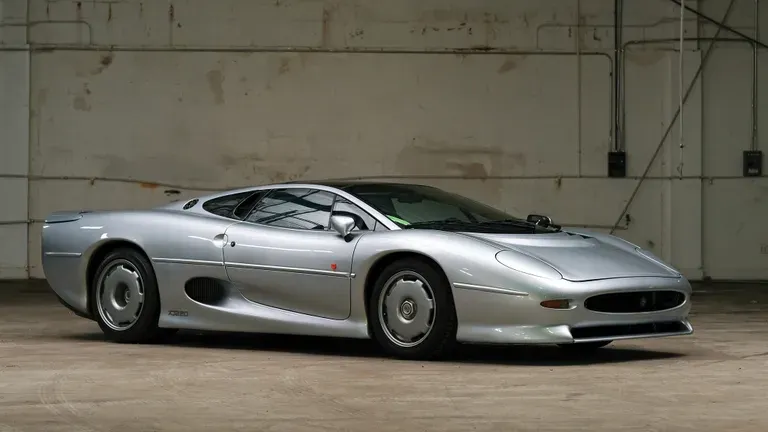
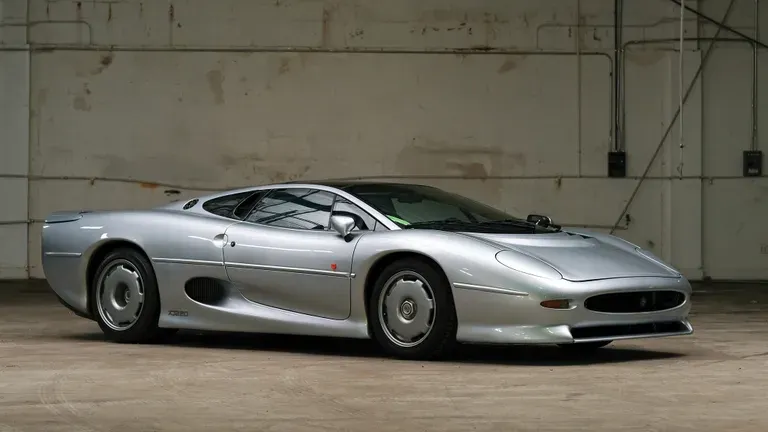
There is a Top Gear segment from 1998 in which Jeremy Clarkson, six years after the launch of the fastest production car in the world, stands in front of a Jaguar XJ220 and explains that you can now buy one brand new for £150,000. Brand new. Delivery mileage. The same car that in 1992 cost £470,000 from the factory. Clarkson reads the line with that drawn-out incredulity of his, and the camera lingers on the car like a museum piece nobody wanted.
Six years. Five hundred and seventy percent depreciation in real terms. The fastest road car on Earth, going for less than a third of sticker price, sitting in the warehouse with no takers. That is the Jaguar XJ220, and it is the most underrated supercar of the 1990s, and at the same time the most misunderstood. Let’s tell the story from the workshop, because from the workshop it reads differently than from the marketing brochure.
A Saturday Hobby That Got Out of Hand
It started, as most great British engineering stories do, with a small group of people doing something they shouldn’t have been doing. Christmas 1984. Jim Randle, head of Jaguar engineering, sat at home over the holiday and sketched a car designed to do 220 miles per hour. From which the name. He recruited twelve Jaguar engineers — among them Keith Helfet for the body design — who agreed to give up their Saturdays to develop it. No budget. No corporate sign-off. They called themselves The Saturday Club.
Around forty Jaguar suppliers chipped in parts, hours, prototype components. For four years, this group built a car off the books, in their own time, until in October 1988 it was wheeled onto the Jaguar stand at the National Exhibition Centre in Birmingham. The spec sheet read like a fever dream of Maranello and Stuttgart engineers having a particularly bad week:
A 6.2-litre 48-valve V12, 500 horsepower claimed. All-wheel drive, system developed by FF Developments. Four-wheel steering. Active suspension. Scissor doors. A bonded aluminium monocoque. Target top speed: 220 mph.
Ferrari had the F40 on the adjacent stand. Models in undress were deployed to draw the punters back. It didn’t work. The crowds stood in front of the Jaguar prototype six and twelve deep. In the first hour of the show, around 1,500 deposit-holders handed over £50,000 each to secure a car. No price quoted. No production prototype tested. No date of delivery.
A detail that rarely gets told: the V12 in the show car had seized on the Friday before the show. The car was dead. At 3 AM on the Saturday morning, the team pushed it onto the Jaguar stand by hand, ready for the 11 AM opening. Of the five experimental 48-valve V12s in existence anywhere in the world, they had just welded one into an expensive paperweight. Twenty percent of global stock, gone in a weekend, in time for a press unveiling that was already too late to cancel. That is the level of seat-of-the-pants engineering this thing was being built on.
The Decision That Broke the Brand’s Promise (and Made the Car Better)
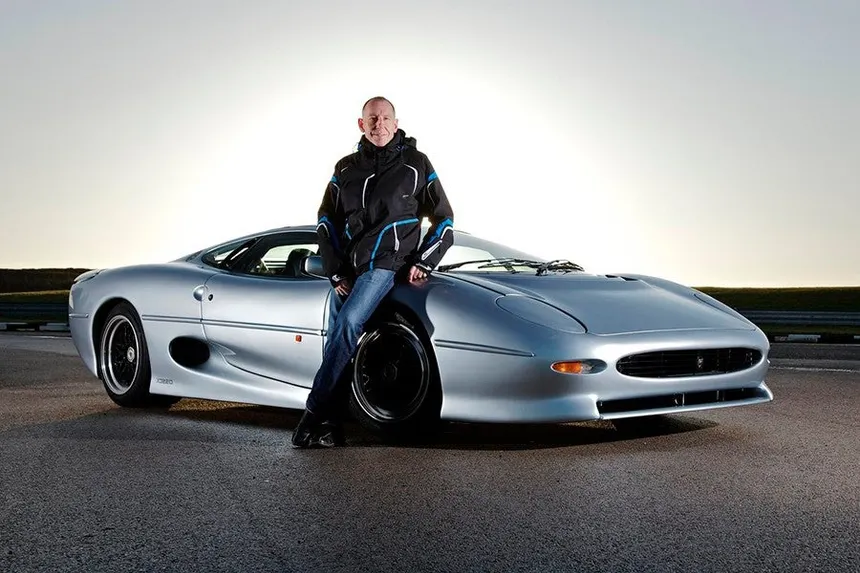
In 1989 Ford bought Jaguar. Walkinshaw, whose TWR had been running Jaguar’s Group C campaigns to two outright Le Mans wins, sat down with Randle to review the project. The straight engineering reading was this: that 6.2-litre V12 was not ready. It was heavy. It was complex. It was expensive. And it was unreliable enough that five examples had been built and one had already seized. Building 250 customer cars with that engine was a guaranteed lawsuit factory.
So they binned the V12. In its place went the Williams-developed V64V, the 3.5-litre V6 that TWR had inherited from the MG Metro 6R4 Group B rally car when the FIA killed Group B after the 1986 season. Williams-engineered, rally-bred, light, compact, vicious. They strapped two turbochargers to it. Output: 542 horsepower at 7,000 rpm, 644 Nm at 4,500 rpm. More power than the V12 was going to make. About 200 kg less mass.
Out went the all-wheel drive. Out went the four-wheel steering. Out went the scissor doors. Out went ABS, which they didn’t have time to develop. In came rear-wheel drive, a five-speed manual, AP Racing twin-plate clutch, AP Racing brakes with four-piston calipers, a shortened wheelbase (the prototype’s 2,845 mm cut by 20 cm), and Abbey Panels of Coventry making the aluminium bodywork by hand.
Here’s the thing that the buyers in 1992 missed and that anyone with a spanner in their hand sees immediately. That V6 was a weapon. The complaint was that it was “just a V6”, as if having six cylinders was a deficiency. What they had in the chassis was a Group B rally engine, built up in aluminium, with twin Garrett T3s breathing through it, producing 542 verified horsepower at the crank and — according to dyno measurements published later by Fastest Laps citing TorqueStats — peaks closer to 697 BHP in some examples. The 0–200 km/h time was quicker than an F40. Quicker than a 959. Quicker than a Diablo. Quicker than the EB110 SS until that car got its quad-turbo V12. The number on the spec sheet said V6. The thing under the bonnet was a sledgehammer.
And the price kept moving. The original 1988–89 contracts referenced a price near £290,000. By the time the first cars rolled out of Bloxham in June 1992, with index-linked clauses kicking in and inflation rolling, the actual invoice price was £470,000 according to Jaguar Heritage Trust’s official record. A 62% increase in four years. Even by Cosworth-era standards, that hurt.
What the Car Actually Was, Underneath
Let me stop the narrative for a moment, because from the workshop with a torque wrench in hand, an XJ220 with its bodywork off tells a story you don’t get from any glossy magazine.
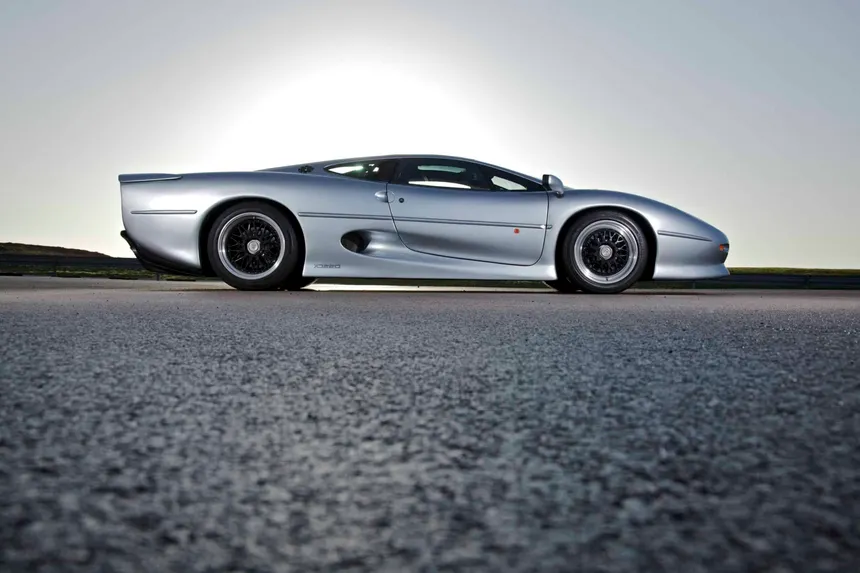
The chassis. Bonded aluminium honeycomb monocoque. Not riveted. Not bolted. Bonded. In 1992 this was frontier technology. Lotus had been using aluminium panels for years. McLaren was just then committing to carbon. But nobody was bonding a full honeycomb aluminium tub for a customer road car at this scale. The result: 1,470 kg kerb weight per Jaguar’s own data. Lighter than a Lamborghini Diablo (1,625 kg, tubular chassis). Lighter than a Bugatti EB110 SS (1,620 kg, carbon tub). Heavier than an F40 (1,100 kg, tubular plus kevlar/carbon panels) but with a more torsionally rigid base. The Jaguar Heritage Trust describes the construction as “immensely strong” — and after thirty-four years of cars actually surviving in collector hands, the structural integrity has aged better than most carbon-and-kevlar contemporaries.
The aerodynamics. Underneath the XJ220 are real ground-effect tunnels. Not decorative scoops. Actual venturi channels routing airflow under the floor to generate genuine downforce at speed. That is the reason Martin Brundle could verify 217 mph at Nardò in 1991 without the car taking off. A car this tall and this wide at that velocity will lift unless there is real aero work underneath. There was.
The engine. The Metro 6R4 V64V was a rally engine designed by Williams Grand Prix Engineering for FISA Group B regulations in 1985. Group B was a category that, frankly, killed enough people that the FIA shut it down. The 6R4 itself never won a championship before the cull. But the engine survived, TWR bought the rights, and what they put in the XJ220 was that base engine with twin Garrett T3 turbos, water-to-air intercoolers, dry-sump lubrication, and a four-cam, 24-valve top end.
What did it sound like? Here are the period reviewers, in their own words, so this doesn’t read as opinion. Andrew Frankel, writing for Autocar in 1992: “The noise is raw, savage, hard-edged and devoid of any warmth; a noise that warns you to remember that this is a racing car at its core.” John Barker, in Performance Car the same year, took a more measured tone: “The V6 has a rumbly, loping note which, in league with a remarkably supple ride, belies the speed we are travelling at.” And thirty years later, again Frankel in Autocar’s anniversary retrospective: “I’m even finally growing to like the deep and gravelly voice of the V6.”
Not a Ferrari V12 aria. Not the dry crack of a normally aspirated V8. A lower, more mechanical roar — closer to the Group C XJRs that TWR had been taking to Le Mans wins. For a rally-derived V6 with two turbos working hard, that was the correct noise. The problem was the typical Jaguar buyer in 1992 had come from an XJ-S V12 or an Aston V8. The XJ220 didn’t sound like anything in their listening history. And that, at that moment, mattered.
The handling. Long wheelbase, very wide track, mid-mounted engine, heavy turbo lag, no driver aids. Demanding on public roads. Brutal on the autostrada or on a circuit, where the speed and the downforce paid off. Andy Wallace and Brundle both reported that the car was a handful below 60 mph but settled into a calm at 150 mph that few rivals could match. That’s the trade-off of a car designed to do 220. It doesn’t want to do 30.
The Recession, the Lawsuits, and the Angry Phone Calls
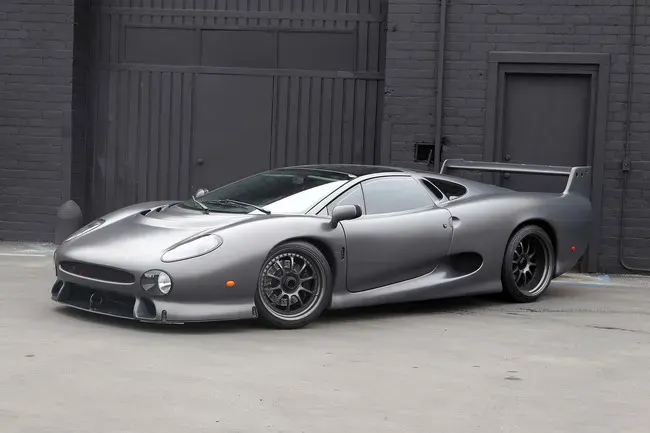
- Global recession bites. The collector exotic market, which in 1988 was in full speculative bubble, deflates. F40s that traded at £1 million in 1989 dropped to £125,000 by 1993. Testarossas from £350,000 to £35,000. The speculators who had handed over £50,000 deposits on XJ220s in 1988, watching their F40 collateral collapse and now seeing the production XJ220 was a V6 rear-drive car instead of the promised V12 four-wheel-drive, started ringing their lawyers.
Many demanded their deposits back. Jaguar refused, pointing out — correctly — that the actual contracts signed in 1989 specified rear-wheel drive and a V6 engine, as documented by Wheels Australia citing the original contract terms. The promise was made by the prototype, not by the contract. But public perception was set by the prototype, and the public was the one buying.
Lawsuits followed. Jaguar won most of them. Reputational damage stuck regardless. Twenty-two cars from the original production run remained unsold. Several customers who had taken delivery parked the cars and stopped driving them, waiting for values to recover. Of the planned 350 cars, only 281 were completed per Jaguar Heritage Trust records. Final stock units were still being sold off in 1997 at roughly £150,000, less than a third of original sticker, as reported by the 1998 Top Gear segment that opened this article.
This is the paradox that defines the XJ220: it was the fastest production car in the world, and nobody wanted it.
Two Years on Top of the World
The numbers. Let’s get to the numbers, because the numbers shut up any argument about whether the XJ220 was a real supercar or a marketing exercise.
1991, Nardò test track, southern Italy. Martin Brundle behind the wheel. 217.1 mph (349.4 km/h), two-way average for FIA verification. That was the production-car top speed record. Faster than the F40 (324 km/h). Faster than the 959 (315 km/h). Faster than the Diablo (325 km/h claimed). Between 1992 and 1994, there was no production car in the world that could top the XJ220 in a straight line.
The XJ220 held the absolute production-car top speed record for a little over a year. The car that took it away wasn’t the McLaren F1 — it was the Bugatti EB110 SS. May 1993, again at Nardò, an EB110 SS clocked 351 km/h (218 mph). Quad-turbo 3.5L V12, 603 hp, all-wheel drive, carbon fibre monocoque. Bugatti turned up with exactly the artillery Jaguar had walked away from: V12, AWD, carbon. The McLaren F1, presented in 1992 and first delivered in late 1993, was playing a different game altogether: carbon fibre monocoque, naturally aspirated 6.1-litre BMW V12 with 627 hp, 1,138 kg kerb weight, central driving position. The 386 km/h (240 mph) record attributed to the F1 doesn’t come until March 1998, when Andy Wallace took an XP5 development car to Ehra-Lessien. Seven years after the XJ220’s Nardò run. A different generation of car, a different generation of tyres, a different generation of aerodynamics.
Comparing the XJ220 to the F1 on top speed is comparing cars from different eras with different technologies. And from the workshop angle there’s another wrinkle worth saying out loud: comparing a 3.5L twin-turbo to a 6.1L naturally aspirated engine on raw displacement is cheating. The historical FIA equivalence factor for forced induction was 1.4 — apply it and the XJ220’s 3.5 litres equate to about 4.9 atmospheric litres. Not half the F1’s displacement, but around 80 percent. And the cube law of velocity bites harder still: going from 349 to 386 km/h needs roughly 35 percent more aerodynamic power assuming similar drag coefficients and frontal areas. To match the F1’s top end in the XJ220’s body, you would need to lift the engine from 542 hp to around 730. That’s why the McLaren reaches what it reaches: more power than the XJ220 would have needed, in a car that weighs 332 kg less and is narrower.
The XJ220 was not “23 mph off the F1”. It was a full generation of car away, a more modern tyre compound away, and 200 horsepower of usable thrust away at the top of the speed envelope. What is true, and what actually matters, is that in its specific window — June 1991 to May 1993 — it was the fastest production car in the world. A legitimate record. Fourteen months at the top of the global podium.
Acceleration. Road & Track and Fastest Laps with dyno data both reported figures around: 0–60 mph in 3.6 to 3.8 seconds depending on the test, 0–100 mph in 6.7 seconds, 0–150 mph in 15.1 seconds, quarter mile in 11.3 seconds at 130 mph. Those numbers in 2026 still match many hybrid hypercars costing five times more.
And one more figure that rarely gets mentioned. September 1991, Nürburgring Nordschleife. An XJ220 prototype, with Danish Le Mans winner John Nielsen at the wheel, lapped the Green Hell in 7:46.36 — the fastest production-car lap of the circuit at that point in history, per Jaguar’s own records preserved on Wikipedia. Before the XJ220, no road car had broken 8 minutes around the Nordschleife. The XJ220 held that record until the year 2000, according to the Țiriac Collection archives. Nine years at the top.
Le Mans 1993: The Win That Wasn’t
The XJ220 story has one chapter that hurts more than the lawsuits, and that’s June 1993.
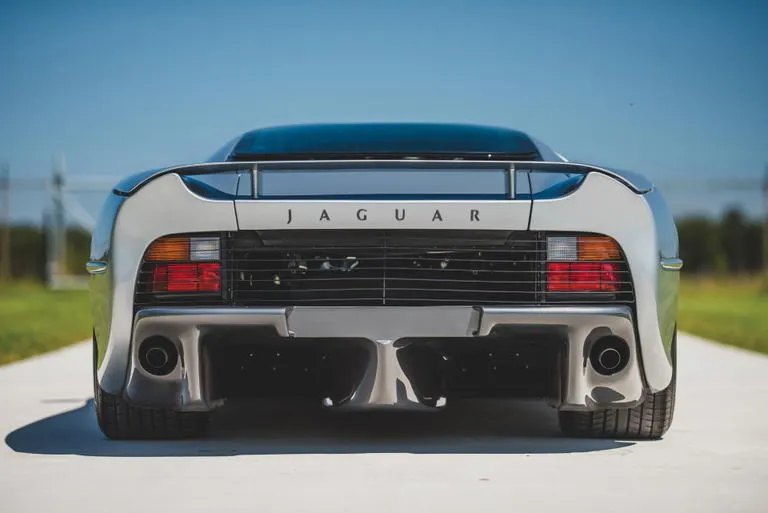
TWR built three XJ220C race cars — the competition version, 400 kg lighter than the road car, fully detachable carbon-composite body panels, kevlar racing seats, the same V6 twin-turbo retuned for endurance. They entered them in the new GT class at Le Mans. Driver assignments: car 50, David Brabham, John Nielsen, David Coulthard. Coulthard was making his name in single-seaters and this was his first and only 24 Hours. Nielsen had won Le Mans for Jaguar in 1988 with the XJR-9. Brabham was the son of Sir Jack Brabham, and his older brother Geoff was driving the works Peugeot 905.
In testing, ACO scrutineers noted that the XJ220Cs had no catalytic converters. The road XJ220 did. The XJ220Cs had been built to IMSA GT regulations, which did not require them, and no other car in the GT class at Le Mans was running catalysts either. TWR appealed. The Jaguars were allowed to race under appeal.
Twenty-four hours later. Brabham, Nielsen and Coulthard finished 15th overall and first in GT class, two laps ahead of the Porsche Carrera RSR of Barth/Gouhier/Dupuy. The last Le Mans class win for Jaguar to date. Geoff Brabham took outright victory in the Peugeot 905 Evo1C with Helary and Bouchut. Sir Jack Brabham watched both his sons on the podium on the same Sunday afternoon.
A month later, the Jaguars were disqualified. Not for the catalysts. For a procedural error: TWR had failed to lodge the appeal correctly within the required time window. The FIA had already supported the original appeal on its merits, but the administrative procedure was invalid. All three XJ220Cs struck from the record. GT class victory transferred to the Porsche.
Motor Sport Magazine quotes David Brabham years later: “Tom Walkinshaw and the ACO hated each other. We were wrapped up in all that mess. It’s a shame for everybody who put the effort in. Because it wasn’t just my victory. It was everyone who worked on that programme’s victory. And it was taken away from all of us.”
That asterisk defines the XJ220 better than any other event. A genuinely brutal racing car, a legitimate winner on track, removed from the record book by a paperwork failure. A genuinely brutal road car, a record-holder of the absolute top speed crown, removed from the customer base by a recession and a V12-shaped expectations problem.
The Car Nobody Wanted Then That Everybody Wants Now
Time has done what time does with undervalued machinery. The dust settled. Perspective arrived. People started looking at what they had in front of them.
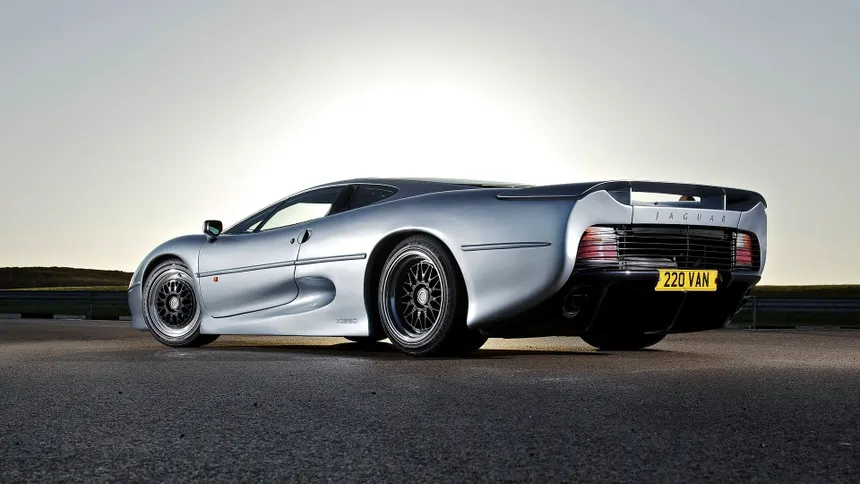
By 2005 you could buy an XJ220 publicly for around $120,000. A car that listed at £470,000 in 1992 trading at under 25 percent of original sticker. The floor of the market. Today, in 2026, concours #1 examples sit around $680,000 according to Hagerty, which tracks gains of nearly 30 percent in just the last six years. From $120,000 to nearly $700,000 in twenty years. That is appreciation.
Why? For the same reasons the buyers in 1992 didn’t want them. Because the XJ220 is an analogue twin-turbo V6 with a five-speed manual, no traction control, no electronic brakes, no software, nothing between the road and the driver’s hands. What was “less car” in 1992 is exactly what 2026 buyers want. A pure, raw, mid-90s supercar with mechanical linkages and a pulse instead of an ECU map.
Rarity matters too. 281 built. Less than F40 (1,315 units). Less than Diablo (2,903). Just above 959 (337). Considerably more than EB110 SS (33). Considerably more than McLaren F1 (106). In the production volume sweet spot for collector demand, with a verified top-speed record, a Le Mans class win with an asterisk, and a story of lawsuits and customer fury that gives the car that “cursed icon” patina collectors love.
And here’s a thing the workshop perspective rewards. Of all the great 1990s exotics, the XJ220 has aged unusually well in terms of being keepable. Don Law Racing in Staffordshire specialises in the cars and stocks parts. Bridgestone reintroduced its custom Expedia S-01 compound in 2020 specifically for XJ220 owners, ten years after the original tyre was discontinued. That kind of long-tail support is rare. An F40 today is expensive to maintain. A 959 is a logistical nightmare. An EB110 SS depends on three specialists worldwide. The XJ220 has people willing to look after it, and that is more than many of its contemporaries can claim.
What Jaguar Was, Then
To close out, from the workshop. What the XJ220 tells you about the Jaguar that built it is this.
In 1984, Jaguar was a marque with problems. Emerging from the British Leyland years, the strikes, the quality issues that had been the trade press joke for a decade. The XJ-S and XJ6 were the gameplan, both fine cars carrying complicated reputations. The marque was profitable but not confident.
And inside that company, twelve engineers gave up their Saturdays without pay to build a car that could humiliate Ferrari and Porsche. Not for the money. For the principle. For the proof that it could be done. Jim Randle sketched it over Christmas 1984. By 1988 they had a presentable prototype. Four years, no official budget, forty external suppliers donating effort, in the middle of Thatcher’s Britain.
That was Jaguar then. A commercially troubled marque with engineers willing to walk into the factory on a Saturday morning between coffee and lunch and build the fastest car in the world for the love of doing it.
And the car got built. It wasn’t perfect. It arrived late, expensive, with half its buyers angry. But it arrived. 217 mph. 7:46.36 around the Nordschleife. World speed record for two consecutive years. Le Mans GT class win with an asterisk. And a Williams-engineered, TWR-developed, rally-derived twin-turbo V6 that, thirty-four years later, remains the fastest six-cylinder engine ever homologated in a production car.
Check you’re still alive.