Volkswagen W12 Nardò: the supercar that was always a test rig
If you watched Top Gear in the early 2000s, you remember the era. Clarkson worshipping the McLaren F1. May still mourning the death of the V12 Vantage. The Veyron was about to land like a meteor and rewrite everything we thought we knew about production cars. Ferrari was being Ferrari. Lamborghini was finally being properly Italian again under Audi’s chequebook. And in the middle of that landscape, with all the noise and all the names, Volkswagen built a 591-horsepower mid-engined supercar that ran 24 hours flat-out at 322 km/h average — and never sold a single example.
Read that again. Volkswagen. Built a supercar. Set the all-time 24-hour speed record. Then locked the keys away forever.
That sounds like a punchline. It isn’t. It’s the most quietly successful engineering project of the entire VW Group era. And nobody talks about it because the car was a sideshow. The real product was the engine sitting inside it.
This is the story of the W12 Nardò. Or more accurately, the story of how a Volkswagen-badged supercar was built specifically so that a six-litre engine could be tortured for a day and a night on a banked Italian oval, just to prove it was ready to live inside Bentleys, Audis and Phaetons for the next twenty-three years.
The man with the chequebook
Ferdinand Piëch was not a CEO in the modern sense. Modern CEOs do investor calls and approve PowerPoint slides. Piëch was an engineer who happened to be running the second-largest car company in the world, and he ran it the way an obsessive mechanical genius runs a Bavarian workshop. Which is to say: badly for everyone working under him, brilliantly for the engineering.
By 1997 he had already pulled off the Audi Quattro, was finalising the takeover of Bentley, Lamborghini and Bugatti (all three landed in 1998), and was setting up the hostile takeover of his grandfather’s company, Porsche. He had also decided that Volkswagen, the People’s Car company, needed a supercar. Not a Bentley. Not a Lamborghini. A Volkswagen-badged supercar with twelve cylinders.
He gave the job to Giorgetto Giugiaro at Italdesign. The brief was thin: mid-engined, all-wheel drive Syncro, and the engine had to be a W12. Not a V12. A W12. That last bit is where the whole story actually lives.
The W12 is not what you think it is
Forget what you think a W engine is. The W12s of automotive history — Napier Lions, the doomed Life Racing Formula 1 entry of 1990 — were three banks of four cylinders arranged like a fan. That’s not what Volkswagen built.
Piëch’s W12 is two narrow-angle VR6 engines welded onto the same crankshaft. Two VR6s, each with their cylinders at a tight 15-degree internal V, joined at a 72-degree angle. Four banks of three cylinders. It’s closer to a folded V12 than to a traditional W. And the engineering reason it exists at all is brutally simple: a 6.0-litre W12 built this way is physically shorter than the Group’s contemporary 4.2-litre V8. Twelve cylinders, six litres of displacement, and it fits where an eight-cylinder fits.
That is the entire point. Piëch wasn’t building a supercar engine. He was building a packaging solution. A twelve-cylinder block that would slot lengthways into a luxury saloon ahead of the front axle without making the nose look like a Caterpillar. A block that would later fit under the bonnet of a Touareg SUV. A block that would, with twin turbos bolted on, become the heart of the first-generation Bentley Continental GT and rescue Crewe.
But to sell that to the Group board, and to the Audi engineers who would have to integrate it, you needed proof the thing worked. Proof it survived heat. Proof it survived sustained high revs. Proof it didn’t grenade at four hours.
You needed a test bed. And Piëch decided the test bed was going to be a supercar.
Three concepts, three iterations
The first one showed up at the Tokyo Motor Show in October 1997. Bright yellow. Called the W12 Syncro. Mid-engined, 5.6-litre W12, 414 horsepower, all-wheel drive, six-speed sequential gearbox, gullwing doors. Giugiaro’s lines. Press release said it was a styling exercise. Press release was lying.
Eight months later, Geneva 1998, a second car appeared. Red. Roadster. Same engine, but now rear-wheel drive only. Look at that detail and ignore the missing roof. Volkswagen had swapped from Syncro all-wheel drive to pure RWD on the same chassis with the same engine. They weren’t messing about with aesthetics. They were validating the powertrain in two completely different drivetrain configurations to see how the engine behaved under different load and torque distribution scenarios.
Anyone who has ever spent a day in a real test lab recognises what was happening. The press saw two pretty show cars. Volkswagen was running a methodical, multi-year engine validation programme in plain sight.
Then came Tokyo 2001. The same hall. The same brand. Four years on. And the third car.
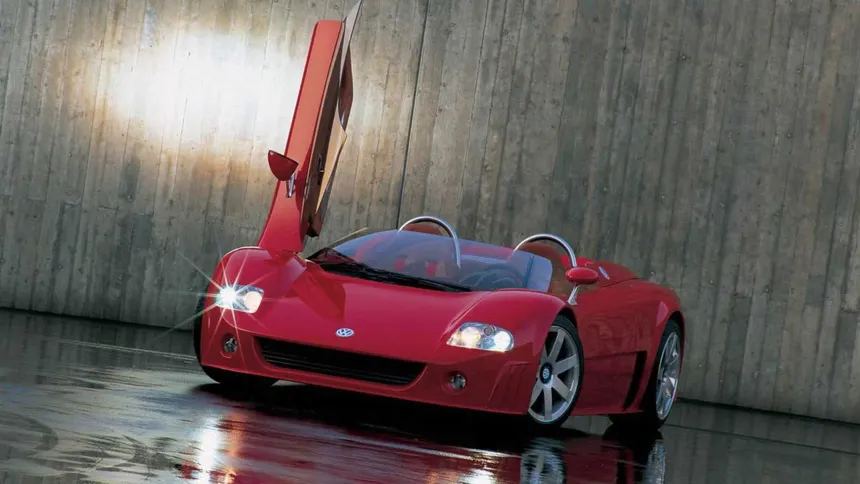
The Nardò Coupé
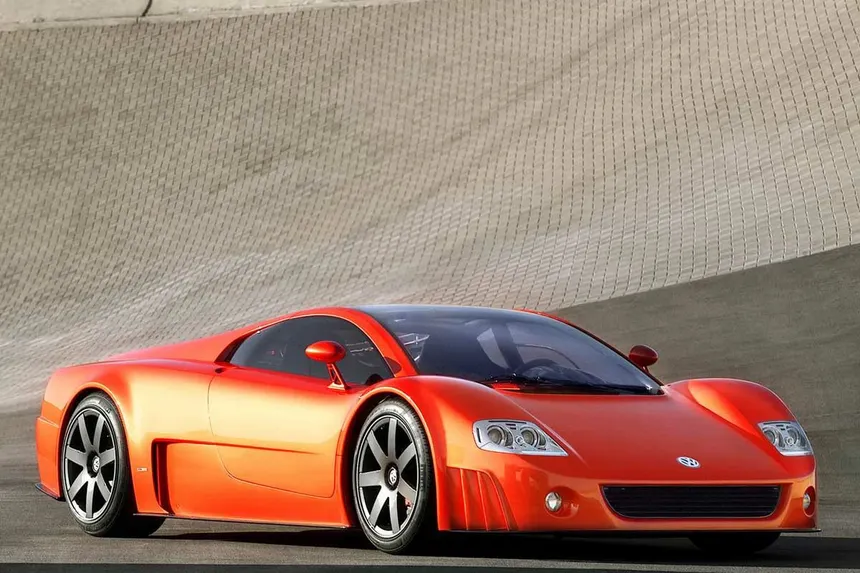
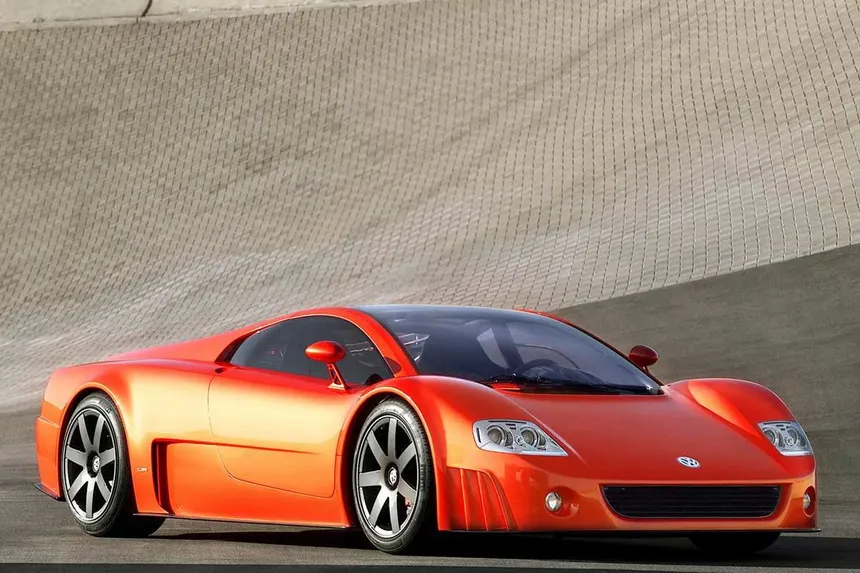
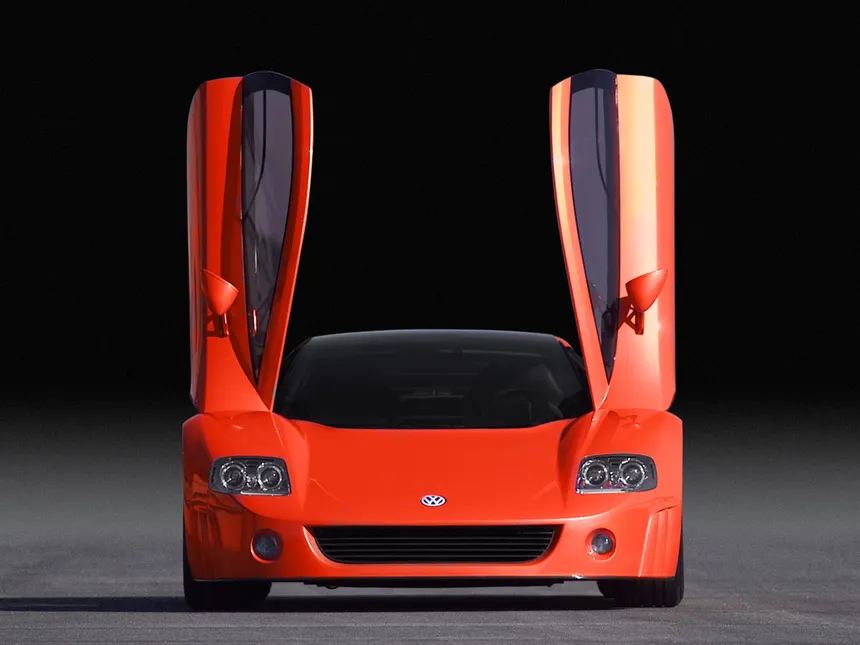
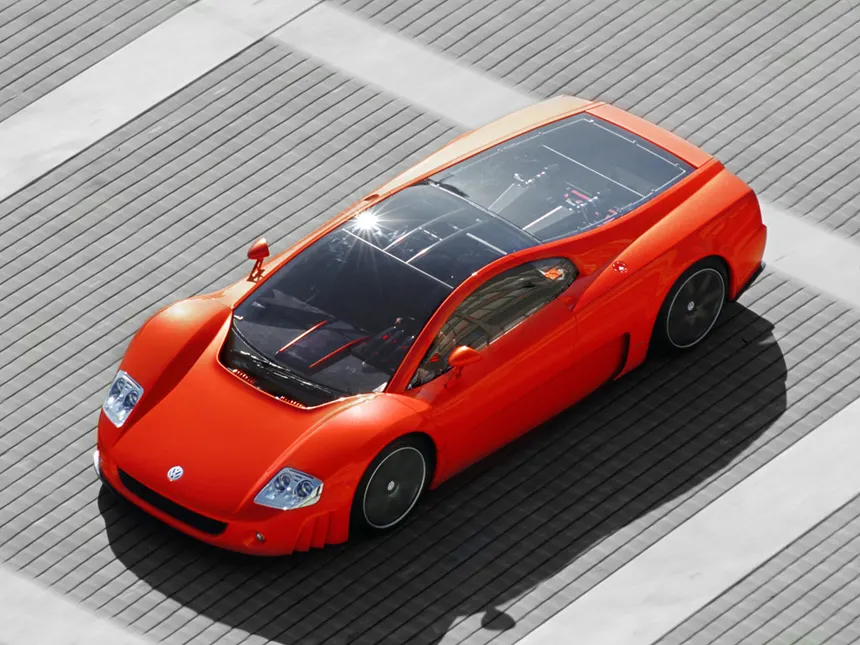
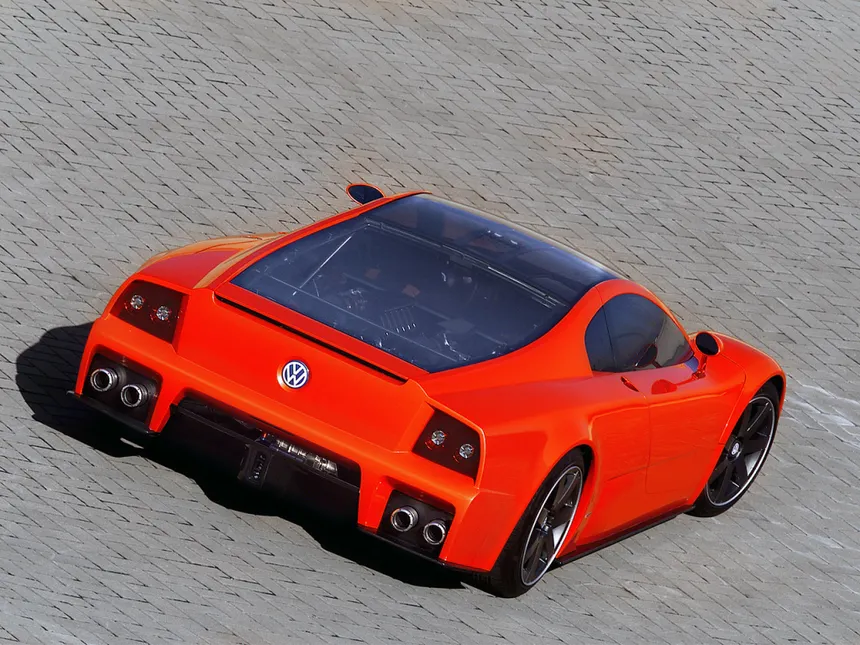
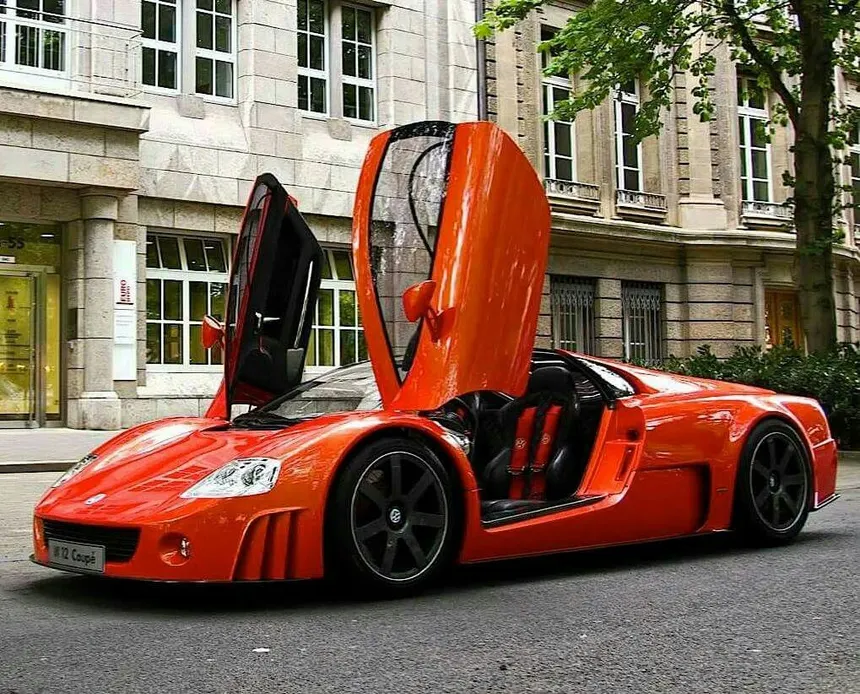
It’s painted orange pearl. It’s 4.55 metres long, 1.92 wide, 1.10 tall. It weighs 1,200 kg dry. Perfect 50:50 weight distribution. Aluminium monocoque. Double wishbones front and rear. Rear spoiler that deploys automatically at 120 km/h. Twin gullwing doors. Glass engine cover so you can see the W12 like a watch movement.
The engine has grown to 6.0 litres. Still naturally aspirated. 591 horsepower. 458 lb-ft of torque. Six-speed manual sequential. Volkswagen claimed 0–100 km/h in 3.5 seconds and a top speed of 357 km/h (222 mph).
For context: the McLaren F1, the era’s defining benchmark, had 627 hp from a BMW V12, weighed 1,138 kg, and was made of carbon fibre. The Nardò Coupé was within striking distance of an F1 in performance, and wearing a Volkswagen badge. Whatever you think of the badge, that is genuinely remarkable.
But the Tokyo car was never the endgame. The endgame was sitting in southern Italy.
Nardò Ring, 14 October 2001: three Italians and a record that wasn’t enough
The Nardò Ring is a 12.5-kilometre circular banked test track built by Fiat in 1975 outside Lecce. It exists for one reason: sustained high-speed testing. You can hold flat-out throttle on the banking for hours without lifting. It’s the closest thing on earth to a treadmill for cars.
That’s where Volkswagen took the W12 in October 2001. The car had been heavily reworked from the Tokyo show specification, and crucially this wasn’t the orange show car. The record car was painted black, riding on gold BBS rims.
Piëch was there in person. He was 64 years old. He stood and watched.
The driver line-up was not a marketing exercise. Volkswagen hired three Italian professionals with serious records of their own. Mauro Baldi, from Reggio Emilia, winner of the 1994 Le Mans 24 Hours in a Dauer 962 Porsche, World Sportscar Champion in 1990 with Sauber-Mercedes, 36 Formula 1 starts in the early 1980s with Arrows, Alfa Romeo and Spirit, and a holder of the unofficial Triple Crown of endurance — Le Mans, Daytona, Sebring. Critically, Baldi had also won the 24 Hours of Daytona in February 2002 itself, in the Doran Lista Dallara LMP-Judd. The man was at his absolute career peak. Emanuele Naspetti, another Italian, former F1 driver with March and Jordan, with deep credentials in GT and sportscar racing. And Giorgio Sanna, then Lamborghini’s official test driver, the man who would go on to run Lamborghini’s entire Squadra Corse motorsport division.
Three Italians. One Le Mans winner, one ex-F1, one direct Lamborghini insider. That wasn’t a coincidence. Volkswagen had owned Lamborghini for three years by then. Sant’Agata Bolognese sat 90 minutes by motorway from Italdesign’s Moncalieri facility where the W12 had been built. The Group was leveraging Italian resources, in Italian hands, on Italian tarmac, with a German-badged car. Whatever the badge said on the nose, the people doing the work were from Emilia-Romagna and Piedmont.
The team ran for 24 hours straight. The car covered 7,085.7 kilometres. Average speed: 295.238 km/h (183 mph). Nine world records fell that day. By any normal standard, mission accomplished.
Piëch wasn’t normal. He wanted the team to crack the 300 km/h average barrier. Nine world records weren’t enough. He sent everyone home and told them to come back.
This is the part of the story that tells you everything about working for the man. Nine world records in a single 24-hour run, with a brand-new untested engine architecture, and the answer is not good enough.
The Murciélago test mule nobody talks about
Between October 2001 and February 2002, Volkswagen did something it never publicised properly. Engineers in Wolfsburg took a complete W12 engine and bolted it into the chassis of a Lamborghini Murciélago, then ran the assembly on track for weeks. This was not a backup car for the Nardò itself. It was a parallel test mule built specifically to subject the engine to the same sustained-load conditions it would face in Apulia, but using a chassis that was already proven, already engineered, already understood. Test the block on its own, without the unknown variable of the W12 Nardò’s bespoke aluminium monocoque clouding the picture.
This is the move that tells you what the project actually was. Piëch had Lamborghini in his pocket. He used it. The Murciélago had only entered production in 2001; its tubular steel frame with carbon fibre panels was one of the most rigid chassis on the planet at the time, and made an ideal stress rig for evaluating the engine in isolation. Italian engineers from Sant’Agata worked alongside the Wolfsburg team on that rolling test bed. Everything they learned about the W12’s thermal behaviour, oil pressure stability, and fatigue response under sustained 6,000+ rpm went straight into the February run.
That experimental Murciélago with the VW W12 in the back was never shown to the press, never officially photographed, never appears in any VAG or Lamborghini catalogue. The Group preferred to keep it quiet. But it existed. And it was the unsung hero of what Mauro Baldi and his teammates pulled off four months later.
23 February 2002: 322,891 km/h for 24 hours straight
Four months after the first attempt. Same Apulian oval. Same driver team. The car, now informally known as the W12 Nardò, arrived dialled in with every lesson from the Murciélago test rig integrated. The team pitted every 80 minutes for fuel, tyres and a driver swap.
The car ran for 24 hours. Distance covered: 7,740.576 kilometres (4,809 miles). Average speed: 322.891 km/h (200.6 mph). Peak speed registered: 357 km/h.
Seven outright world records. Twelve international class records, including the highest average speed sustained over 24 hours by any vehicle, ever.
Volkswagen now held nine of the twelve world records for distance and time in the class. The other two still belonged to the ARVW (Aerodynamic Research VW) project from 1980 — another in-house Volkswagen effort. According to the FIA, all those records remain valid today.
That 24-hour average speed record still stands twenty-four years later. Nobody has touched it. Not the Veyron, not the Chiron, not Koenigsegg, not SSC, not the new electric hypercars. The all-time 24-hour speed record belongs to a black Volkswagen on gold wheels with a naturally aspirated 591 hp twelve-cylinder.
What the cockpit felt like
The numbers are one thing. The sensation is something else. None of the three drivers has left long public interviews about what those 24 hours actually felt like from inside the car, but the technical configuration of the W12 Nardò sends very clear signals about what kind of machine they were strapped into.
A banked oval means that, at record speed, the car is pinned against the outer wall by the geometry of the track itself. The Nardò Ring’s banking rises about 12 metres from inner edge to outer edge at its steepest point. At 322 km/h, the lateral G-load crushes the driver into the seat without the car needing to consciously turn. You aren’t driving in a straight line. You’re driving an infinite, never-ending curve. Top Gear’s Chris Harris has talked at length about the disorientating sensation of high-banking tracks — the W12 drivers were living that for 24 hours.
Then there’s the sound. A naturally aspirated 6.0-litre W12 running between 5,500 and 7,000 rpm for 80 minutes at a time, no pause, no lift, is not the high screaming wail of a Ferrari V12. It’s something denser. Lower. More industrial. The engine bay of the Nardò sits directly behind the driver’s shoulders, separated only by a glass cover and a few centimetres of aluminium bulkhead. The sound enters through the base of the skull. Twenty-four hours of that. The mind goes to strange places.
The cabin is tight. Bucket seats in suede and leather. A small Formula 1-inspired steering wheel with red-anodised aluminium accents. No paddles. The Nardò had a centre-console manual sequential lever, and the driver shifted gears with his right hand for an entire shift. Doing that for 80 minutes solid is itself an exercise in concentration.
But the hardest part of a record run like that isn’t the speed. It’s the boredom. Eighty minutes of concentration at 320 km/h with nothing to see but grey banking sliding under the wheels and the Apulian horizon. Any endurance driver will tell you the same: 24-hour records aren’t won by going fast. They’re won by not making a mistake. Not dropping the rhythm. Not falling asleep at four in the morning when you’ve been alternating with your teammates for twelve hours and your inner ear has stopped trusting which way is up.
That’s why Volkswagen hired Baldi. That’s why Naspetti. That’s why Sanna. Not for outright pace. For the absence of failure across a day and a night at 322 km/h average. They delivered.
And then the car disappeared. It wasn’t built. It wasn’t sold. There was no Volkswagen W12 GT at any dealership. The fastest concept ever to wear a VW badge was wheeled into the Wolfsburg museum and left there.
Why no production?
Two reasons. Both true.
The first one is what Volkswagen always says publicly. By 2002 the Group already owned Lamborghini, Bentley and Bugatti. Why sell a VW-badged supercar when you could sell a Murciélago, a Continental GT, or wait for the Veyron? The Phaeton, VW’s flagship saloon, launched the same year as the Nardò record. It was a brilliant car — Piëch had demanded it could sustain 150 mph indefinitely with the air conditioning at full blast — and it sold appallingly. Buyers who could afford a Phaeton bought a 7 Series or an S-Class. The VW badge, beloved on a Golf, simply didn’t carry any prestige in that segment.
The second reason is the one that matters. The car had never been the product. The engine had been the product. And by 2002, the engine was ready to ship.
The same year the Nardò set its first record (2001), the Audi A8 D2 entered production with the naturally aspirated 6.0 W12. First production car in the world to use the engine. The Nardò’s engine, in a saloon.
In 2003, the first-generation Bentley Continental GT launched with the twin-turbocharged version of the same engine. 552 horsepower. Rear of the chassis was borrowed straight from the Phaeton. The Conti GT became the most commercially successful grand tourer of the decade and pulled Bentley out of its post-war financial coma. It saved Crewe. It made Bentley profitable. It is, by a long margin, the most important car Bentley built in the last fifty years.
Then came: Volkswagen Phaeton W12 (2004–2011). Volkswagen Touareg W12 (2005–2010). Audi A8L W12 (through 2018). Bentley Flying Spur W12 (2005–2024). Bentley Bentayga W12 (2015–2024). Spyker C12 La Turbie (2006). Spyker C12 Zagato (2008).
Twenty-three years in continuous production. Bentley alone built more than 100,000 cars with this engine. The final Continental GT Speed (2024) made 659 hp. The Batur Mulliner one-off made 740 hp. Same fundamental block architecture as that orange concept on the banked oval in Apulia.
And then there’s the W16. Logical extension: take the W12 architecture, add two more cylinders, bolt on four turbos. The result was the 1,001 hp engine of the Bugatti Veyron, the car that arguably defined what a hypercar even was for the 21st century. Without the W12 Nardò proving the architecture worked in 2001 and 2002, there is no Veyron. There is no Chiron. The whole modern hypercar era starts on that Italian oval.
All of it. From a car that never sold.
What the workshop sees
Here is what looks different when you’ve spent thirty years putting engines into cars instead of writing about them.
Mid-rear longitudinal mount: not for theatre. For 50:50 distribution and for clearing the 1.10-metre roof line. Two VR6s at 72°: not exotic for the sake of it. The only block configuration that lets a 12-cylinder engine fit lengthways under the bonnet of a luxury saloon without redesigning the front of the car. Naturally aspirated: because you don’t validate a block by bolting two turbos onto it. You validate the block bare, then you add the turbos to it for Bentley a year later. Six-speed manual sequential: because in 2001 the Group’s torque-converter automatics couldn’t reliably handle 591 hp on a banked oval for 24 hours. DSG didn’t exist yet. So they used the only transmission that wouldn’t be the weak link in the chain.
1,200-kilo monocoque: lightweight not to look good on a Top Gear leaderboard. Lightweight because the goal was to stress-test the engine for 24 hours straight, and a lighter chassis means less load on the engine and more telemetry data about what the engine itself was actually doing. The lighter the car, the more naked the engine in the data.
322 km/h average for 24 hours is not a marketing stunt. That is sustained thermal load, sustained oil pressure, sustained fatigue cycles on every component of the powertrain. If the block had failed, there would have been no Phaeton W12, no Continental GT, no Bentayga, no Veyron. The entire VW Group’s 2000s flagship strategy hinged on whether that orange car would survive a full day at flat throttle.
It survived. And the decision not to put the Nardò into production wasn’t a defeat. It was the team walking out of the test cell with the result they came for.
The last W12
Bentley retired the W12 in April 2024. Emissions targets. Electrification. What started in Tokyo in 1997 with a yellow show car ended in 2024 with a 740-horsepower hand-built Mulliner. That arc isn’t going to happen again. Not in production cars. Not at that scale.
Ferdinand Piëch died in 2019. He didn’t live to see his engine retire. But he lived long enough to watch the block he conceived as a packaging trick become the heart of the most profitable brand his group ever bought.
The Volkswagen W12 Nardò still lives in the Wolfsburg museum. Orange paint. Small in person, by all accounts. Visitors who have stood next to it describe it as feeling more like a tool than a car. Which is exactly what it always was.
Check you’re still alive.