
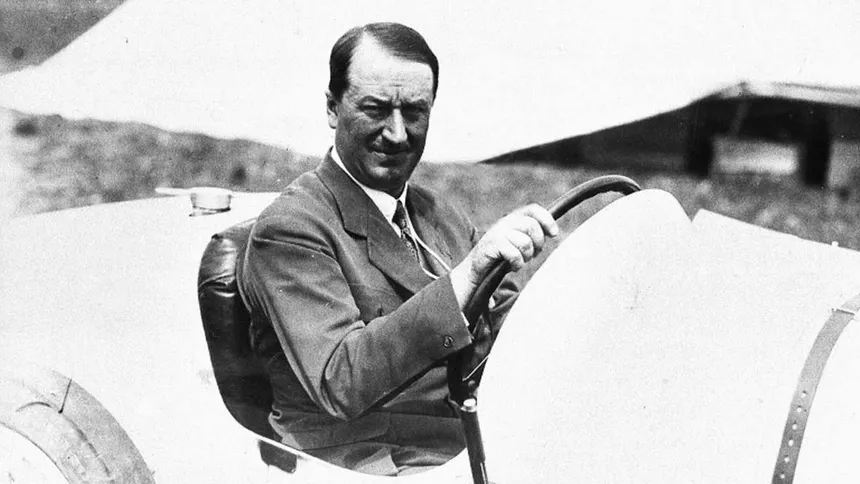
Ettore Bugatti: the patron who thought he was an artist
When James May stood in front of a Veyron on Top Gear and called it the greatest car of the century, he was looking at a machine engineered by Volkswagen with a thousand and one horsepower, a four-turbo W16 and a price tag bigger than most people’s houses. What he was not looking at was a Bugatti. Not really. Not in the sense that the man who founded the marque would have recognised.
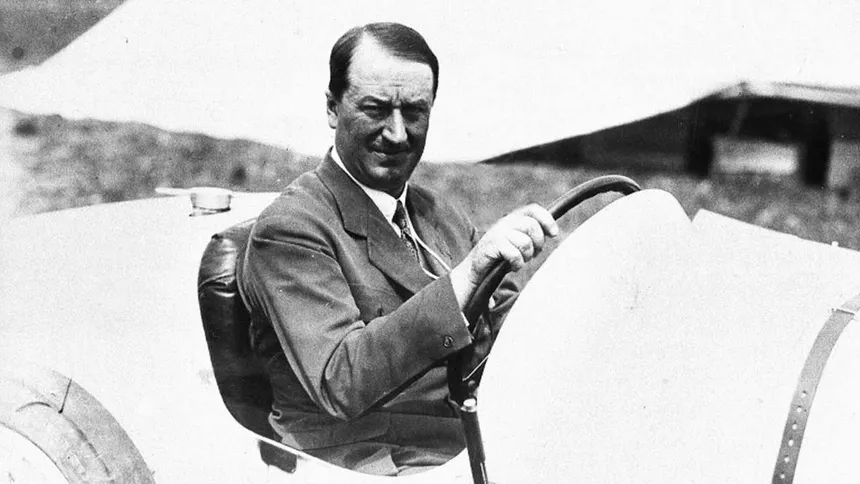
The man who founded the marque hated hydraulic brakes. He kept his racing cars on cable-operated drums into the late 1930s, while Mercedes, Alfa Romeo and Maserati had moved on a decade earlier. He treated his factory like an artisan’s atelier and his workers like Renaissance craftsmen. He came from a family of sculptors and painters and tried to be one before realising he wasn’t quite good enough. So he turned to mechanics and treated mechanics as if they were sculpture instead.
His name was Ettore Arco Isidoro Bugatti, and the legend wrapped around him is mostly polished. Time to scrape some of the polish off and look at the metal underneath.
The Milanese boy who grew up surrounded by chisels
Ettore was born in Milan on 15 September 1881. His father Carlo was a successful Art Nouveau designer of furniture and jewellery. His grandfather Giovanni Luigi was a sculptor and architect. His aunt Luigia was married to the painter Giovanni Segantini. His younger brother Rembrandt became a celebrated sculptor of animals before taking his own life in Paris in 1916, aged 31.
This is the household Ettore grew up in. Art was the family business. He went to Milan’s Brera Academy to follow the family trade, and he discovered fairly quickly that he wasn’t the most talented Bugatti at the easel. So he changed direction. By 16 he was apprenticed to Prinetti & Stucchi, makers of bicycles and motorised tricycles. By 17 he had built his own tricycle and entered it in the Paris-Bordeaux race. By 19, his first car.
What he could not be as a sculptor, he became as an engineer. But the artist’s reflex never left him. And that reflex is the key to understanding Bugatti the man, and Bugatti the marque, before the Volkswagen money came along and rewrote the story.
Molsheim, where the factory floor was cleaner than most kitchens
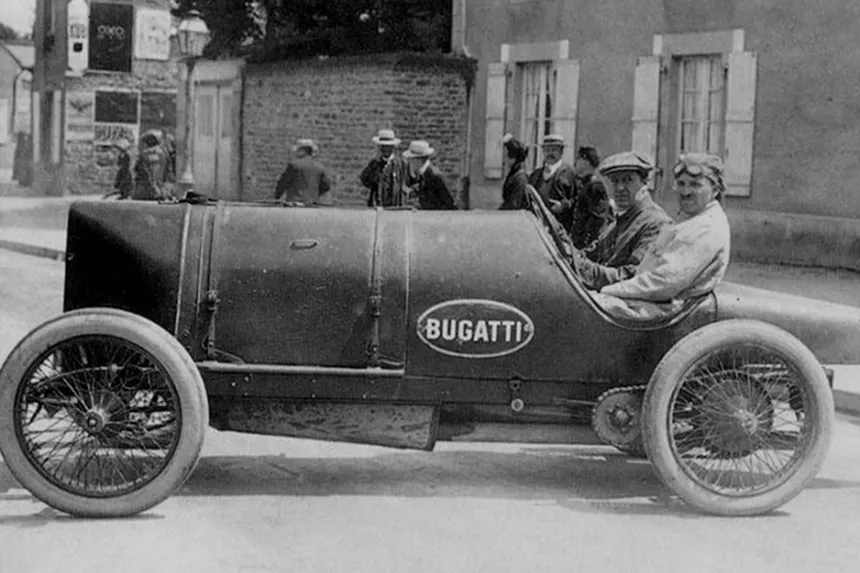
Bugatti founded his company in 1909 in Molsheim, in Alsace. Worth pausing on the geography here, because British and American readers tend to assume Bugatti was always French. It wasn’t. Alsace had been annexed by Germany in 1871 and only returned to France with the Treaty of Versailles in 1919. So for the first decade of its existence, Bugatti was a German company run by an Italian. Borders meant little to Ettore. Place meant everything.
And the place was Molsheim. The factory that has been described, in Bugatti’s own marketing and a long line of journalists, as more atelier than industrial plant. The atelier framing is real in terms of process even if some of the romantic detail around it is unverified. Engine blocks were hand-scraped flat to seal without gaskets. Safety wires through the bolts were threaded in decorative patterns. Front axles weren’t bolted to the leaf springs in the conventional way; they were forged with a hole through which the spring passed, an elegant solution that needed fewer parts. More expensive, more elaborate, more time-consuming. More beautiful.
The temptation, when British or American writers describe this stuff, is to call it engineering excellence. Some of it was. But some of it was vanity, and a long time spent leaning over a workshop bench teaches you to tell the two apart. An elegant solution is one that solves the problem with the minimum of parts and friction. A vain solution is one that solves the problem and also looks good in a catalogue photograph. Bugatti often did both at once. But when forced to choose, he chose the latter.
Take the engine of a Type 35, the racing car that Bugatti’s reputation rests on more than any other. That straight-eight is famously beautiful from any angle, and famously expensive to build. Its crankshaft has five bearings, two of them roller and three of them ball, all hand-assembled, all costing a fortune to produce. The romance says Ettore designed it that way to chase high revs. The engineering reality, well documented in period sources, is that he did it because he didn’t trust pressure-fed lubrication, which by the 1920s was already standard practice elsewhere. Rather than fit a conventional pressurised oil system, he built a jewel-like 77-kilogram crankshaft assembled piece by piece, on dry roller bearings, just to avoid using a technology he didn’t like. The thing ran. It revved to 6,000 rpm. It won everywhere. But producing it was murder. When the cheaper customer version arrived, the Type 35A, the factory simply deleted the roller-bearing crankshaft and fitted plain bearings. The cheaper car worked fine on the road. Owners nicknamed it the Tecla, after a make of imitation pearls. The Tecla was actually the honest model in the catalogue. The other one was Ettore’s mirror.
The brakes are the more familiar giveaway.
A man who refused to stop
While Mercedes, Alfa Romeo and Maserati were fitting hydraulic brakes to their Grand Prix cars in the early 1930s, Ettore Bugatti stuck with cable-operated drums. He had even attempted his own hydraulic system, which didn’t work well, and rather than swallow his pride and licence Lockheed components like every serious manufacturer, he went back to cables. The Type 59, his last great pre-war Grand Prix car, debuted in 1934 with cables and solid axles when independent suspension and hydraulics were already industry standard.
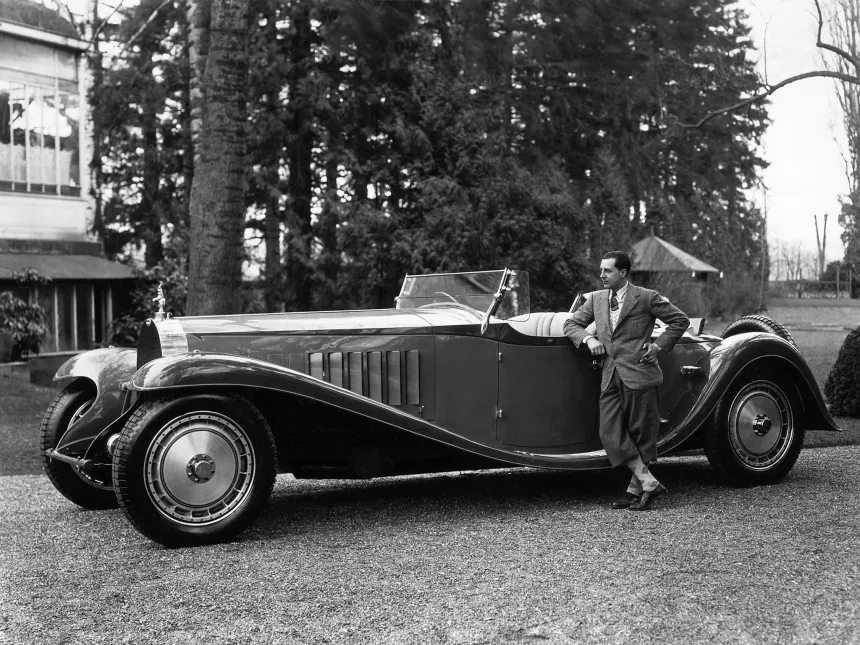
The line famously attributed to Ettore, I build my cars to go, not to stop, captures the official version of this. Mechanical purity. The direct connection between driver and brake shoe. The romance of the cable. Even Jeremy Clarkson would struggle to make this sound rational, and indeed the engineering reality is straightforward. A properly engineered hydraulic system distributes pressure equally across all four wheels. Cables stretch, lose tension, fall out of adjustment, drift away from balance. On the Type 41 Royale, Bugatti’s enormous five-metre, two-and-a-half-tonne luxury car, cable brakes were genuinely inadequate to stop the thing.
Ettore knew this. The man wasn’t ignorant of physics. But conceding to hydraulics meant admitting that an uglier system worked better than his. For someone who treated his cars as sculpture, that was unacceptable. The road-going Type 57 finally received Lockheed hydraulics as standard in 1938, almost three decades after the company was founded and a full decade behind the competition. This is not mechanical purity. It is industrial ego, dressed up as principle.
The engineers who made the sculptures actually work
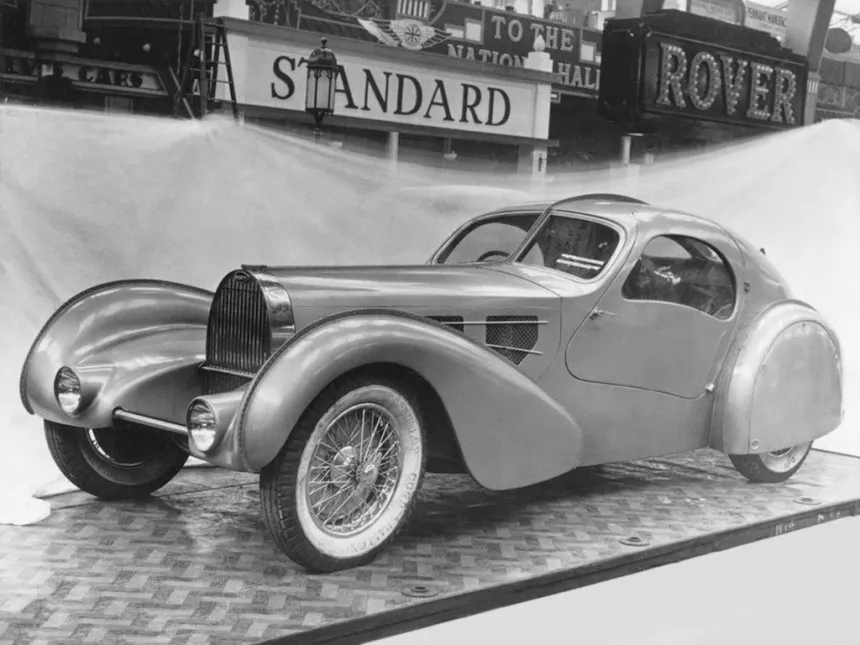
Here’s the part the polished version tends to skip. Ettore did not design alone. Behind every car bearing his signature were engineers and technicians who barely register in the popular narrative. Jean Chassagne, engineer and racing driver, was central to the Type 35’s development. And Ettore’s own son Jean Bugatti, the heir apparent, was the real stylistic force behind the Type 57 and almost certainly behind the Atlantic, the riveted-spine coupé that today commands prices in the tens of millions.
Jean died on 11 August 1939, aged 30, testing a Type 57 on a stretch of road between Strasbourg and Molsheim. The road was officially closed for testing, but a cyclist wandered onto it. Jean swerved, lost control, crashed and died. Bugatti the company never recovered. Production of anything significant essentially stopped. Ettore tried to plan a new factory at Levallois near Paris, but the war swallowed everything.
What this tells you, if you read it honestly, is that the creative engine of Bugatti’s last great period was not Ettore alone. It was Jean. When Jean died, the spark went out. Ettore without his son was a patron with a refined eye and an enormous ego, but no longer the hand that translated his ideas into cars that genuinely worked.
The quote about lorries that he probably never said
While we’re dismantling things, here’s the most famous Bugatti line of all. The one about Bentleys being the fastest lorries in the world. The line that has been repeated in every guide to Le Mans, every Bentley Boys retrospective, every Top Gear voiceover.
It’s apocryphal. David Venables, one of the leading authorities on Bugatti racing history and author of Bugatti, A Racing History, traced the quote to French press coverage of the 1929 Le Mans 24 Hours. When the comment appeared in print, Ettore wrote personally to Walter Owen Bentley to dissociate himself from it. He apologised for any offence caused. He insisted he had not said it. Venables concludes the line was almost certainly invented by a French journalist looking for a headline.
This doesn’t make Ettore humble. He wasn’t. He was arrogant in a hundred documented ways, and the rivalry between Molsheim and Cricklewood was real and bitter. But the single line that everyone uses to characterise that arrogance, the one quote that does the work of a thousand others, was apparently never his. That tells you something about how legends in this industry are built. They’re built on lines the protagonist didn’t say, attributed by writers in a hurry, repeated by readers with no time to check.
We checked. That’s the difference.
A patron sold for half what he was worth
The window between Jean’s death in August 1939 and the German occupation in 1940 contains one small but revealing piece of history. In June 1939, four months before Jean’s accident, a Bugatti Type 57C Tank won the Le Mans 24 Hours with Jean-Pierre Wimille and Pierre Veyron at the wheel. That name on the second driver will look familiar. The car Volkswagen would later name as the most expensive production car in history was named after the man who drove Bugatti’s last great victory as an independent marque. Le Mans 1939 was proof that Molsheim could still compete with Alfa Romeo, Mercedes, anything thrown at it. Four months later Jean was dead. Three weeks after that, Hitler invaded Poland. The year of glory lasted about three minutes in historical terms.
Ettore tried to keep going. During the war he drew up plans for a new factory at Levallois, northwest of Paris, and designed cars that would never be built. His other son Roland, much younger, grew up around the company without ever showing Jean’s creative spark. Molsheim limped along on minimal production until the worst arrived.
When Germany occupied France in 1940, Molsheim was seized in 1941. Ettore, who had remained an Italian citizen until 1947 and only became French in the year of his death, was forced to sell his company to the occupier for 150 million francs. Half its actual value, but the alternative was judicial auction. After the war, the French state put him on trial for collaboration with the enemy precisely because he had sold the factory. He was convicted. His personal assets were confiscated.
Ettore Bugatti died on 21 August 1947 at the American Hospital in Neuilly-sur-Seine, aged 65. He had taken French citizenship only months earlier. He died convicted, dispossessed, separated from the company he had built from a former dye works in 1909.
The acquittal arrived on appeal, months after the funeral. Justice that arrives too late is the worst kind, the kind that only serves the corpse. He is buried at Dorlisheim, near the factory. Molsheim never returned to building proper Bugattis. The marque went dormant for forty years before an Italian named Romano Artioli revived it in Campogalliano in the late 1980s with the EB110, but that is a different story for a different day.
What’s left when the polish comes off
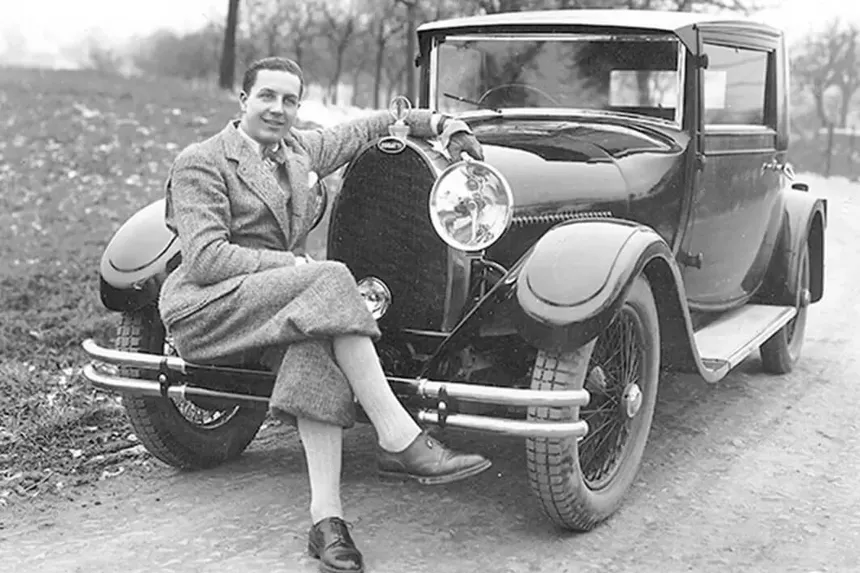
Strip the legend back and what you see is this. A Milanese boy from a family of artists who wanted to be one and couldn’t quite manage it. A patron with a remarkable eye and a tuned ear for mechanical sound, but also an ego that cost his company decades of technical regression and a near-collapse before the Second World War even started. A man who surrounded himself with very capable engineers, including his own son, and who signed his name to cars they had helped him bring into the world.
And in spite of all of that, he produced the Type 35. He produced the Atlantic. He produced the Royale. Cars that a century later remain the gold standard of what a car can aspire to be when someone decides to treat the object as an artwork rather than a product.
Was he a genius? He was a patron with an eye, a family behind him, very good engineers next to him, and an ego the size of the factory he built. Calling him a lone genius is selling today’s Bugattis. Calling him what he actually was, a frustrated artist who became an industrialist with unusual aesthetic standards, is telling the real story.
And that, in the end, is what happens to almost every motoring myth when you look at it up close. They don’t get smaller. They get more human. More real. More interesting.
Check you’re still alive.
1 thought on “ETTORE BUGATTI”