Built to Spite Rolls-Royce, It Ended Up Hauling Trains
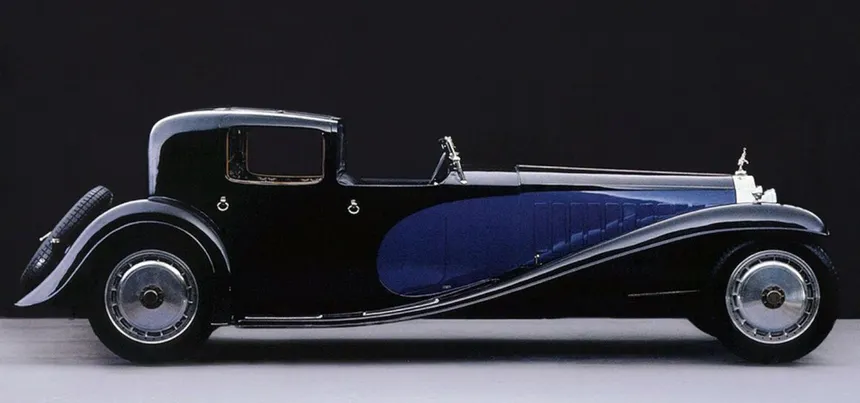
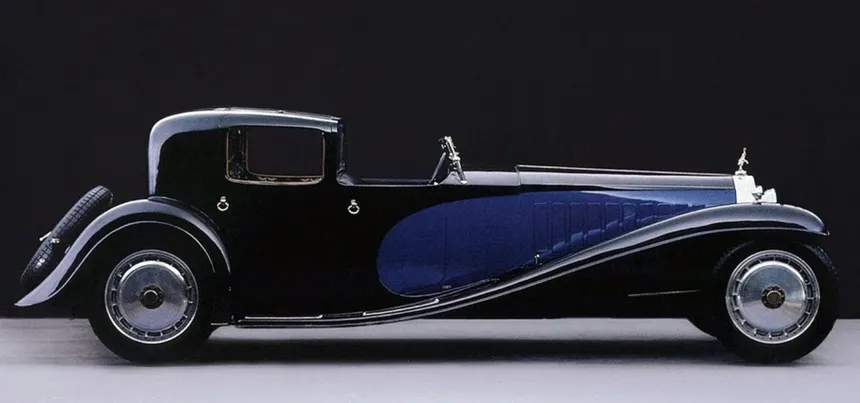
Some cars are born from a vision. Years of sketches, a lifetime’s ambition distilled into metal. The Bugatti Royale was born from something far more petty and far more human: wounded pride. At a dinner, an English lady is said to have compared Ettore Bugatti’s cars unfavourably with Rolls-Royce. Not kindly, either.
Bugatti took it personally. And rather than swallow it and smile, he resolved to build the largest, most luxurious, most expensive motor car the world had ever seen — something so far above a Rolls-Royce that the comparison would look absurd. A car for kings. Literally for kings.
What followed is one of the most beautiful and crooked stories in all of motoring. Because the car built for royalty was bought by no royalty at all. It was a colossal commercial failure. And out of that failure, Ettore conjured a second life nobody saw coming: he turned the most catastrophic flop in his history into one of the world’s first modern high-speed trains. It’s worth telling in full.
The Sheer Scale of It
You have to grasp the size first, because nothing else makes sense without it.
The Royale — the Type 41 to those in the know — measured 6.4 metres long. The wheelbase alone, axle to axle, was 4.3 metres. To put that in perspective: you could park a small hatchback within a Royale’s wheelbase and still have room to spare. It weighed around 3,175kg. Over three tonnes. The wheels, the famous Roue Royale, were 24-inch cast aluminium items with the brake drums integrated into the rim itself — works of art in their own right.
Set against a modern Rolls-Royce Phantom, the sort built since 2003, the Royale is more than 10% longer and more than 25% heavier. And this was a car from the late 1920s. There was nothing else like it. There has scarcely been anything like it since.
Beneath that endless bonnet — it took two people to lift the thing — sat an engine that beggars belief just in the describing.
An Engine That Was Almost a Myth
A straight-eight. Nearly 12.8 litres. Each of those eight cylinders, on its own, displaced more than the entire engine of a contemporary Type 40 touring Bugatti. Read that twice: a single cylinder of the Royale had more capacity than a whole ordinary car from the same marque.
Factory paperwork claimed up to 300bhp at around 1,800rpm. Time to be straight with you, because that’s the job: modern experts reckon the real output sat closer to 275. The 300 figure was the brochure number, the one for boasting. Either way, 275 or 300, it was enough to shove three tonnes up to 200km/h — an outrageous figure for 1929.
The engine was genuinely enormous in the physical sense too: roughly a metre and a half long, over a metre tall. One of the largest car engines ever actually built. A nine-bearing crankshaft kept it from shaking itself apart, dry-sump lubrication fed it, and a single carburettor supplied the whole beast. The block was a monobloc, no detachable cylinder head, the Bugatti way — if you wanted to touch anything inside, the entire engine came apart, crankshaft and all. A maintenance nightmare, but a piece of clockwork.
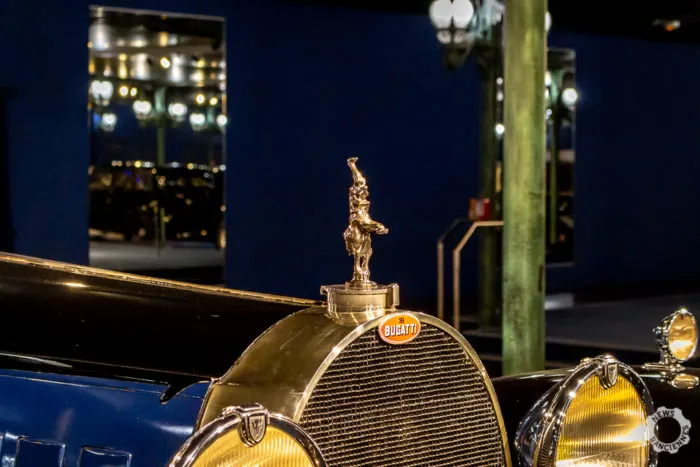
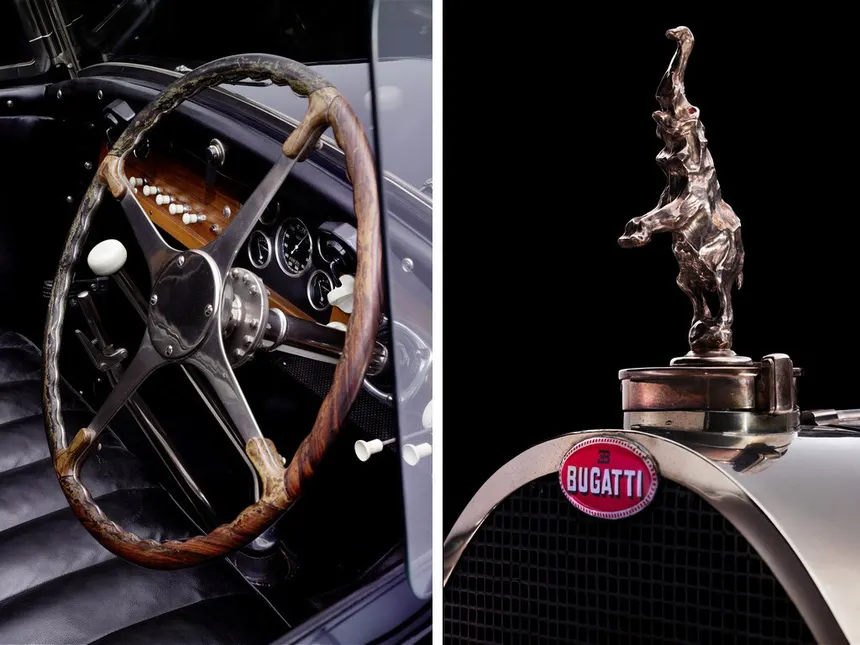
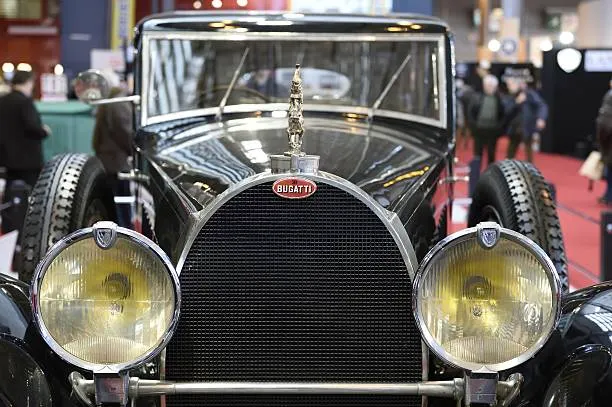
And a lovely detail: the Royale is the only Bugatti ever to wear a bonnet mascot. A dancing elephant, sculpted by Rembrandt Bugatti, Ettore’s brother, a serious artist who had taken his own life some years earlier. The car carried a piece of family grief on its nose.
One Car, Many Suits
Before we get to how the business sank, you need to understand a peculiarity of the Royale, because it wasn’t a car in the ordinary sense.
Bugatti sold the chassis and engine. The body was the customer’s affair, commissioned from whichever coachbuilder they fancied, exactly as the very highest-end cars of the era were sold. That’s why no two Royales are alike: each wears a different suit, from three-seat coupés to phaetons and vast limousines. Several were also rebodied more than once across their lives, changing skin to suit a new owner or to recover from the latest accident.
The most extreme case is the first prototype, chassis 41100, completed in 1927. It started life wearing a Packard body, then two more after that, and very nearly vanished altogether when it was wrecked in a crash. From that wreck it was reborn as the Coupé Napoléon, the car that would become Ettore’s own, rebodied by his son Jean. Some accounts reckon 41100 may have been on its fifth body by then. One chassis, a whole life spent changing shape. That’s the nature of the Royale: less a model than a foundation on which unique pieces were built.
Built for Kings, Bought by None
Here’s where it turns crooked.
Ettore’s plan was clear: build 25 Royales and sell them to the royal houses of Europe. The most luxurious car for the most powerful people. The chassis price alone — bodywork extra, supplied by each customer’s own coachbuilder — was $30,000 of period money. A staggering fortune. But then, we’re talking about kings.
The trouble was that the Royale arrived just as the world fell apart. He unveiled it in 1929, the year of the Wall Street Crash, at the dawn of a Great Depression that swallowed the entire decade. And it turns out even kings weren’t in the market for ostentation while half the planet went hungry.
The anecdotes from this period are gold. Ettore had announced in 1928 that “this year King Alfonso of Spain will receive his Royale.” King Alfonso XIII was deposed and Spain became a republic before the car ever reached him. Another: King Zog of Albania wanted to buy one, and Bugatti refused to sell it to him. The reason? He found the king’s table manners beyond belief. Bugatti would rather not sell his car at all than sell it to a man who ate badly. That was the level of the man’s pride.
The result: of the six Royales built — plus a prototype destroyed in a 1931 accident — only three went to outside customers, according to the most rigorous technical sources. Bugatti himself spoke of four sold, counting later transactions; the exact number still wobbles depending on who’s counting. What doesn’t wobble is the gist: the rest stayed in the family. One became Ettore’s personal car until the day he died, the famous Coupé Napoléon, bodied by his son Jean at just 21. The car for kings ended up as the carmaker’s own, because there were no kings who wanted it.
An absolute commercial failure. The most expensive and elegant one in history, probably. But the story doesn’t end there, and this is where Ettore proves his greatness.
The Engines Left Over
Banking on selling far more cars than he did, Bugatti had built around a hundred Royale engines. A hundred monstrous 12.8-litre lumps gathering dust in a warehouse, with no car to live in. For any manufacturer, that’s ruin in its purest form: dead capital, eye-wateringly expensive iron turned into luxury scrap.
Ettore did something only a mind like his would conceive. If there were no cars to carry the engines, there would be something else. And that something else was trains.
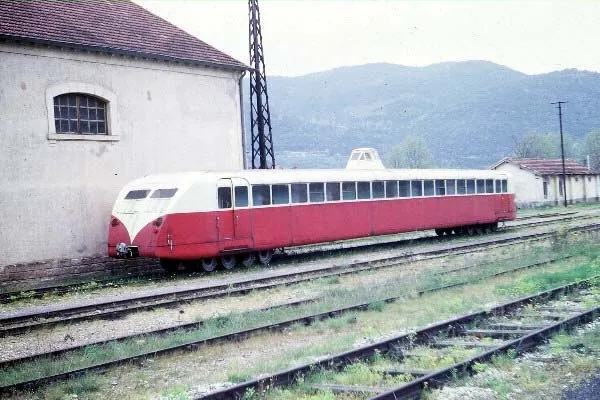
Bugatti offered the engines to the French state railway, the ETAT — forerunner of today’s SNCF — for a new kind of fast railcar. The autorail was born, the XB 1000. Depending on the version, each one carried between two and four Royale engines, each producing around 200bhp, hauling the train with barely any vibration thanks to the silken nature of that straight-eight. In early trials, one of these trains hit 172km/h. Some sources go further: an average of 196km/h sustained over 70 kilometres. They were, to all intents and purposes, among the first modern high-speed trains in the world.
The SNCF ordered dozens of these railcars — figures range from 79 to 88 depending on the source — and they ran in service from 1935 right through to 1958. Bugatti also handled engine maintenance, so this wasn’t a sell-and-wave-goodbye deal; it was sustained income over years. A warehouse of dead engines became a profitable business. The marque’s greatest failure became, through the back door, one of its greatest successes.
What Genuinely Fascinates Me About This
Stop and trace the whole arc, because it’s one of the finest things motoring has ever produced.
A car born from a tantrum, from the bruised ego of a man told his cars didn’t measure up to a Rolls. A car conceived for kings, built regardless of cost, the biggest and most expensive in the world. A car that arrived exactly as the world went broke, bought by no royalty at all — to the point where the maker kept several and refused one to a monarch over his manners. A textbook failure. And from that failure, from those dead engines in a warehouse, came a train. A fast train. One of the world’s first, running across France for over twenty years.
I build trains for a living. Which is why this story lands on me a particular way. Because the most absurd, most failed luxury of its age — the ego project of a furious genius — ended up transformed into real transport, into something that moved people city to city at speeds that then seemed like science fiction. The dancing elephant on the bonnet ended up hauling, in a manner of speaking, a railway.
All six original Royales survive today. Two in the Schlumpf Collection at Mulhouse, one at Bugatti’s home in Molsheim, the rest in private hands. Each wears different coachwork, several rebodied more than once across their lives. Were any to come to auction now, it would almost certainly be the most expensive car in the world. The one no king wanted.
As for the autorails, the trains that saved the project, current knowledge suggests just one survives, in the railway museum at Mulhouse. The same city holds both halves of the tale: the car that failed and the train that redeemed it, a few metres apart. Almost no one who visits the Royales realises that, a little further on, sits the proof of how that failure found a way not to be one.
That’s the Royale: proof that sometimes the biggest disaster and the biggest triumph are the same engine, mounted in two different places. All it took was someone stubborn enough not to throw the engines away — and arrogant enough to have built a hundred of them in the first place, certain the kings would come. They didn’t. The trains did instead.
Then check you’re still alive.