Same Brain, Two Worlds: The Man Behind Your Wheel and a Miura’s
Chris Harris once said the best engineering solutions look obvious in hindsight. He’s right. And there is no better proof than the small lever that holds your bicycle wheel in place. You’ve used it a thousand times without a second thought. Flick it, the wheel locks. Flick it back, the wheel drops out. It looks like it was always there, like gravity or the wind.
It wasn’t. A frozen-fingered amateur racer invented it on a snowy mountain pass because he couldn’t undo a wing nut. And here’s the part that should stop you cold: the same man who solved that problem went on to build the wheels under a Lamborghini Miura. One brain. Two worlds. Almost nobody tells this story properly. Let’s fix that.
A Cold Day, A Lost Race
Picture it. The Italian Dolomites, freezing, snow on the road. A young amateur named Tullio Campagnolo is well placed in a race and needs to change gear. In the 1920s that was not a flick of a finger. The rear wheel carried one cog on each side, one for climbing, one for the flat. To change, you stopped, dismounted, loosened the wing nuts holding the wheel, pulled the wheel out completely, flipped it around so the chain caught the other cog, and bolted it back on. Mid-race. In a hurry. In the cold.
Sources disagree on the exact date, and I’m going to put that disagreement on the table rather than hide it, because that’s how you separate a clean record from a polished legend. The most-repeated version places it on 11 November 1927 at the Croce d’Aune pass. Other tellings, including one from his own son Valentino, point to November 1924. What doesn’t wobble is the substance: snow, frozen wing nuts, numb hands, and a wheel that won’t come off. Campagnolo lost his chance that day. And as he fought the frozen nuts, he muttered a line in his regional dialect that cycling never forgot: something has to change in the back.
He wasn’t philosophising. He was furious. That fury became an industry.
The First Fix
Campagnolo wasn’t some lucky tinkerer. He grew up in his father’s hardware shop in Vicenza, the kind of kid who takes things apart and builds them back differently. So he went home with that mountain-pass curse in his head and, in 1930, patented the quick release. A cam lever that clamps and releases the wheel with no tools, no wing nuts, no frozen fingers. Turn it one way, locked. Turn it the other, out. Brutally simple.
Now the headline. Nearly a century later, that mechanism is essentially unchanged. As an enduring piece of cycling design, only the double-diamond frame and the spoked wheel itself outrank it for longevity. Think about what that means. Shifting has been reinvented, brakes have gone hydraulic, frames have gone from steel to carbon to aero everything. But the way you hold a wheel on? A man with frozen hands nailed it in 1930 and we have never genuinely improved it.
I’ve mounted and stripped thousands of wheels on that system. Fifteen years running a bike shop will do that to you. And here’s what I learned: when a part is designed so well it never needs to evolve, the person who made it understood the problem better than anyone else in the room. That’s Campagnolo in one sentence.
And the riders made it a legend as much as the engineering did. Fausto Coppi and Gino Bartali, the two faces of post-war Italy, rode Campagnolo. Eddy Merckx, the most dominant cyclist who ever lived, was a close personal friend of Tullio and became a walking advert for the brand. Bernard Hinault, Greg LeMond, Miguel Indurain. The greats, for decades. When the best in the world choose your kit and keep choosing it across generations, that isn’t marketing. That’s the product talking. But the quick release was only the opening act. What turned Campagnolo into an empire came next, and it wasn’t a wheel at all.
The Empire Built One Part at a Time
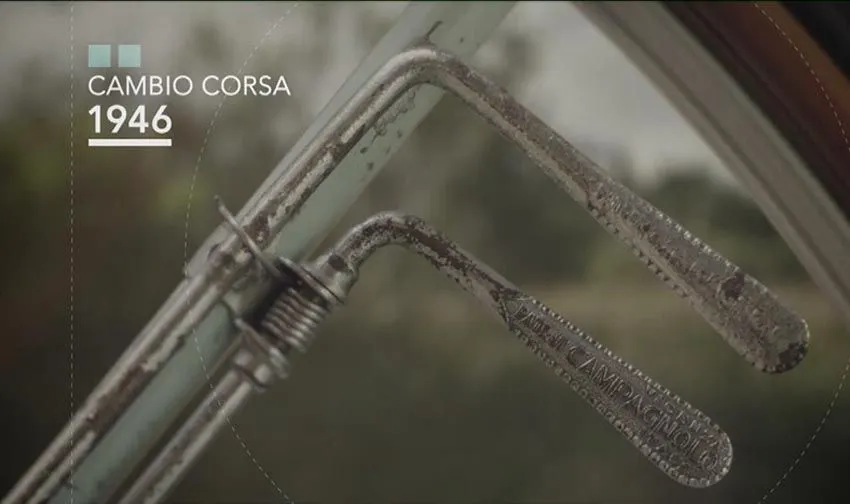
To understand why Campagnolo could leap into cars, you have to understand what built the empire in the first place, because it wasn’t wheels. It was the derailleur. Campagnolo patented its first shifting mechanism in 1933 and, after the war, began series production of the Cambio Corsa, that two-lever contraption on the seat-stay that moved the chain without removing the wheel. It was a nightmare to operate, you released the wheel, backpedalled and prayed, yet it won Tours de France. Then in 1949 came the real leap, the Gran Sport parallelogram derailleur, the grandfather of whatever hangs off your bike today. While Huret and Simplex squabbled over scraps, Campagnolo swallowed the peloton whole. The gear-changing business is what made the money and the name.
Beyond that, it built complete systems where everything mated to everything else, and where nothing from outside got in without a passport. That was its strength and, years later, its trap. Through the 1970s and 80s, Campagnolo was the undisputed king. But while it dozed on the throne, Shimano in Japan started inventing. Indexed shifting, the kind that clicks into each gear instead of forcing you to tune by ear. Combined brake-and-shift levers in one unit, the famous STI. Campagnolo arrived late to almost all of it and paid for it. There were wilderness years, including a forgettable foray into mountain biking that’s best left forgotten: heavy, overbuilt groupsets that convinced nobody. Campagnolo pulled out of the MTB market entirely in 1994 and refocused on what it knew, high-end road.
And there it came back to life. It answered Shimano with its ErgoPower levers, pushed carbon and titanium where steel used to sit, and became what it had always been: the brand you pay more for because it has a soul. A Campagnolo part stirs something even though it’s a lump of metal that ought to be cold. That’s the strange Vicenza magic, and Shimano, for all its brilliant engineering, has never quite bottled it.
The Second Fix: Into the Cars
Here’s where the story gets misunderstood. People assume this flowed from cars to bikes, that alloy wheels existed on sports cars first and someone shrunk them for cycling. It’s the exact opposite.
The magnesium expertise, the obsession with grams, the knack for making light metal stiff without making it heavy, all of it was born on two wheels. Then it jumped to four, and the timing matters. This wasn’t a struggling outfit looking for a lifeline. By the time Campagnolo wheels showed up under Italian supercars in the 1960s and 70s, the company had already spent two decades owning professional cycling. The leap to cars wasn’t a rescue. It was a flex. A consolidated giant with a command of light metal nobody else could match, deciding to point that skill at the motor world. In an Italy busy building the most beautiful sports cars in history, that skill was gold.
Campagnolo made magnesium wheels for Alfa Romeo, Ferrari, Maserati and Lamborghini. Not as filler, either. Ferrari’s Formula 1 team brought them on as a supplier in the 1970s. In 1969 they even supplied lightweight structures for NASA satellites. The same head that worked out how to remove a bike wheel without tools worked out how to build a car wheel that weighed half what the rivals weighed.
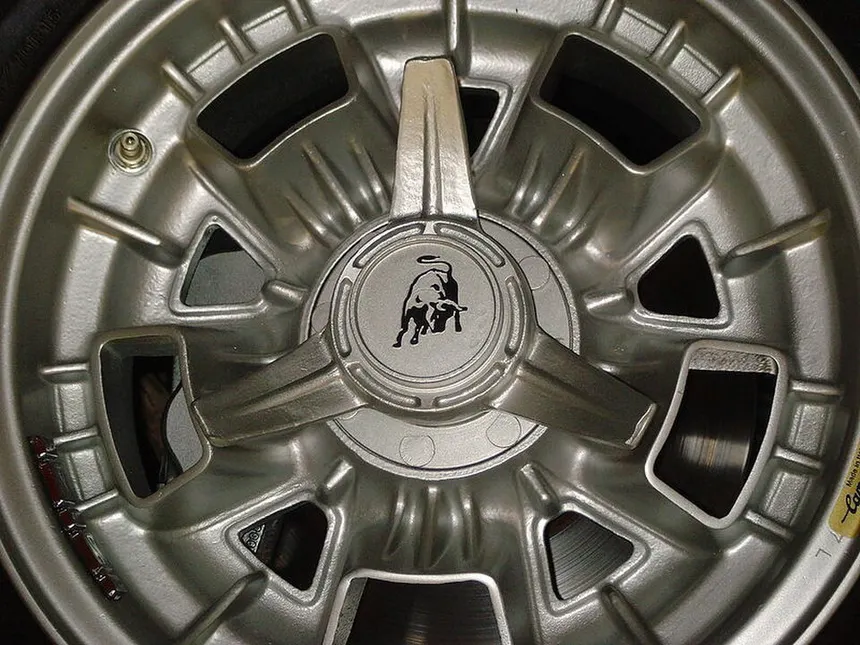
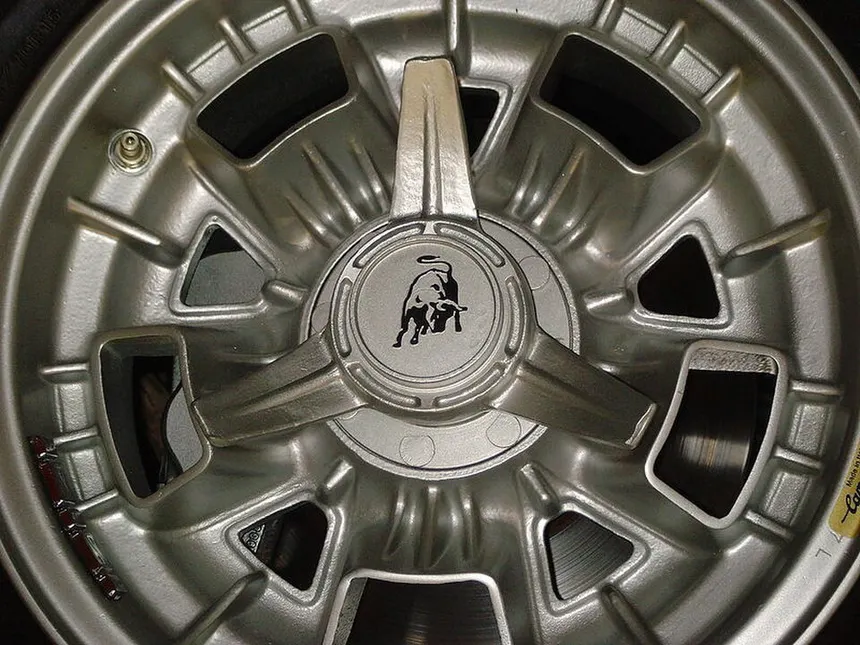
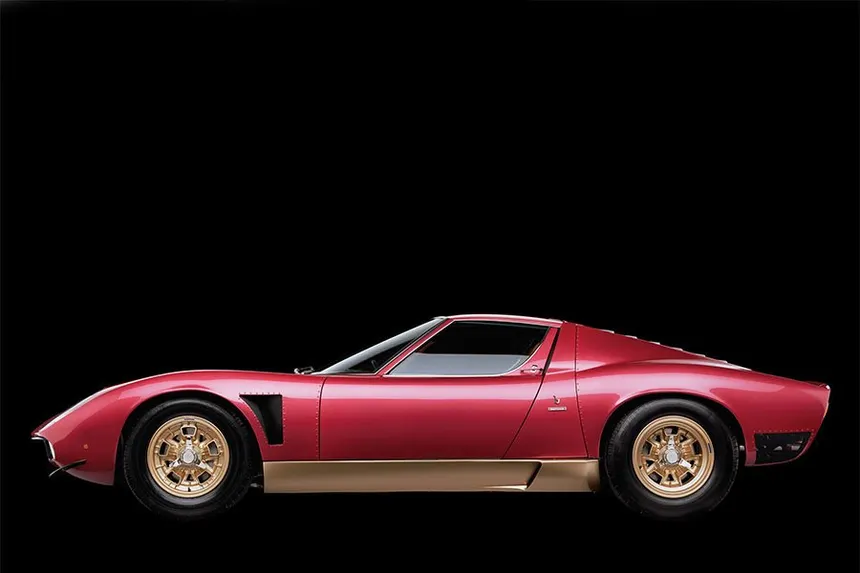
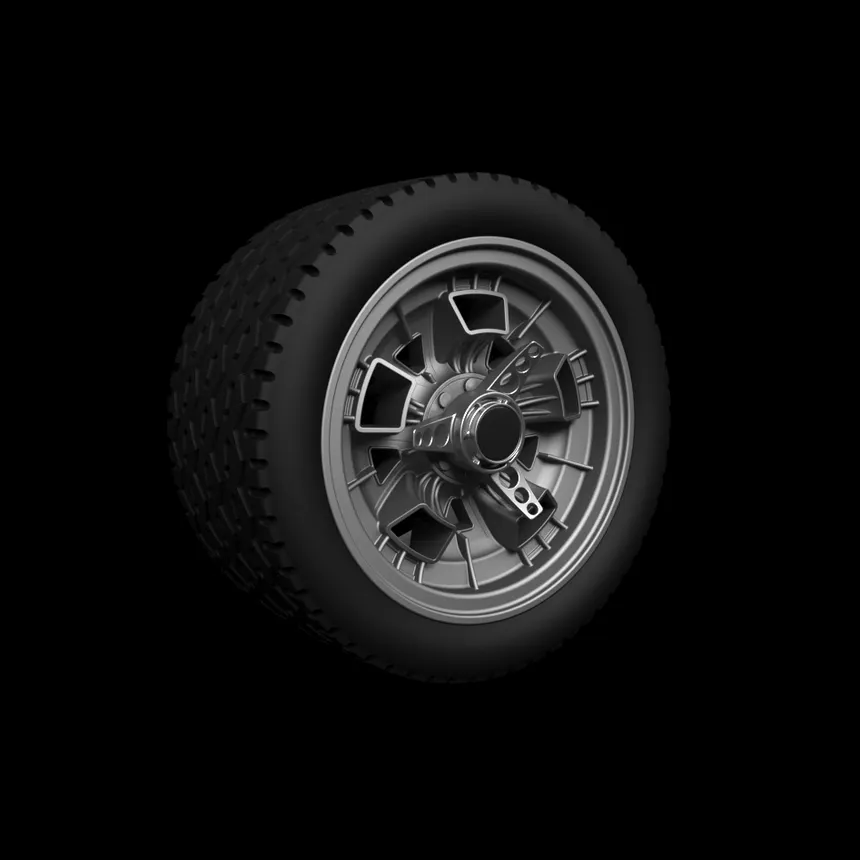
The example that raises the hair on your arms is the Lamborghini Miura. The 1966 Geneva show prototype rolled on Borrani wire wheels, but the production car wore Campagnolo magnesium wheels designed specifically for it. That low, mid-engined missile, 1,055 mm tall with a transverse V12 behind the driver’s head, sat on the road via four pieces of magnesium that came from the same mind as Coppi’s cranks. Those five-spoke Miura wheels, with the trumpet-like holes flaring out from the centre, are now so rare that specialists remake the molds to cast replicas.
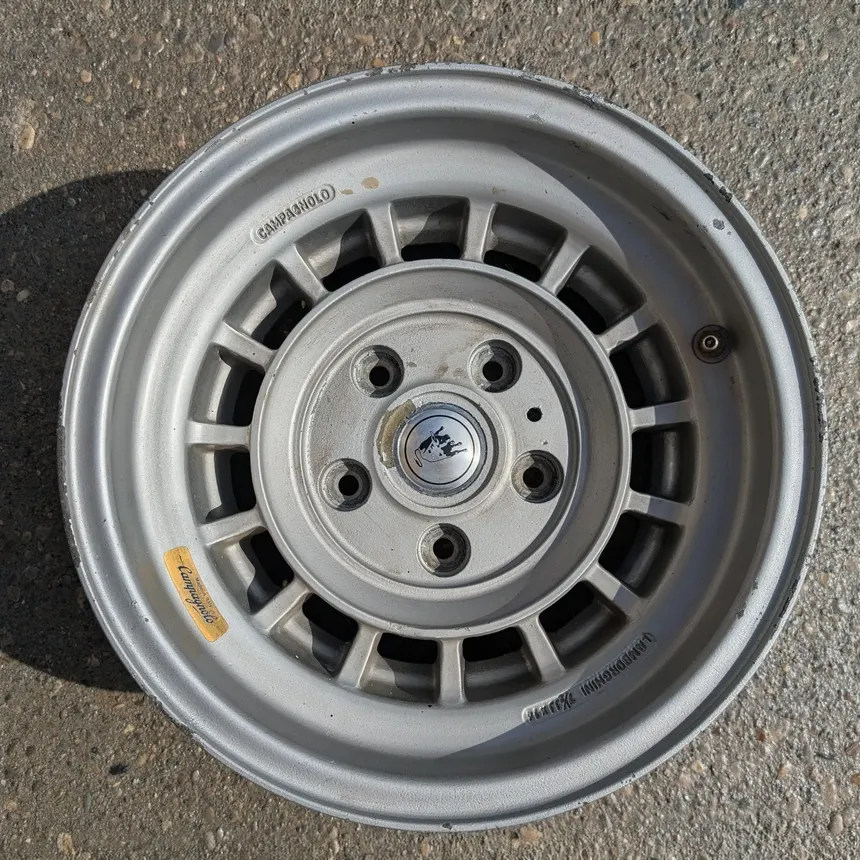
It wasn’t only the Miura. The Espada, Lamborghini’s four-seat grand tourer, also wore Campagnolo magnesium on a knock-off central hub, the same design as the Miura’s. And here’s a detail people get wrong: those car wheels never came out of Sant’Agata or Maranello. They were cast at Campagnolo’s automotive components factory in Vicenza, on Viale del Lavoro. Same city as Tullio, same name, different product. The Vicenza signature rolled under half of Sant’Agata without the factory ever leaving home.
A point of precision, because precision is the job. Those magnesium wheels were superb for their era, featherweight, but they had a real enemy: corrosion. Magnesium doesn’t shrug off the weather and doesn’t last like aluminium. That’s why a well-kept Miura magnesium wheel is worth a fortune today and a kerb strike is a very expensive tragedy. They were the best of their moment, not eternal. Telling the story straight means telling that part too.
The Third Wheel: Carbon and a Trip Home
Tullio died in 1983. His son Valentino took the wheel, and the company kept changing the wheel instead of staring at the rear-view mirror.
In 1994 came the Bora, Campagnolo’s first carbon-rimmed wheel. I’ve had Boras in my hands, ridden them, sold them. Pick one up for the first time and feel what isn’t there, and you understand it’s the same old obsession in a new material. The same Tullio who wrestled magnesium now wrestling carbon fibre, except he wasn’t around to see it.
Along the way, 1999 brought the Record Carbon Ergo levers and, that same year, far lighter hubs with aluminium-alloy axles. Ten-speed arrived with the turn of the century. A Record Carbon ten-speed groupset is a fingerprint of that exact moment, Campagnolo pushing carbon and titanium where steel used to live, fighting for every gram. I’ve got an aluminium Cinelli in the garage running a Record Carbon ten-speed from precisely that period. Not a museum piece. A bike that rides. And every time I roll it out, I think about the fact that the quick release I flick to drop the wheel is the same invention from those frozen hands, almost a hundred years on.
And here’s the shop-counter wink, because I lived this one selling it. In 2004 Campagnolo created Fulcrum. The official version, the one the brand tells, is about three aerospace engineers who love bikes founding an independent company in Arcugnano, next to Vicenza. Lovely. But anyone behind a counter in those years knew the real story: Fulcrum was Campagnolo’s sister brand, built to sell wheels to the dark side. To the Shimano crowd. The Campagnolo freehub wouldn’t take a Shimano or SRAM cassette, and there was a huge market out there they couldn’t sell to without “polluting” the name. Elegant solution: a second brand, shared patents, same factory, neutral looks. I sold stacks of Fulcrums to riders running Shimano who wanted Italian rolling without the mixed-allegiance guilt. It worked.
What He Actually Invented
If you take one idea away, take this. Campagnolo didn’t invent a part. He invented a way of looking at the problem.
The bicycle wheel and the Miura wheel share a father because the problem was identical: how do you make something spin better, weigh less and last longer? It doesn’t matter whether there’s a rider with burning legs underneath or a transverse V12. Light metal, stiffness, every gram fought for one at a time. That brain didn’t distinguish between bike and car. It saw wheels, and it saw how to make them better.
That’s why this story belongs to both tribes at once. The petrolhead who goes weak at the knees for a Miura and the mechanic who built Campagnolo groupsets by hand are looking, without knowing it, at the same man. At the same frozen fingers on a Dolomites pass that once decided something had to change in the back.
It changed. Twice. And we’re still spinning on what he thought up.
Check you’re still alive.