Eccentrica V12: The Analogue Rebellion That Just Spent a Million Quid on a Diablo
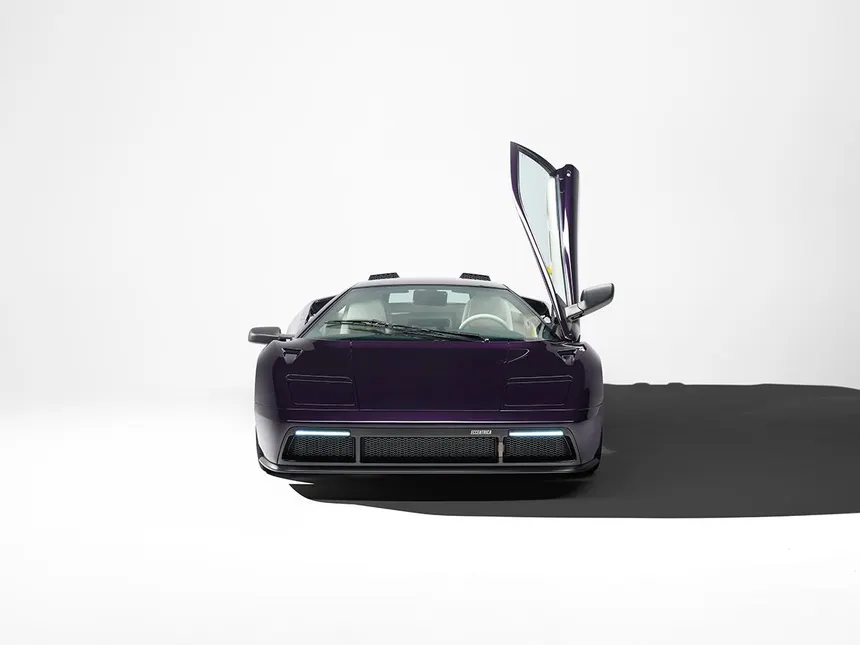
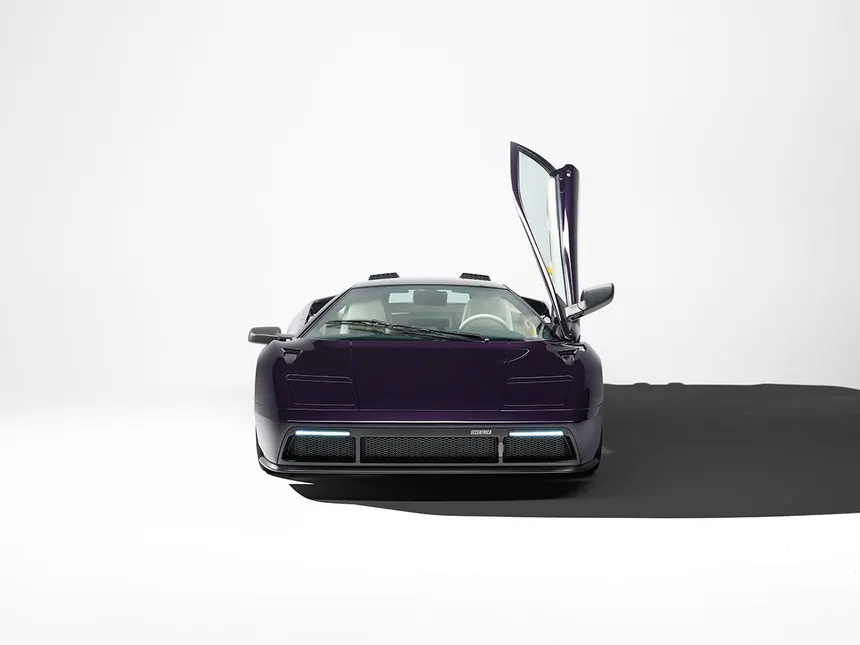
In an age where the average new supercar fields three electric motors, fifteen hundred horsepower from a battery pack and a Nürburgring mode that scores your laps to Hans Zimmer, a quietly stubborn man from San Marino has set about doing the exact opposite. He’s taken a 1990s Lamborghini Diablo, stripped away every modern crutch he could, kept the open-gated manual, refused it stability control, and asked his engineering team to leave it — his own words — “monstrously analogue.”
It’s called the Eccentrica V12. It costs over a million euros without the donor car, and only 19 will be built. And it might just be the most defiant new car of this century.
An entrepreneur, a Diablo in a showroom, and the obsession that came back
Behind the project sits a name worth knowing: Emanuel Colombini. Furniture and kitchen tycoon, president of the Colombini group, classic car collector and amateur racer in the Lamborghini Super Trofeo series. Which is to say: a man with money, taste and hands that know what they’re doing at the wheel. The idea hit him, as the best ones often do, by accident. He spotted a Diablo in a dealership, and the childhood obsession came roaring back.
Colombini didn’t want to restore a Diablo. He wanted to reinterpret it. Strip out everything that had aged badly and keep everything that made it a Diablo. Preserve the soul, modernise the body. The philosophy, for once, is crystal clear from the start. The company is called Eccentrica, operates out of San Marino, and is built on three pillars its founder names openly: eccentricity, nostalgia, hedonism. He says it, not me. On first reading it sounds like marketing fluff. Once you understand what he’s built, you realise it’s the most precise description possible.
Borromeo de Silva holds the pencil. Reggiani provides the brain.
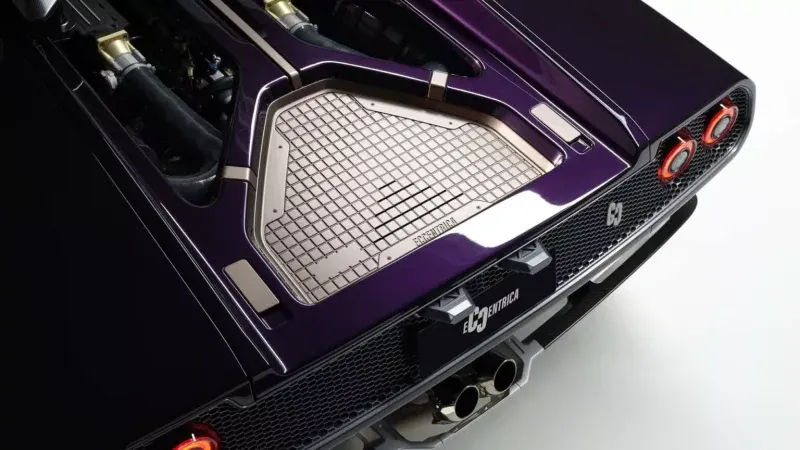
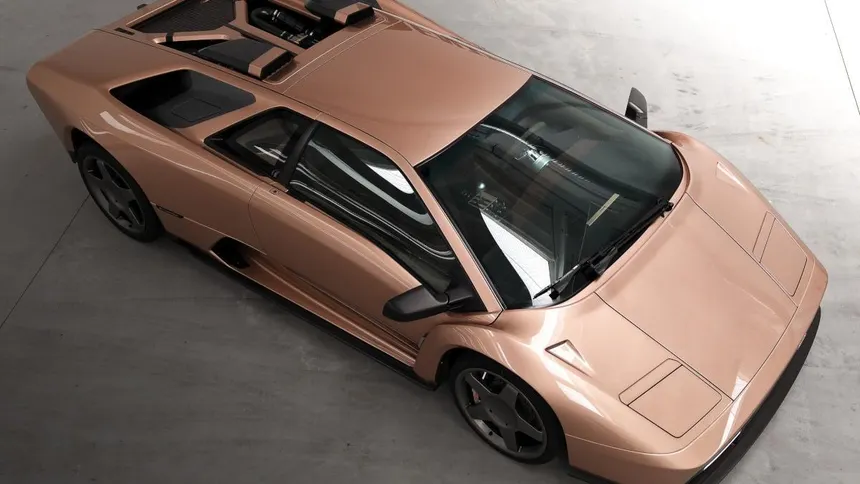
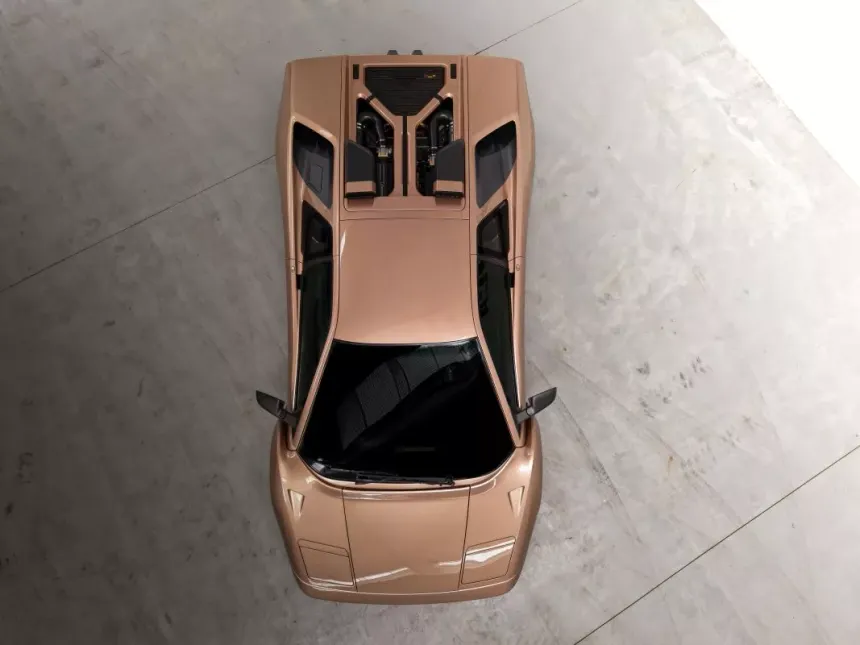
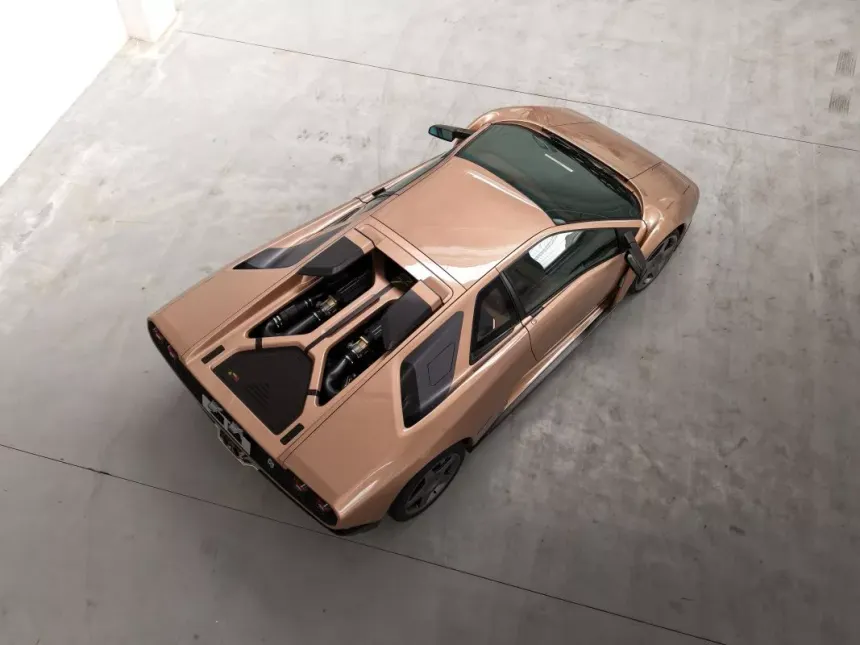
For the design, Colombini went to Milan, to the studio Borromeo de Silva. The aesthetic reference is the Diablo GTR, the rawest racing variant of the family. The challenge was modernising the lines without betraying Marcello Gandini, who penned the original. They’ve pulled off a very difficult trick here: the Eccentrica still reads, at first glance, as a Diablo. The pop-up headlights are still there, the silhouette is still that unmistakeable 1990s wedge, the proportions intact. But everything is retightened, widened, sharpened. The wheel arches grow, the rear pinches in, the aero integrates as if Gandini had drawn it that way from the start. Very few people get that balance right. They have.
And then comes the detail that changes the entire conversation. For the technical engineering, Colombini hired Maurizio Reggiani. If the name doesn’t land: Reggiani was Lamborghini’s Chief Technical Officer for nearly thirty years. The man who signed off the Murciélago, the Aventador, the Huracán, the Urus. The technical brain behind modern Sant’Agata. He’d only just retired when Colombini snapped him up to lead the Eccentrica. Sit with the implication: the very engineer who designed Lamborghini’s hybrid, digital twenty-first-century cars, the moment he hands back his factory badge, goes off to do a restomod of the 1990s Diablo. That alone is a statement.
It’s worth lingering on that. When a Chief Technical Officer retires from one of the most famous performance manufacturers on earth, the usual next move is a board seat, a consultancy, a comfortable couple of years on the speaking circuit. Reggiani signed up for none of that. Asked by Motor1 about the philosophy, he said the goal was to “solve things with technology, without introducing a huge quantity of electronics.” That’s the sentence of an engineer who spent decades adding electronics to Lamborghinis and decided, at the end of it all, that the cleanest project he’d ever do would be the one taking them out.
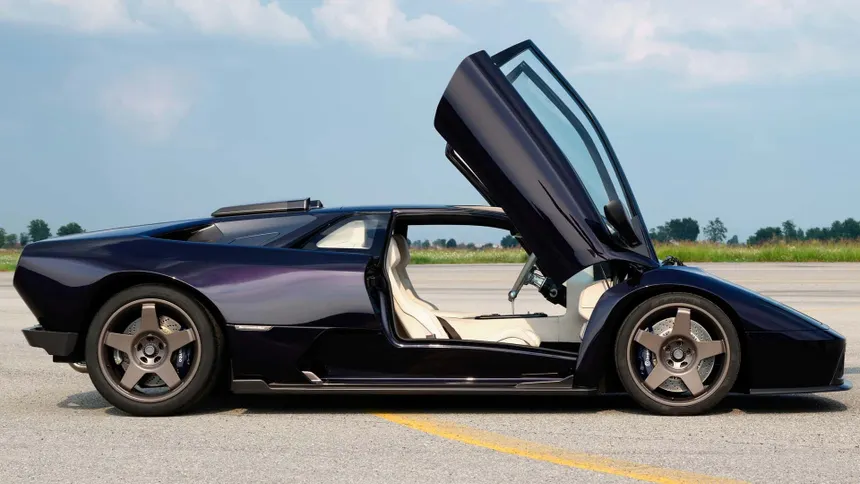
The engine: naturally aspirated V12, 5.7 litres, and the choice that hurts
Here’s the call that’ll have the purists shouting and the romantics applauding. The Eccentrica uses the 5.7-litre naturally aspirated V12 from the Diablo, not the larger 6.0 that arrived at the end of production. Into that 5.7 go new camshafts, new valves, electronic throttle bodies, a re-engineered flywheel, single-coil ignition and a centre-exit exhaust. The result: 550 bhp at 7,000 rpm and 443 lb-ft at 6,500 rpm. 208 mph flat out and 0–62 mph in 3.8 seconds, per Top Gear’s recent test.
Some have asked the obvious question: hang on, the factory Diablo VT 6.0 already made 550 bhp. Why begin with the older 5.7 if the 6.0 gives you the same number out of the box? Eccentrica’s answer is the best thing about the car, and it sums up its whole philosophy: because the 5.7 is the proper Diablo engine, the early one, the one with the rawer, more abrasive, more 1990s delivery. The 6.0 was a Diablo nearing death — civilised, almost Audi-ish. Eccentrica didn’t want the most polished Diablo. They wanted the most Diablo.
One word, and everything changes.
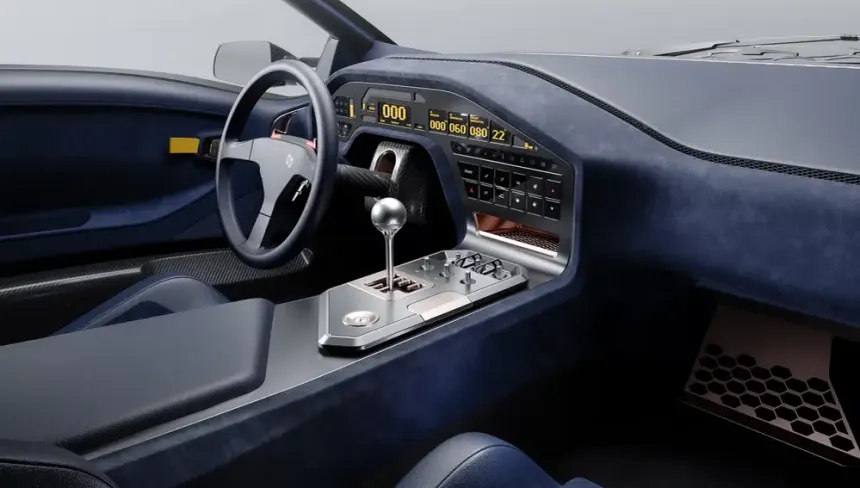
The gearbox: six speeds, manual, open gate
If the engine choice surprises, the transmission moves you. The Eccentrica runs a six-speed manual gearbox, built bespoke for this car alone. It isn’t a recycled Lamborghini unit. It’s a brand-new transmission with ratios shorter than the Diablo’s original five-speed, slotted inside the original casing, even occupying the cavity where the all-wheel-drive power take-off used to live on the VT cars. Reverse engages electrically at the touch of a button, and the six forward gears travel through the most revered open metal gate in recent motoring memory: the aluminium lever that pings against the slot every time you shift, the most addictive sound in Italian motoring.
That somebody in 2025 has spent a fortune fabricating a fully bespoke manual gearbox from scratch for nineteen cars is a political statement. Manuals are dying out not on a manufacturer’s whim, but because dual-clutch automatics are technically superior at almost everything. Faster. More precise. Easier. Building a new manual today is like commissioning a sailing yacht when motor cruisers exist: a beautiful piece of stubbornness against pure efficiency.
What it doesn’t have, which matters more than what it does
The car’s philosophy comes through clearest in what’s missing. No stability control. Only traction control. The difference is enormous: traction control stops wheels spinning under throttle. Stability control is the one that catches the car when the back end steps out, the one that saves your skin, the one bolted to every modern hypercar making you look a better driver than you are. Eccentrica removes it on purpose. Lose the car, you lose it. Catch it, you catch it. Colombini himself put it plainly: the goal isn’t to chase four-digit horsepower or hybrid lap records. It’s to give the driver back something “raw and unfiltered.”
No hybridisation either. No automatic gearbox. No twelve-position drive selector. No regenerative braking. No piped-in synthetic engine noise through the speakers. One hundred per cent analogue, says Eccentrica. A deliberate celebration of the pre-electronic era.
What it does carry, by way of modern concessions? The bare essentials. TracTive semi-active dampers with three settings. A front axle lift to clear nasty driveways. Brembo competition brakes. Three drive modes (Acqua, Strada, Pista) on a centre-tunnel dial. A small digital cluster, integrated discreetly enough not to offend. Air conditioning, power steering. And little else. Exactly enough to make it genuinely usable without selling its soul.
The weight thing, and why it matters
The Eccentrica’s body is nearly entirely new, built in carbon fibre with titanium components produced by metal 3D printing. Not for showmanship — to drop weight. The finished car comes in around 1,600 kg, a figure that in 2025 sounds absurdly light. Reference points: a Ferrari Purosangue from the factory tips past 2,000 kg. Any modern hybrid hypercar sits near 1,800. A Lamborghini Revuelto, the Diablo’s spiritual successor in today’s catalogue, comes in at about 1,770 kg dry. The Eccentrica undercuts the lot by a good hundred kilos, with no plugs, no batteries, nothing to charge.
Colombini calls it “a 550-horsepower go-kart.” From the outside, with that wide stance and that snarling V12, it sounds like hyperbole. Once you understand the power-to-weight number and the deliberate stripping of electronic safety nets, you realise he’s being literal.
The restomod ecosystem: Italy steps up
It’s worth putting the Eccentrica in context, because it isn’t appearing in a vacuum. We’re watching a small but thrilling industry consolidate: the Italian high-end restomod. Eccentrica is not alone. In Italy, Kimera Automobili has spent years doing the same thing with the Lancia 037 (the Kimera EVO37, already covered on NEC with Luca Betti), reimagining Group B rallying through modern engineering. Borromeo de Silva — Eccentrica’s own design partner — works with several other houses besides. Maranello Project tackles Fiat 500s and other classics. In miniature, it’s a revival of the Italian coachbuilder’s trade that had looked extinct since the 1980s.
The inevitable international reference point is Singer Vehicle Design in California, whose reimagined Porsche 911s have proved the business model works: customers with money happy to pay over a million for a perfectly reinterpreted classic. The Eccentrica is, in many ways, the Italian answer to Singer. Singer took the German icon and elevated it. Eccentrica is doing the same to the Italian one. The difference is that the Diablo, as a base, was always rawer, more theatrical and more visceral than the 911. And the Eccentrica preserves that brutality rather than polishing it out. Singer distils. Eccentrica concentrates.
Why this car matters
The Eccentrica V12 could easily be filed as another millionaire’s plaything, of which the modern Italian coachbuilder catalogues offer plenty. But it isn’t, and the distinction is worth making.
In today’s supercar landscape, every arrow points the same way: more electronics, more assists, more battery boost, more automation, faster Nordschleife times as the ultimate goal. Each new generation is quicker and, almost always, less involving to drive. More car, less driver. More algorithm, less pulse. The Eccentrica V12 stares all of that down and says: no.
Not with a tweet, not with a manifesto, but with an entire car built in opposition. Manual, naturally aspirated, light, no electronic safety net, designed by Lamborghini modern’s own technical brain, dressed by one of Italy’s finest design houses, on the chassis of Gandini’s Diablo. It’s at once a beautiful restomod and an opinion column about where the industry is going.
That only 19 will be made, at over a million euros without donor, makes the gesture almost symbolic. It isn’t going to change anything’s direction. It isn’t going to save the manual gearbox or stem hybridisation. But it will sit in 19 garages around the world, reminding owners that there was a time when Lamborghinis were driven rather than programmed. And, above all, proving that that time, if someone is willing and has the nerve, can still be brought back.
Romantics will weep at this car. 6.0 purists will wince. Spreadsheet obsessives will call it expensive for what it delivers. The rest of us, the ones who understand that a car is rather more than a column of numbers, will see it for what it is: one of the best things to happen to motoring in years.
Then check you’re still alive.