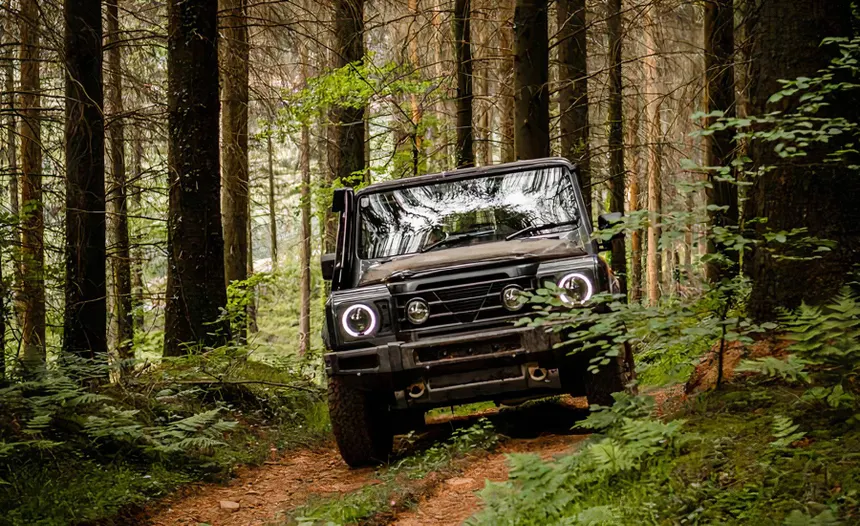
The chemist who built his own Defender, the Ineos Grenadier.
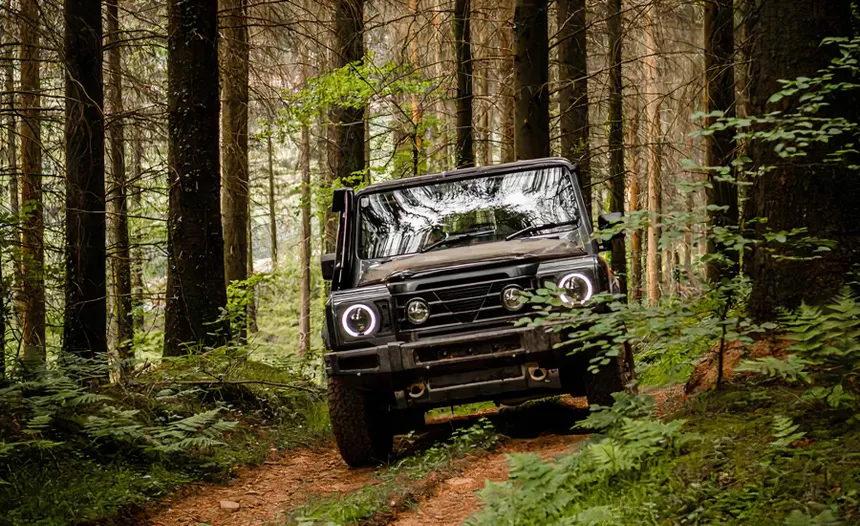
How a British billionaire fell out with Land Rover, called BMW, and bought a Mercedes factory to make the car JLR refused to build
Some cars are born from an engineer’s passion. Others from a customer’s frustration. And a very few — a very small minority — are born from the irritation of a wealthy man who has been told no. The Ineos Grenadier belongs squarely in this third category. It is the car Sir Jim Ratcliffe, British chemical billionaire and chairman of Ineos, decided to build for himself when Jaguar Land Rover turned him away. And the story of how he did it is one of the strangest of the last ten years of the automotive industry.
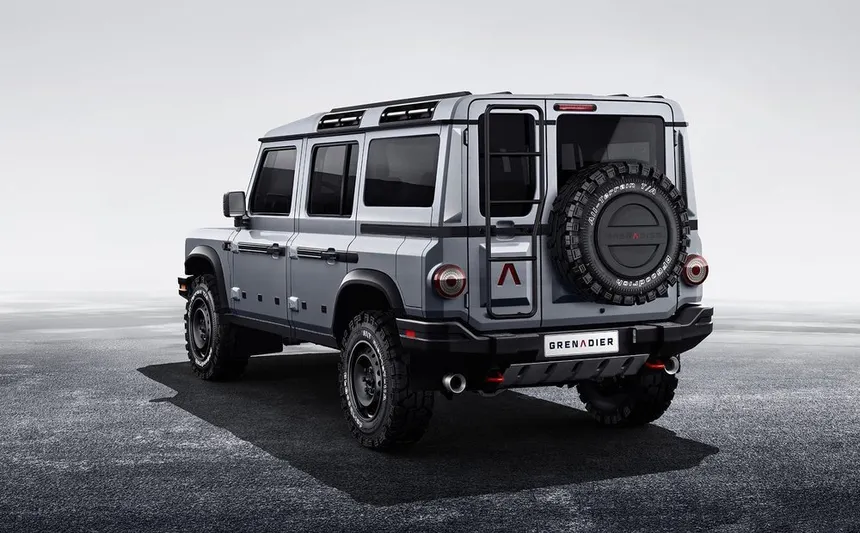
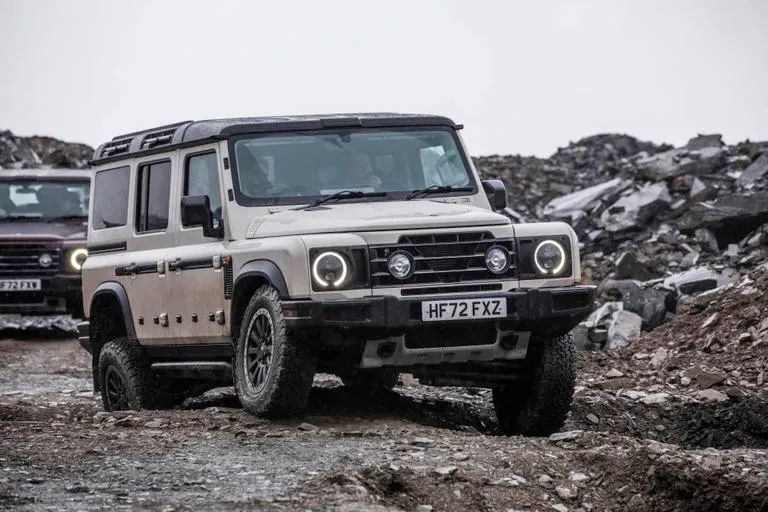
There is a steel ladder chassis, beam axles front and rear, long-travel coil suspension, a BMW B58 inline six (the same engine fitted to the Toyota GR Supra and the BMW M340i), a ZF eight-speed automatic, a mechanical two-range transfer case, optional locking differentials front and rear, and a bodyshell so close in silhouette to the classic Land Rover Defender that JLR took Ineos to court trying to stop it. JLR lost. The Grenadier is on sale. And the open question is whether Ratcliffe has made a legitimate tribute to a vehicle the industry abandoned, or whether he has used the proceeds of oil and plastics to indulge a wealthy man’s whim that he was entitled to his own Defender.
Probably both at once.
The Belgravia pub
The Grenadier story begins in a London pub. Specifically, in The Grenadier, a narrow-street pub in Belgravia, the wealthy area south of Hyde Park. It was January 2016. Land Rover had just shut down Defender production at its Solihull plant after 67 years of building the car in continuous evolution since the 1948 Series I. The new Defender, announced by Gerry McGovern as a monocoque, luxury, electronically sophisticated and visually radical product, had not yet hit the market (it would launch in 2020). The classic Defender, with its ladder chassis and riveted aluminium body, was dead.
Sir Jim Ratcliffe, founder and chairman of Ineos, the fourth-largest privately held chemicals group in the world, declared Defender fan, regular owner-driver of several variants on his Scottish estates and African properties, refused to accept the decision. He called JLR. He offered to buy the tooling, the moulds, the dies and the licensing rights to continue producing the classic Defender under contract. A serious industrial proposal, with real money behind it, which would have allowed JLR to monetise an obsolete industrial tool while keeping classic Defenders in the world without damaging their new product strategy.
JLR said no.
The story goes that the same afternoon Ratcliffe met a couple of friends at The Grenadier, a pub he knew well, and there they decided that if JLR wouldn’t make the car the market wanted, they would. On a napkin from the pub, according to Ineos’s own communications, the first sketch of what would become Projekt Grenadier was drawn. The project name came from the pub. The car name, later, came from the project.
It was January 2016. Ineos Automotive was formally founded in 2017. The first production unit rolled out of the factory in October 2022. Almost seven years from napkin to customer.
A chemical company building a car
The first thing to understand is that Ineos doesn’t build cars. Ineos builds chemicals. Polyethylene, phenol, ethylene oxide, heavy hydrocarbons, the basic industrial catalogue that feeds other industries downstream. Ratcliffe turned Ineos, since its founding in 1998, into one of the largest privately held companies in Europe by buying plants that other groups were selling as non-core assets. He is a chemical engineer by training, not an automotive one. And his company had no prior experience designing, assembling or homologating vehicles.
The solution was to hire people who did. And here Ineos opened the chequebook in earnest. The initial development team was set up in Stuttgart, Germany, with around 200 engineers, many of them coming from Mercedes-Benz, BMW and Magna. The technical project lead was Mark Tennant, formerly head of operations at Ford’s Genk plant. The head of design was Toby Ecuyer, a British architect who had previously designed luxury yachts and had no prior automotive experience. The executive lead was Dirk Heilmann, formerly of Magna. And at the supplier level, they went after the best in the business: chassis from Magna Steyr (the same Austrians who build the G-Class in Graz), engines from BMW (the petrol B58 and diesel B57, both six-cylinder inline units), the ZF 8HP eight-speed transmission (the gearbox used by half of the European premium industry), axles from Carraro (the Italian specialist in beam axles), brakes from Brembo, electronics from Bosch, steering from ZF, seats from Recaro.
The Grenadier isn’t an Ineos vehicle. It is a vehicle assembled from the best European supplier components of the moment, integrated under a body that Toby Ecuyer drew with one eye firmly on the classic Defender. And that is simultaneously its greatest strength and its greatest weakness. Strength, because the components are the right ones: the B58 is one of the most refined and reliable engines on the market, the ZF 8HP is the best automatic gearbox in its category, Carraro axles are serious hardware, the suspension is properly dimensioned for hard off-road use. Weakness, because none of those components is Ineos. It is a mosaic car, a reborn Defender with German-Italian-Austrian body and Bavarian heart, sold by a British chemical company that set up a new division specifically to sell it.
The fragility of this supply-chain model became evident in late 2024, when Recaro Automotive entered liquidation with only a few weeks’ notice to its customers. Grenadier production was suspended for four months for lack of seats. It took until early 2025 and the rescue of Recaro by the Italian Proma Group for the pace to recover. Lynn Calder, Ineos Automotive’s CEO, told Autocar plainly: when you depend on external suppliers for everything, the day one of them goes under, your factory stops. That is the cost of not making your own parts.
The Toyota Supra engine inside the Defender that isn’t a Defender
The engine choice is what best explains Ineos’s approach. The BMW B58 is a three-litre turbocharged inline six that BMW launched in 2015 and has since fitted to practically its entire mid-to-upper catalogue: M340i, M440i, X3 M40i, X5 40i, and also, under a supply agreement, in the Toyota GR Supra Mk5. It is a closed-deck block with a rigid architecture and an intake, valvetrain and cooling design that has allowed BMW to extract anything from 286 hp to 530 hp from it depending on calibration.
In the Grenadier it produces 286 hp (281 in US spec) and 450 Nm of torque. It isn’t the most powerful version in BMW’s catalogue, but it is exactly the version this car needs. Torque from 1,750 rpm, the inline-six refinement no four-cylinder turbo can replicate, fiability proven across hundreds of thousands of units sold globally. The diesel version is the B57, also an inline six, three litres, 249 hp and 550 Nm.
The gearbox is the ZF 8HP eight-speed, with a mechanical two-range transfer case for low-range work. Permanent four-wheel drive with a standard centre locking differential. Options: front and rear locking differentials for extreme use. But here’s an important detail: the Grenadier is not electronically managed 4WD in the style of modern off-roaders. It is permanent mechanical 4WD, with all locks operated manually. When you engage the centre lock, the front and rear axles rotate at the same speed. When you engage the front or rear, both wheels on that axle rotate together. It is the classic system, the one fitted to Defenders and military G-Wagens before computers got involved.
Over these components sits a steel ladder chassis, built by Magna Steyr in Austria, with beam axles front and rear, long-travel coil springs, Bilstein dampers, and a painted steel body on top. No monocoque. No active anti-roll bars. No air suspension. None of the half-dozen things modern SUVs come with.
It is deliberate. The Grenadier is not an SUV. It is a utility off-roader in the precise tradition of the pre-2016 Defender and the military G-Class. It is built to go slowly over bad terrain, not quickly over good roads.
The sound that doesn’t want to be sound
There is a detail of the Grenadier that deserves particular attention to understand the whole car’s philosophy. You start the B58 and you can barely hear it. Which is precisely the opposite of what happens with the same engine in a BMW M340i, a Toyota GR Supra or any other car from BMW’s catalogue where the sound engineer has spent months calibrating the exhaust, the resonators, the in-cabin acoustic simulation and the harmonic filtering to make the inline six sound like what it is: one of the most musical engine architectures ever produced in series. In the Grenadier, all that sound-design work simply doesn’t exist. The engine is deliberately silenced.
Road testers who have driven it agree word for word. Autocar, in an 8,000-mile long-term test: “it’s really well isolated, and while it can be bumped around by big undulations, it’s actually refined and quiet inside when driving on pockmarked asphalt”. Top Gear: “despite its barn-door aerodynamics and body-on-frame chassis, it’s pretty refined”. CarExpert, on the diesel Quartermaster: “you get a smooth and clatter-free inline-six sound, which is a nice and refined change”. Car Throttle: “ZF’s eight-speed 8HP automatic gearbox is deployed with its usual smoothness”. They all talk about refinement, none of them talks about sound.
And the most damning proof is in the aftermarket. Companies like Milltek Sport, Kooks Headers and Fabspeed Motorsport have been developing catback exhausts for the B58 Grenadier since 2023, precisely because the typical buyer coming from a BMW misses the bavarian six-cylinder bark. Milltek presented theirs at Goodwood Festival of Speed 2023 with the exact phrase: “the B58 version gets a much needed sound upgrade”. Mansory has developed tunes that take the engine to 350 hp and 560 Nm without touching the block, only changing intake, exhaust and ECU. There is a whole market dedicated to giving sound to a car from which Ineos has deliberately removed it.
Why have they silenced it? Because the Grenadier’s typical customer isn’t the M340i’s typical customer. The Grenadier is aimed at farmers, explorers, rescue teams, large-estate owners, people who will be doing eight straight hours on a gravel track and don’t want to listen to the engine the whole way. Ineos’s philosophy is coherent: if the car is going to be used to cross deserts at 50 mph for ten hours at a stretch, the last thing you want is a sports exhaust hammering your ears. Better a smooth, linear six-cylinder, present without being demanding, pushing without asking for attention. It’s the same call Mercedes made on the Australian military G-Wagens: solid, reliable, quiet engine. Not theatre.
Whoever wants theatre spends another thousand euros on a Milltek catback and problem solved. The rest enjoys the most well-mannered six-cylinder fitted to a utility off-roader in many years.
The Smart factory in Hambach
Here comes the most curious chapter in the Grenadier’s industrial story. In September 2019 Ineos announced that the Grenadier would be built in a new factory, purpose-constructed in Bridgend, Wales. Ratcliffe, who had publicly supported Brexit in 2016, presented the decision as an act of faith in post-Brexit British manufacturing. “The decision to build in the UK is a significant expression of confidence in British manufacturing,” he said at the press conference.
Nine months later, in July 2020, Ineos announced a change of plan. The Welsh factory was cancelled. Instead, they would purchase the Mercedes-Benz Smart plant in Hambach, in the French region of Moselle, near the German border. The transaction formally closed in December 2020.
The detail: Hambach had been the plant where Mercedes built the Smart ForTwo for 23 years, from 1997 to 2020. A modern facility, with robotic lines, Daimler-paid infrastructure, a German-trained workforce. Mercedes had decided to shut it because they were moving new Smart electric production to China under their agreement with Geely. That left 1,600 jobs hanging in Moselle. Ineos rescued them by buying the plant.
Industrially, it was the correct decision. Hambach is a car factory built from scratch by Daimler, with all the European certifications, with trained staff, with established supplier chains in the Rhine corridor. Starting a new factory in Wales would have cost an additional £600 million to £1 billion and delayed launch by another two years. The coronavirus pandemic, which began in March 2020, accelerated the decision. Hambach was the logical shortcut.
Politically, it was a public-relations disaster. Ratcliffe had sold the project as a flag of Brexit and British manufacturing. He ended up building the car in France, with German parts, a German engine, an Austrian chassis, Italian axles. The Daily Telegraph and the British press crucified him. Welsh trade unions, who had spent months working with Ineos to prepare the ground, said they felt betrayed. Ratcliffe responded with an interview defending the decision as a business matter separate from his political position on Brexit. The reputational damage, however, was done.
The Hambach plant remains today where the Grenadier is built. Ineos has made several upgrades since the purchase, expanding the lines to produce different variants (Station Wagon, Utility Wagon, Quartermaster pickup, and the upcoming Fusilier electric/hybrid). In 2024 the Hambach plant also resumed building the electric Smart under contract for Mercedes, alongside the Grenadier. A considerable industrial irony. And in April 2025 Ineos opened a biomass plant at Hambach that cuts the factory’s CO2 emissions by around 20% and covers 70% of the site’s heating needs. Real industrial sustainability, not marketing.
The court case JLR lost
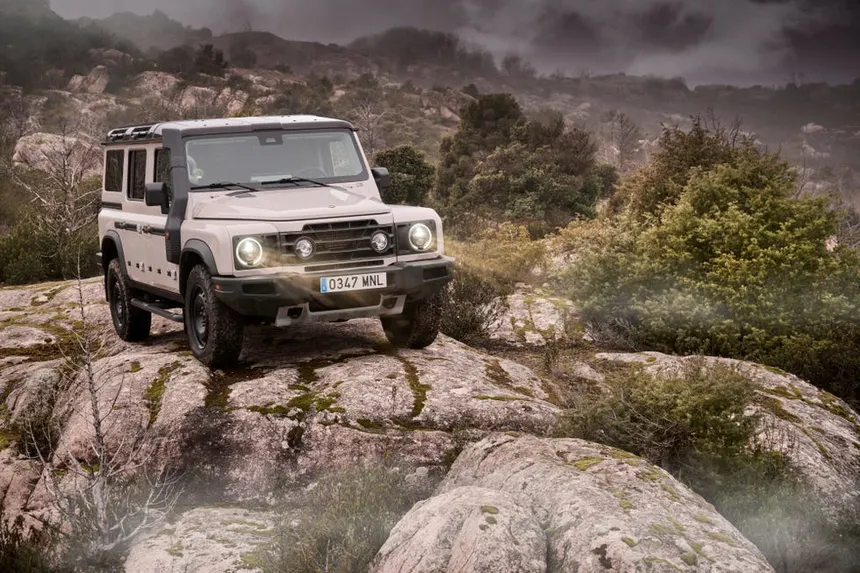
While Ineos was preparing production, JLR was preparing the legal artillery. In 2016, even before the formal Grenadier announcement, JLR had filed to register the exact shape of the classic Defender as a three-dimensional trademark. The idea was simple: if no one else can make cars with that silhouette, no one can put a Defender alternative on the market. The strategy was preventive, designed to stop anyone doing exactly what Ratcliffe was planning.
The UK Intellectual Property Office (UKIPO) rejected the application in 2019. The British IP tribunal’s reasoning was blunt: the shapes JLR was trying to protect were not distinctive enough to constitute a trademark. That is, the Defender looks physically similar to other boxy off-roaders with beam axles, flat glass and rectangular proportions. That shape isn’t JLR’s exclusive property; it is a common industrial design solution for an entire category of vehicles. It cannot be registered.
JLR appealed. In August 2020 the High Court in London dismissed the appeal. The judge upheld the UKIPO’s finding with words worth remembering: the differences between the Defender and other vehicles of the same silhouette “may be unimportant, or may not even register, with average consumers”. In other words: the typical buyer of a boxy off-roader does not distinguish a Defender from a Grenadier by silhouette. Therefore, JLR cannot prevent vehicles of that general silhouette from being manufactured.
There was an additional point that was particularly damaging for JLR. The court considered that the trademark application had been made “in bad faith” for non-4×4 products, because JLR had announced in 2015 that it was discontinuing the classic Defender. That is: in 2016, when JLR filed to register the silhouette, they had already publicly said they would no longer build cars with that silhouette. The trademark filing had the sole purpose of blocking competition, not of protecting their own product. Bad faith.
Ineos celebrated the result. JLR issued a statement regretting the decision and asserting that the Defender’s shape is “iconic” and that they would continue protecting it in other jurisdictions. And indeed, in the United States JLR attempted a similar fight. Ineos got ahead of it this time: in 2021 they filed a declaratory action in a federal court in New Jersey asking the judge to confirm that the Grenadier’s design did not infringe JLR’s rights in the North American market. The action remained pending at the time of writing.
How the Grenadier actually drives
And here is the real question: once you discount all the Ratcliffe epic, the pub, the French factory, the lawsuit and the image troubles, what is left underneath? The verdict from road testers who have driven it hard is broadly consistent across every serious review: it is an extraordinarily capable off-roader, surprisingly refined, and reasonably expensive.
On the road, the Grenadier is what you’d expect from a ladder chassis with beam axles. The steering is slow, almost truck-like, with multiple turns lock-to-lock. The dynamic behaviour is that of a tall, heavy vehicle with a high centre of gravity, which translates into body roll in corners and a permanent need to read the road in advance. The Bilstein damping is firm but not uncomfortable. The ZF eight-speed automatic is what it is, that is, possibly the best automatic gearbox on the market in any category, smooth on transitions, quick when required, completely transparent when cruising. And the BMW B58 engine is the component that elevates the experience the most: 286 hp may sound modest for a 2,700 kg car, but 450 Nm of torque from 1,750 rpm is perfectly dimensioned, the engine pulls with the inline-six linearity no turbo four can imitate. On the motorway, at 130 km/h, the Grenadier consumes between 11 and 13 litres per 100 km and rides with a refinement anyone who has driven a classic Defender will find miraculous. The classic Defender roared, vibrated, lurched, leaked oil. The Grenadier is civilised.
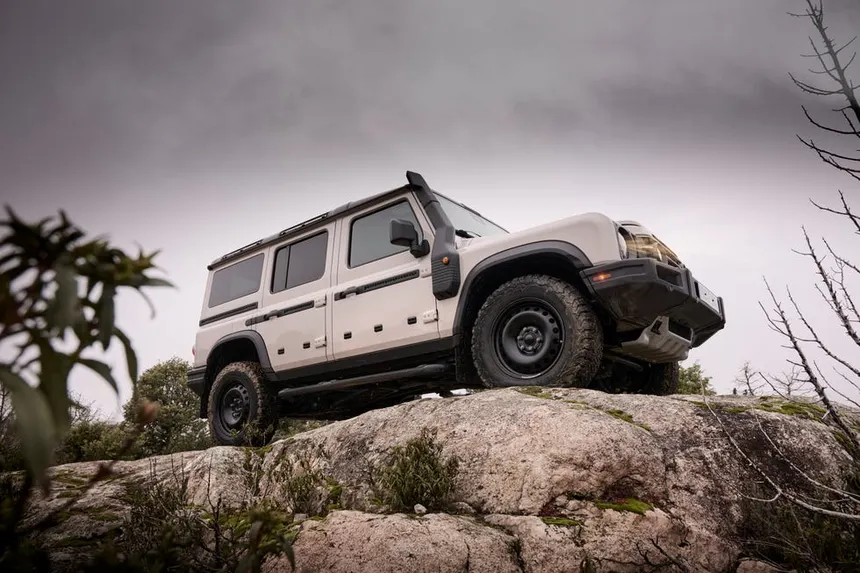
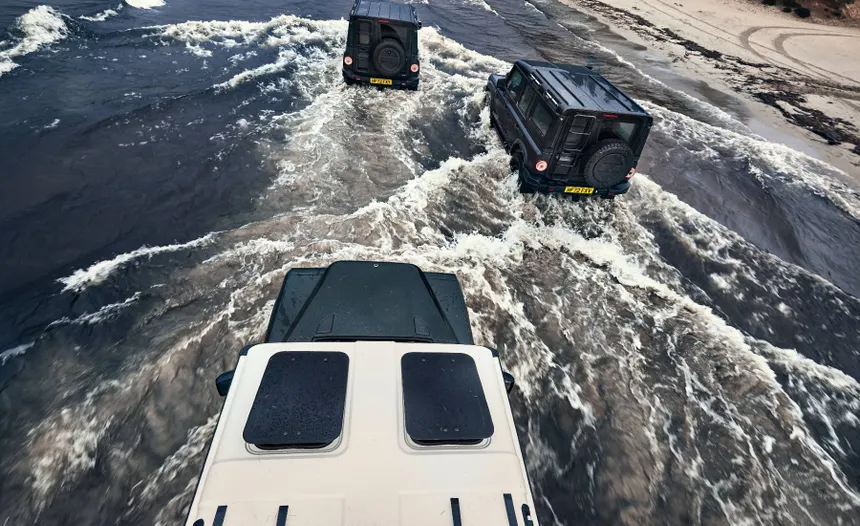
Off-road, the Grenadier does what it is built to do. The three lockers (centre standard, front and rear optional), the 2.5:1 low range, the approach angle (36.2°), departure angle (36.1°) and breakover angle (28.2°), the 264 mm ground clearance and the 800 mm wading depth allow it to clear obstacles that would stop any modern monocoque SUV. Road testers who have run it in serious terrain in Scotland, Morocco and South Africa agree that the car is mechanically well-dimensioned for hard utility use. It isn’t a trophy of greater off-road capability than the G-Class, or than the new Defender in its most capable configurations. But it stands alongside them.
What the Grenadier offers that no direct competitor does is operational simplicity. The lockers engage with physical levers in the cabin roof, not with on-screen menus. The transfer case engages with a mechanical lever beside the automatic shifter, not with a button. There are no electronic intermediaries that have to validate your decisions. If you want to engage low range and lock all three differentials at the start of a bad track, you do it yourself with your own hands in thirty seconds. That philosophy is what Ratcliffe wanted to rescue. And in that, the car delivers.
Prices at the time of writing: in Spain the entry-level Trialmaster with the B58 petrol starts at around €75,000 and rises easily above €90,000 with full equipment and optional lockers. In the UK, the same base configuration is around £69,000 and tops £85,000 with extras. In the United States, where it officially arrived in late 2023, the range goes from USD 73,000 in the base trim to close to USD 95,000 in the Trialmaster. In every market, it is expensive. More so than a new Defender 110 of similar performance. And vastly more than an equivalent Toyota Land Cruiser. That is the project’s other weakness: for many people the Grenadier doesn’t solve an economic problem, it creates one.
What comes after the Grenadier
Ineos hasn’t stopped. Ratcliffe’s strategy for the coming years is to turn what started as a single car into a full mass-market automotive company with a complete catalogue. The first step was the Quartermaster, launched in 2023, a double-cab pickup version of the Grenadier 5.40 metres long (54 cm longer than the Station Wagon), with an extended 3,227 mm wheelbase, an open polyethylene-lined cargo bed at the rear, and the same BMW engines and ZF gearbox as the Station Wagon. It sells in Australia, the UK, continental Europe and the United States, with strong reception in the professional segment (farming, estate management, civil works crews in remote areas).
The second step was the Fusilier, announced in February 2024 at the very Grenadier pub in Belgravia where the story had begun eight years earlier. The Fusilier was to be a slightly smaller SUV than the Grenadier (4,521 mm long, almost a metre shorter than the Quartermaster), built on a skateboard electric platform designed by Magna, with a 100% electric version and a range-extender version (a small petrol engine acting only as a generator, with no direct mechanical link to the wheels, like the Ram 1500 Ramcharger setup). Initial plan: start production in 2026 at the Magna Steyr plant in Graz, with annual capacity of 40,000-50,000 units split 50-50 between EV and range extender. Ambitious numbers.
In July 2024 Ineos postponed production. And in April 2025, Lynn Calder confirmed in an Autocar interview that the Fusilier won’t arrive until 2028 or 2029. The reason, according to her, is European regulation. The EU will ban hybrids from 2035, and although the range extender is technically not a hybrid (the combustion engine doesn’t drive the wheels), regulators haven’t yet defined whether they’ll treat it as a hybrid or as an EV with an onboard generator. “We’re too small to spend huge amounts on product development to then find that we can’t produce it, we can’t sell it, in key markets”, Calder said. Ineos is waiting for regulatory clarity before sinking more money into the Fusilier.
Meanwhile, the brand has gone for incremental improvements to the Grenadier. In 2025 they introduced a variable-ratio steering box that reduces the number of turns lock-to-lock (one of the most criticised points of the original car), a redesigned climate control system, and new driver-assistance features to comply with European regulations. 2026 model year cars include a fully blacked-out Inky Black Edition trim, the Fieldmaster trim with leather, heated front seats, an upgraded sound system and the aircraft-cockpit-style pop-up roof window that is one of the car’s most distinctive features. And in parallel, Ineos has presented a hydrogen fuel-cell Grenadier prototype, demonstrating that the technology works while waiting for European hydrogen refuelling infrastructure to mature enough to justify series production.
The Hambach plant is in the process of expansion to reach 50,000 units annually from 2027. Current capacity is around 25,000. Ratcliffe has publicly stated that his goal is to turn Ineos Automotive profitable by 2027, and that the total accumulated cost of the project, originally estimated at USD 1.5 billion, is on its way to USD 2 billion as new platforms and variants are added. It is a lot of money. But it is money Ineos generates every quarter from its chemical operations under normal trading conditions. Ratcliffe can afford to keep investing.
What the Grenadier means
There are two ways to read the Grenadier. The first is as a billionaire’s whim. A man with too much money who, told no by a manufacturer, refused to accept it and spent close to USD 2 billion building it himself. From that angle, the car is a symbol of the excesses that late-2010s capitalism permits to a very specific kind of buyer. There is no industrial rationality behind it. It is ego with a budget.
The second reading is more interesting. JLR killed the classic Defender because they calculated that the hard utility market was too small and too unprofitable compared with the luxury SUV market. It was a defensible business decision. But in doing so they left a hole in a category that did have demand: farmers, explorers, rescue teams, geologists, livestock workers in remote areas, utility crews in developing countries, people who had relied on the classic Defender for seventy years and didn’t want a vehicle with a 12-inch touchscreen and air suspension. That market, much smaller than the luxury SUV market but real and existing, was orphaned in 2016. Ratcliffe identified the gap and filled it.
Whether he did it for money or for whim is academic in practice. The outcome is that in 2026 there is a vehicle in production that a customer can buy to do what the classic Defender did: hard terrain, mechanical reliability, minimal electronics, real capability. With a BMW engine of proven manufacturing record, a ZF gearbox among the best on the market, a Magna Steyr Austrian-origin chassis, built in a French Mercedes factory by German-trained staff. It is the most cosmopolitan vehicle Europe can currently produce, and at the same time the closest thing on sale today to one of the good Defenders.
Meanwhile, JLR has rolled out the new Defender in 90, 110 and 130 variants, with six- and eight-cylinder engines, air suspension, touchscreens and prices starting at £65,000 and rising to £175,000 for the V8 P525. A radically different car from the classic, aimed at a completely different buyer, with vastly superior road performance and also very high off-road capability but with an integrated electronic philosophy. And it sells very well. JLR didn’t make a commercial mistake killing the classic Defender.
What is also true is that Ratcliffe didn’t make a mistake noticing that a market still existed for the other car. Both things are true at once.
Check you’re still alive.