
Peralta S: the Giugiaro Name Returns to the Wedge
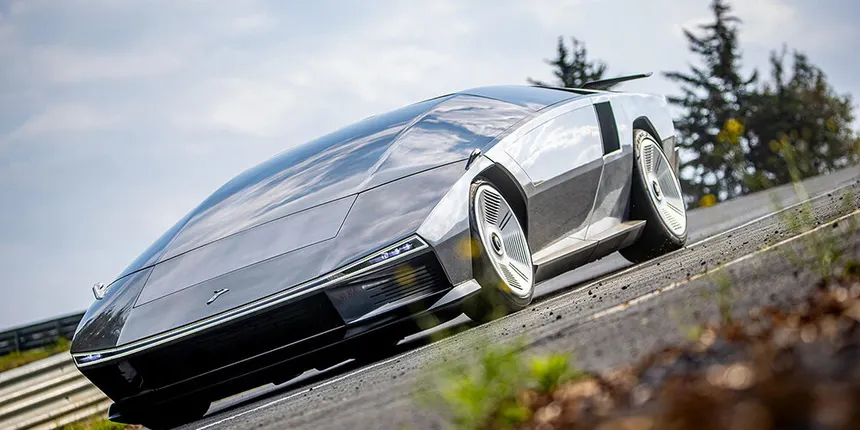
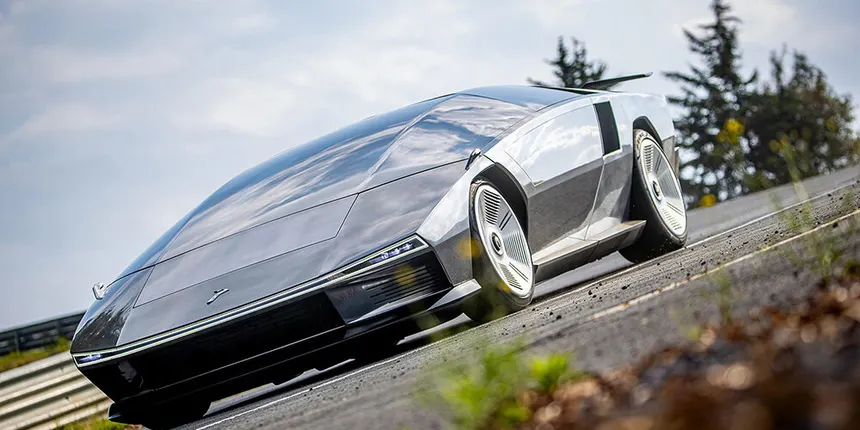
Here’s a neat trick of symmetry. In 1972, a Giugiaro drew an impossible wedge over a Maserati and turned it into a legend. In 2025, another Giugiaro did exactly the same thing. Same surname. Same brand, near enough. Same wedge. But fifty-three years sit between the two, and with them a difference that changes everything — a difference almost nobody bothers to point out.
Because the father, Giorgetto, took the extreme language of the Boomerang and spent his career distilling it down into cars that half the world drove. The Golf. The Panda. The Ibiza. The wedge came down to the street. The son, Fabrizio, has made the opposite journey: he’s taken the wedge and put it straight back up on the pedestal. The Peralta S is a one-off, hideously expensive, that nobody will drive except one man. And that inversion — that journey in reverse — is what actually makes this car worth talking about.
What the Peralta S actually is
Facts first, philosophy later. The Peralta S is a one-off, a single bespoke piece, built by GFG Style — the studio Giorgetto Giugiaro founded in 2015 with his son Fabrizio after selling Italdesign to the Volkswagen group. It was revealed on 22 March 2025 at the Pastejé Automotive Invitational, an event held in Mexico, and made its American debut that August during Monterey Car Week.
The name isn’t a whim or a nod to a sitcom about Brooklyn cops. It comes from Carlos Peralta, the Mexican collector who commissioned and paid for the car. It’s his. It was never for sale, it isn’t a production model, and you couldn’t buy one if you tried. It’s a piece made to order for a single person, and that’s where the commercial story ends.
Under the bodywork sits a Maserati MC20. And precision matters here, because it’s central to understanding the car: the mechanicals are the standard MC20’s, untouched. The 3.0-litre twin-turbo V6, the 621 horsepower, the 538 lb-ft, the eight-speed dual-clutch, the rear-wheel drive. All of it is pure Maserati, straight off the line. The sub-three-second 0-60 and the 200-plus mph top speed are, in fact, the MC20’s own numbers, inherited unchanged. GFG didn’t touch the engine. It touched everything else.
And the base being an MC20 is neither a minor detail nor a lazy pick. The MC20 is, in its own right, one of the most interesting cars Maserati has built in decades: a carbon-fibre monocoque, the in-house Nettuno engine with pre-chamber combustion tech lifted straight from Formula 1, and the kind of performance that’ll trade blows with a McLaren GT down a straight. So Fabrizio didn’t grab any old platform to drape a pretty body over. He picked one of the most technically serious Maseratis going — exactly as his father, in 1972, didn’t pick any old car but the Bora, Maserati’s first mid-engined machine. There’s a consistency there: father and son each building their sculpture on the most advanced thing the marque had at the time.
What Fabrizio actually did
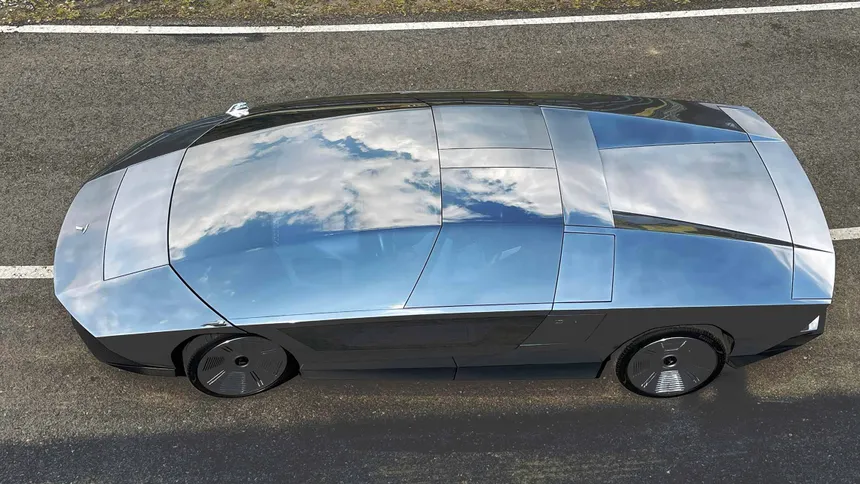
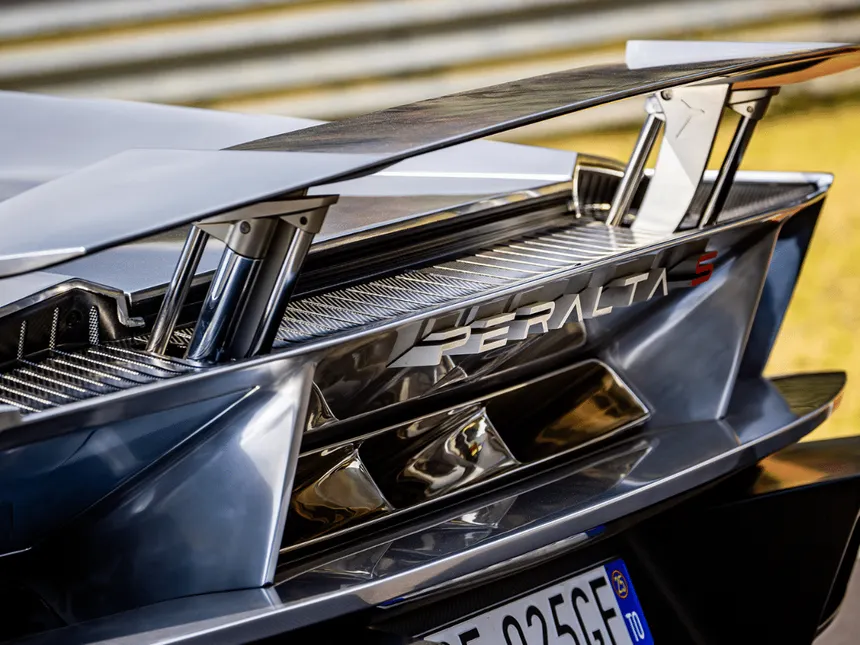
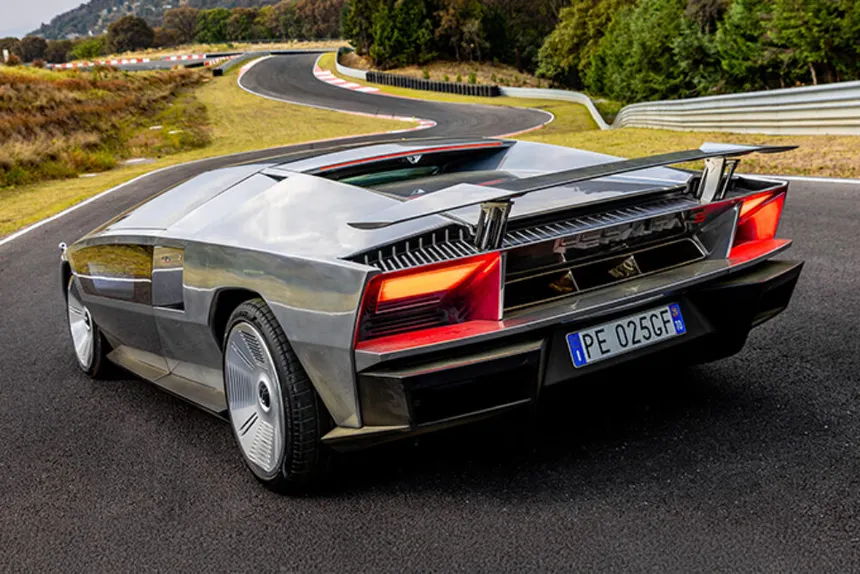
What GFG built is the skin and the soul, not the guts. The body is hand-beaten, mirror-polished aluminium, a finish that throws back a reflection of everything around it and is, by some distance, the most direct homage to the original Boomerang, which was itself shown in bare aluminium back in the day.
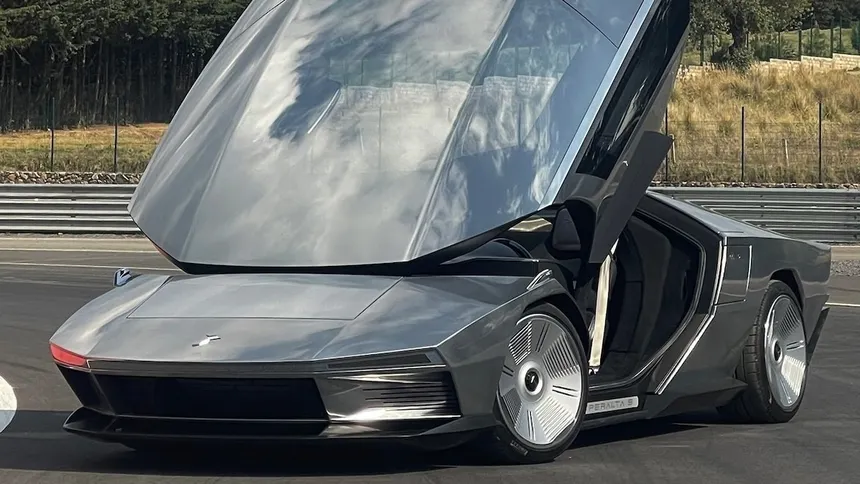
But the detail that really defines the car is how you get in. Fabrizio binned the MC20’s butterfly doors and fitted a full canopy in their place — a single dome that hinges forward, with little gullwing hatches to poke your head out of. It’s an odd solution, probably awkward, undeniably spectacular, and completely different from both the donor MC20 and the original Boomerang. It isn’t a copy. It’s a re-reading.
There’s more outside: a front light bar, a rear diffuser, side skirts, and a rear wing that deploys with speed — a touch one writer described as almost Countach-like. The silhouette is still clearly a wedge, but a curvier, more organic one, less set-square-and-ruler than the Boomerang. Where the father drew with a T-square, the son has let the line breathe a little.
And there’s a detail worth grasping, because it changes how you judge the car. Fabrizio didn’t start with a blank sheet. His father, in 1972, did: the Boomerang was drawn free, with no limit beyond imagination, on a platform that bent to the shape. Fabrizio, by contrast, had to work inside the cage of the MC20’s carbon-fibre chassis — a sealed, rigid structure built for one specific car, the kind of thing you can’t reinvent. It’s the difference between drawing on blank paper and drawing inside the borders of something that already exists. That the result looks as free as it does, with that straitjacket underneath, carries more engineering credit than it gets. Creating a shape and wrapping a shape without the seam showing are not the same job.
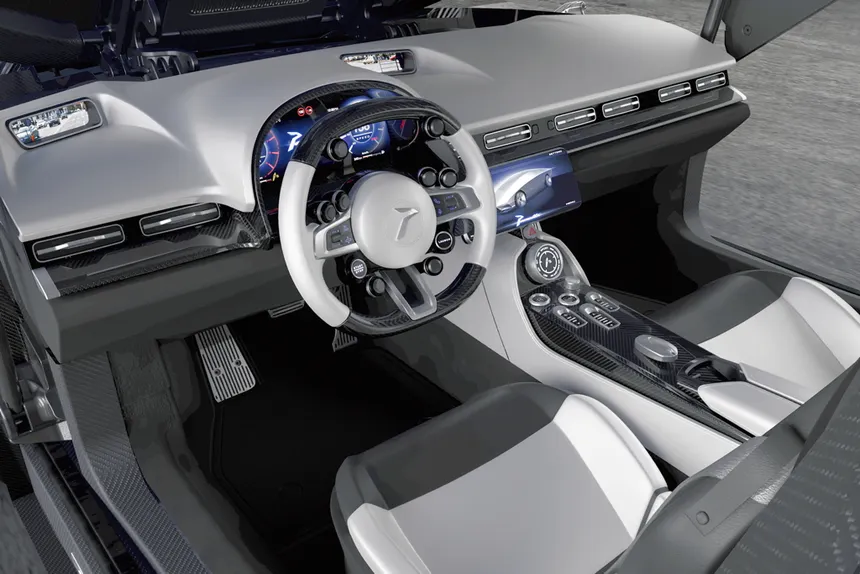
Where the homage falls short
And here we have to be straight, because NEC isn’t in the business of flattering anyone, not even a Giugiaro. Inside, the Peralta S disappoints anyone who came looking for the soul of the Boomerang.
The original Boomerang had that astonishing steering wheel with the entire instrument pack mounted inside the rim — a piece of science fiction that still impresses today. The Peralta S, instead, fits a reworked version of the MC20’s own three-spoke wheel. Which means the single most radical and memorable idea of the car it claims to honour — the one that genuinely looked to the future — hasn’t been revived at all. There are metallic-effect materials, seventies nods in the trim, a beautifully made cabin. But the original interior’s masterstroke has been left at the door. The homage is all surface, all silhouette, all finish. It never reaches the brain of the car it pays tribute to.
It’s not a flaw that sinks the car. But somebody had to say it: outside it screams Boomerang, inside it whispers MC20.
The inversion that explains it all
Now the part that matters, and the part that closes this whole series on Giugiaro.
Think about what the father did. Giorgetto took the Boomerang’s scream — that useless, gorgeous wedge — and spent decades distilling it, calming it, making it buildable, until that same shape fit a Golf that sold in the millions and drove half of Europe to work. Giorgetto’s move was always downward: toward the street, toward people. Take the extraordinary and make it everyday. That was his greatness, and it was a generous kind of greatness — he handed his talent to millions of people who never even knew his name.
The son has made the journey in reverse. Fabrizio has taken the wedge and, instead of distilling it for everyone, concentrated it into a single piece for a single man. He’s taken a Maserati that’s already a car for the very few and turned it into a car for exactly one. Fabrizio’s move is upward: toward the pedestal, toward absolute exclusivity. Where the father democratised, the son has locked it back up.
And here’s the awkward question, the one that actually makes you think. Is the Peralta S a tribute to the Boomerang, or is it something else? Because there’s a more bitter reading available. Giorgetto Giugiaro was the most important designer of his century and never got the cult, the mass recognition, the worship handed to others who drew far less. He paid for his greatness with anonymity — precisely because he drew cars people wanted without knowing who’d made them. The Peralta S, by contrast, is pure scream. It’s exclusive, it’s expensive, it’s impossible to ignore, it wears the surname out front and it shows up at collector events. Could it be that the son is collecting, up on a pedestal, the fame the world never gave the father out on the street?
I don’t know. Maybe it’s just a son’s straight tribute to his father, nothing more. But the form he chose to do it in — upward, not down; for one, not for all — says something, and it says precisely the opposite of what old Giugiaro defended his whole life with a pencil.
The car is good. The question is better
Don’t read this as a kicking for the Peralta S. It’s a gorgeous car, superbly made, the polished-aluminium finish is jaw-dropping and the forward canopy is a brave solution few studios would dare sign off. As an object, it’s top marks. GFG has proved the Giugiaro name still knows how to draw a wedge that stops traffic.
The thing is, a car like this — one that exists only once and that you’ll never see on the road — is worth mostly what it says. And what the Peralta S says, whether Fabrizio means it or not, is the perfect ending to his father’s story. The Boomerang was the scream. The Golf was the whisper that scream became when it turned useful for millions. And the Peralta S is the scream returning, half a century later, turned back into a single piece for a single owner. The circle closes exactly where it started: an aluminium wedge over a Maserati, built for the world to look at and almost nobody to drive.
Giorgetto spent his life bringing genius down to the street. His son has carried it back up to the showroom. And somewhere between those two acts lies the whole story of why the best designer of the century is still, to the wider public, a stranger.
There’s one last way to read it, maybe the fairest to Fabrizio. Perhaps the Peralta S doesn’t contradict his father — it completes him. Perhaps somebody needed to lift the wedge back onto the pedestal, if only once, so we’d remember where all that beauty came from, the beauty we take for granted every time we start a hatchback. The Golf wouldn’t exist without the Boomerang. Maybe the Boomerang needed, half a century on, somebody to remind the world that it came first — before its DNA scattered across thirty million anonymous cars. In that light the Peralta S isn’t a rich man’s toy at all, but an act of memory. A way of saying: this, the thing you drive without thinking, started life as that — an aluminium sculpture that stopped traffic. Don’t forget it.
Both readings are true at once, which is the best a car like this can hope for. It’s a tribute and a contradiction, a memorial and a vanity, the closing of a circle and the reopening of a question. Not bad for a one-off nobody will ever drive.
One more thing: that supposed “estimated value of four or five million” doing the rounds on social media appears in no serious source. GFG has published no price. It’s a commissioned one-off, and what a commission like that is worth is known to nobody but the man who paid for it. Be suspicious of round numbers that arrive without a source.
Check you’re still alive.