
Lamborghini Formula 1 Engine: Five Years, 49 Starts, No Wins
In 1993 Bob Lutz, the Chrysler executive who green-lit the Dodge Viper, shook hands with Ron Dennis on a deal to put a Lamborghini V12 in the back of a McLaren. Ayrton Senna drove it, loved it, and asked to race it at Suzuka that October. He won Suzuka instead with the Ford V8 McLaren already had, and the Lamborghini never started another Grand Prix.
For five seasons Chrysler owned a Formula 1 engine, painted its own name on the cars that used it, and never paid for a car good enough to win with it. The McLaren test was the one time anyone found out what the engine could really do.
Chrysler’s Italian Racing Department
Chrysler bought Lamborghini in April 1987. Lee Iacocca decided his new Italian brand needed a racing arm, and Lamborghini Engineering opened in Modena, a short drive from Ferrari’s Maranello.
For technical director, Chrysler hired Mauro Forghieri in September 1987. Forghieri had just walked out of Ferrari after 27 years, 23 of them as technical director, with four drivers’ titles and seven constructors’ titles on his watch. In American terms, Chrysler had hired the guy who built Ferrari’s championship cars from the Surtees era through Lauda and Scheckter.
The same ownership put Sant’Agata’s engineers to work on Detroit projects. Lamborghini engineers recast the Dodge Viper‘s truck-derived V10 in aluminum, and that engine went on to define the Viper for two decades. Same owner, same engineers, same years. One program got the money it needed. The other was the F1 V12.
What Forghieri Built
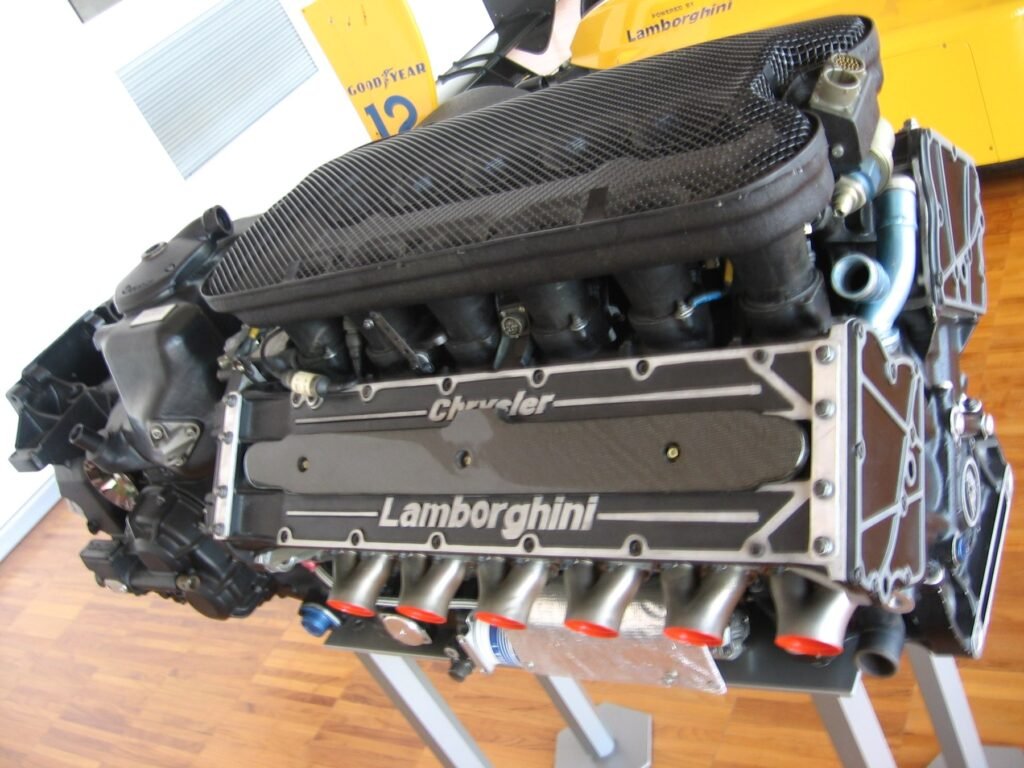
The FIA banned turbos for 1989 and set a 3.5-liter limit for naturally aspirated engines. Forghieri’s answer was the LE3512: an 80-degree V12 of 3,493cc, 87mm bore and 49mm stroke, four valves per cylinder, 48 valves total, about 150 kg (330 lb) dry.
That stroke is under two inches. Compare that with the 3.48-inch stroke of a small-block Chevy 350 and you see what Forghieri was chasing. A short stroke means the piston travels less distance each revolution, so the engine can spin faster without tearing itself apart, and in F1, revs are horsepower.
The first version made around 600 hp at 11,200 rpm. It made 640 hp in 1990 and 1991, and 700 hp at 13,800 rpm by 1992. Over a hundred horsepower found on the same basic architecture is what a properly developed engine looks like.
It also had a sound people still talk about. Of all the 3.5-liter engines of that era, the Lamborghini is the one fans remember by ear.
The V12 Wasn’t the Problem
The easy excuse at the time was that twelve cylinders were too many for the new rules. Honda shot that down. Its RA121E V12, 3,498cc and 800 hp, powered the McLaren MP4/6 to both the 1991 drivers’ title with Senna and the constructors’ title. It’s still the last V12 to win a Formula 1 World Championship, and Ferrari stayed with V12s through 1995.
Twelve cylinders weren’t the issue. The 160-horsepower gap to Honda in 1991 (640 against 800) was one. The bigger one was what the engine did to the car carrying it.
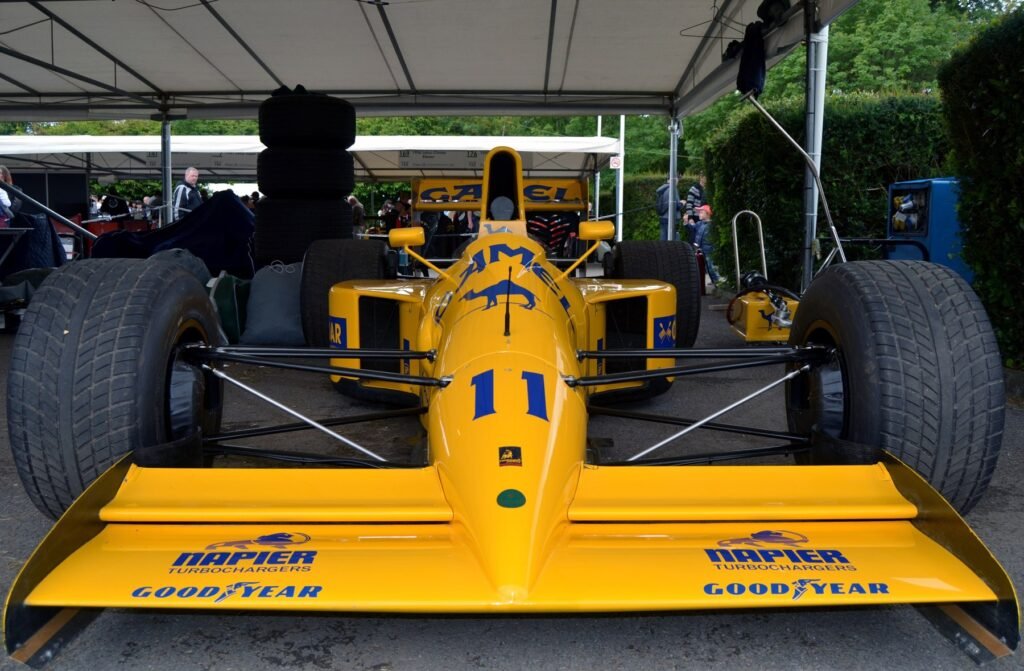
A V12 is long, heavier than a V8, and thirstier. The 1991 Ligier JS35 was described as overweight and bulky, partly because of the big oil tank the engine needed. On the 1990 Lotus 102, the V12’s mass forced the designers to go over every part on the car looking for weight to cut. More fuel burned per lap means a bigger fuel load from the green flag.
There was one reason a team would sign up anyway, and it was money. When Minardi swapped Ferrari V12s for Lamborghini V12s in 1992, it cut its engine budget by about 20%. The M192’s own spec sheet lists the engine at 145 kg.
Who Actually Ran It
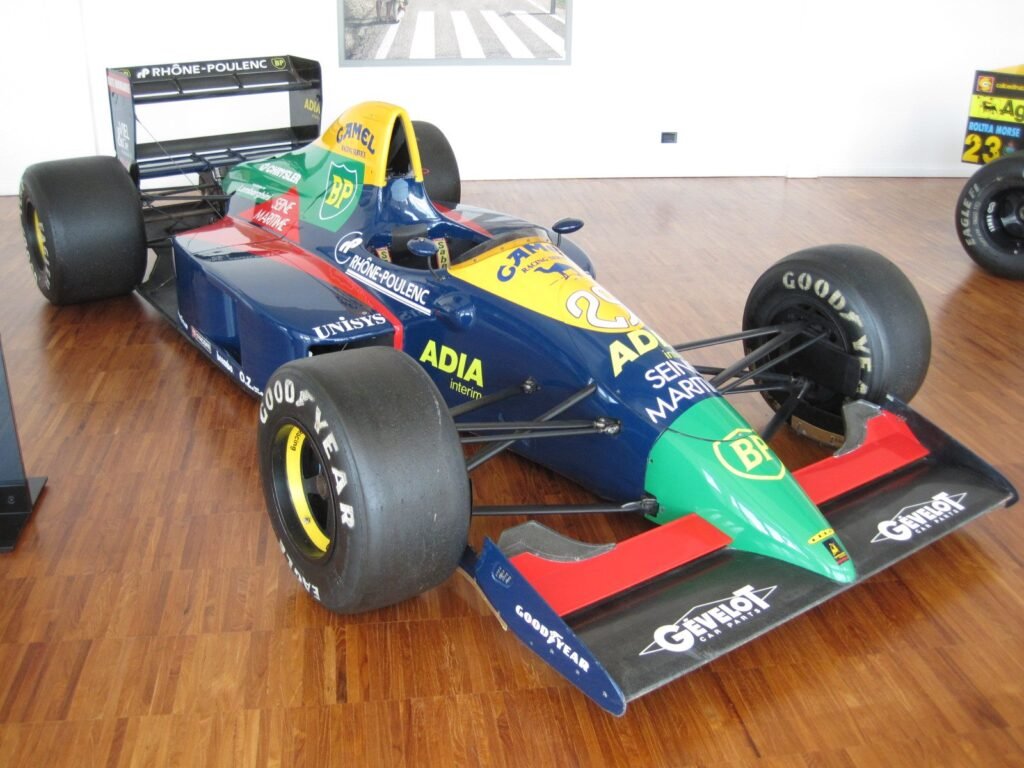
Larrousse in 1989, 1990, 1992 and 1993. Lotus in 1990, sliding toward the end. Ligier in 1991. The Modena Team in 1991. Minardi in 1992.
None of them was a front-runner. The scoring is short. Bertrand Gachot finished sixth at Monaco in 1992, Larrousse’s only point that season. Christian Fittipaldi finished sixth in Japan in 1992 after racing Jean Alesi’s Ferrari, Minardi’s only point that year. Philippe Alliot and Érik Comas scored three points between them in 1993.
The engine’s best qualifying spot in five seasons came early, at the 1989 Spanish Grand Prix at Jerez, where Alliot put the Larrousse Lola fifth on the grid. Jerez also produced the program’s worst day. In Friday practice for the 1990 Spanish Grand Prix, Martin Donnelly crashed his Lotus 102 in the fast right-hander behind the pits. The car broke in two and the seat tore out of the tub, leaving Donnelly on the track still strapped into it. He needed months to recover and never raced in Formula 1 again. Lotus finished 1990 with three points, its worst season since 1958, and lost Camel, its sponsor since 1987.
A Podium, Then a Penalty
The engine’s lone podium came at the 1990 Japanese Grand Prix, where Aguri Suzuki finished third at Suzuka in front of his home crowd in the Larrousse Lola. Larrousse ended that year sixth in the constructors’ standings with 11 points.
Then the FIA took the points away. Larrousse had entered the car as its own construction, when Lola had designed and built it in England. The team kept its prize money, its travel benefits and its exemption from pre-qualifying, but the sixth place was wiped off the books. The best season the Lamborghini F1 engine ever had doesn’t officially exist.
Phoenix, 1991: A Lamborghini on American Streets
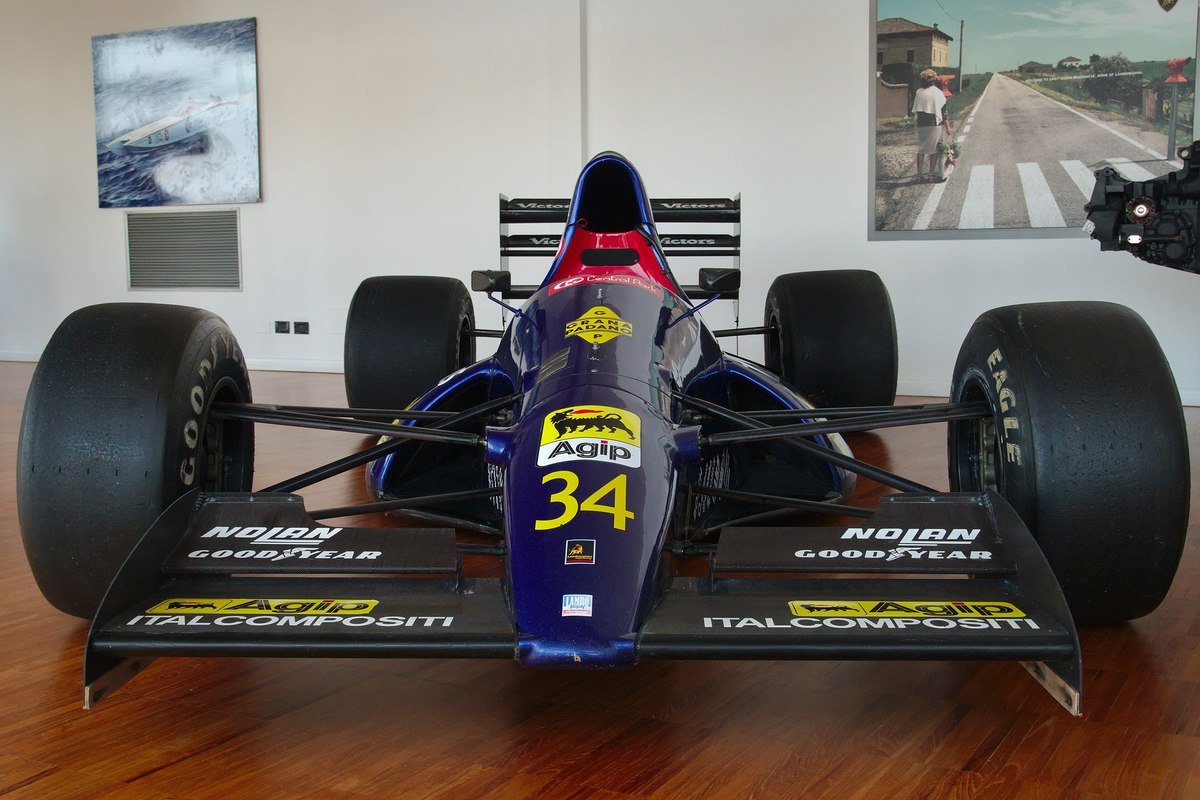
The only complete Lamborghini Formula 1 car raced in the United States. It started life in early 1990 as GLAS, backed by Mexican businessman Fernando González Luna, who was reported to be putting in around $20 million. Then González Luna vanished, and his money went with him. Lamborghini stepped in to keep the project alive, and Carlo Patrucco, previously at Fila, took over as team principal.
The car was the Lambo 291, designed by Forghieri with Mario Tolentino: carbon-fiber tub, pushrod double wishbones front and rear, 510 kg, a six-speed sequential gearbox and the LE3512 behind the driver. Blue paint, triangular sidepods and slanted radiators.
Its best result came in the season opener, the 1991 United States Grand Prix on the streets of Phoenix, where Nicola Larini finished seventh, three laps down. In 1991, seventh paid nothing. Eric van de Poele came closer at Imola, where he was running fifth and on course for two points when a fuel system problem stopped him on the final lap. He was classified ninth.
Sixteen Grands Prix entered, six starts, zero points. No serious sponsor showed up, Lamborghini refused to put in more money, and the team folded before the 1992 season. One chassis sits in the Lamborghini museum in Sant’Agata Bolognese.
Two Sports Cars, Same Story
The F1 engine wasn’t Lamborghini’s first try at serious racing, and the earlier try ended the same way. In 1985 Spice Engineering in England built the Countach QVX, a Group C car commissioned by David Jolliffe, Lamborghini’s British importer, around the 5.7-liter V12 from the Countach Quattrovalvole, developed by Luigi Marmiroli to between 650 and 700 hp. Unipart was the only sponsor. It raced exactly once, at the Kyalami 500km in November 1986, where Tiff Needell qualified seventh and finished fifth. Entries for the 1987 Silverstone 1000km and Le Mans followed, and the car showed up at neither. The money had run out.
Five years later the F1 V12 went into a sports prototype, the Konrad KM-011, designed by Geoff Kingston for the 1991 World Sportscar Championship and rated at 640 hp. It failed to qualify on its debut at the Nürburgring and never reached a finish in the championship: in Mexico City the gearbox quit after 36 laps, at Autopolis the suspension failed after 24. Its best result was fourth overall at a 1992 Interserie race at the Nürburgring. It was announced for the 1992 World Championship and never turned up.
Forghieri Was Already Gone
By then Forghieri was out. Chrysler completely reorganized Lamborghini Engineering in 1991 and replaced him with Mike Royce. He went to Bugatti as technical director from 1992 to 1994, the EB110 years, and co-founded Oral Engineering on January 1, 1995.
When his engine finally got into a chassis good enough to show what it could do, he had been gone for two years.
The McLaren Test, Lap by Lap
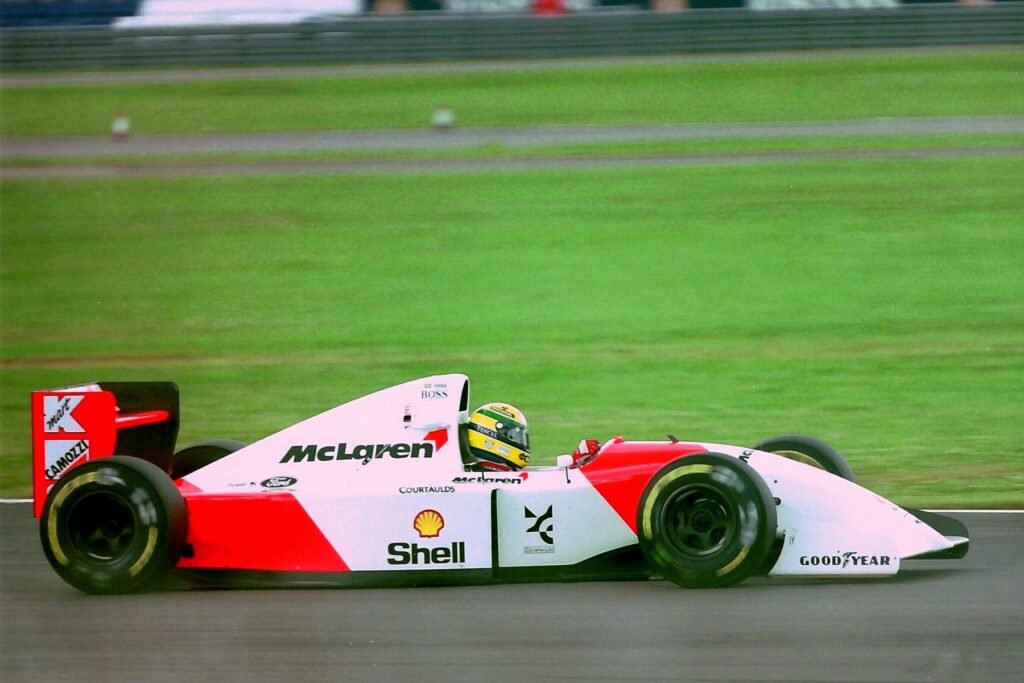
The Lutz-Dennis handshake produced the MP4/8B: an all-white McLaren with no sponsor logos, run by a crew of just three mechanics. One of them, Adrian Burgess, later described the program in detail. They went to Pembrey in Wales, then Silverstone, then Estoril.
At Silverstone, Mika Häkkinen lapped 1.4 seconds quicker than in the Ford-powered car McLaren was racing. He also blew up an engine. At Estoril, the day after the Portuguese Grand Prix, Dennis gave the crew a target: be five seconds faster than the Larrousse with the same engine, and he would consider the deal. Within half a day, they were 4.9 seconds quicker than the Larrousse had been at the Grand Prix.
Burgess said Senna loved it and thought the engine was great. Reliability was another story. By the time the engine was warm it had usually destroyed itself, and the longest run they managed was 19 laps. When it let go, he said, you could look down the intake trumpets and see daylight out the bottom. With all that practice, the crew got an engine change down to 26 minutes, from rolling the car into the garage to driving it back out.
In McLaren’s hands the engine was reported at around 750 hp, against 710 for the 1993 race version. McLaren was racing a Ford V8 rated at about 507 kW, roughly 680 hp.
Why Chrysler Let It Go
Burgess put it plainly: everything came down to Chrysler spending the money to develop the engine and make it reliable. Dennis couldn’t get that deal done and signed Peugeot for 1994. Senna moved to Williams.
The LE3512 never raced in Formula 1 after 1993. Chrysler sold Lamborghini in 1994 to an Indonesian investor group linked to Tommy Suharto, and the engine program went with the company. Every car that raced the engine carried “Chrysler powered by Lamborghini” on its bodywork. The McLaren test car just said Chrysler.
NEC Verdict
The record says 80 entries, 49 starts, 20 points, one podium, no wins. File it under technical failure if you like.
Meanwhile another Sant’Agata V12 was winning on water: Lamborghini marine engines took ten Class 1 offshore world titles between 1994 and 2007.
Look at what the record leaves out. The engine was designed by the man behind eleven Ferrari world titles, spent five years in Larrousses, a collapsing Lotus, a Ligier and a Minardi, and the only time anyone put it in a top car it beat the Ford by 1.4 seconds a lap. Chrysler funded the Viper V10 all the way to production. It wouldn’t fund reliability for an F1 engine Ayrton Senna wanted to race, even though it blew up inside 19 laps.
Iacocca’s company owned a Formula 1 engine that Senna asked for by name, and it let Ron Dennis walk to Peugeot over the bill.
Check you’re still alive.
Photos: Lambo 291, Rob Oo (CC BY 2.0); LE3512 engine, Schuy (public domain); Lola LC89 at the Lamborghini museum, Arnaud 25 (CC BY-SA 3.0); Lotus 102, Nic Redhead (CC BY-SA 2.0); Senna’s McLaren MP4/8, Martin Lee (CC BY-SA 2.0). Via Wikimedia Commons.