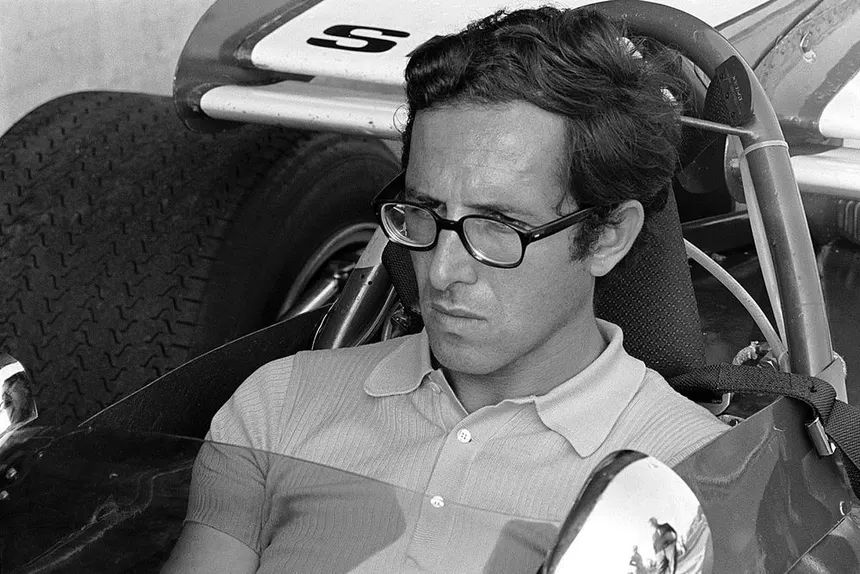
MAURO FORGHIERI: The Engineer Who Held Ferrari Together for 27 Years and Got a Decorative Office in Return
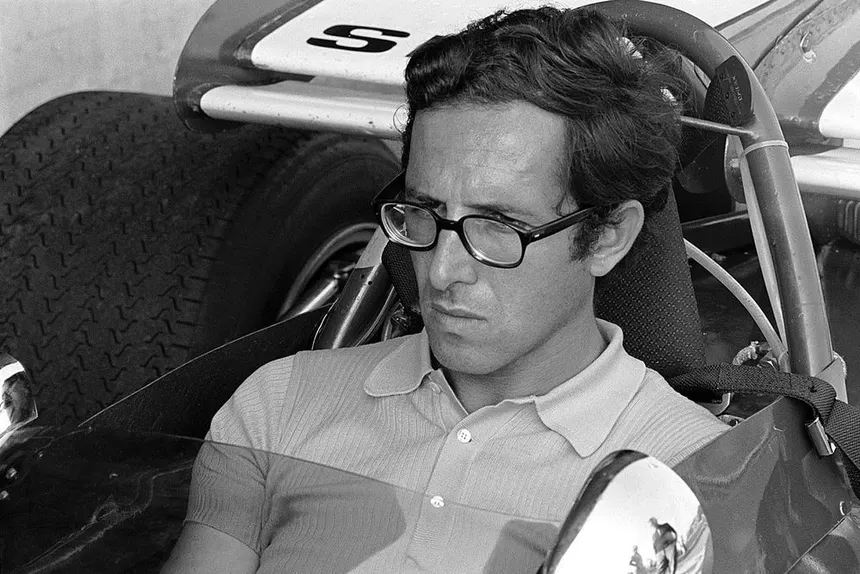
Picture this. You’re 26. You’ve been at Ferrari for one year. Last week, every senior engineer in the place walked out at once. You’re the only qualified engineer left because you happen to be the youngest one and nobody bothered to take you with them. Enzo Ferrari calls you into his office. Sits you down across that absurd oversized desk that forces visitors to half-bow to shake his hand. And tells you that from this moment forward you are responsible for the entire technical operation of the Scuderia.
You answer: “With all due respect, are you out of your mind?”
That’s how the story starts. And Maranello has never told it the way it deserves to be told.
A childhood in oil
Mauro Forghieri was born in Modena in January 1935. His father, Reclus Forghieri, was a lathe operator. Not just any lathe operator. One of the men who worked alongside Enzo Ferrari in the late 1930s on the Alfa Romeo 158, the single-seater that would dominate the first years of the Formula 1 World Championship after the war ended. Reclus then went directly to Ferrari and stayed there until 1973.
Which means Mauro grew up breathing benzene before he could ride a bicycle. He didn’t discover engines. He inherited them.
He studied mechanical engineering at the University of Bologna. Took a doctorate. Started teaching at the university. Had his life mapped out: emigrate to California, work in aviation, leave postwar Italy behind. Plane ticket practically in hand.
His father picked up the phone and called Enzo Ferrari. Told him his son was leaving the country. Enzo offered Mauro what Mauro would later call, with a half-smile, “a summer job”. In 1960 he walked into Ferrari’s engine department. He was 25 years old.
California stopped existing. Maranello started.
The Great Walkout
A year passed. Then came what Ferrari folklore calls the Great Walkout. Carlo Chiti, Giotto Bizzarrini, Romolo Tavoni, Girolamo Gardini, others. The heavy hitters of Ferrari’s engineering and racing department all left at the same time. The reasons were complicated and nobody wanted to say them out loud, but the common thread was simple. Working for Enzo Ferrari, on his terms, eventually wears down anyone.
Forghieri stayed. Not because he was the best. Because he was the only qualified engineer still in the building. Enzo summoned him. Handed him the keys to the technical kingdom. Forghieri asked if he was serious. Enzo said yes.
Forghieri walked out of that office with the entire technical direction of the racing department on his back. He was 26. The average age of a Formula 1 technical director in that era was closer to fifty. He had been at the company for twelve months. Twelve.
First job: take the Ferrari 156 — the famous “shark nose” that had won the 1961 title with Phil Hill — and redesign it from the rear suspension up. Lighter chassis. Bosch fuel injection. He did it without a safety net. Nobody above him knew the work better. Nobody below him could carry the weight if things went wrong. He did all of it.
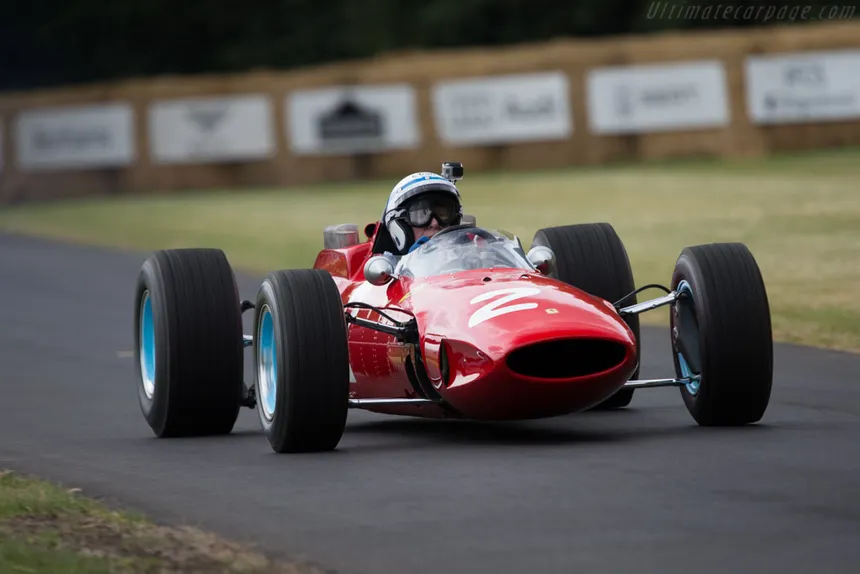
In 1964, John Surtees won the Formula 1 World Championship in a Ferrari 158 designed by Mauro Forghieri. Ferrari took the constructors’ title too. Forghieri was 29.
He was just getting started.
The wing that broke Formula 1
Belgian Grand Prix, 1968. Spa. Forghieri had been talking for weeks with Frank Gardner, a privateer running aerodynamic experiments in New Zealand. He had also been picking up echoes of what Lotus was quietly trying. Others were hinting. Others were testing in garages behind closed doors.
Forghieri built it, mounted it, and rolled it out to the grid.
The Ferrari 312 turned up at Spa with a real, properly designed rear wing. Not an improvised plank. An actual aerodynamic profile mounted on supports that channeled downforce onto the rear axle. The FIA looked at it, looked at the rest of the field, looked at it again, and within months had to write specific regulations to control wings because every other team had copied the idea by the next race.
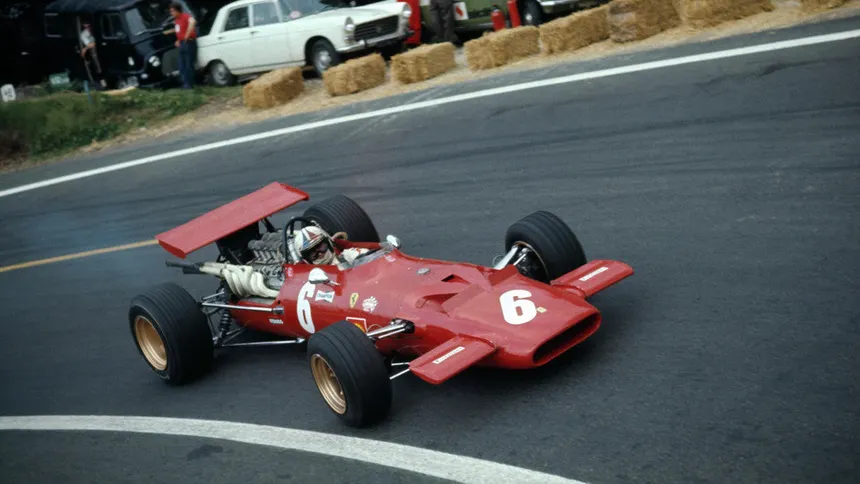
Forghieri didn’t stop there. He added hydraulic cylinders so the driver could adjust the wing angle while driving. The FIA banned that too, eventually. The point isn’t whether the trick survived. The point is that Forghieri kept inventing things faster than anyone could write rules to ban them.
This is what you have to understand about him. He didn’t innovate because he had time on his hands. He innovated because he had a race to win on Sunday and his brain happened to run two laps ahead of the rest of the paddock.
The flat-12
- The Ferrari 312B appeared. And inside it sat an engine that would define the next eleven seasons of Ferrari Formula 1: the flat-12.
Twelve cylinders laid out at 180 degrees. Pistons moving horizontally, parallel to the asphalt. The boxer concept wasn’t new — boxer engines had existed since the dawn of the automobile — but doing it with twelve cylinders for Formula 1 was another matter entirely. Forghieri pushed for it for two reasons that make sense the moment you visualise the car.
One. A flat engine drops the centre of gravity in a way nothing else can. The car feels glued to the road through corners. More than four hundred and fifty horsepower in its first iteration, all of it sitting as low as physics will allow.
Two. And here’s the chess move. A flat engine leaves the entire upper rear of the car free. Which means the air leaving the diffuser arrives clean at the rear wing. The aerodynamicist on the project was also called Forghieri. Same person, both jobs, same brain solving two problems at once.
The flat-12 ran in Formula 1 until 1980. Eleven seasons with the same fundamental architecture. In Formula 1. Where the typical lifespan of a technical advantage is two seasons before someone catches up. Eleven.
Lauda
- Niki Lauda arrived at Ferrari. Forghieri put him in the 312T. The T stood for “Trasversale” — gearbox mounted transversely, another geometric decision aimed at improving weight distribution.
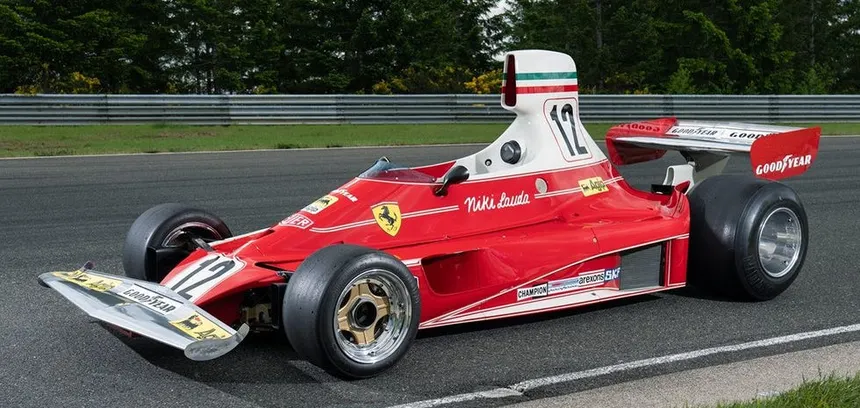
Lauda won the World Championship. Ferrari took the constructors’ too.
- Lauda nearly died at the Nürburgring. Other drivers pulled him out of a burning car. A priest gave him last rites in the hospital. His face was permanently scarred. Forty-two days later he was back in a Forghieri Ferrari at Monza, with the burns still raw, and finished fourth. He lost the title by a single point after pulling out of the rain at Fuji. Ferrari still won the constructors’ that year. The car was always there. The car was always there.
- Lauda, second world title. Ferrari, another constructors’ crown.
- Jody Scheckter, World Champion. Gilles Villeneuve, runner-up. Forghieri’s 312T4 destroyed the field. Ferrari, constructors’ again.
Four drivers’ world titles. Seven constructors’. Fifty-four Grand Prix wins. Every single one of those cars came from the same brain.
The gearbox that arrived ten years too early
Here’s a story that almost nobody tells you. 1979. Forghieri designed a semi-automatic gearbox for the 312T. No clutch pedal for shifts. Paddles behind the wheel. Hydraulic actuation.
He handed it to Gilles Villeneuve to test. It worked. It never made it to a race — internal politics chose otherwise — but the system existed, was built, was run on track.
Exactly ten years later, in 1989, Ferrari debuted the 640 with a semi-automatic gearbox in Formula 1, and the entire press corps called it “revolutionary”. Not exactly the same system, but the same idea. The same line of thinking. And eighteen years later, the road-going Ferrari F355 wore the “F1” transmission that every Ferrari owner celebrates as the moment Maranello brought the racetrack to the road.
Forghieri had already designed it in 1979. He just wasn’t allowed to use it.
The turbo
- Ferrari’s first turbocharged Formula 1 engine appeared, the 126C. Forghieri had been developing it since 1979, in parallel to everything else. Another new architecture. Another leap.
In 1982 and 1983, Forghieri’s turbos — by then with British designer Harvey Postlethwaite working alongside him on the chassis — won back-to-back constructors’ titles. The 1982 season also contained the death of Gilles Villeneuve at Zolder and the career-ending crash of Didier Pironi. A season that destroyed the team emotionally and still ended with a constructors’ trophy in Maranello because the car was the fastest in the championship.
And then the other half of the story began.
Sidelined
- Ferrari won a single race the entire year. Internal politics at Maranello started shifting. Someone had to be blamed. Someone had to be reorganised. New faces had to appear.
In 1985, Mauro Forghieri was removed from the technical directorship of Formula 1. The official title they gave him was “Director of the Advanced Research Office”. A pretty name for an office without power. Postlethwaite was left in charge of Formula 1 engineering. Forghieri was sent to work on the 408 4RM concept car, an interesting project that wasn’t Formula 1, wasn’t racing, wasn’t what he had been doing since he was 26 years old.
Twenty-five years inside the company. Four drivers’ world titles on the table. Seven constructors’. And they handed him a side office with a decorative plaque on the door.
Forghieri resigned. Ferrari refused the resignation. Forghieri resigned again. Refused again. He resigned a third time. In 1987 they finally let him go.
No farewell in the way you or I would understand a farewell. No plaque, no speech, no thank-you-for-twenty-seven-years. A press release and silence.
To understand what Ferrari did to Forghieri, you have to understand who Forghieri worked for. That other side of the story exists on NEC too — Enzo at his desk, the absurd table, the way he managed people like spare engine parts. Read it whenever you want. It’s the exact other half of this story.
After Maranello
This is where the quiet decline could have started. The bit where an old man retires to write his memoirs and collect honorary awards. That isn’t what happened.
Lamborghini Engineering hired him on the spot. Chrysler had bought Sant’Agata and wanted to enter Formula 1 with their own engine. Forghieri sat down at a new desk, in a new company, fifteen minutes from Maranello, and started designing a 3.5-litre V12 from scratch. The Lamborghini 3512. Twelve cylinders in a V at 80 degrees. It debuted at the 1989 Brazilian Grand Prix in a Larrousse-Lola. Best result of its entire racing life, sixth place for Philippe Alliot in Spain. The engine was strong. The project wasn’t. Lotus ran it for a season. So did Modena Team. So did Minardi. Five years of Formula 1 with an engine that sounded like the Italy that no longer existed. Forghieri hadn’t taken a Monday off.
- A Mexican businessman named Fernando González Luna appeared with his own Formula 1 project and enough money to hire whoever he wanted. He wanted Forghieri. Forghieri signed. He designed the GLAS 001. Worked on it for months. The car was finished, painted, ready to roll. The press launch was scheduled. The day before the launch, González Luna disappeared with all the money. The car stayed in the workshop covered with a tarp. The company collapsed. Forghieri went home and started over.
- ENEL commissioned him to design an electric minivan. Yes, electric. In 1992. While the rest of the automotive world was still arguing about whether the catalytic converter wasn’t some kind of green-lobby fad. Forghieri delivered the drawings and moved on to the next thing. Twenty years ahead of the curve. Again.
1992 to 1994. Technical director at Bugatti Automobili. He worked on the EB110 — quad-turbo, all-wheel drive, mid-engined — and pushed forward the 112 project, the four-seat saloon Romano Artioli wanted to put on sale. Bugatti went bankrupt. The 112 stayed unfinished. Forghieri went home. Again.
- He founded Oral Engineering in Modena with Franco Antoniazzi and Sergio Lugli. Three engineers, an industrial unit, a sign on the door. They started by doing R&D for whoever paid. BMW commissioned work. Bugatti came back years later. Aprilia, motorcycles. Marine engines, kart engines, automotive engines. Anything with combustion inside and a client with budget on the other side. They turned the Ferrari Pinin concept into an actual road-legal car, capable of getting to the petrol station and back. They did it outside Ferrari. After Ferrari. Without asking Ferrari for permission. And Maranello didn’t send so much as a postcard.
In the mid-2000s he was chief engineer of the Project 1221 MF1, a mid-engined supercar almost nobody remembers. He was asked to serve as a technical expert on the trial investigating Ayrton Senna’s death at Imola. He accepted. Studied the car, the data, the crash. His report carried weight. In 2013 he published “Forghieri on Ferrari: 1947 to the present” through Giorgio Nada Editore. The book sold out. The brand he had given twenty-seven years to organised no event, sent no flowers, sent nothing.
He died in Modena on 2 November 2022. He was 87. Maranello issued a statement.
The bumblebee
Forghieri had a phrase he used whenever a young engineer was paralysed by a problem with no obvious solution.
“A bumblebee knows nothing about the laws of aerodynamics, and yet it flies.”
That’s the entire man right there. Intuition before calculation, “this could work” before “this should be able to work”, and at the same time the discipline to build the thing afterwards with engineering precise enough that it didn’t break under load. He was volcanic, like everyone in that Ferrari — shouted in the pits, argued in the workshop, hugged on the podium — but unlike almost every other technical director in the history of the sport, he was also humble. His own people said it. The drivers who worked with him said it. His rivals said it. In a world of egos blown up like tractor tyres, this man didn’t need to tell you he was the best. He showed you on Sunday with the car.
The question that stays open
How many more championships would Ferrari have won if they had treated Mauro Forghieri like what he was?
That’s the question Maranello has been ducking for decades. Four drivers’ world titles. Seven constructors’. The first proper rear wing in Formula 1 history. The flat-12. The semi-automatic gearbox. The marque’s first turbo.
And a decorative plaque on a side office door.
Ferrari won what it won because Forghieri was inside the building. And it hurt their pride to figure that out. Which is exactly why they pushed him out.
Check you’re still alive.
2 thoughts on “MAURO FORGHIERI”