Lamborghini Marine Engines: The V12s That Won Ten World Titles at Sea
Sonny Crockett drove a Ferrari on TV. Don Johnson, the man who played him, set a record on the Mississippi with Lamborghini engines.
The boat was a Wellcraft Scarab, the race covered 1,034 miles of river, and the time was 19 hours and 51 minutes. It is a nice piece of Miami Vice trivia, and it points at something much bigger that most Lamborghini fans have never heard of. Between 1994 and 2007, catamarans powered by Lamborghini V12s won the Class 1 offshore powerboat world championship ten times. Over the same era, Lamborghini’s Formula 1 engine scored one podium in five seasons.
Ten world titles against one podium. Only one of those two stories ever made it onto a bedroom wall.
A 500-cubic-inch V12 with no car to go in
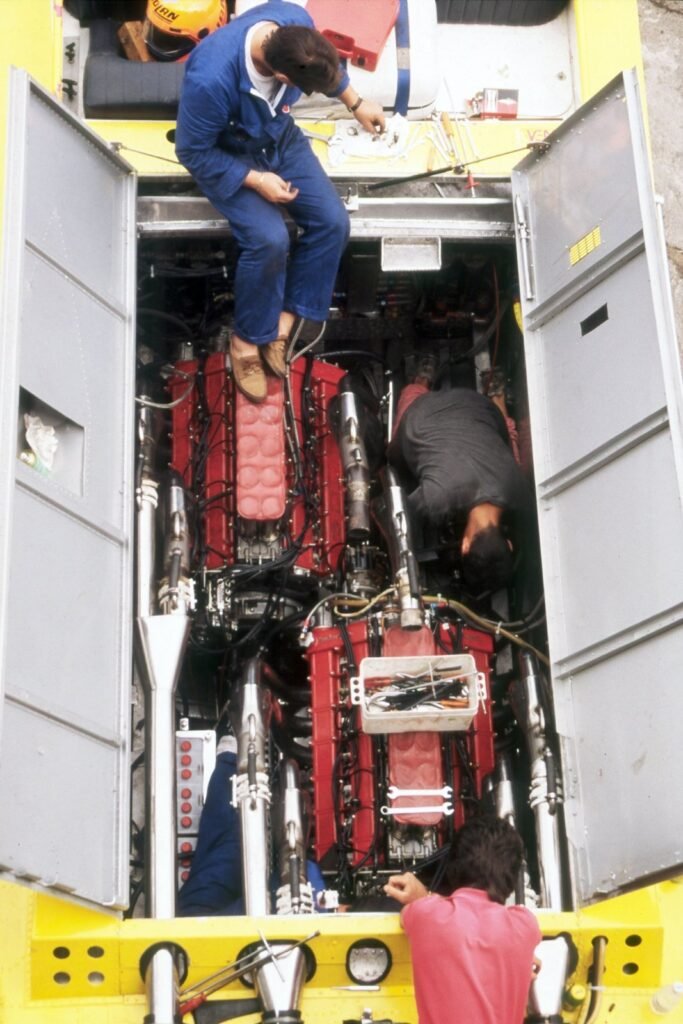
The marine program did not start with a grand plan. It started with leftover hardware.
In 1980 the Swiss Mimran brothers took over a bankrupt Lamborghini. Patrick Mimran found prototype V12s of around eight liters in Sant’Agata, built for a luxury sedan project that never needed them. Engines without a car. He decided they belonged in a race boat.
The logic was sound. Offshore racing at the time ran on huge diesels or supercharged American V8s, and a light-alloy V12 weighed a lot less than a diesel making similar power. Lamborghini also had a seven-liter V12 conceived for marine use that it tried in the LM004, a 1984 off-road prototype. That one was dropped: the engine underdelivered and the truck got too heavy.
The man running engineering then was Giulio Alfieri, who came to Lamborghini in 1975 and became general manager in 1982. Before that he spent more than twenty years at Maserati, where he was behind the 3500 GT and the Birdcage. Alejandro de Tomaso bought Maserati in August 1975 and fired him the same day.
The L804, in numbers a hot rodder understands
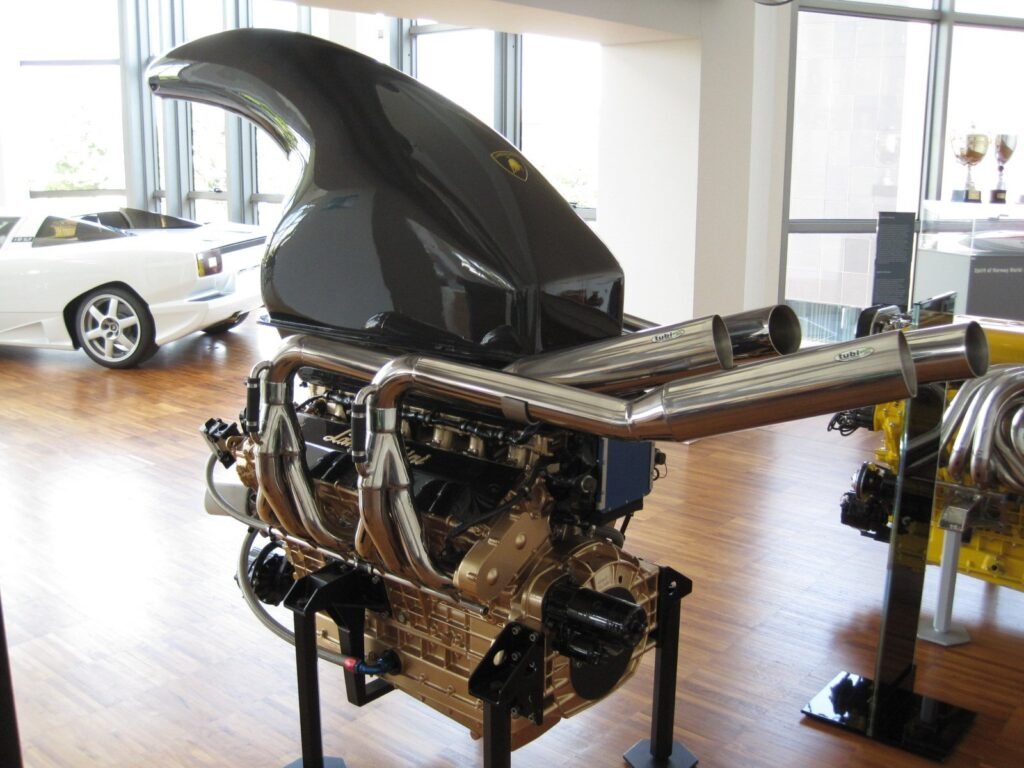
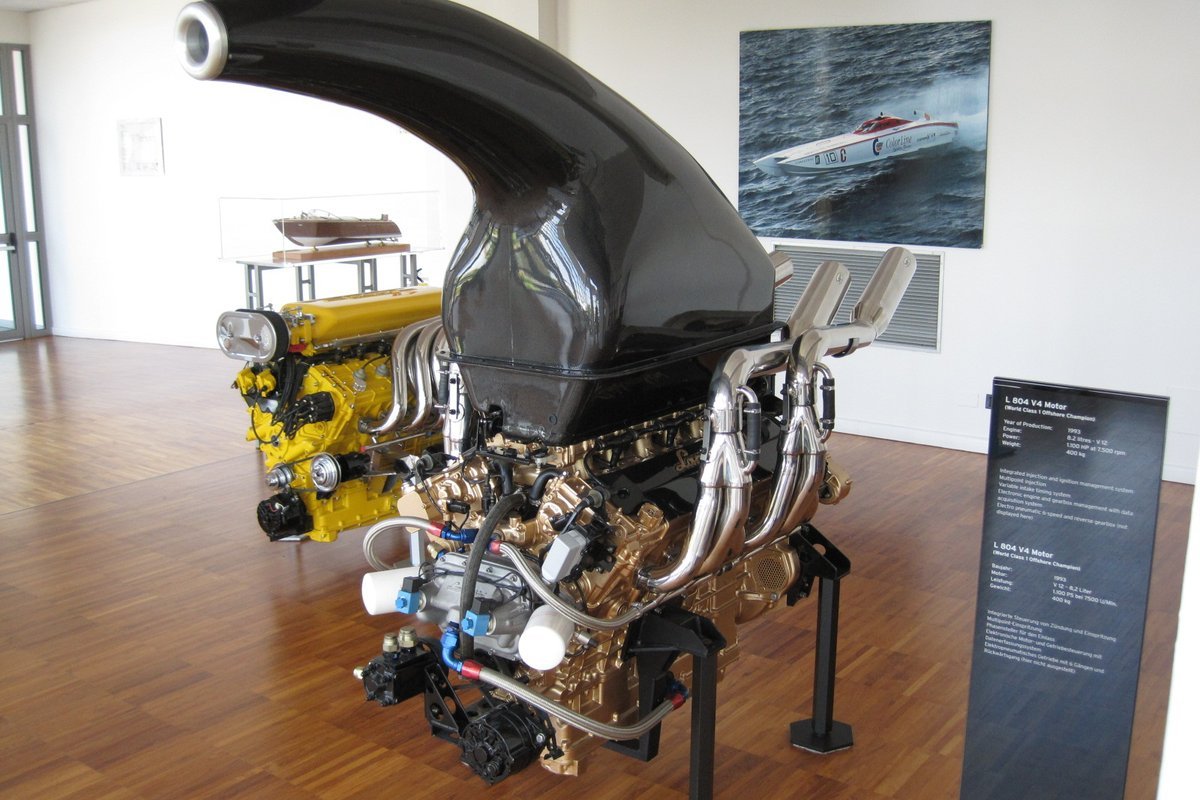
The engine that did the winning was the L804, and it entered competition in 1987.
It was a 60-degree V12 displacing 8,172cc, or 499 cubic inches, with a 98.7mm bore and 89mm stroke, four overhead cams, four valves per cylinder, electronic fuel injection and Marelli Microplex ignition. Output was 880 horsepower at 6,650 rpm, with the limiter at 6,800, and about 738 lb-ft of torque at 5,500. Depending on the source it weighed between 793 and 877 pounds dry. Block and heads were light alloy. It kept growing: the placard in the Sant’Agata museum credits the 1993 version with 1,100 horsepower at 7,500 rpm for 400 kg, about 880 pounds.
For context, the European-spec Countach Quattrovalvole of 1985 made 455 PS, and the US version less than that. The 3.5-liter F1 V12 that Mauro Forghieri‘s team built for 1989 made around 600. The strongest engine coming out of Sant’Agata at the end of the 1980s went into no car at all.
There was a bigger brother, the L900. It displaced 9,336cc, used carburetors instead of injection and made 770 horsepower. Less power from more displacement sounds backwards until you think about who bought it. A race engine gets torn down by a team after every few events. A yacht engine gets run hard for years by an owner with no mechanic on board, so you give it a lazier state of tune and fewer electronics to fail far from the dock.
Sold through Wisconsin
Here is the part American readers should enjoy. Lamborghini signed a deal with MerCruiser under which the American company would buy 300 engines and distribute them in the United States: the 8.2-liter for racing, the 9.3-liter for pleasure boats.
That is how a Lamborghini V12 ended up in a Wellcraft Scarab with Don Johnson at the wheel. It also means that the boat-dealer catalogs of the late 1980s were selling something the car showrooms could not: the most powerful engine the company built.
By the time the L804 started racing in 1987, Lamborghini itself had a new owner in Detroit. Chrysler bought the company that year, and the Chrysler era is remembered for the Diablo and the F1 adventure. The boat engines that were actually winning get a footnote at best.
Ten championships, mostly flying a Norwegian flag
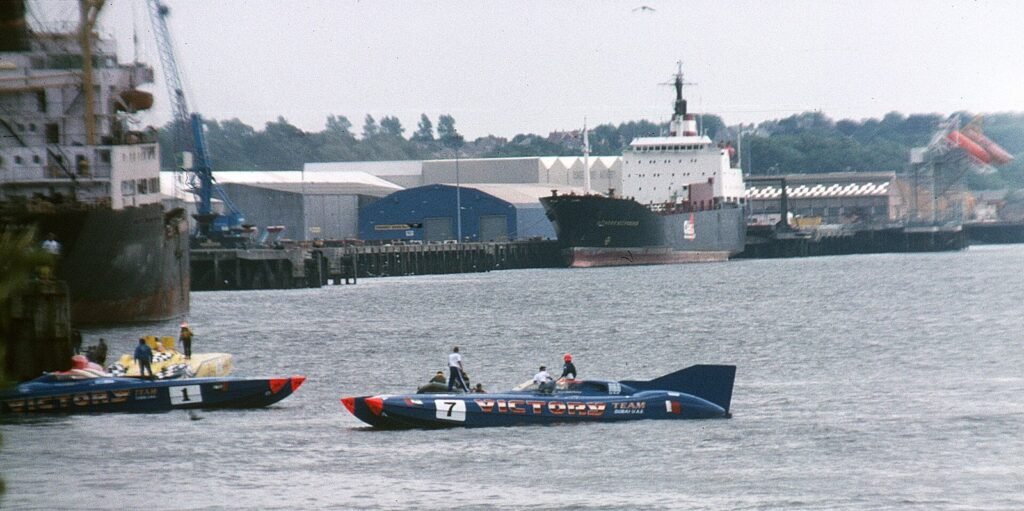
Class 1 is the top category of offshore powerboat racing. It has existed since 1964 under the Union Internationale Motonautique. The boats are catamarans 39 to 46 feet long and about 11 feet wide, built in carbon fiber and Kevlar, with a minimum weight of 4,950 kg, roughly 10,900 pounds. Two people ride inside: a driver who steers and a throttleman who works the throttles and the trim, keeping the hull from launching off a wave and flipping.
Until 2014 the engine rules were open. Daytona, Detroit Diesel, MerCruiser, Aeromarine, KS & W, Seatek, Isotta Fraschini, Sterling and Lamborghini all showed up. This is where the record gets serious.
The first undisputed title came on November 25, 1994, in Dubai, at the last race of the season. Giesse Philosophy, a Tencara hull with two L804s, won the championship with Norberto Ferretti and Luca Ferrari aboard. Ferretti went on to build one of Italy’s biggest yacht groups. In 1997 another Tencara with Lamborghini power, driven by Laith Pharaon, won again.
Then came Spirit of Norway. It measured about 41 feet by 12, weighed 4.8 tonnes and ran two 8.2-liter Lamborghini V12s rated at 850 horsepower each, good for a top speed listed at around 155 mph. Norwegian businessman Bjørn Rune Gjelsten won the world title with it in 1998, 2002, 2003, 2004 and 2006, with Englishman Steve Curtis on the throttles. Class 1 calls them its most successful partnership ever. The 2005 title went to the same boat under a different owner: Bård Eker bought the team in 2004, won in 2005 with Curtis, and sold it back to Gjelsten in 2006.
The Dubai-based Victory Team filled in the gaps, also on Lamborghini power, winning in 2001 with Mohammed Al Marri and in 2007 with Arif Saif Al Zafeen. In 2008 the champion ran Victory’s own engines, and the Lamborghini run was over.
That makes ten world championships between 1994 and 2007 on the Class 1 champions list. Powerboat News counts twelve and credits the engines with 88 race wins.
Set that next to the F1 numbers: 80 entries, 49 starts, 20 points, one podium, no wins. A complete race engine with its air scoop cost around €90,000 in the mid-2000s, according to the Italian magazine Barche a Motore. An F1 team would spend that on a test session.
The 1984 title everybody quotes
Most stories about these engines open with a boat called Miura.
Cantieri Uniti Viareggio built it: a 38-foot aluminum monohull. Alberto Petri drove it with Franco Statua and won the 1984 UIM championship. The usual version says it did so with two eight-liter Lamborghini V12s of 720 horsepower each, which makes it the brand’s first world title.
The paperwork disagrees. RM Sotheby’s catalog for the boat says it left the yard with two MerCruiser V8s and got the Lamborghinis later. The Class 1 champions list credits the 1984 title to Petri’s CUV boat with MerCruiser engines. No source we found settles which engines were in the hull when the season ended, so treat that “first Lamborghini title” as unproven. If the list is right, Lamborghini’s first world championship at sea was won with American engines.
The name is the solid part. Miura is the fighting-bull ranch at Zahariche, in Lora del Río, near Seville, breeding bulls since 1842. Ferruccio visited in 1966, met Don Eduardo Miura and left with a name for his mid-engined car, the Miura. Eighteen years later the same Spanish ranch was painted on a race boat in Viareggio.
The other hull of that period was the Quetzal, designed by Aldo Cichero and shown in 1984: 39 feet, a luxury version called Axxes Quetzal that ran 65 knots, and a stripped version with two V12s totaling 1,440 horsepower.
Ferruccio’s mahogany hot rod
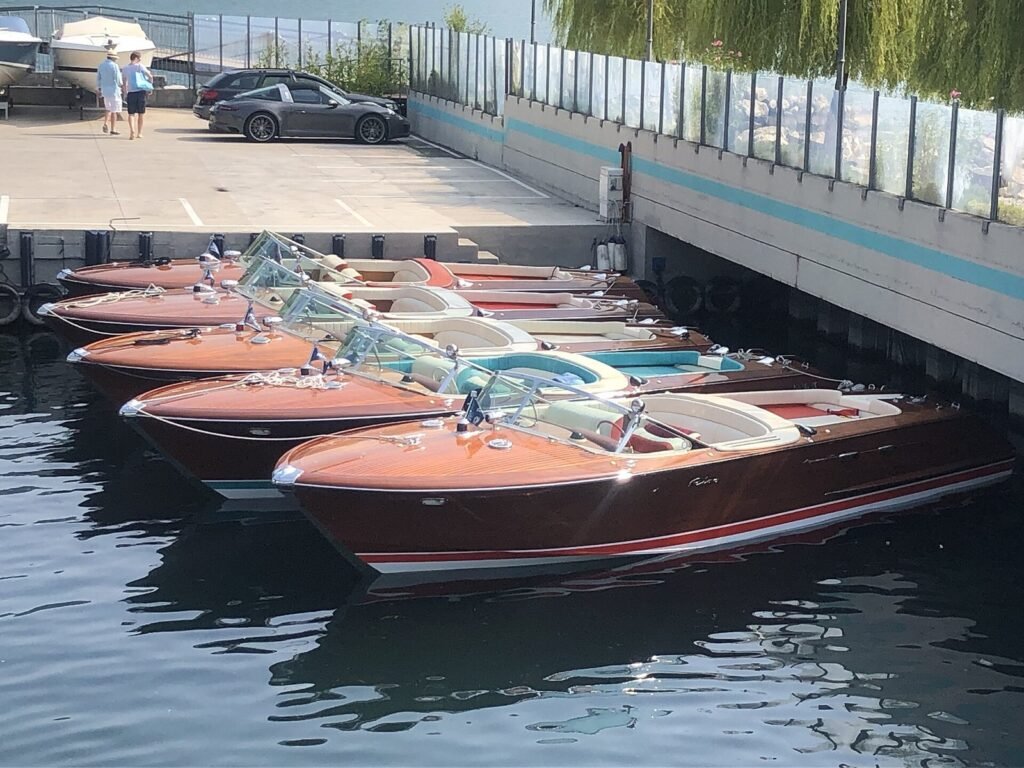
The boat program came after Ferruccio was gone. He sold 51% of the car company in 1972 and the rest by the end of 1974. But the idea of a Lamborghini V12 on water was his.
In 1968 Carlo Riva delivered him an Aquarama, hull number 278, built in three months at Sarnico. Ferruccio skipped the standard V8s and asked for two V12s from his 350 GT. Test driver Bob Wallace did the conversion with Lino Morosini, head of Riva’s engine department. Marine engines run near full load for long stretches and are cooled by the water they float on, so the job took new exhausts, a different cooling circuit and dedicated drive parts. One engine was set up to spin the opposite way to the other so the propellers would not pull the boat sideways.
Each V12 made 350 horsepower against 280 in the road car. The boat ran 48 knots, 55 mph, eight knots more than a stock Aquarama, and no Riva of the 1960s was faster.
The boat was sold in 1988, the V12s went back to Lamborghini, and the new owner fitted Riva V8s. After Ferruccio died in 1993 it rotted under a tarp in a boatyard. Dutch collector Sandro Zani found it near Punta Ala, in Tuscany, in 2010, and his company Riva-World spent three years rebuilding it with period 350 GT engines, since one of the originals sits in the Museo Ferruccio Lamborghini. It runs 48 knots again, lives in the Netherlands and was insured for about $3 million in 2015.
You could order the boat engine in a truck
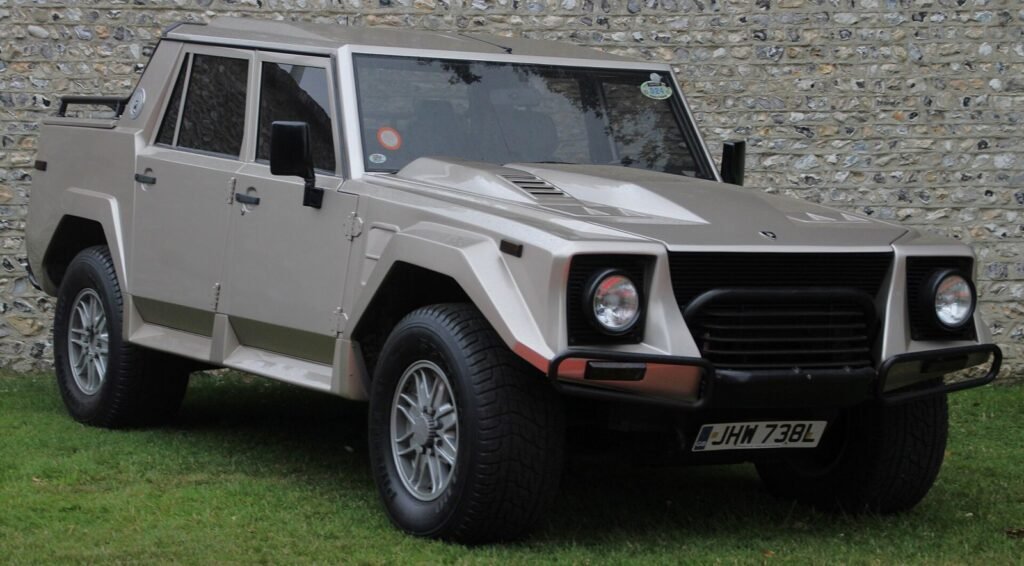
The traffic between water and land ran both ways.
The LM002, the off-roader that grew out of the failed Cheetah military project, was built in 301 units between 1986 and 1993, the last 60 as the LM/American sold only in the United States. The standard engine was the Countach’s 5.2-liter V12. The options list included the L804 marine V12. Spec sheets call it a 7.2-liter, which does not match the 8,172cc race engine, and no primary source says exactly which version went in or how many trucks got one. The few references talk about a handful.
The truck had a Spanish skin. Irizar, the bus body builder from Ormaiztegi in the Basque Country, made the LM002’s body panels, many of them in composites, plus several interior parts, all shipped to Sant’Agata. The contract was signed in 1986 and the relationship was rough: the Italians complained about the finish and redid part of the work.
The yacht with the bull on it runs on truck diesels
Lamborghini went back to sea in 2020, this time as a name.
The Tecnomar for Lamborghini 63 is built by Tecnomar, part of The Italian Sea Group, in a run of 63 boats, a nod to 1963, the year Automobili Lamborghini was founded. It is about 65 feet long, weighs 24 tonnes at half load, uses a lot of carbon fiber and borrows styling from the Sián FKP 37. Top speed is 63 knots, about 72 mph. Conor McGregor bought one in 2021.
It is powered by two MAN V12-2000 diesels of 2,000 horsepower each. Each one displaces 24.2 liters, close to 1,480 cubic inches, and peaks at 2,300 rpm. The L804 made 880 horsepower from 8.2 liters at 6,650.
MAN Engines belongs to MAN Truck & Bus, which belongs to Traton, Volkswagen’s heavy truck group. Lamborghini belongs to Audi, which belongs to Volkswagen. So the boat with the raging bull on the bow is pushed by a truck-derived diesel from a corporate cousin in Nuremberg.
The old rival tells the rest. Class 1 now runs a spec formula with twin Mercury Racing nine-liter engines for everyone. MerCruiser, the company that once resold Lamborghini V12s across America, is a Mercury brand. The category that Sant’Agata used to win with its own engines is now a one-make series for the people who used to distribute them.
Why the poster shows a Countach
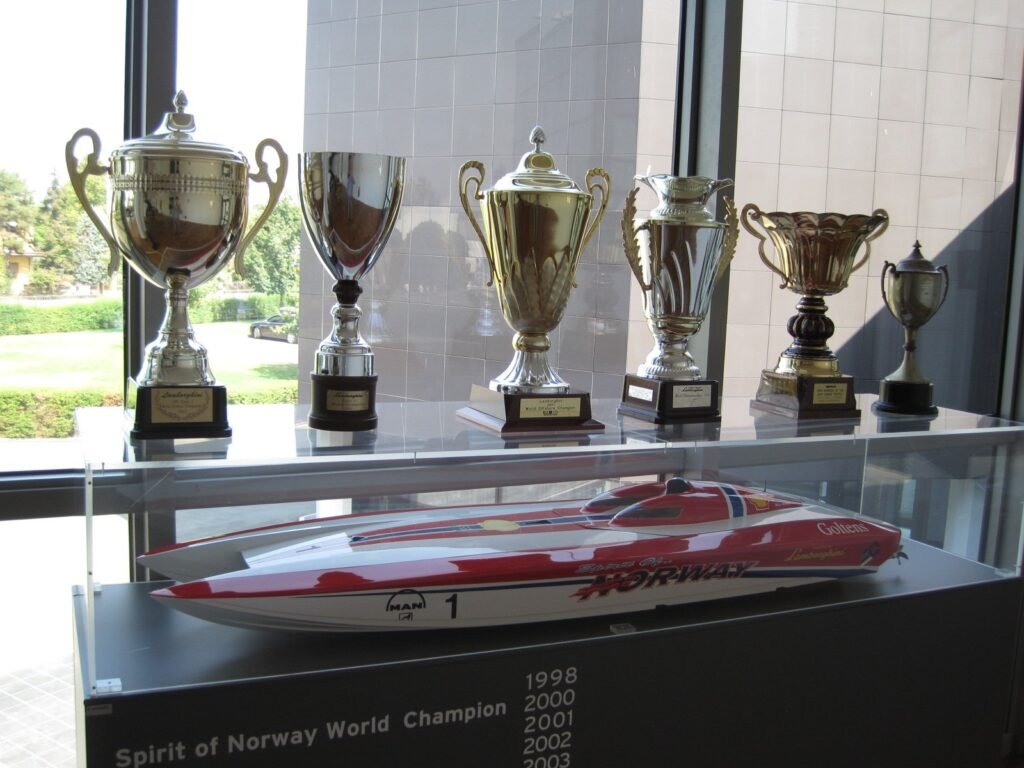
The factory museum in Sant’Agata does not hide the boats completely. In 2013 it displayed a Spirit of Norway model with its trophies, an L804 under its giant carbon air scoop, a yellow L900 and a model of Ferruccio’s Aquarama.
But ask a Lamborghini fan who Bjørn Rune Gjelsten is. The marine story has everything a supercar brand cannot sell. It is not Formula 1. Ferruccio did not do it. The hulls came from Cichero and Tencara, the winning teams were Norwegian, Emirati and Italian, and the engine was sold to anyone with €90,000, even through a dealer catalog. That is the opposite of the scarcity Lamborghini charges for today.
So the racing memory of the Chrysler years stays stuck on Aguri Suzuki’s third place at Suzuka in 1990, the podium whose constructor points the FIA later took away. One podium against ten world titles, and all ten were won on water.
Check you’re still alive.
Photos: L804 and L900 engines, L804 and Spirit of Norway trophies at the Lamborghini Museum, Arnaud 25 (CC BY-SA 3.0); Lamborghini V12s in an offshore race boat, Rennbootarchiv (CC BY-SA 3.0 DE); Class 1 catamarans at Dundee, Laerol (CC0); Riva Aquarama, StuivertjeWisselen (CC BY-SA 4.0); Lamborghini LM002, MrWalkr (CC BY-SA 4.0). Via Wikimedia Commons.