
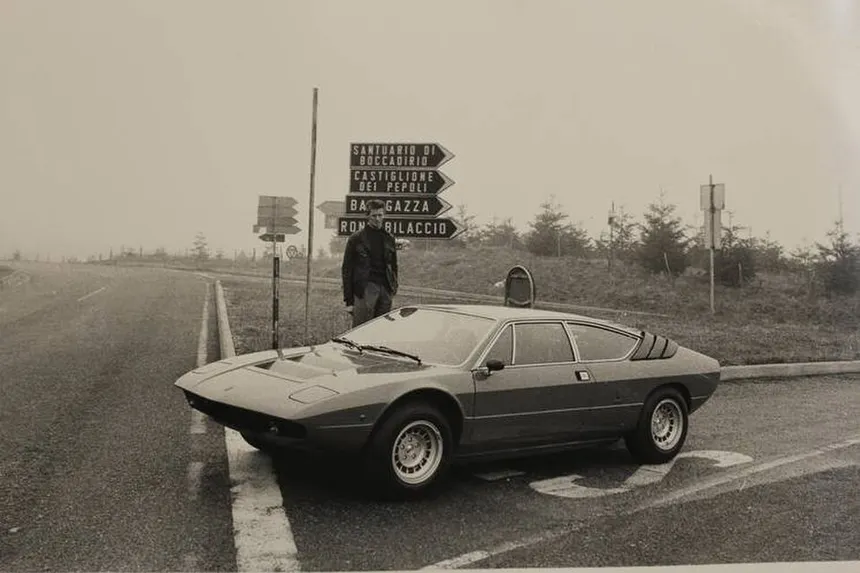
Bob Wallace: The Hot Rodder Who Built Lamborghini’s Forbidden Car
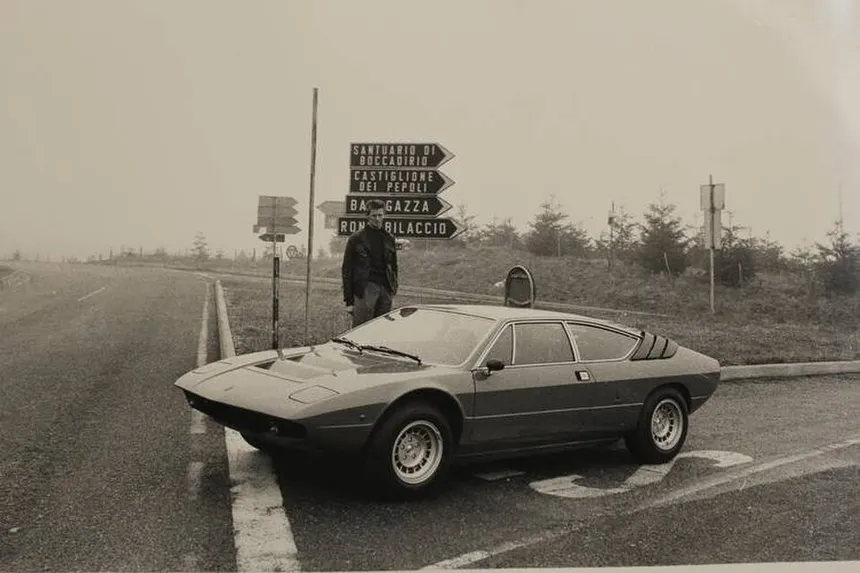
He started out building hot rods with his buddies. He finished up alone in a shop in Phoenix, Arizona, sorting out other people’s Ferraris. In between, he spent twelve years as the man who decided whether a Lamborghini was fit to sell to a human being — and he built, without permission and without a budget, the most legendary car Sant’Agata never officially made.
Here is how far off the books that car was: in 1970 it had no chassis number. It didn’t need one, because as far as Automobili Lamborghini’s paperwork was concerned it did not exist. Nobody had ordered it. Nobody had funded it. It was assembled at night and on weekends using factory tooling and parts pulled from the company store, by a New Zealander who had a day job in the same building.
When the time came to sell it, accounting hit a wall. Issuing an invoice required a production certificate, and a production certificate required a number. So they handed it one from the Miura SV continuation series. Chassis 5084. A borrowed number, stapled after the fact onto a car the company had never recorded being born.
That car was the Miura Jota. The New Zealander was Bob Wallace.
Auckland to Modena, with a stop at Lotus
Wallace was born in Auckland on October 4, 1938. He got hooked on cars as a teenager, hanging around New Zealand’s local race meetings and building hot rods with his friends — including John Ohlson, who would eventually leave the country with him.
The pair landed in England first, where Wallace put in a stint at Lotus. That’s where Guerino Bertocchi — Maserati‘s legendary development driver — spotted him and offered him a shot in Italy. Wallace and Ohlson crossed Europe without being able to string a sentence together in Italian. When they arrived, there was no job at Maserati.
Most people go home at that point. Wallace stayed.
He picked up work as a mechanic with Camoradi USA — the American privateer outfit founded by Lloyd “Lucky” Casner, running Maserati Tipo 61 Birdcages and Chevrolet Corvettes — and worked the 1960 24 Hours of Le Mans with them. From there he moved to Scuderia Serenissima, where he got his hands on a Ferrari 250 GTO and a Ferrari 250 TR 61 Spyder Fantuzzi, and came into contact with Scuderia Ferrari itself.
One claim about this period needs handling carefully, because the internet repeats it at full volume. The official statement Automobili Lamborghini issued after Wallace’s death, signed by CEO Stephan Winkelmann, says he served as Phil Hill’s chief mechanic during the 1961 Formula 1 World Championship-winning season. That’s Lamborghini’s own account, on the record. What we have not been able to locate is documentation from Maranello confirming the detail. So it goes in as exactly what it is: the version maintained by the company that hired him afterward.
Either way, by twenty-three, a kid from the far side of the world had worked Le Mans, handled the best hardware Maserati and Ferrari were building, and been inside a world championship campaign. The logical move was to stay in Modena. Wallace went somewhere with nothing at all.
A factory with no cars, no history, and nobody who could test them
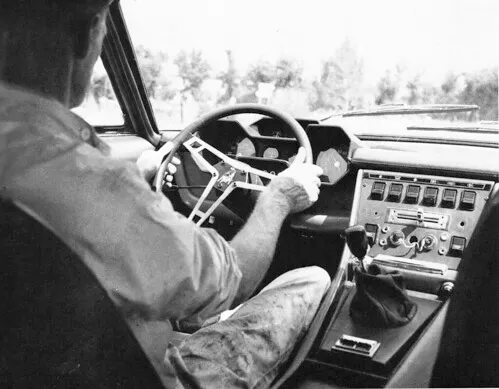
After the 1963 racing season, Lamborghini hired him at the newly built plant in Sant’Agata Bolognese. The job was mechanic and, in Wallace’s own word, trouble-shooter. Lamborghini’s official statement dates his twelve years as chief test driver from 1964 to 1975, so the hire and the promotion are not the same event, however often sources blur them.
Consider what he walked into. A company with no finished production car, no competition history, no test driver, and — this is the part that matters — nobody capable of getting into a prototype and articulating why it behaved badly. His first assignment was civilizing the V12 Giotto Bizzarrini had designed for the company: a brilliant engine and a completely raw one, built to make numbers rather than to live with an owner. Wallace worked through vibration, cooling and driveline reliability on the 350 GT until the thing became a grand tourer somebody could actually buy.
He became the test driver by the most Italian route available. By his own account, there was simply nobody else for the job.
Ferruccio handed him carte blanche: the run of the factory’s best equipment and unlimited access to the parts warehouse. Wallace ran prototypes at night to stay clear of police and photographers, regularly pushing past 170 mph on the autostrada. He timed himself over the 105 miles between the Milan and Modena toll plazas and raced, unofficially, against the test drivers from Ferrari and Maserati — who were out on the same road at the same hour doing the same thing. For serious high-speed work he used the Misano and Variano circuits.
Sit with that image for a second. The development drivers of Italy’s three great sports car makers, settling scores on a public highway at three in the morning, in cars that did not officially exist and had never seen a crash test. Nobody involved thought this was remarkable.
Once he was satisfied a prototype wouldn’t kill its future owner, he handed it to his crew to finish development. That was the actual job for twelve years, and it’s precisely why his name isn’t in the books. What Wallace contributed only becomes visible when it’s missing.
He developed the Miura alongside Gianpaolo Dallara and Paolo Stanzani from 1965, and his road findings fed directly into the Miura S and SV. With the same two men he also signed off the Espada chassis. The 400 GT, Islero, Jarama and Urraco went through his hands, and so — extensively — did the Countach: he spent all of 1971 road-testing the LP500 prototype.
The most famous name in Lamborghini history is a Spanish letter
Wallace was convinced the Miura could race. His target was to build one that complied with the FIA’s Appendix J — the section of the sporting code defining classification and specification for competition cars. The letter J doesn’t exist in the Italian alphabet, so for a project name he reached for the Spanish pronunciation of it.
Jota. The most mythologized Lamborghini ever built carries that name because somebody read an FIA rulebook in Spanish. At a company already naming its cars after Spanish fighting bulls and the ranches that bred them, the logic was airtight. Half a century later, most enthusiasts say “Jota” with no idea they’re speaking Spanish.
The car came together through 1970 on a semi-monocoque chassis drilled to within an inch of its life, with much of the original steel replaced by Avional, a lightweight aluminum alloy. The rocker panels were enlarged to swallow a 60-liter fuel tank on each side, replacing the single tank the production Miura carried under the front lid — less mass hanging off the nose, better balance. Ride height came down through a full rework of the suspension geometry, with fully adjustable Koni dampers and anti-roll bars at both ends, riding on 15-inch cast magnesium Campagnolo wheels shod with Dunlop Racing rubber. The glass went in the bin and Plexiglas went in.
The finished car weighed roughly 800 pounds less than a production Miura. The engine — raised compression, revised cams, electronic ignition, free-flow exhaust and dry-sump lubrication — went from the Miura S’s 370 hp to a figure sources place between 418 and 440 hp at 8,800 rpm.
Two things get repeated about this car that deserve correcting. First, the oiling. The Jota ran a dry sump, with a remote oil reservoir — a race system. The last production Miura SVs ran a split sump, which is a different animal entirely: it separated engine and gearbox lubrication so each could use its own oil and so gearbox debris stopped touring the engine. The two terms get used interchangeably in Jota coverage and they solve different problems. Second, top speed. The near-190-mph figures and acceleration times floating around forums and aggregator sites are not backed by any factory documentation we’ve been able to find. We don’t estimate here. It’s unverified, and we say so.
The car that could never have raced anyway
Wallace tested it for months and racked up tens of thousands of kilometers. Period press started calling it the Miura Privata — the private Miura — because that’s exactly what it was.
But there’s a detail that makes the story considerably harsher than the usual telling. By 1970 the FIA ran two production-based GT categories, Group 3 and Group 4. Group 4 homologation required 500 cars built within twelve consecutive months. Miura production never reached even half that figure in any year of its life.
So the Jota didn’t miss out on racing because Ferruccio blocked it, or because the car failed, or because of bad luck. It couldn’t race because of arithmetic. The rulebook Wallace gave up his nights and weekends to satisfy was one his employer was never going to fit inside, and anyone could have worked that out with a pencil before starting. He built it anyway, to a finish standard appropriate for a car that was going to win on Sunday.
When the SV launched at Geneva in 1971, Ferruccio ordered the Jota scrapped — he had no interest in racing and considered the SV the better street car. The Jota escaped the scrapyard and was sold through the InterAuto dealership in Brescia to Dr. Alfredo Belponer, owner and president of the Scuderia Brescia Corse team. That’s when the chassis number had to be invented so somebody could write an invoice.
Belponer barely had it. In April 1971 the car crashed and burned to nothing on Brescia’s new ring road, a stretch still closed to traffic. Nothing usable survived.
What followed carries its own irony. Customers who had seen the car at the factory started asking for their own, and Lamborghini answered with the Miura SVJ. How many were built while the Miura remained in production is genuinely unsettled: counts of four, five — two built new and three converted from existing SVs — and six all circulate, with chassis lists that don’t match each other. We’re not going to hand you a number that isn’t nailed down.
One SVJ produced one of the strangest ownership chains in the business. It ended up in Tehran, owned by the Shah, Mohammad Reza Pahlavi, kept under armed guard at the royal palace. After the Iranian Revolution the government seized it. It resurfaced in Dubai in 1995 and sold at a Brooks auction in 1997 to Nicolas Cage for $490,000. Cage sold it on in 2002.
Wallace saw nothing from any of them.
Two more specials, and a prototype crashed on purpose
After the Jota came two more cars nobody asked for.
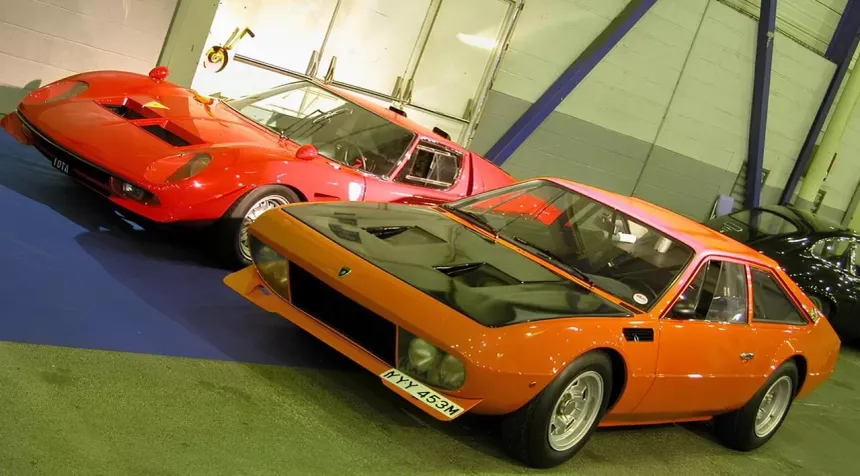
The Jarama Bob — also called the Jarama Rally or RS — was built up from a bare shell, rewelded for stiffness and fitted with a lightweight steel rear roll cage. Wallace moved the 3.9-liter V12 rearward in the bay to bring weight distribution close to 50/50, against the standard Jarama’s 53/47, and took it to 380 hp at 8,000 rpm, fifteen more than stock. Aluminum bodywork ditched the flip-up headlights and the whole car came out around 660 pounds lighter than a standard Jarama. Painted orange and black, it never raced. It turned up years later in Saudi Arabia and was restored in the UK in 1990.
The Urraco Bob was built from a pre-production prototype of the company’s small V8 car: lightened, stiffened, fitted with a roll cage, a stalk-mounted rear wing, flared arches, a deep front spoiler and a six-speed transaxle. It ran a 3.0-liter four-valve V8 making 310 hp, later swapped for a two-valve P300 unit. It was the only one of the three Bob Specials to see competition, in a single outing at Misano.
Then there’s the LP500. Wallace spent all of 1971 road-testing the yellow Countach prototype that had stunned Geneva. In the spring of 1974, Lamborghini deliberately destroyed it, crashing the car to satisfy homologation testing. The second machine Wallace knew down to the millimeter, written off by a decision that wasn’t his.
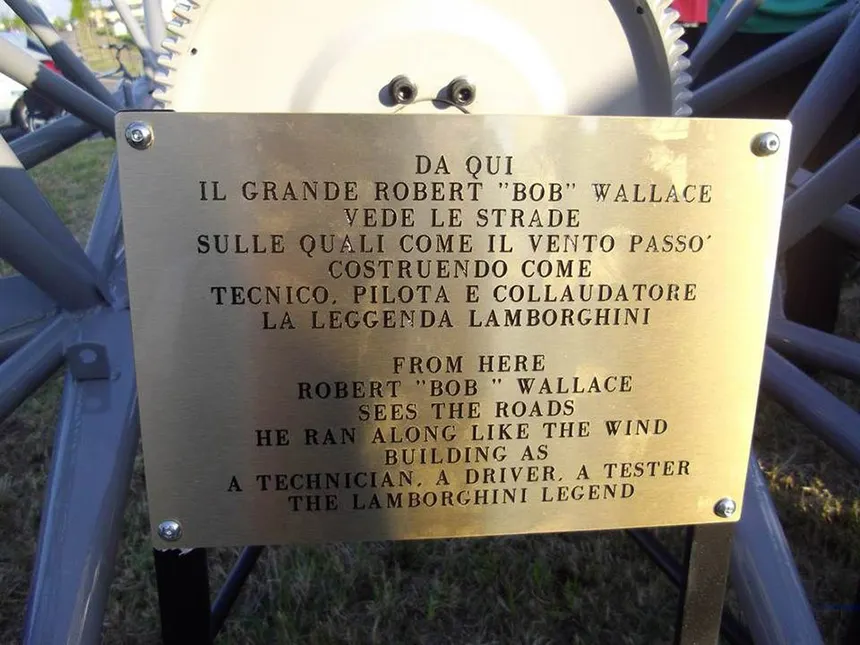
Phoenix, and the last irony
The company dissolved underneath him. Ferruccio sold 51% of Automobili Lamborghini to Swiss industrialist Georges-Henri Rossetti in 1972, and the remaining 49% to René Leimer in 1974. Wallace lasted until 1975. His replacement was Valentino Balboni, whom he had trained as a young mechanic and who would hold the job for more than forty years.
He and his wife Anna went back to New Zealand. They lasted three months. They moved to Phoenix, Arizona, where Wallace set up Bob Wallace Cars and spent close to four decades working alone, restoring and sorting classic Lamborghinis and Ferraris. A large share of that work was race preparation for vintage Ferraris.
Which is the punchline to the whole thing: the man who spent twelve years proving Sant’Agata could take on Maranello made his living in the Arizona desert getting the other guy’s cars ready to run.
Wallace died on September 19, 2013, at seventy-five. Months earlier, Lamborghini had invited him to the brand’s fiftieth anniversary at the factory. Health kept him away, so he sent a recorded message that flattened a thousand guests. The statement the company issued on September 24, signed by its president, said the news left them with great sorrow and that Wallace had contributed strongly to the birth of the myth of the Bull.
Forty-four years after that car burned outside Brescia, Lamborghini launched the Huracán Performante and marketed it as a tribute to the Bob Specials. The man who built them never got his name on a model.
And here’s what grates. This industry knows exactly who it celebrates: the guy who draws a shape you can hang on a bedroom wall, and the guy who signs the chassis drawing. Wallace left no signature because his trade was making sure the car didn’t kill anybody, and that doesn’t photograph. He built a competition car for a rulebook his employer could never satisfy, knowing the math, and he finished it to a standard nobody was going to inspect. That isn’t romantic stubbornness — it’s the working standard of a man who didn’t care whether anyone was watching. Today he wouldn’t get past the front gate. There’s no department to file him under and no budget line that justifies what he was doing at three in the morning.
Gandini drew the Miura. Dallara gave it a chassis. Wallace made it work and made it survivable. Of the three, he’s the only one who never asked for his name on anything.
Check you’re still alive.
2 thoughts on “BOB WALLACE”