Koenigsegg Advanced Manufacturing: The Spanish Village That Builds Koenigsegg’s Carbon

The most photographed car at Monterey Car Week in August 2026 was white, and the white wasn’t paint. Koenigsegg pulled the cover off the CCGT1 on August 13 with bodywork in something it calls Ghost Fibre: 1,280 hp on pump gas, 1,600 hp on E85, 800 kg of downforce at 250 km/h by the factory’s own numbers (call it 1,760 lb at 155 mph), and all 70 cars allocated before the public ever saw one. Every American outlet ran the photos. None of them asked who actually laid up those panels.
The answer is about sixty people on an industrial estate in Fogars de la Selva, a Catalan village of 1,704 souls according to Spain’s 2025 municipal register.
Fogars is an oddity even by Spanish standards. It sits in the Selva county, whose other towns all belong to the province of Girona, but Fogars alone belongs to Barcelona. So the company’s phone number starts with Girona’s 972 and its tax paperwork says Barcelona. The local economy, on paper, is irrigated farmland, livestock and poultry. Then there’s a building on Carrer Llevant where carbon fiber gets laid by hand into the tubs of the most expensive Swedish hypercars ever sold.
The company is Koenigsegg Advanced Manufacturing, KAM for short. Its quality policy, dated March 2022 and signed by managing director Daniel Urbina Albesa, says three things in its first paragraph: the company belongs to the Koenigsegg Group, it makes composite parts, “mainly carbon fiber,” along with the tooling to produce them, and it holds ISO 9001:2015 certification for that work.
We wrote to Urbina. He wrote back, at length, with the kind of detail a PR department would normally strike out. Unless it says otherwise, what follows comes from him.
Owned, not hired
Koenigsegg sells itself on doing everything under one roof. It designs its own engines, from the Freevalve camless heads to the V8 itself, builds its own gearboxes like the nine-speed Light Speed Transmission, and makes its own carbon wheels. When it announced the Ängelholm expansion in February 2022, the release boasted of design, engineering, sourcing, production, assembly, prototyping and R&D all on one site, a building footprint of more than 30,000 square meters next to an 11,000-square-meter second plant opened the year before, around 500 staff and a target of close to 800.
So a carbon shop 1,200 miles away in Spain looks like a contradiction. We asked Urbina exactly that. His answer:
“Koenigsegg’s philosophy is to keep critical competencies and production in-house. KAM is not a supplier: it is owned by and forms part of the Koenigsegg Group, so producing carbon fiber parts in Barcelona remains an in-house activity for the group. For capacity reasons, KAM was developed within Koenigsegg’s infrastructure to support parts production. All the engineering, processes and knowledge stay inside the group.”
The Spanish company registry backs him up, and it tells a better story than any press kit. The firm started operating in June 2016 under a name that meant nothing, Nerontes XXI SL, registered to an office in Barcelona. By August its sole shareholder was Alpraaz AB, the holding company Christian von Koenigsegg uses to control his car company, and its sole director was Halldora von Koenigsegg, who chairs the board of Koenigsegg Automotive. In September it took its current name and moved to Fogars. KAM’s own website adds the missing piece: many of the people inside have been doing this work, at that very address, since 2002. The building and the hands were already there. In 2016 they got a new owner.
Today, Urbina says, 100 percent of KAM’s work is for the group. No outside customers, no sales staff. The website still has a contact form, but there’s nothing behind it to buy.
Unplugged Performance had the number first
That wasn’t always true, and American Tesla owners are the reason.
In January 2022, Unplugged Performance, the California tuner that has been dressing up Teslas since the early Model S days, announced a line of carbon aero parts built by KAM. The pitch was hard to resist: spoilers and wings for your Model 3 or Model X, made with the same materials and on the same production line as Koenigsegg’s own hypercar aero. One long-tail spoiler listed at $4,495. Jalopnik’s headline said the parts were as expensive as you’d think.
Urbina’s version is less glamorous. Back then KAM had a small handful of outside clients, around five percent of the business in total, and nobody went out looking for them. “We didn’t go out to find them, they came to us.” Unplugged came through the friendship between its CEO and Sasha Selipanov, who ran design at Koenigsegg at the time. KAM made wings, spoilers and similar parts for them, 20 or 30 a year by his estimate, and the arrangement ended years ago. He suspects Unplugged’s site may still mention it and doubts there’s anything left in stock.
So if there’s a UP x KAM spoiler on a Tesla in your neighborhood, that’s a piece of Catalan hypercar carbon that will never be made again. Fogars stopped taking outside orders and went all in on Koenigsegg.
The part that never leaves the family
We asked Urbina which part he’s proudest of and expected a nice anecdote. He gave us the whole division of labor instead:
“At KAM we make the most important parts of the car: the structural ones, the homologated ones, the ones with a lot of engineering behind them and the patented ones. All of that always stays inside the group, for obvious reasons of safety and intellectual property. That includes parts like the monocoque, the seats and the wheels, which are patented.”
A splitter, a side skirt or a wing, he adds, “is no great mystery.”
The monocoque deserves a minute, because spec sheets throw the word around as if everyone knew what it meant. A Camry or a Civic is built around a shell of stamped steel, with subframes bolted on to carry the engine and suspension. A modern Koenigsegg has no steel shell at all. Its core is a single carbon fiber tub that is the frame, the cabin and the crash cell at once. Everything else bolts to it.
Koenigsegg’s official spec sheet for the Jesko Attack describes that tub as carbon fiber with aluminum honeycomb and integrated fuel tanks, rates it at 65,000 Nm per degree of torsional rigidity, and puts the whole car at 1,320 kg dry, 2,910 lb. Torsional rigidity is a measure of how much a car twists when one front wheel climbs a curb and the other doesn’t. The stiffer the structure, the more the suspension can do its actual job instead of fighting a chassis that flexes like a diving board. A good modern road car sits somewhere between 20,000 and 30,000 Nm per degree. The Lamborghini Aventador, which brought a carbon tub to Sant’Agata in 2011, was announced at 35,000. The Jesko comes close to doubling it.
That tub comes out of Fogars.

Bake, add honeycomb, bake, close, bake
The lower chassis, the biggest single piece of that monocoque, goes into the autoclave three times. Nobody had published that before, and to see why it matters you need two bits of vocabulary.
First, prepreg. That’s carbon cloth that arrives already soaked in exactly the right amount of resin. Nobody brushes anything on. The resin starts to cure the moment the roll is made, and the only brake on that reaction is cold, so prepreg lives in freezers and has an expiry date. KAM keeps two freezers for it and an automatic cutter that turns the rolls into plies, the individual shaped pieces that get stacked into a mold.
Second, the autoclave. Picture an industrial pressure cooker big enough to walk into. The stacked part goes in sealed inside a vacuum bag. Heat triggers the chemistry that hardens the resin. Pressure squeezes the plies together and drives out any air trapped between them. That trapped air is called porosity, and a porous part is weaker than it looks, however glossy the surface.
With that in hand, here is the lower chassis, as Urbina describes it. Three cycles, all at 120 °C, each at a different pressure, each adding material.

The first run goes in at 6 bar, about 87 psi. That’s the first layer of carbon, the cosmetic one, the face you’ll see on the finished car. Maximum pressure packs the plies tight so there’s no porosity in the skin that matters most to the customer.
The second run drops to half a bar. This is where the aluminum honeycomb goes in, a sheet of hexagonal cells that sits in the middle of the laminate. Honeycomb works the way the web of a steel I-beam does: it holds two skins apart, and spreading them apart multiplies stiffness while filling the gap mostly with air. The catch is that this core, in the configuration KAM uses, would crush at the pressure of the first run. So the second cycle is gentle, and its only job is to bond the honeycomb to the carbon underneath.
The third run goes back up to 3 bar. The second carbon skin closes the sandwich, and with the core now trapped between two skins, the pressure can climb again to compact the new plies properly.
Carbon, honeycomb, carbon. It’s the recipe printed on the Jesko’s spec sheet in six words. What the spec sheet leaves out is that the recipe takes three trips through a machine the size of a shipping container.
Three ovens, two freezers and a six-meter mill
KAM’s website lists the hardware, and Urbina explains why it looks the way it does.
There are three autoclaves and no two are the same. Two large ones measure 2.7 meters across by 5 meters long; one is rated to 250 °C, the other to 8 bar. Each can swallow two chassis at once. A third, much smaller unit handles small parts.
Why not one giant oven? Because parts don’t all cure at the same pressure, for the same time or at the same temperature, and they don’t come off the layup bench at the same moment either. With one autoclave you either wait until you have enough parts to fill it or you waste a cycle. And molds, which at KAM are usually carbon too, need long low-temperature, high-pressure cycles that would tie up a single machine for hours.
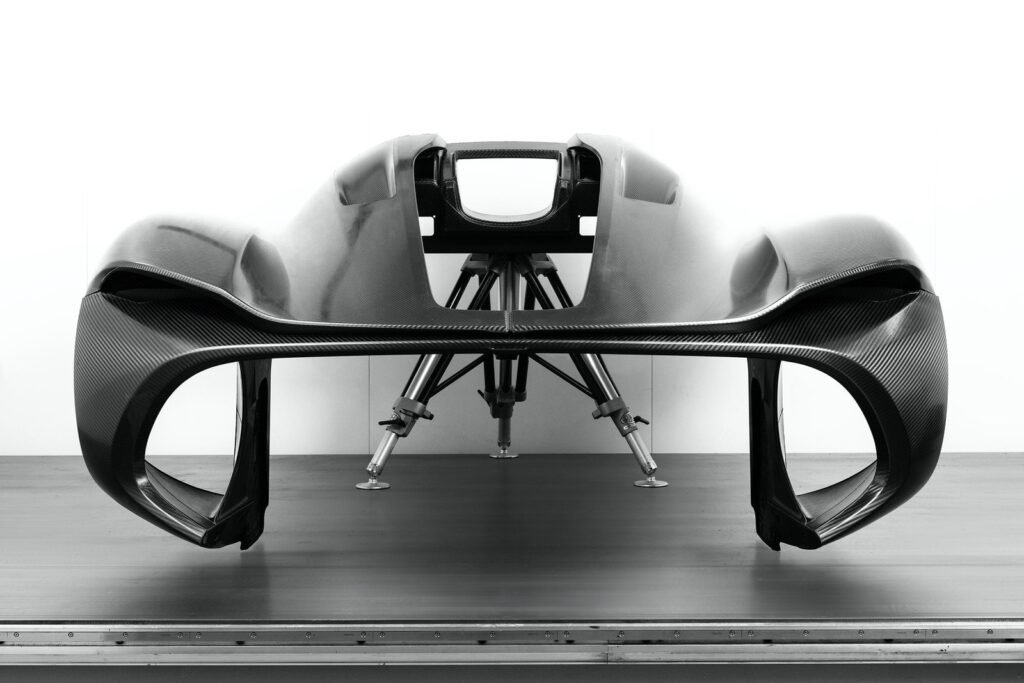
Molds bring their own chain of work, and it’s the part of the trade outsiders never see. To make a carbon part you need a carbon mold, because a metal one expands differently from the part as it heats and throws your dimensions off. To make that mold you first need a master pattern, machined from blocks of epoxy or polyurethane. That’s three levels of fabrication before anyone cuts the first ply of the real part.
The patterns come off two five-axis CNC machines. The smaller one, with 3.6 by 2.8 by 1.2 meters of travel, takes seats and wheels. The big one has six meters of travel in X and handles chassis and patterns. Urbina describes a trick that tells you a production person designed the floor: on the big machine they keep a fixed table running medium-sized parts while the main bed machines a chassis, and they can leave several fixtures set up at once so parts run back to back without changeovers. On the small machine, every new part means a new fixture.
So is Fogars just a shop that executes Swedish drawings? Urbina:
“We receive the design of a part, let’s say a seat. The requirement is that we need that seat with certain characteristics. Well, at KAM we do the production engineering: we design, develop and produce everything needed to get that seat.”
Everything means the patterns, the molds and the trim fixtures; the shape of every ply; the CNC programs; the layup, trimming and finishing manuals; the assembly steps, the quality checks and the pass-fail criteria. Sweden sends a target. Fogars works out how to make it, then makes it. His own summary: “They tell us: do what you know how to do, I want this seat.”
Nobody hires a laminator in Fogars. They grow one
Here’s the question any American shop owner would ask. Where do you find people who can work to that standard in a farming county with no motorsport industry to speak of?
You don’t. Eighty percent of KAM’s laminators had their first laminating job at KAM. The company looks for good hands and a willingness to learn and trains everyone in-house. The other twenty percent come from neighboring trades: boatyards used to fiberglass, pattern makers, people from aerospace.
About that last group, Urbina says something that won’t go down well in certain hangars. Aerospace uses carbon too, he says, but compared with the parts he measures his own work against, its geometries are a lot simpler than those of a car like theirs.
A 9.5 gets sent back
One line from Urbina explains the place better than any quality manual: “We don’t accept a 9.5 on the exam.”
Every part leaves KAM in exposed carbon. With KNC, Koenigsegg Naked Carbon, there isn’t even clear coat: the weave is polished bare, with nothing to hide behind. A flaw in a KNC panel is a flaw forever. What would pass at 99 percent of supercar and hypercar makers, he says, can be a reject in Fogars.

The trouble with carbon is that a perfect-looking part can still hide trouble inside: air between plies, a poorly compacted patch, a skin that never properly bonded. The standard way to look inside without cutting is a C-scan, an ultrasound pass that reads echoes bouncing back from the laminate. Echoes where there shouldn’t be any mean something in there isn’t solid carbon.
KAM’s approach is different. Every part is checked at several stages and inspected at the end, one by one, no sampling. The autoclaves log temperature, pressure, vacuum and time for every cycle, so a problem leaves a trail: lose vacuum and they know that part may have trapped air, miss the pressure and they know the plies weren’t compacted properly. Most defects, Urbina adds, end up visible on the part itself.
He doesn’t pretend that replaces ultrasound. KAM still runs C-scans now and then, to check something specific or when a new process means they’d rather not cut a part open to see inside. In Fogars it’s outsourced: someone shows up with portable equipment and it’s done in a few hours. In Ängelholm they have their own gear and a dedicated technician who happens to be from Mallorca. The ultrasound man at the Swedish factory is Spanish too. You won’t find that in a press kit either.
Ghost Fibre, from the inside
Now back to Monterey, because this is where Fogars earned its keep.

Koenigsegg describes Ghost Fibre as a crystal-white aramid and carbon matrix with ballistic-grade protective properties, lighter than a carbon-only layup and quieter, too. Aramid is the family of fibers Kevlar belongs to. Two things need saying, and the second one comes straight from the factory. This isn’t carbon that somehow turned white. And KAM doesn’t make Ghost Fibre. KAM doesn’t make any fiber. What KAM did was work with the supplier until the material could be handled roughly like any other carbon, and then build the process around it.
The process, Urbina says, was brutal, for three reasons.
Dirt was the first. On white, every speck shows and every touch leaves a mark. The fix was a clean room inside the clean room. His description: people going in like NASA astronauts landing on another planet, in white suits, blowing themselves down with antistatic guns.
The second was transparency. The weave lets the plies underneath show through, so the part never comes out quite as white as the designer drew it.
The third was movement. The material shifts during layup and builds up tension that shows in the finished part.
Add the 9.5 rule on top of all that. KAM has had decades with black carbon and one year with white. And Koenigsegg had already lost this fight once. Its own CCGT1 press release admits it: in 2009 the CCXR Trevita, Swedish for “three whites,” wore a white fiber finish that proved so hard to execute that Koenigsegg stopped production. Three cars were planned and two were built, one of which later went to Floyd Mayweather. That battle was fought in Sweden, years before KAM existed. Seventeen years later the white is back, and this time it landed in Fogars.
What it took, Urbina says, was refining the process and repeating a lot of parts until good ones came out. Then he told us something nobody has printed anywhere. The CCGT1’s body is all white fiber, but a good number of panels ended up painted white, because as exposed fiber they weren’t hitting a ten.

Read that the right way before someone spins it. This is cosmetic rejection, not structural. A panel can be mechanically perfect and still fail as show carbon, and when it does, it gets paint. Paint doesn’t fix a structural problem and nobody is suggesting it was used to. What the detail does tell you is that on a car whose whole visual hook is white weave on display, some panels didn’t pass and were painted rather than shipped at a B-plus. Koenigsegg hasn’t said a word about it, and we couldn’t confirm it any other way. It comes from the man who runs the factory that made them.
What gets me about all this
The fastest production car in the world right now isn’t a Koenigsegg. Since September 14, 2025, that claim has belonged to the Yangwang U9 Xtreme, BYD’s electric hypercar, which Marc Basseng drove to 496.22 km/h, 308.3 mph, at the Papenburg test track in Germany. An electric car from China, on turf where Rimac had been setting the pace for years. We’ll say it plainly. It just isn’t the story here.
The story is a factory where a 9.5 is a fail, in a village of 1,704 people, owned outright by a Swedish company that trusts nobody else with its critical parts, staffed by people four out of five of whom learned to lay carbon inside that same building. According to the business database Iberinform, it had 61 employees in 2024, and revenue rose almost 37 percent in a single year. It isn’t even alone in Spain: Managing Composites, founded by a former Koenigsegg engineer, builds structures for hypercars it mostly isn’t allowed to name.
American enthusiasts tend to picture this kind of work happening in Modena, in Woking, or in some aerospace park outside Los Angeles. It happens in all those places. It also happens between Barcelona and Girona, and hardly anyone has knocked on the door. The Spanish motoring press is the most to blame for that, not you.
KAM turned ten in 2026. Christian von Koenigsegg came down to Fogars to celebrate, as he posted himself. The founder of a company that builds its own engines, gearboxes and wheels, crossing Europe to visit a carbon plant in a farming village. If that’s not a story, nothing is.
For the record, KAM wasn’t looking for any of this. No sales team, no need to be discovered, doing fine without a single article. The failure is ours, for taking ten years to ask.
Check you’re still alive.
Photos: Koenigsegg Advanced Manufacturing and Koenigsegg.