The 428 Cobra Jet: The Engine Ford Invented Because of a Rebel Dealer
Some engines are born in high-tech engineering labs. Some are the result of years of strategic planning and multi-million dollar budgets. And then there are engines born because a dealer in Rhode Island got tired of watching his Mustangs lose at stoplights and decided to fix it himself.
The Ford 428 Cobra Jet belongs to the second category.
This is the story of how a man named Bob Tasca, owner of a Ford dealership in Providence, Rhode Island, built in his back workshop the engine that would save the Mustang from irrelevance. And how Ford, upon seeing it, refused to let him leave with his car.
1967: The Mustang Was Losing the War
To understand why the Cobra Jet matters, you need to understand the context of 1967. The American muscle war was at its most brutal. Chevrolet had the Camaro SS 396. Pontiac had the GTO with the 400. Dodge had the Charger with the Hemi. And Ford had the Mustang with the 390 GT — a motor that looked reasonable on paper but in street reality lost to practically everything lined up against it.
The 390 was a low-torque, lazy-response motor. Heavy, with restrictive heads that choked airflow. Mustang 390 GTs posted quarter-mile times around 14.5-15 seconds. Rivals were doing 13 or better. In late-60s American muscle car terms, that was the difference between a champion and an organ donor.
Ford knew it. The public knew it. And Bob Tasca, owner of Tasca Ford in Rhode Island, knew it better than anyone because he was the one watching customers arrive excited, buy a Mustang GT, and return the following week defeated because they’d just lost to a Camaro at a light.
Tasca decided to act.
The KR-8: When a Dealer Did Ford’s Job
In his workshop, Tasca began experimenting. The 428 block was available — it was the engine Ford used in its full-size cars, the Thunderbird and the Galaxie. It had displacement, it had a robust block, but its standard heads were mediocre for performance.
The solution Tasca found was elegant in its simplicity: take the 428 block and fit it with 427 cylinder heads. The 427 was Ford’s competition engine, dominating NASCAR and Le Mans. The 427 Low Riser heads had 2.09-inch intake valves and 1.66-inch exhaust valves — significantly larger than the standard 428. It was nearly a direct swap — the head bolt pattern was compatible — and the performance difference was immediate and dramatic.
Tasca called his creation the KR-8 Mustang. Track numbers were better than any production Mustang Ford had ever built. At its best, the KR-8 posted 13.4 seconds at 108 mph in the quarter-mile.
Tasca, far from staying quiet, began publicly pressuring Ford. He wrote letters. He gave interviews. In November 1967, Hot Rod magazine published an article that included a vote form for readers to pressure Ford into action. An estimated 2,000 forms arrived in Dearborn.
Ford Reacts: The 428 Cobra Jet Is Born in 1968
Ford’s executives responded quickly. When Dearborn engineers saw Tasca’s KR-8, they made a drastic decision: they didn’t let him leave with the car. They kept it to dissect it, understand what made it so effective, and develop a production version based on that formula.
The resulting 428 Cobra Jet was announced to dealers in December 1967 and debuted publicly at the NHRA Winternationals in January 1968 in Pomona, California. The debut was anything but subtle: Ford prepared a small batch of specially prepared Mustangs and entered them in Super Stock competition. The result was a thrashing. The CJ Mustangs won their classes with times of 11.6 seconds at 120 mph in competition-spec configuration.
Motor Trend delivered a verdict that has echoed ever since: “The entire world will come to recognize this engine — the 428 Cobra Jet — at the pop of a hood.” They were right.
The 428 Cobra Jet entered official production for Mustangs in April 1968, with the R engine code in the VIN. From that moment, the era of the stoplight-incompetent Mustang was over.
The Technical Recipe: Police Parts, Racing Soul
What makes the 428 Cobra Jet interesting from a technical standpoint is that it was not designed from scratch. It was built using what Ford already had, mixed intelligently to extract maximum performance:
The block: Derived from the 428 Police Interceptor — the engine Ford used in high-speed police vehicles. Already a robust block, designed to handle hard continuous use. The connecting rods use heavier 13/32-inch rod bolts, and the crankshaft is nodular iron.
The cylinder heads: Here’s the magic. The Cobra Jet uses 427 Low Riser-type heads, with 2.09-inch intake valves and 1.66-inch exhaust. Intake port openings measure 2.34 x 1.34 inches — significantly more generous than the standard 428. This is exactly what Tasca had discovered in his workshop.
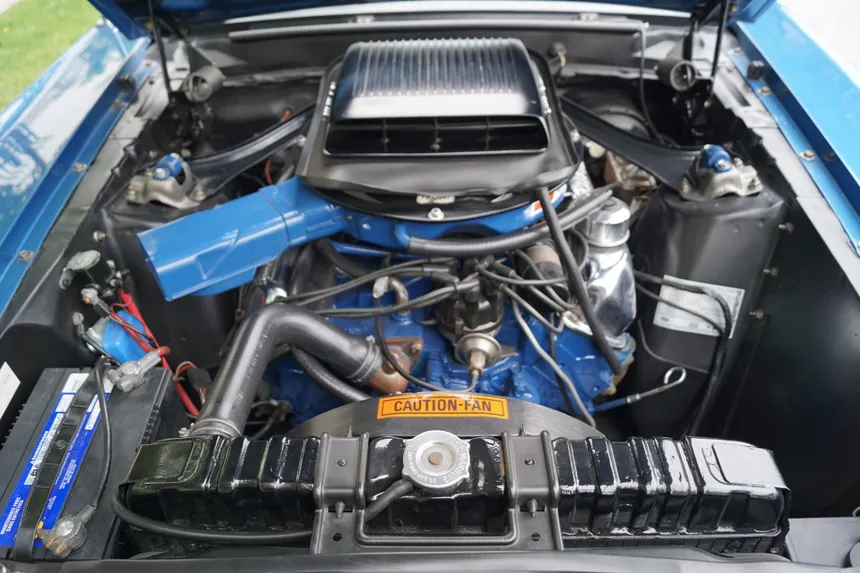
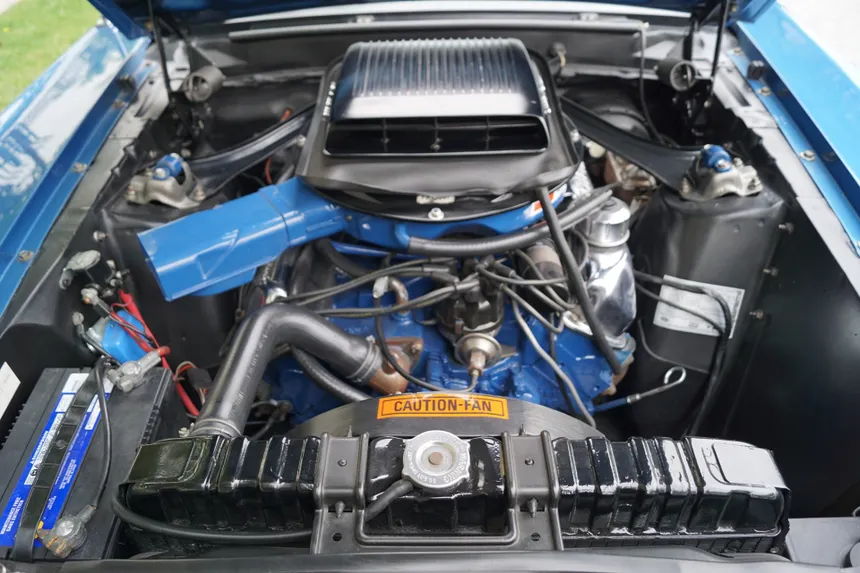
The carburetor: A 735-CFM Holley four-barrel. In the Ram Air version, the induction system adds a functional hood scoop with a vacuum-actuated butterfly valve that opens under wide-open throttle, feeding cold air directly to the carburetor.
Compression ratio: 10.8:1. High for a street engine, but within what premium-grade fuel of the era could handle without detonation.
Official figures: 335 hp at 5,200 rpm and 440 lb-ft of torque at 3,400 rpm. These numbers are, with total certainty, a lie. And Ford knew it perfectly well.
The Deliberate Lie: 335 Horsepower That Weren’t 335 Horsepower
This deserves its own section, because it is one of the most fascinating episodes in American muscle car history.
Ford announced the 428 Cobra Jet at 335 horsepower. Simultaneously, it offered the 428 Police Interceptor — the same base block — at 360 horsepower. How could the performance engine be less powerful than the police engine?
It couldn’t. It wasn’t.
Real output of the 428 Cobra Jet is estimated between 400 and 410 horsepower. Standard production quarter-mile test data pointed to times around 13.5-13.9 seconds with trap speeds of 101-103 mph. For a car weighing around 3,300 lbs, those numbers only work out to approximately 400 real horsepower.
Why did Ford lie? For two reasons that in 1968 were of maximum practical importance. First, insurance companies used declared horsepower to calculate premiums — a high figure could spike insurance costs so dramatically it could destroy sales among the primary target demographic of 18-25 year-olds. Second, NHRA drag competition categories were also based on the declared weight-to-power ratio — understating horsepower placed the car in a more favorable competition class.
It was standard practice across the industry. GM did it. Chrysler did it. It was the secret language of performance engineers of the era: the real insiders knew how to read between the lines, knew that a Ford 335 wasn’t a real 335. And those who didn’t know learned quickly the first time they made the mistake of opening that hood at the wrong stoplight.
The Super Cobra Jet: For Those Who Were Serious
In late 1968, Ford introduced the 428 Super Cobra Jet, available as part of the “Drag Pack” option when the car was ordered with 3.91 or 4.30:1 rear axle ratios. It was essentially a signal that the buyer intended to use the engine seriously on the drag strip.
The internal differences between the CJ and the SCJ are subtle but revealing: the Super Cobra Jet receives the Le Mans-type connecting rods from the 427 MR — more resistant, with a different cap bolt design to clear the block. The pistons use the same casting as the CJ, but with slightly different piston-to-bore clearance specifications to handle higher operating temperatures. It also included an external oil cooler, which explains why the SCJ couldn’t be ordered with air conditioning — the cooler occupied that space in the engine compartment.
Declared power: the same 335 horsepower as the CJ. Real power: estimated above 400. Total irony.
On the Strip and Street: What It Could Do
Standard production quarter-mile numbers for the 428 Cobra Jet were, for 1968, simply devastating. With stock tires and a competent driver, a Mustang 428 CJ left the dealership capable of running the quarter-mile in the low-14-second range — brushing the high 13s on the best runs — with trap speeds of 101 to 103 mph. For context: the Camaro SS 396 of the same era ran around 14.0-14.5 seconds.
The Cobra Jet transformed the Mustang from victim to executioner at American stoplights. And it did so with considerable external discretion — the only visual indicators were the hood with its black air intake dome and black stripe. Without reading the VIN code, without knowing how to read the engine tag, many potential rivals underestimated what they were facing.
That was, perhaps, the most terrifying characteristic of the 428 Cobra Jet: it was a quiet killer. Or at least quiet until you pressed the accelerator.
The Cobra Jet’s Life: 1968-1970
The 428 Cobra Jet had a relatively short but intense life. It was offered in Mustangs for 1968, 1969, and 1970, including the Shelby GT500 during part of this period. It was also available in the Ford Fairlane, Ford Torino, and Mercury variants including the Cougar, Comet, and Cyclone.
In total, Ford built approximately 19,451 Cobra Jet-equipped Mustangs across its three years of production.
For 1971, the 428 was replaced by the 429 Cobra Jet, part of the 385-series engine family that represented the next generation of Ford big blocks. The 428 FE had reached the end of its development life, and the high-performance car world was beginning to change irreversibly under the pressure of emissions regulations and skyrocketing insurance costs.
But the 428 Cobra Jet’s legend was already secured. Three years of production, track victories, thousands of stoplights won, and an origin story with no equivalent in American automotive history.
The Legacy: The Name That Never Died
The Cobra Jet name didn’t disappear with the 428. Ford has revived it multiple times, because the brand value is real and tangible: the 2008 Cobra Jet Mustang, the all-electric Mustang Cobra Jet 1400 presented in 2020 (with over 1,400 hp), and the Super Cobra Jet 1800. The name remains synonymous with pure performance, with Mustang with the inhibitions removed.
But none of those projects have the origin story of the original. None were born in the back workshop of a rebel dealer from Rhode Island who got tired of losing.
My Final Manifesto
The story of the 428 Cobra Jet is, at its core, a story about what happens when corporate bureaucracy fails and a mechanic’s instinct succeeds.
Bob Tasca didn’t have an engineering laboratory. He didn’t have sophisticated test equipment or R&D budgets. He had a workshop, practical experience, and the uncomfortable certainty that what Ford was selling him wasn’t good enough. So he fixed it.
What I find fascinating about this story is not that Tasca built a better engine — it’s that Ford had the intelligence to recognize it and the humility not to let him leave with his car until they’d copied it. In the modern corporate world, where development processes are measured in years and approval cycles in committees, that story would be impossible. A dealer building the engine your engineering department hadn’t managed to create, and you responding with “brilliant, thank you, now we’re keeping this” requires the kind of institutional agility that very few companies possess.
The 428 Cobra Jet also reminds us that in engineering, the most elegant solution is not always the most complex. Sometimes the solution is: take this robust block that already exists, put the right cylinder heads on it that also already exist, add the right carburetor, and get out of the engine’s way.
Tasca saw it before Ford’s engineers did. And that’s why the Cobra Jet exists.
Bureaucracy optimizes. Mechanics solve. And sometimes, mechanics win.
Did you know the story of Bob Tasca and the KR-8 Mustang? Do you know other cases where an outsider forced a manufacturer to improve its own product? Tell me in the comments.
2 thoughts on “FORD 428 COBRA JET”