Toyota Corolla AE86 GT-S: The Tofu Tax on a Commuter Car

Somewhere in America right now, someone is explaining to their spouse why a 1986 Toyota Corolla with 195,000 miles on the clock is worth more than the family crossover. He has a point. Hagerty’s records show exactly that car, a blue GT-S liftback, changing hands for $35,175. The Toyota Corolla AE86 GT-S is the only economy car in history whose price chart looks like a tech stock, and the reasons have almost nothing to do with horsepower.
It had 112 of them in US trim. A Mustang GT of the same era would have laughed at it at a stoplight. But stoplights were never the point.
Toyota built a rear-drive Corolla when everyone else had given up
Rewind to 1983. Detroit and Tokyo were both busy converting small cars to front-wheel drive, because it was cheaper to build, packaged better and was easier for regular drivers to live with. Toyota did the same with the fifth-generation Corolla, the E80. Sedans, wagons and hatchbacks all went front-drive.
Except the sporty coupe and three-door liftback. Those kept the engine up front and the drive at the rear, with a live axle out back, the way a pickup does it. Fit the 1.6-liter twin-cam engine and the factory code became AE86. A for the engine family, E for Corolla, 8 for the generation, 6 for the variant. In Japanese, eight-six is hachi-roku, and that’s what people around the world still call it. It was the last rear-wheel-drive Corolla Toyota ever made.
That matters because a rear-driven car splits the job. The front tires steer, the rear tires push. Get on the gas mid-corner and you can steer with your right foot, rotating the car and holding a slide. Try that in a front-driver and you just plow toward the outside of the turn. Add a weight split of roughly 53 percent front and 47 percent rear, the figure published by the European owners’ club AEU86, and you get a car that turns in eagerly and lets you know exactly what the rear is doing.
Same car, five names
Toyota sold it in Japan through two dealer networks with two faces. The Corolla Levin had fixed headlights. The Sprinter Trueno had pop-ups. Trueno is Spanish for thunder, and that’s the one that became famous. Europeans bought it as the Corolla GT. Americans got the Corolla Sport, and the twin-cam version was the GT-S.
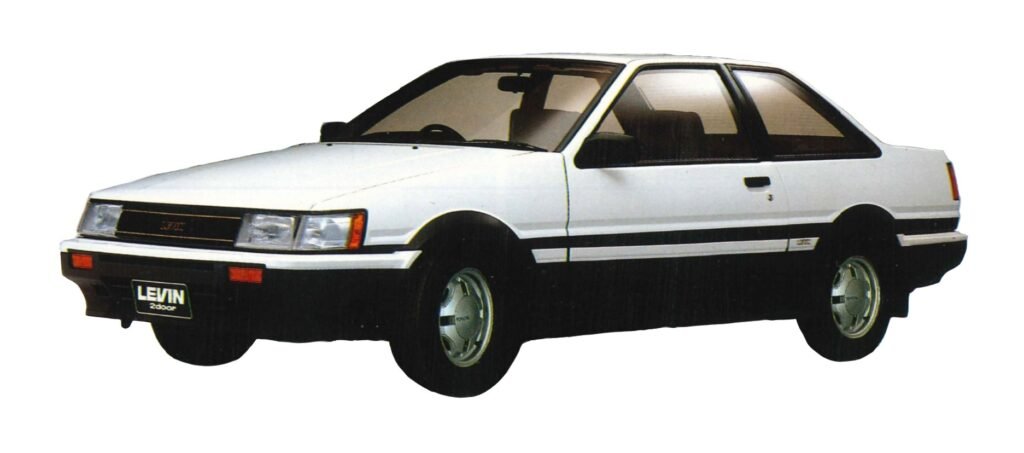
How many came here is fuzzy. Jalopnik, digging through old enthusiast data in 2020, put North American imports at around 18,000 out of a total run north of 360,000, and it admitted the figures were shaky. Not rare, then. But years of hard driving have thinned the herd dramatically, and the clean survivors are a much smaller club.
The 4A-GE: an engine that begs for revs
The heart of the thing was the 4A-GE, a 1,587 cc four with dual overhead cams and sixteen valves. In 1983 that layout belonged to more expensive machinery. Four valves per cylinder means the engine can breathe in and exhale more easily at high rpm, and an engine that breathes easily wants to rev. The US GT-S had its tach redlined at 7,500 rpm. Specs compiled by AEU86 list a maximum engine speed of 7,700, and peak power arrived at 6,600.
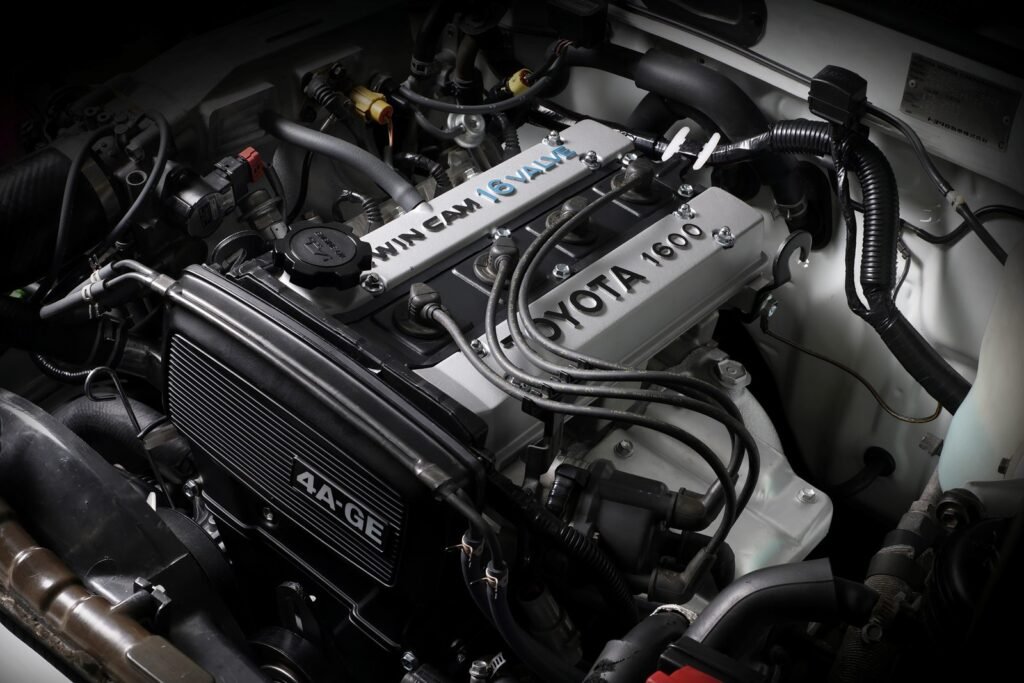
Horsepower numbers vary wildly by market, and people compare them carelessly. The US 4A-GEC, rated SAE net with emissions hardware, made 112 hp. The European version made 124 PS on the DIN standard. Japan quoted 130 PS, but that was a gross figure measured without the accessories an engine drags around in real life. Same basic motor, three different rulebooks.
None of those numbers was impressive even then. Volkswagen’s Golf GTI 16V of 1986 made 139 PS in European trim, a clear win on paper. It just sent that power through the front wheels, which is the wrong end if you want to play.
Under a ton, and that changes everything
What made the AE86 special was the scale. European spec sheets list 950 kg (about 2,090 lb) for the coupe and 970 kg for the liftback. North American cars, with bigger bumpers and more equipment, landed around 2,200 to 2,300 lb. For context, the Peugeot 205 GTI, the French benchmark of 1984, weighed 850 kg with 105 PS. Europe never sold that car in the States, but it gives you the class the Toyota was fighting in.
Low mass is the cheat code. With little weight to manage, brakes last, tires grip, the car changes direction instantly and a modest engine feels lively. Toyota also offered a limited-slip differential on manual twin-cams, the T283 unit. An LSD stops all the power from spinning away through the inside rear wheel when you accelerate out of a corner. For drifting, that option box was worth more than another twenty horsepower.
Forty years on, the recipe still works. In October 2026 David Durán of the Spanish site Motor.es drove a red coupe from Toyota’s heritage collection near The Hague. His notes: unassisted steering that is “incredibly precise”, an engine that doesn’t feel its age, and a warning that parallel parking takes real arm strength. His verdict was that the car lives up to the legend, which is more than most legends manage.
Japan’s mountain passes made it a legend
By the mid-1980s, Japanese kids were racing at night on the winding mountain roads they call touge. They needed something cheap, light and rear-drive. The AE86 was all three. On a tight pass, power barely mattered. Carrying speed through corner after corner did, and a skilled driver in a used Corolla could embarrass far pricier machinery.
The patron saint of all this is Keiichi Tsuchiya, the Drift King. Toyota’s own Corolla 50th anniversary site notes he was already sliding his way through the 1984 Freshman Race at Fuji and that he’s a devoted owner of both a Trueno and a Levin. In 1987, the production outfit Pluspy shot him throwing an AE86 sideways down the Usui and Gotemba passes, and the footage was sold on VHS through Carboy magazine. Japan’s motorsport authority was not amused. Accounts disagree on whether it actually suspended his racing license or only threatened to, but Tsuchiya came close to paying for those tapes.
Drifting existed before the AE86 and has plenty of other heroes. Still, few things spread it like those grainy videos of a little Toyota hanging its tail out on public roads. When drifting arrived in the US decades later as a pro sport, the hachiroku came with it as a founding myth.
It won real races, too
Don’t file this car under street racing only. In Group A, the production-based touring car category of the era, the Corolla GT ran in the European Touring Car Championship’s smallest class from 1984 to 1988 and took the 1986 manufacturers’ title with 267 points, beating the class-above BMW 325i. Chris Hodgetts won the British Touring Car Championship outright in 1986 and 1987 in one. It dominated its class at the Spa and Nürburgring 24 Hours through much of the decade, and Per Eklund won the 1985 British Open Rally Championship’s Group A category with an AE86.
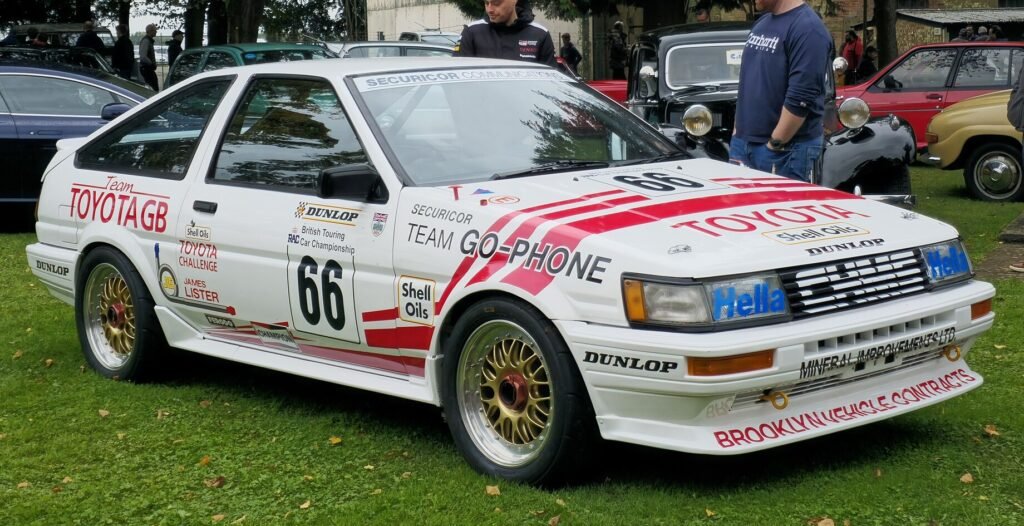
So the tuners who built drift cars in the 1990s already had a deep parts catalog and plenty of race know-how to borrow from.
Initial D and the price spike
Then came the anime effect. Initial D started as a manga in 1995 and ran until 2013. Its hero, Takumi Fujiwara, delivers tofu for his father’s shop before dawn in a white-and-black Sprinter Trueno and, without meaning to, becomes the fastest driver on his mountain. The series went global as an anime, and a generation of American teenagers who’d never seen an AE86 in person decided they needed one.
Those kids grew up and got paid. Enthusiasts call the resulting premium the “tofu tax.” In 2021 Hagerty used the phrase in a headline when a completely original, one-owner 1987 Corolla GT sold for £46,250 on Car & Classic in the UK. The same piece put the US auction record at that point at $40,000.
Today Classic.com’s market benchmark for the GT-S sits around $21,600, with recent sold listings from $12,000 to $25,000, and dealers asking as much as $69,900. Spain, where Toyota never sold the car, tells the same story at a smaller scale: in 2012 the magazine Autofácil reported that an enthusiast there had paid €9,500 for one imported from Portugal, and estimated about €9,000 to bring one in. Nobody gets that deal anymore.
America adds a twist: the 25-year import rule. The Japanese Trueno and Levin are now decades past it, so they can be brought in legally, which is why a pop-up-headlight Trueno with a US plate doesn’t have to be a fake. Make sure you know which one you’re looking at, because the paperwork, the power figures and the parts differ.
What goes wrong
Goodwood’s buyer’s guide is blunt: rust and crash damage are your two main concerns. Corrosion likes the sunroof surround, the sills and suspension mounts, and the spare-wheel well. And since half the planet’s AE86s were thrashed sideways at some point, check for bent shells, cheap repairs, and the usual drift-car junk: aftermarket wheels, gauges, body kits and coilovers.
The sneakiest trap is the sibling. Elsewhere Toyota built a single-cam version called the AE85, and Goodwood warns about AE85s masquerading as twin-cam 86s. In the US the cheap one was the Corolla Sport SR5, with a single-cam engine in the same body, and the VIN codes make it worse, not better. Pull up Hagerty’s sale records and you’ll find SR5s with AE86 stamped in the VIN, while the twin-cam GT-S cars carry AE88. So a seller can show you, without lying, “AE86” on the paperwork of the car you don’t want. Check the engine, check for the GT-S equipment, and only then check your bank balance.
Parts supply is improving. Toyota’s GR Heritage Parts program has restarted production of some AE86 components, and Spain’s Motor.es reported in 2026 that the list included a new engine block.
Toyota’s own AE86 restomods
Toyota knows exactly what it has. At the Tokyo Auto Salon in January 2023 it showed two converted AE86s. The AE86 H2 Concept, built on a Trueno, kept its 4A-GE but modified it to burn hydrogen, with two high-pressure tanks borrowed from the Mirai. The AE86 BEV Concept, built on a Levin, went fully electric, using a motor from the Tundra hybrid pickup and a battery from the Prius Plug-in, and it kept a manual transmission. Toyota stressed that both preserved the car’s low weight and front-to-rear balance. When a company the size of Toyota picks a 1980s Corolla to sell its carbon-neutral future, you know where it thinks the fun lives.

A cheap car that won
Japan has other cult heroes from that era, from the rally-bred Mazda 323 GT-R to the bigger-name turbo icons. None started as humbly as this one. The AE86 had no turbo, no all-wheel drive, nothing on its spec sheet to brag about. It won a European title, two British championships and the hearts of a generation anyway, by being light, balanced and rear-driven when nobody else bothered.
That’s why a high-mileage Corolla can outprice a new crossover. Buyers aren’t paying for a car. They’re paying for the last time an affordable Toyota let you steer with the throttle.
Check you’re still alive.
Photos: Toyota (prensa oficial), Toyota (prensa oficial), Toyota Gazoo Racing (prensa oficial), Calreyn88 (CC BY-SA 4.0), Toyota (prensa oficial).