Alfa Romeo 155 V6 TI: How Italy Humiliated Mercedes, BMW, and Opel in Germany’s Own Championship
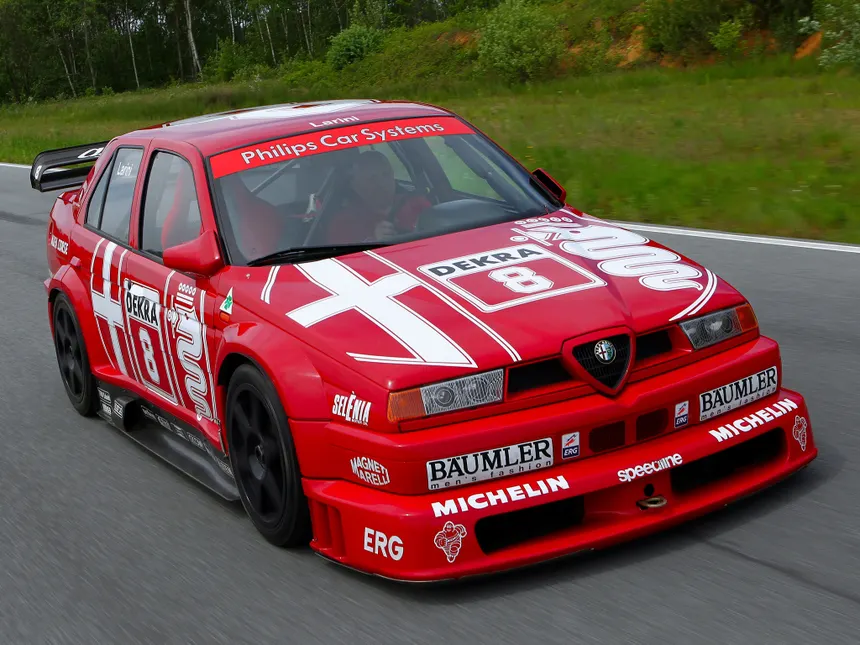
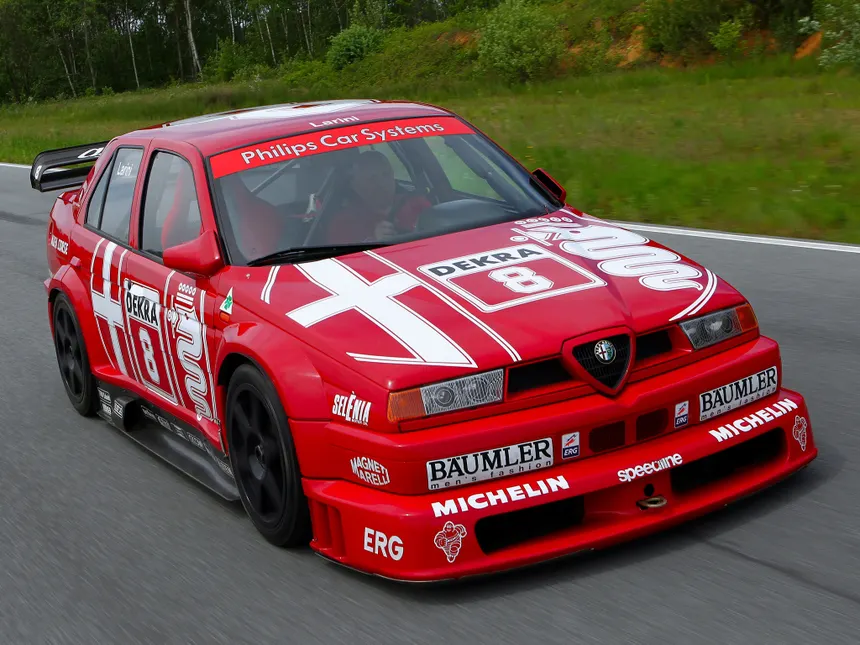
In 1993, an Italian team showed up in Germany with a sedan based on a Fiat platform, carrying a naturally aspirated 2.5-liter V6 that revved to nearly 12,000 rpm, and proceeded to win 12 of 20 races, the drivers’ championship, and the constructors’ title — humiliating Mercedes-Benz, BMW, and Opel in their own national championship. This was not a movie. This was the Deutsche Tourenwagen Meisterschaft. And the car was the Alfa Romeo 155 V6 TI.
The story of the 155 V6 TI is not one of overwhelming technological superiority — though the technology was exceptional. It is the story of how a group of Italian engineers, led by Giorgio Pianta at Alfa Corse with technical support from Abarth, read a new set of technical regulations, found every available loophole, and built a race car so sophisticated that the Germans needed more than a year to catch up. And by the time they did, the rules changed and the party was over.
For American readers unfamiliar with DTM, think of it as Germany’s answer to NASCAR or IMSA — a premier touring car championship where major manufacturers poured enormous resources into competition, using production-based sedans modified to extremes. In the early 1990s, DTM was arguably the most technologically advanced touring car series in the world, and its paddock was exclusively German. Until Alfa Romeo showed up.
The rules of the game: Class 1 and technical freedom
The FIA introduced a two-tier system for touring cars in 1993: Class 2 (more restrictive, 2.0-liter engines) and Class 1 (far more permissive). DTM adopted Class 1. The rules allowed: engines up to 2.5 liters, maximum six cylinders, four valves per cylinder. The engine had to be based on a production unit built by the same manufacturer but did not need to be the one fitted to the road car. Electronics were unrestricted: ABS and traction control were permitted. Aerodynamic devices had to be mounted below the wheel centerline, except for the rear wing.
In short: Class 1 allowed teams to build a Formula 1 car wearing a sedan body. And that is exactly what Alfa Corse did.
The engine: a Busso V6 turned into an F1 motor
The heart of the 155 V6 TI was a competition version of the 60-degree Busso V6 at 2.5 liters. But calling it a “competition version” is a massive understatement. The road car’s engine produced 166 hp. The DTM engine, at its 1993 debut, delivered 420 hp at 11,500 rpm.
The specifications read like a formula car engine: 93 mm bore, 61.3 mm stroke — an extremely oversquare bore/stroke ratio favoring high revs. Four valves per cylinder, gear-driven timing, sequential injection with two injectors per cylinder. The regulatory rev limit was set at 12,000 rpm, but Alfa Corse engineers stated the engine would have happily revved well beyond that. The block was aluminum alloy monoblock construction, and total engine weight was just 234 lbs (106 kg).
By 1996, in the series’ final season under the ITC (International Touring Car Championship) name, the engine had evolved. Alfa Romeo replaced the 60-degree Busso V6 with a new 90-degree V6 (type 690, based on the PRV architecture) reaching 490 hp at 11,900 rpm. The car’s top speed in that configuration was approximately 186 mph, at a weight of just 2,337 lbs (1,060 kg).
The sound of that engine at full load is, without any possible debate, one of the most extraordinary noises ever produced by a touring car. It does not sound like a V6. It does not sound like a V8. It sounds like an instrument that should not exist — a mechanical scream that rises in pitch until it becomes almost unbearable, sustained by the precision of a Swiss watch spinning at insane velocities. If you have never heard it, search for it online. It will change your understanding of what a six-cylinder engine can sound like.
The chassis: a race car disguised as a sedan
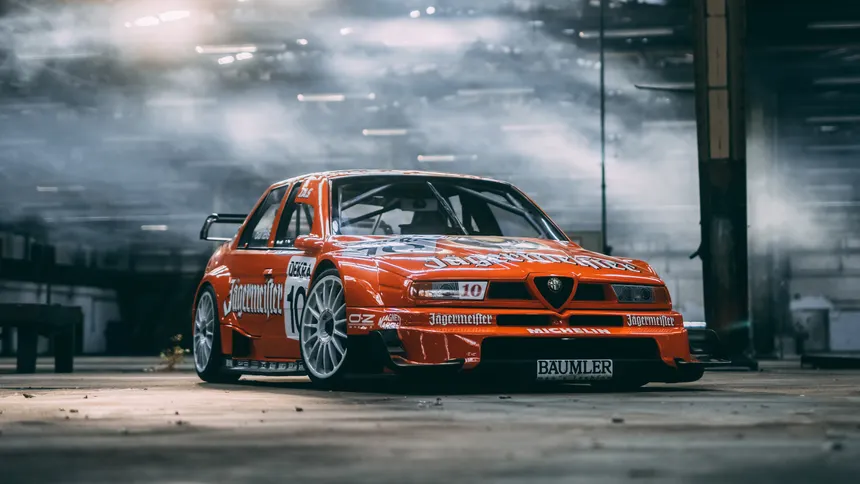
The 155 V6 TI shared with the road-going 155 little more than the general silhouette and the headlights. The chassis was essentially a new structure with an integral roll cage. The hood and side panels opened clamshell-style for engine and mechanical access — pure motorsport design.
The most important mechanical difference from the road car: the engine was mounted longitudinally, ahead of the front axle — in the street 155, it sat transversely. It was mated to a transverse six-speed sequential semi-automatic gearbox. Drive was permanent all-wheel, derived from the Lancia Delta HF Integrale system, with approximately 35-40% front / 60-65% rear torque split — a rear-biased setup that gave the car handling closer to a rear-drive car than a front-driver.
Suspension evolved across seasons: MacPherson at the 1993 debut, with completely redesigned geometry and components from 1995 onward (the “Step 2” car), when regulations relaxed further and cars retained only the silhouette of the production model.
Weight in early versions was approximately 2,425 lbs (1,100 kg). Combined with 420 hp and all-wheel drive, the performance was devastating.
1993: the debut that rewrote history
The 155 V6 TI was ready for the season opener at Zolder, Belgium. Five cars lined up: two from the works Alfa Corse team driven by former F1 drivers Alessandro Nannini and Nicola Larini, and three from the Schübel Engineering privateer team for Giorgio Francia, Christian Danner, and later Kris Nissen.
Nannini’s story deserves special mention: in 1990, while an active F1 driver with Benetton, he suffered a helicopter crash that severed his right forearm. The arm was surgically reattached, but Nannini never returned to F1. The 155 V6 TI was specially adapted to facilitate his driving. His DTM victories — with a reattached arm — remain one of the most extraordinary chapters in motorsport history.
The primary opposition came from Mercedes-Benz, still running evolved 190E machines from previous seasons. Their Class 1 C-Class would not be ready until 1994. The only other new Class 1 car that season was the Opel Calibra V6 4×4, debuting in the final round.
The result was demolition. Larini put his car on pole at Zolder and won both heats. He kept winning. By season’s end, Larini had accumulated 10 victories in 20 races — the highest win count in a DTM season at that point. Nannini added 2 more wins. Danner also won. Alfa Romeo took both the drivers’ title (Larini) and the constructors’ championship.
Alfa Romeo became the only non-German manufacturer to win the DTM title. That record still stands today.
The media impact in Germany was enormous. The specialized German press, accustomed to covering Mercedes and BMW victories as near-routine events, had to dedicate their covers to a red Alfa Romeo driven by Italians. Road-car sales of the 155 in Germany spiked as a direct consequence of the DTM success — the halo effect worked exactly as Alfa Romeo intended. The ugly duckling that nobody wanted was suddenly the car everyone had watched winning on Sunday television.
Larini’s dominance was not just statistical — it was visceral. The 155 V6 TI, when leading a pack of Mercedes and Opel machines down a straight, announced itself through sound alone. The V6 at 11,500 rpm produced a high-pitched, almost electric note, completely different from the deeper growl of the German V6 engines. Fans who attended the 1993 races describe that sound as something they had never heard before and have never heard since. It was a mechanical wail that announced the Italians were coming.
For American motorsport fans, the closest comparison might be the period when Audi dominated Le Mans with its R8 — a European manufacturer entering a series with established hierarchy and systematically dismantling the competition through superior engineering. Except the 155 V6 TI did it with a fraction of Audi’s budget and in a championship where the home-field advantage was massive.
1994: more wins, but the title slips away
With Mercedes-Benz’s new Class 1 C-Class arriving for 1994, the playing field leveled. The 1994 155 V6 TI was significantly improved: lowered and optimized engine, Kelsey-Hayes ABS, active suspension, lower bodywork with sill air intakes and rear Venturi trays.
Nannini dominated the first half, winning 7 of the first 10 races. But Mercedes, with Klaus Ludwig, was more consistent in the second half. Alfa Romeo accumulated more total wins than Mercedes in 1994, but the spread across drivers meant the title went to Ludwig.
Then came the Singen incident. At the penultimate round on the Alemannenring circuit, Nannini was hit in the first heat and crashed into the barriers. For the second heat, he used teammate Francia’s car. Starting last, he fought through to fourth. At a tight hairpin, Roland Asch in his AMG Mercedes hit him, spinning him out. What followed was the “Vendetta di Nannini”: Nannini did not lift and rammed the rear of Asch’s Mercedes at the next corner, taking both cars out. Ludwig won the championship. The incident remains one of the most controversial and cinematic moments in DTM history.
1995-1996: ITC, Martini, and the end
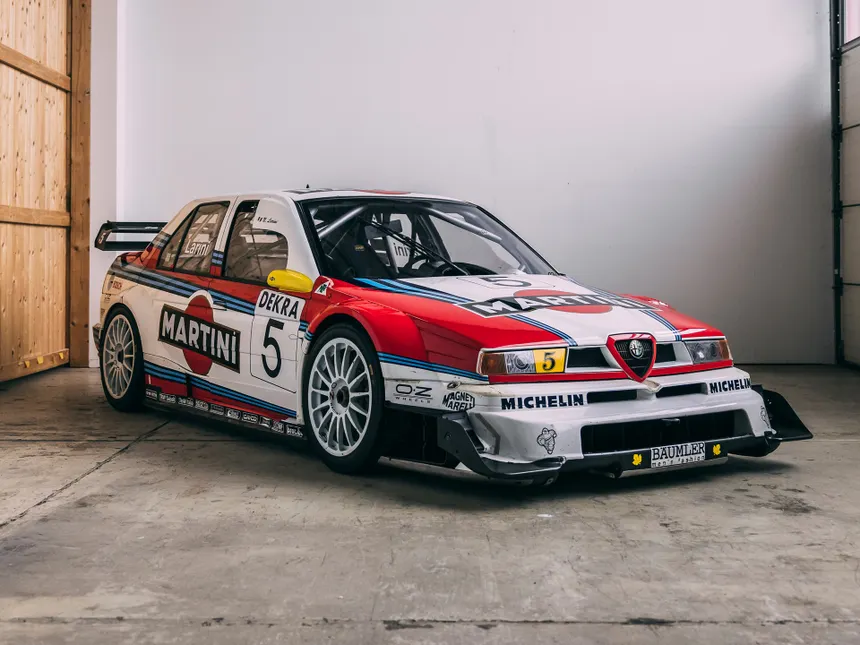
In 1995, DTM expanded internationally under the ITC name with even more relaxed regulations. Alfa Romeo fielded six official cars in Martini Racing livery. Development of the new “Step 2” car was delayed and the season was inconsistent. Bernd Schneider in a Mercedes took the title.
For 1996, Alfa Romeo introduced the new 90-degree V6 (type 690) making 490 hp at 11,900 rpm. The car was faster than ever — 186 mph top speed, 2,337 lbs. Alfa won 10 of 26 races that season, but Mercedes (7 wins) and Opel (9 wins) scored more points through consistency. The ITC collapsed at the end of 1996 due to unsustainable costs, and with it ended the 155 V6 TI’s campaign.
The numbers: the complete record
The Alfa Romeo 155 V6 TI amassed 38 championship victories (plus 3 non-championship wins). Victories were shared among seven drivers: Nicola Larini with 17 (+1 non-championship), Alessandro Nannini with 13 (+1), Stefano Modena 2, Christian Danner 2 (+1), Michael Bartels 2, Kris Nissen 1, and Gabriele Tarquini 1.
Beyond DTM, the 155 in its various forms (GTA Supertouring and V6 TI) won the Italian Superturismo Championship (1992, Larini), the Spanish Touring Car Championship (1994, Adrián Campos; 1995, Luis Villamil; 1997, Fabrizio Giovanardi), and the British Touring Car Championship (1994, Gabriele Tarquini).
What it meant: more than racing
The 155 V6 TI was not just a successful race car. It was a political statement.
In the 1990s, DTM was the exclusive domain of German manufacturers. Mercedes, BMW, and Opel invested massive budgets as a technology and marketing showcase. That an Italian manufacturer — under Fiat’s umbrella, with a fraction of the budget and no local infrastructure — could enter Germany and win the title in its first year was an unprecedented sporting and corporate humiliation.
The Germans did not take it well. Subsequent seasons were marked by regulatory wars, technical protests, and a cost escalation that ultimately destroyed the category. The ITC dissolved in 1996 partly because the investment required to compete had become unsustainable. The 155 V6 TI stands as both the catalyst and the witness of that era’s collapse.
But the impact endured. The 155 V6 TI proved that Alfa Romeo could compete — and win — at the highest level of touring car motorsport. It remains the only non-German car to win the DTM championship. And it provided the brand with a competition legacy that still resonates today.
The engineering that went into the 155 V6 TI influenced Alfa Romeo’s approach to performance cars for years afterward. The lessons learned about chassis dynamics, aerodynamics, and high-rev naturally aspirated engine development fed directly into subsequent road and competition cars. When Alfa Romeo returned to touring car racing with the 156 in the ETCC and later the WTCC, the institutional knowledge built during the 155 era was the foundation.
Today, original 155 V6 TI DTM cars are among the most valuable touring car racing machines of the 1990s. When they appear at auction — which is rare — prices are measured in six figures. They are treated as what they are: rolling works of art that also happen to be devastatingly effective race cars, carrying one of the finest naturally aspirated competition engines ever built.
An ugly duckling on the street. A swan on the track. 38 victories. The only non-German manufacturer to win the DTM.
Check you’re still alive.
2 thoughts on “Alfa Romeo 155 V6 TI DTM”