Alfa Romeo 155 V6 TI: the 12,000 rpm Alfa that beat Mercedes in Germany, with an Indy 500 winner in the team

In 1994 Danny Sullivan, the man who won the 1985 Indianapolis 500 with a famous spin-and-win, flew to Germany to drive a red Alfa Romeo sedan. It was not a publicity stunt. The car was the Alfa Romeo 155 V6 TI, and the year before it had walked into the German Touring Car Championship, the DTM, and beaten Mercedes-Benz in its own back yard. It looked like a family sedan built on a Fiat platform. Underneath, it had four-wheel drive, a six-speed sequential gearbox and a 2.5-liter V6 that screamed to nearly 12,000 rpm. For three seasons, it was one of the most exotic racing cars on the planet.
In short: the Alfa Romeo 155 V6 TI was Alfa Corse’s DTM car built to the Class 1 rules adopted in 1993: a sedan silhouette over four-wheel drive, a six-speed sequential gearbox and a 2.5-litre racing V6 derived from the Busso, with around 420 hp at 11,500 rpm. It beat Mercedes in Germany in its first season, and in 1996 a new 90-degree V6 made around 490 hp.
A rulebook written for engineers
To understand the 155 V6 TI you have to understand the rules it was built for. In the early nineties the FIA created two categories for touring cars. Class 2 was the restrictive one, with two-liter engines, and became the base for most national championships around the world, including the British Touring Car Championship. Class 1 was the wild one, and the DTM adopted it for 1993.
Class 1 allowed engines of up to 2.5 liters and six cylinders, with four valves per cylinder. The engine had to be based on a production unit from the same manufacturer, but not necessarily one fitted to the road car the racer was based on. Electronics were essentially free: ABS and traction control were allowed. Aerodynamic devices had to sit below the centerline of the wheels, with the exception of the rear wing. Weight and body dimensions had to relate to the production car, but under the skin the freedom was enormous. In practice, Class 1 let manufacturers build a prototype racing car and dress it as a sedan. That is exactly what Alfa did.
The project was run by Alfa Corse under Giorgio Pianta, with technical support from Abarth. The Italians read the new rules, found every loophole, and built a car so sophisticated that the Germans needed more than a season to catch up.
A Busso V6 turned into a racing engine
The heart of the car was a racing version of Alfa’s 60-degree V6, the engine family designed by Giuseppe Busso. Calling it a racing version undersells it. The road-going 155 V6 made 166 hp. The DTM engine made around 420 hp at 11,500 rpm in its first season.
The numbers read like a Formula 1 engine. Bore was 93 mm and stroke just 61.3 mm, an extremely oversquare layout made for high revs. It had four valves per cylinder, gear-driven camshafts and sequential injection with two injectors per cylinder. The rules limited revs to 12,000 rpm, and Alfa Corse engineers said the engine would have gone well beyond that. The block was aluminum, and the whole engine weighed around 106 kg, roughly 234 pounds.

For 1996, the last season of the series, Alfa replaced it with a new 90-degree V6, the Type 690, that produced around 490 hp at 11,900 rpm. With it, the car reached about 300 km/h, roughly 186 mph, and weighed around 1,060 kg.
The sound is what everyone remembers. It was not the bark of a V8 or the deep growl of the German sixes. It was a high, almost electric shriek that rose and rose, like a superbike engine with an extra pair of cylinders, and you could hear it coming long before you saw the car. Spectators who stood by the fences in 1993 still describe it as a sound they had never heard from a sedan before and have not heard since. For many fans it is still the sound of the old Class 1 DTM, the one that comes back first whenever anybody mentions those years.
A race car in a sedan’s clothes
The 155 V6 TI shared little with the road car except its silhouette and headlights. The chassis was a new structure with a full roll cage, and the hood and front fenders lifted off as one piece for access to the mechanicals. The engine sat longitudinally, ahead of the front axle, where the road car’s sat transversely. It drove through a six-speed sequential semi-automatic gearbox to a permanent four-wheel-drive system derived from the Lancia Delta Integrale, the rally car that had won six World Rally Championships. The torque split was biased to the rear, roughly 35 to 40 percent front and 60 to 65 percent rear, which made the car behave more like a rear-driver than a front-driver.
The suspension started with MacPherson struts in 1993 and was completely redesigned for 1995, when the rules opened even further and the cars only had to keep the silhouette of the production model. The early cars weighed about 1,100 kg. With 420 hp and four-wheel drive, the performance was devastating.
1993: Zolder and a German summer
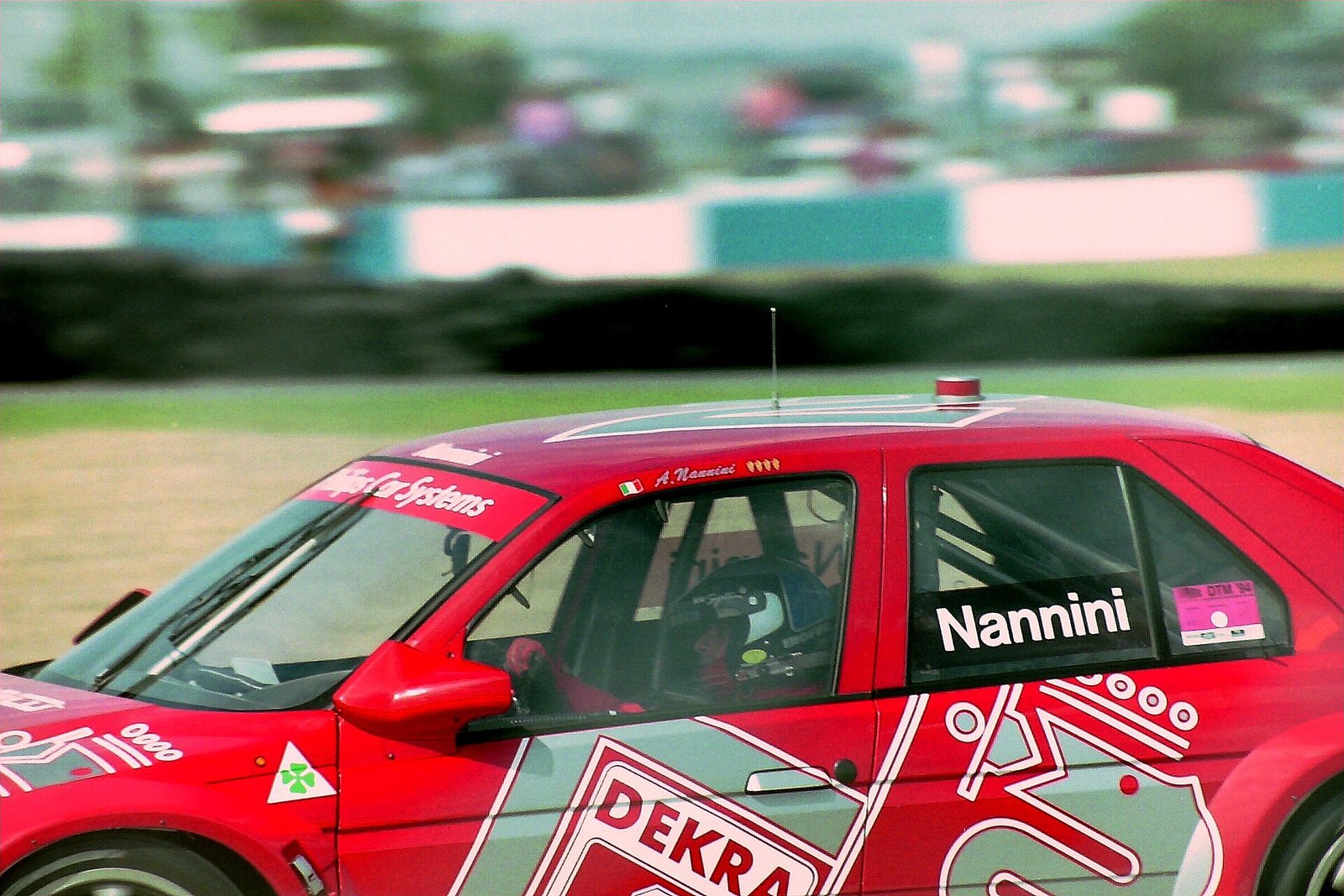
The car was ready for the first round of 1993, at Zolder in Belgium. Alfa entered five cars. The works Alfa Corse team ran former Formula 1 drivers Alessandro Nannini and Nicola Larini, and three more cars with strong factory support were run by Schübel Engineering for Giorgio Francia, Christian Danner and, later in the season, Kris Nissen.
Nannini’s presence was a story in itself. In 1990, while he was a Benetton Formula 1 driver, he lost his right forearm in a helicopter accident. Surgeons reattached it, but he never returned to Formula 1. The 155 V6 TI was adapted to make it easier for him to drive, and his wins in the DTM with a reattached arm remain one of the most remarkable comebacks in motor racing.
The opposition was mainly Mercedes-Benz, still running evolutions of its 190E because its Class 1 C-Class would not be ready until 1994. BMW had left the series at the end of 1992. Opel’s new Calibra V6 4×4 only appeared at the last round.
The result was crushing. Larini took pole at Zolder and won both races. He kept winning. By the end of the year he had 10 wins from 20 races, a DTM record at the time, and Nannini added two more. Danner won a non-championship race at Donington Park in England. Alfa took both the drivers’ and manufacturers’ titles. It was the first time since Kurt Thiim’s Rover won in 1986 that a non-German brand had taken the DTM title, and Alfa would remain the only Italian champion until Mirko Bortolotti won with Lamborghini in 2024.
The German media, used to covering Mercedes and BMW wins as routine, had to put a red Alfa driven by Italians on their front pages. Sales of the road-going 155 in Germany rose on the back of the racing success. The ugly duckling sedan that nobody had wanted was suddenly the car everyone had seen winning on Sunday television.
1994: Sullivan, Nannini and the revenge at Singen
For 1994 Mercedes arrived with its new Class 1 C-Class and the field leveled. The 155 V6 TI got a lower body with side intakes, Venturi tunnels at the rear, ABS and active suspension, and was several seconds a lap faster than the 1993 car. Alfa also brought in Danny Sullivan, the 1985 Indy 500 winner and 1988 CART champion, to drive for Alfa Corse, one of the very few Americans ever to race in the DTM.
The opposition had grown teeth. Mercedes now had a purpose-built C-Class with a 2.5-liter V6 prepared by AMG, and Opel’s Calibra V6 4×4, with an engine developed by Cosworth in England, was improving race by race. The DTM had turned into an engineering arms race between three manufacturers, each spending sums that would have funded a Formula 1 midfield team, all to win on Sunday afternoons in front of German crowds.
Alfa answered with more of everything. More electronics, more aerodynamics hidden under the body where the rules allowed it, and a constant flow of updates from Arese and from Abarth’s workshops in Turin. Larini and Nannini remained the spearhead, with Sullivan and the Schübel drivers backing them up. For a few months, the red cars were still the ones to beat.
Nannini won 7 of the first 10 races. But Mercedes, with Klaus Ludwig, was more consistent in the second half. Alfa scored more wins in total, but the points were split between its drivers, and Ludwig took the title. The manufacturers’ crown slipped away too.
Then came Singen. At the Alemannenring, the penultimate round, Nannini was hit in the first race and ended up in the barriers. For the second race he took his teammate Francia’s car, started last and climbed to fourth. At a hairpin, Roland Asch’s Mercedes knocked him off the track. Nannini rejoined, did not lift, and rammed the back of Asch’s car at the next corner, taking both of them out. Italians call it Nannini’s vendetta. Ludwig won the championship, and the incident remains one of the most cinematic moments in DTM history.
1995 and 1996: Martini colors and the end of an era
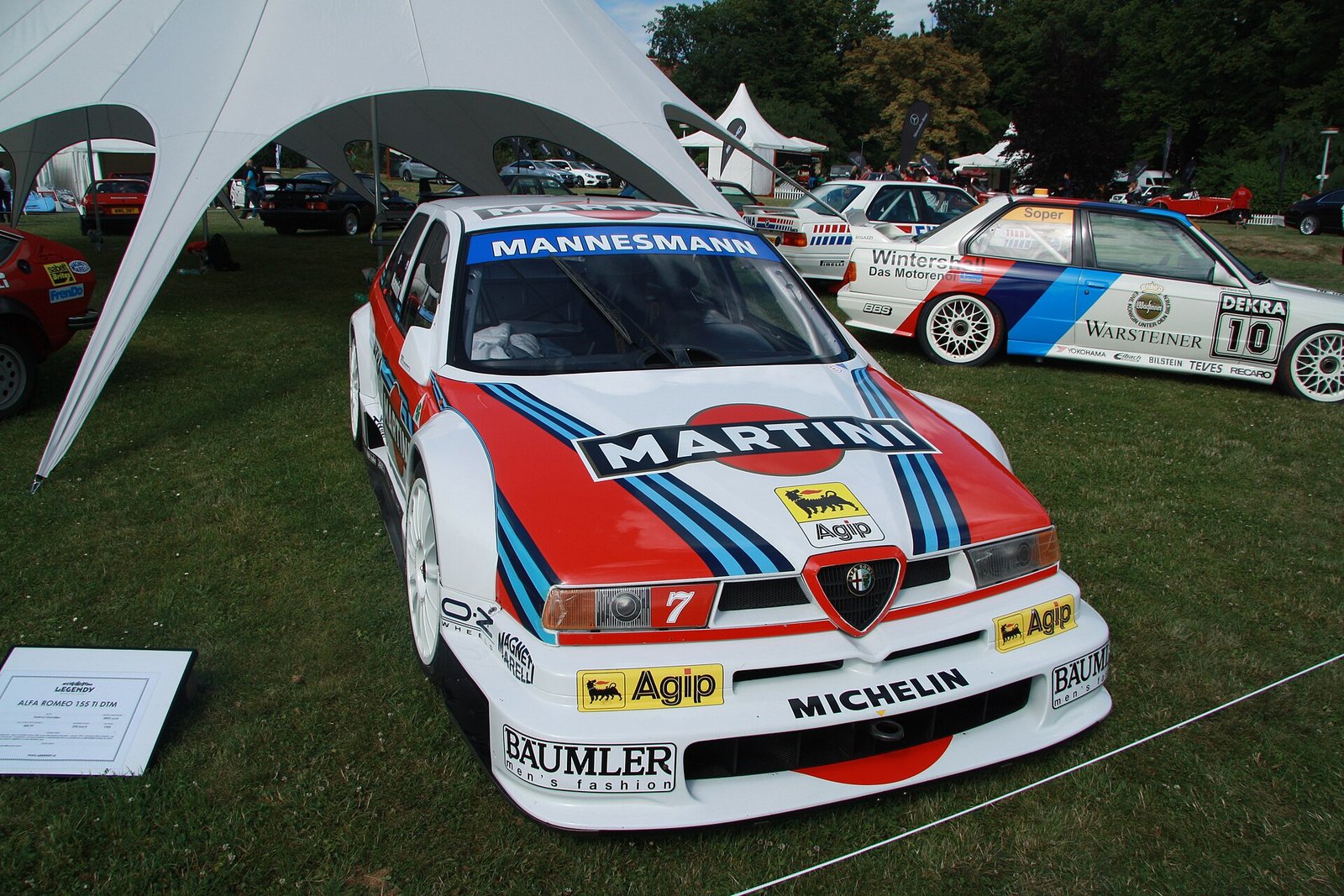
In 1995 the series went international as the ITC, the International Touring Car Championship, and the rules relaxed further: chassis and suspension were now completely free, and the cars only had to look like their road versions. Alfa entered six works cars in Martini Racing colors, with Larini and Nannini at Alfa Corse, Stefano Modena and Michael Bartels at Euroteam, and Michele Alboreto and Danner at Schübel. The new car was late and the season was uneven. Bernd Schneider won the title for Mercedes.

For 1996 Alfa introduced the 490 hp 90-degree V6. The car was faster than ever and won 10 of 26 races, but Mercedes and Opel scored more points. At the end of the year the ITC collapsed under its own costs. Mercedes and Opel pulled out, and the 155 V6 TI’s career was over.
The record
The Alfa Romeo 155 V6 TI won 38 championship races, plus three non-championship events, shared among seven drivers. Nicola Larini won 17, Alessandro Nannini 13, Stefano Modena, Christian Danner and Michael Bartels two each, and Kris Nissen and Gabriele Tarquini one each.
The wider 155 family won even more. The 155 GTA took the Italian Superturismo title in 1992 with Larini. The Class 2 155 won the British Touring Car Championship in 1994 with Tarquini, after a season famous for the arguments over its homologated aero kit. In Spain, 155s won the national touring car title in 1994 with Adrián Campos, the former Formula 1 driver who would later give Fernando Alonso his start in single-seaters, in 1995 with Luis Villamil and in 1997 with Fabrizio Giovanardi. We tell the story of the road car in our history of the Alfa Romeo 155 Q4 and V6.
Why it mattered
In the nineties the DTM was home ground for the German manufacturers, a shop window where Mercedes and Opel, and BMW before them, spent enormous sums. An Italian brand under Fiat, with a fraction of the budget and no local infrastructure, came in and won the title at its first attempt. In Stuttgart, that hurt.

The years that followed brought rules wars, technical protests and spiralling costs that eventually destroyed the series. The Mercedes 190E Evolution II had been the symbol of the previous era; the 155 V6 TI became the symbol of the one that ended it. The DTM name itself would only return in 2000, with very different rules, and you can read the whole arc in our history of the DTM.
The 155 V6 TI proved that Alfa Romeo could still win at the highest level of touring car racing, established Alfa Corse as a top team and gave the brand a racing legacy that the beautiful 156 inherited a few years later. An ugly duckling on the street. A swan on the track. And for American fans, the one DTM car with an Indy 500 winner in its history.
The thread that started with the touring car 155s runs all the way to the Alfa Romeo Giulia Quadrifoglio, the 505-hp sedan Alfa built to beat the BMW M3.
Alfa Romeo 155 V6 TI FAQ
What engine did the Alfa Romeo 155 DTM have?
A 2.5-litre racing V6 derived from Alfa’s 60-degree Busso family, with four valves per cylinder and gear-driven cams, making around 420 hp at 11,500 rpm in 1993. For 1996 it was replaced by a new 90-degree V6, the Type 690, with around 490 hp.
Did the Alfa Romeo 155 win the DTM?
Yes. In 1993, its first season, the 155 V6 TI beat Mercedes-Benz on home ground and won the championship.
Why was the Alfa 155 DTM so advanced?
The Class 1 rules allowed engines up to 2.5 litres and six cylinders, free electronics and a prototype under a sedan body. Alfa Corse, with Abarth, used four-wheel drive, a sequential gearbox and an engine revving close to 12,000 rpm.
Check you’re still alive.
Photos: MrWalkr (CC BY-SA 4.0), Martin Lee (CC BY-SA 2.0), Rahil Rupawala (CC BY 2.0), Dario Morelli 1 (CC BY-SA 4.0), Charles from Port Chester (CC BY 2.0) and Jiří Sedláček (CC BY-SA 4.0), via Wikimedia Commons.
1 thought on “Alfa Romeo 155 V6 TI: the 12,000 rpm Alfa that beat Mercedes in Germany, with an Indy 500 winner in the team”