BRABUS: The Day a 34-Year-Old Inherited a 900 HP Empire
On April 26, 2018, Constantin Buschmann received the call every son dreads and no business manual prepares you for. His father, Bodo, had died after a short illness. He was 62. It was a Thursday. And from that Thursday onward, Constantin — 34 years old, head of marketing and sales, zero experience as CEO — had to run the world’s largest independent automotive refinement company.
There was no instruction manual. There were 450 employees waiting for direction, a 112,000-square-meter campus in Bottrop, clients in over 100 countries, and one question nobody dared ask out loud: can the son live up to the father?
To understand the weight of that question, you first have to understand who Bodo Buschmann was.
The man who was the car
Bodo Buschmann was born on August 27, 1955, in Bottrop, an industrial city in Germany’s Ruhr Valley. His parents owned a Mercedes-Benz dealership. Bodo bought a Porsche 911 and parked it right in front of the family showroom. His father was furious. Bodo sold the Porsche, ordered a Mercedes W116 S-Class, and modified it until it was as fast as the 911. Customers at the dealership started asking questions. And at 22, still studying law at university, Bodo convinced a friend — Klaus Brackmann — to co-found a company. BRA from Brackmann, BUS from Buschmann. Brackmann sold his share for 100 Deutsche Marks. The price of dinner.
That’s the founding story. What matters is what came after.
Bodo didn’t build cars. Bodo was the cars. That distinction isn’t rhetorical. Everyone who knew him says the same thing: man and machine were one and the same. BRABUS products are imposing, unapologetic, built to dominate the room. And Buschmann was exactly the same. Six foot three of ambition wrapped in a black suit.
He put in 40-hour weeks by Wednesday. He didn’t take weekends off. His motto — “never work for money, work for passion” — wasn’t a LinkedIn platitude. It was the literal description of his life. And he surrounded himself with the best engineers he could find in every discipline. He wasn’t interested in mediocrity. He wasn’t interested in compromise. He was interested in every car that left Bottrop provoking a visceral reaction. And when the VDAT — Germany’s association of automotive tuners — was founded in 1987 and it came time to elect a chairman, the other tuners chose him. Not an engineer from a big manufacturer. Bodo. When your own competitors elect you to bring order to their industry, that says more about your reputation than any speed record.
How committed was he? Here’s a story. At some point in the 2000s, BRABUS organized an event to celebrate its partnership with smart, Daimler’s microcar brand. Bodo had been CEO of the 50/50 joint venture since 2002. Did he show up in a smart fortwo for the occasion? No. He arrived in an 850 hp V12-powered GLS. And when the presentation was over, he launch-controlled it out of the car park to get back to Bottrop as fast as possible. That was Bodo.
The machine nobody could believe
From that small workshop behind his parents’ dealership, BRABUS worked exclusively on Mercedes-Benz. Only Mercedes. But with a philosophy that went beyond any tuner: don’t just improve the engine. Improve the entire car. Reinforced transmission. Recalibrated suspension. Oversized brakes. Functional aerodynamics. Bespoke leather interior. Exhaust optimized for flow. Everything had to function as a unit. The world’s fastest car is worthless if the gearbox disintegrates at 20,000 kilometers.
And the numbers that came out of that philosophy were unprecedented. In 1996, a BRABUS E V12 became the fastest street-legal sedan in the world: 330 km/h. Michael Schumacher bought one. And an estate version. In 2003, the record climbed to 350.2 km/h. And in 2006, the Rocket — a CLS with a 6,233 cc twin-turbo V12 producing 730 hp and 1,320 Nm, the most powerful TÜV-certified engine of German origin — averaged 365.7 km/h at Nardò. Guinness certified it. A four-door sedan. With a trunk. With air conditioning. At 227 mph.
These weren’t laboratory prototypes. They were road-registered, insured, inspected cars. You could buy one on Friday and drive your kids to school on Monday. At 300 km/h on the autobahn, if you wanted. Each one required between 1,500 and 4,000 hours of hand craftsmanship. Leather cut and stitched by hand in over 3,500 color combinations. Carbon fiber manufactured in-house using aerospace-grade prepreg processes. Dyno testing benches handling up to 800 kW of capacity. And every car that left Bottrop met the world’s toughest emissions standards. Brutal power and full homologation. That’s not a contradiction. That’s German engineering taken to its absolute limit.
And the headquarters reflected it. The campus grew from that first workshop behind the dealership to over 112,000 square meters across five buildings. The Bottrop city council renamed the street: Brabus-Allee. When your city renames your road, you’re no longer a workshop. You’re an institution.
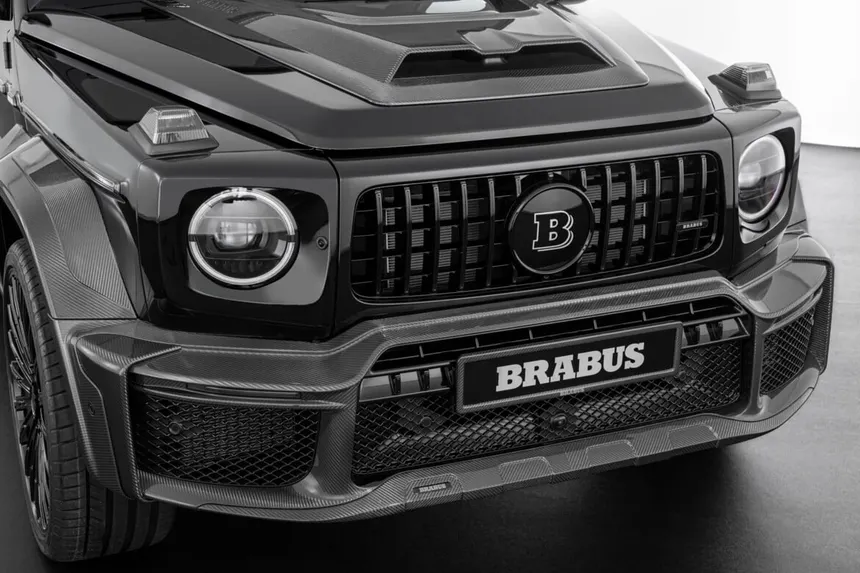
Over 7,500 vehicles a year passed through that campus. And every single one left with a plaque signed by the CEO.
First by Bodo.
The front row
And then Bodo died. And his son had to sign the plaque.
Constantin has said it with a clarity that cuts: “You can’t simulate the front row. You can play the trombone, the flute, the drums, but you can’t understand the stress at the front, next to the first violin, until you’re standing there.”
And there he stood. No manual. No transition. No time to grieve. He’d joined BRABUS in 2005 at 21. By 2012, he was head of sales. By 2018, he was CMO. He knew the company. But knowing the company and being the company are very different things. And Bodo was the company.
The first months must have been brutal. 450 people who had followed one man their entire professional lives, now looking at his 34-year-old son, waiting for answers his father could no longer give. A team of veteran engineers who had built 900 hp V12 engines with Bodo looking over their shoulders. Clients who bought BRABUS because they were buying Bodo.
And this is where the story gets interesting. Because Constantin didn’t try to be his father. He couldn’t. Nobody could. But he had something Bodo never had: the perspective of someone who grew up inside a company without having founded it. Bodo built BRABUS from instinct. Constantin builds it from strategy. And his personal philosophy is as radical as his father’s, only pointing in a different direction: “one face to life.” One face. Don’t be a different person at home, at the office, at a trade show. The same person, always. “As the owner of a family business, you can only represent both the family and the business if you have a strong foundation as a personality. My family, friends, and colleagues want to talk to the same person.”
One Second Wow
What Constantin has done since 2018 isn’t a continuation of what Bodo did. It’s a transformation. Bodo built cars. Constantin builds a luxury brand.
The “1-Second-Wow” concept — every BRABUS product must provoke a visceral reaction in the first second you see it — isn’t an advertising slogan. It’s a decision filter. If a prototype doesn’t generate that instant impact, it doesn’t leave Bottrop. If a stitch isn’t perfect, it’s undone and redone. If a collaboration doesn’t fit the BRABUS identity, it’s rejected.
“Our whole business is based on what you would call the mega-trend of individualisation,” Constantin says. “My job as the owner and CEO is to permanently infuse our brand with energy and new ideas. For this I have to get out of my comfort zone — travel, meet interesting people, immerse myself in inspiration.”
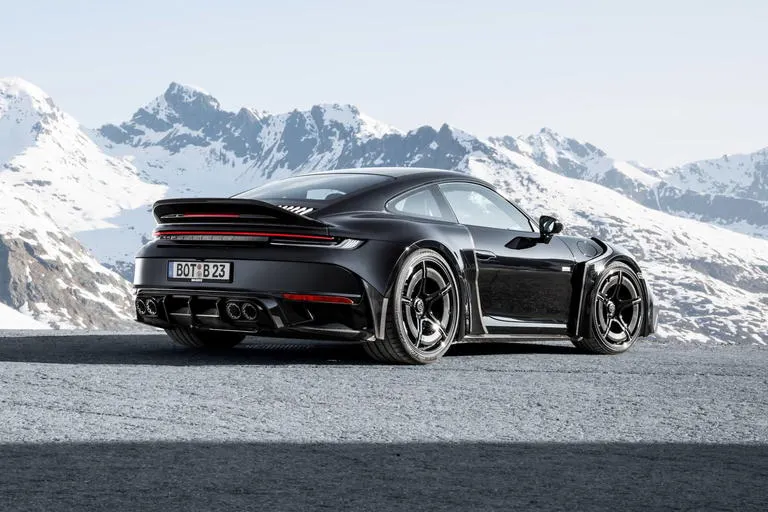
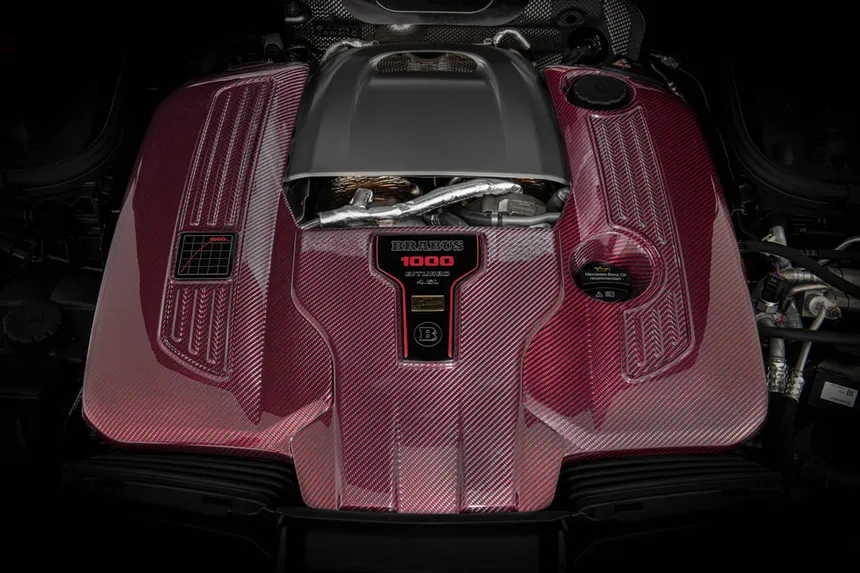
That sounds like corporate speak until you look at the results. BRABUS Marine: 900 hp boats with Mercury Racing V8 engines, in a joint venture with Finland’s Axopar. Red Dot Award for product design. The BRABUS BIG BOY 1200: a 12-meter motorhome with STX Motorhomes that won the Red Dot Best of the Best in 2025. STARTECH, the subsidiary applying the BRABUS philosophy to Aston Martin, Bentley, Jaguar, Land Rover, and Maserati. And in 2024, the move that closed the circle back to the origin: the BRABUS 900 Rocket R. Based, for the first time in company history, on a Porsche 911 Turbo S. 900 hp. 1,000 Nm. Only 25 units. The son of the man who sold his 911 to buy a Mercedes ended up building the most brutal Porsche on the planet.
Why boats? Why motorhomes? Why a Porsche? Because BRABUS is no longer a Mercedes tuner. It’s a luxury brand that creates mechanical objects with immediate emotional impact. The base vehicle doesn’t matter. What matters is the second you see it.
And in spring 2026, Amazon Prime Video premiered “BRABUS: ONE SECOND WOW,” six episodes following Constantin across Bottrop, Beverly Hills, and Milan. The son of the mechanic who worked behind his parents’ dealership now stars on Amazon Prime.
The company has over 450 employees today. At the end of 2025, Constantin reinforced the executive team with three key hires: a new CMO, a Chief Sales Officer, and a Chief Strategy Officer. The BRABUS Classic division restores historic Mercedes to a six-star standard — including a 300 SL Gullwing discovered to be the last object Andy Warhol painted before his death, restored over 4,800 hours of work. And the Dubai boutique serves a Middle Eastern market that buys BRABUS the way others buy Hermès.
The SL his father would have built
But there’s one detail that says more about Constantin Buschmann than all the Red Dot Awards and Amazon series combined.
In 2023, when Mercedes launched the new SL, Constantin knew immediately what had to be done. The SL was Bodo’s favorite car. If you walked into the Bottrop campus back in the day, there’d be one in the lot. Always. It was part of who he was.
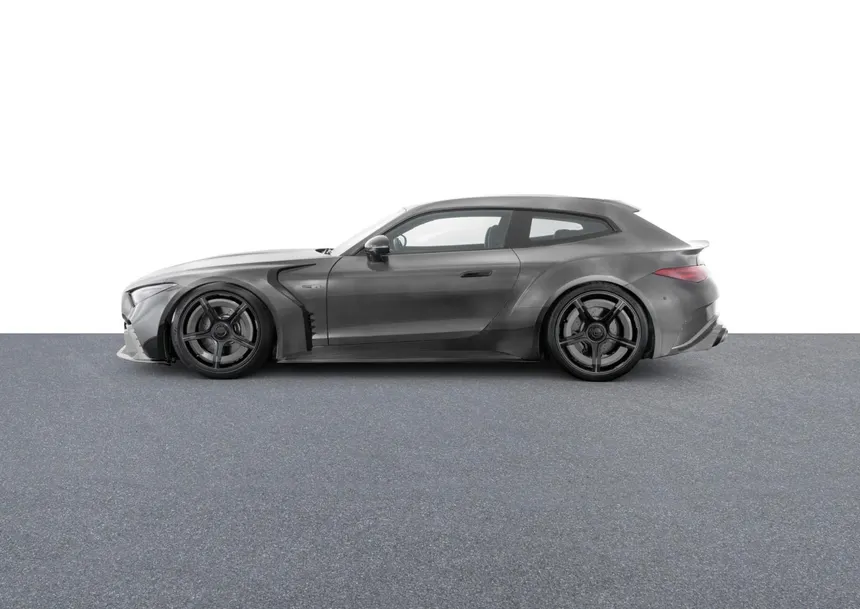
So Constantin created the BRABUS 750 Bodo Buschmann Edition. An SL 63 AMG pushed to 750 hp, designed exactly the way Bodo would have designed it. Not as a posthumous tribute. As proof that the son didn’t just know his father as a father. He knew him as an engineer. He knew which leather Bodo would have chosen. Which wheels. Which engine map. Which color.
“We had to come up with a car that looks just like he would have built it,” Constantin said. And they did.
That’s the answer to the question nobody dared ask out loud on April 26, 2018. Can the son live up to the father? He doesn’t have to. He has to be something else. And he is.
Constantin doesn’t simulate the front row. He occupies it his own way. With a different philosophy, a different market, a different language. But with the same certainty Bodo had when he parked a Porsche in front of the wrong dealership at 22: this is what I want to do. And I’m going to do it better than anyone.
Brabus-Allee, 46240 Bottrop, Germany. They named the street after the company. That’s not something you buy. That’s something you earn.
Check you’re still alive.