The Van That Stole Junkers’ Bomber Skin and Ran 34 Years
Citroën Type H: corrugated steel, unibody construction, and the lesson the industry still hasn’t learned
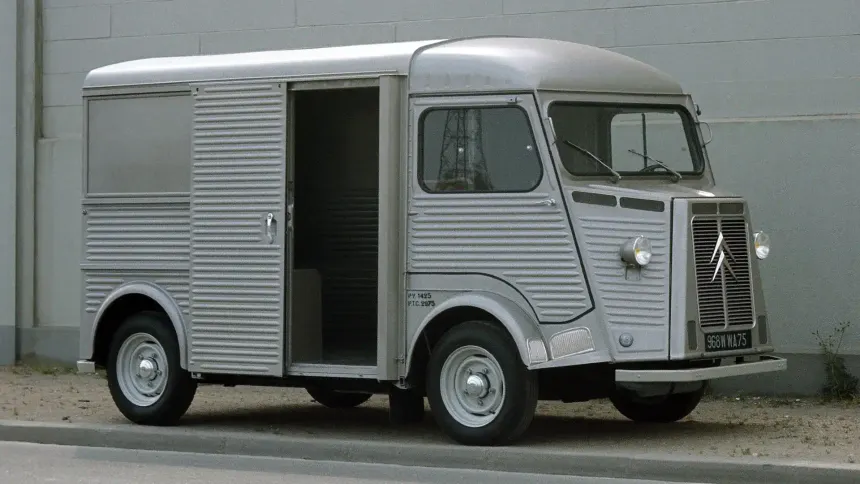
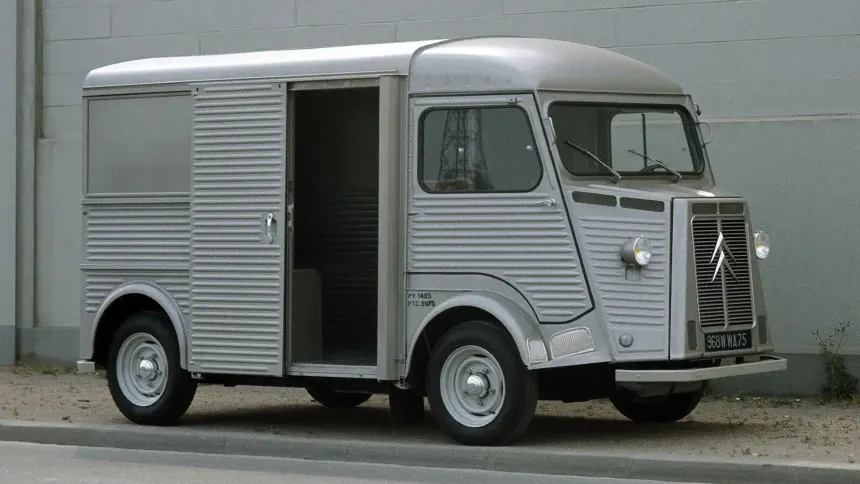
Paris, October 1947. Motor Show. There’s a beast on the Citroën stand that doesn’t look like anything else on Earth. Pig snout up front. Corrugated metal flanks like a barn roof. Standing there with the attitude of something that knows exactly why it was built. Visitors stare at it and can’t decide whether they’re looking at an aircraft, a delivery truck, or a designer’s joke at the boss’s expense.
It was none of those. It was the vehicle that would carry Europe on its back for the next thirty-four years.
And nobody walking past that stand knew the corrugated panels they were touching had been ripped, line for line, from a Nazi-era German bomber.
Boulanger’s brief: nobody understood it at first
Set the scene. France, 1945. Country in pieces. No steel, no fuel, no time. The French government had just rolled out the Plan Pons, a beautifully bureaucratic industrial rationalisation: Peugeot got the medium vans, Renault got the one-tonners, Citroën was told to stick to passenger cars. Pierre-Jules Boulanger, Citroën’s managing director (installed by the Michelin family after they forced André Citroën out in 1935), read the plan and did what any sane founder-type does when a civil servant tells him what to build. He ignored it.
Boulanger already had a project running. He’d kept it alive throughout the German occupation, in secret, in an office where developing new vehicles was forbidden by the Nazis. No fuel for prototypes. No raw materials. No working hours worth the name. The team kept going anyway.
His brief was savagely simple: unitary body, front-wheel drive, maximum reuse of parts from other Citroën models, Traction Avant mechanicals turned around backwards, and one rule written in capitals on every wall: MAKE IT AS CHEAPLY AS POSSIBLE.
The man assigned to the project was Pierre Franchiset, a body engineer at the firm. He drove the design, ran the first prototype, and signed off on the most radical decision in the whole programme: no separate chassis. None of the ladder-frame-with-a-bolted-box approach Renault used on the 1000 kg, Peugeot used on the D3, or pretty much every other European van builder of the era. The Type H would be fully self-supporting. Body as structure. Pure unibody.
And here’s where the problem that changed automotive history walked in.
The problem: a big box made of thin steel
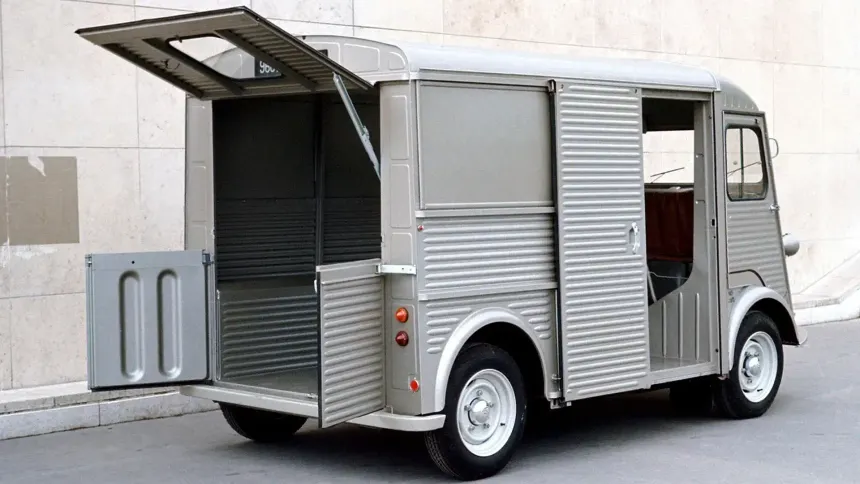
If you’re going to build a unibody van in 1947, you’ve got a textbook contradiction on your hands. The box has to be enormous — 7.3 cubic metres of usable volume on the launch model, 1,200 kg payload, 6 ft (180 cm) interior height so a man can stand up inside. But the walls have to be light, because every kilo of steel you put in is a kilo of customer payload you can’t sell. And all of this in an era when steel was rationed and every gram cost money Citroën didn’t have.
The textbook said two things:
- Thick flat steel: rigid, but heavy and expensive.
- Thin flat steel: cheap, but floppy. It buckles under its own weight.
Franchiset chose the third door. The one nobody was brave enough to push open in road-going automobiles. The one that had been used in aviation for thirty years but had never made it onto a production car.
Thin corrugated steel.
The Junkers heritage: corrugated panels as pure structural engineering
Now we get to the technical core. This is what makes the Type H unique, and it’s what no English-language general write-up has ever explained properly.
Hugo Junkers, the German aerospace engineer who flew the Junkers J 1 in 1915 (the first all-metal aircraft in history, with corrugated steel skin on fuselage and wings), faced a problem startlingly similar to the one Citroën would face thirty years later: how do you build a large, light, rigid structure out of a material that, in its flat form, is structurally useless?
The answer is pure geometry. And it lives inside something called the second moment of area.
Take a flat steel sheet 0.8 mm thick and load it in bending. It buckles laughably easily. The reason is a formula every materials student knows: the second moment of area for a rectangular section is I = (b·h³)/12. What matters for bending stiffness is the section depth h, cubed. Double the depth and you multiply bending stiffness by eight. You add nothing — not one extra gram of material.
That’s exactly what a corrugated panel does. The wave raises the effective section depth without adding mass. It’s geometric trickery. It’s stiffness for free.
Junkers worked it out first on the J 3 design study of 1916, refined it on the all-metal J.I close-support aircraft of 1917, and industrialised it on the F 13 of 1919 — the world’s first all-metal commercial airliner. The corrugated duralumin skin did two things at once: it weighed less than any equivalent wood-and-fabric structure, and it was structural. It wasn’t a covering laid on top of a skeleton. The skin was the skeleton — what aerospace engineers call stressed-skin construction. The skin works in shear, tension and compression alongside the spars. Without the skin, the aircraft falls apart.
The Junkers Ju 52 — the bear-faced trimotor that flew like a flying bus and carried half of European commercial aviation through the 1930s and Wehrmacht logistics through the 1940s — kept that corrugated duralumin skin until the end. When Franchiset, in 1945, stared at his brief and saw he had to build a big box from very little thin steel, he reached for the trick the Germans had been quietly using above his head all through the war. He stole it without a flinch.
What most people miss: corrugations don’t work alone
Here’s the technical detail that separates the Type H from everything else and that the general-interest write-ups always skip.
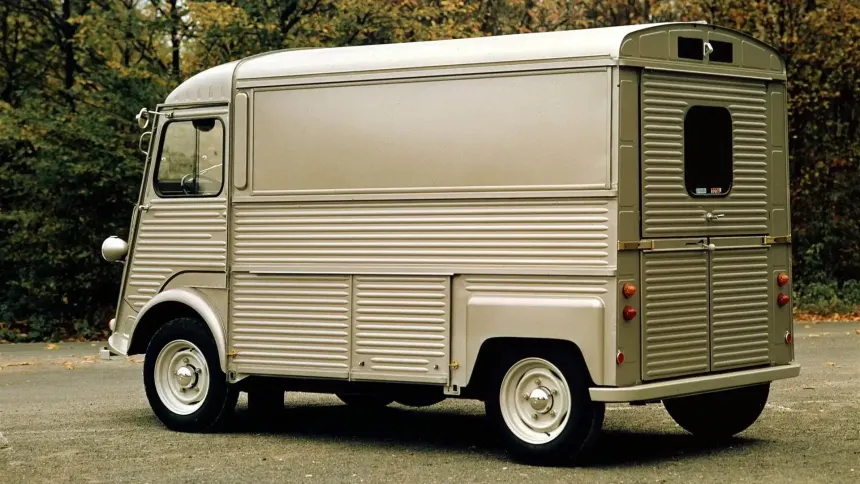
The Type H’s corrugations run vertically. Up and down the flanks. That matters: they stiffen the panel against vertical buckling, which is the failure mode the side wall faces when the van is loaded (the roof pushes down, the floor pushes up, the flanks want to bow outward).
But the ribs alone wouldn’t be enough. Look inside a Type H and you’ll see the corrugated outer skin is reinforced at right angles by internal sections shaped like the Greek letter ω — omega profiles, called top-hat sections in body engineering. These run perpendicular to the corrugations, welded to the inside of the skin. The combination is what’s known as an orthogonally stiffened panel: the waves give stiffness along one axis, the top-hat sections give stiffness along the other. A flat sheet that on its own would be chicken wire becomes a structural sandwich panel that any 1930s aircraft engineer would recognise the moment he ran a hand across it.
Compare that to a modern road-car unibody and the conceptual difference is sharp. A modern unibody achieves stiffness through complex three-dimensional stamped pressings (roof bows, header rails, B-pillar reinforcements, side-impact beams) and increasingly through advanced steels (martensitic grades, hot-formed steels, ultra-high-strength alloys). Stiffness through complex form and advanced material.
The Type H gets the same result with thin plain-carbon steel, corrugated and welded to top-hat reinforcements. Stiffness through simple geometry. No special steel. No complex stampings. Cheap presses. That gap is exactly the difference between postwar engineering and modern engineering: the first solved problems with brains, the second solves them with budget.
The mechanicals: Citroën cannibalism taken to the limit
The Type H is a manual of industrial cannibalism. Boulanger’s rule was unambiguous: no new parts if an old one can do the job.
- Engine: 1,911 cc inline-four with cast-iron block and head, lifted directly from the Traction Avant. 35 hp SAE at launch — the engine known as the 11D. The block went unchanged until 1963, when it received an aluminium cross-flow head. Some sources point to it as the longest-running engine block in automotive history: the basic block was introduced in the Traction Avant in 1934 and remained in production until 1981. Forty-seven years.
- Reversed rotation: the Traction’s engine was mounted backwards, hung in front of the front axle. That forced the rotation direction to be flipped.
- Gearbox: three speeds, no synchro on first. Same as the Traction.
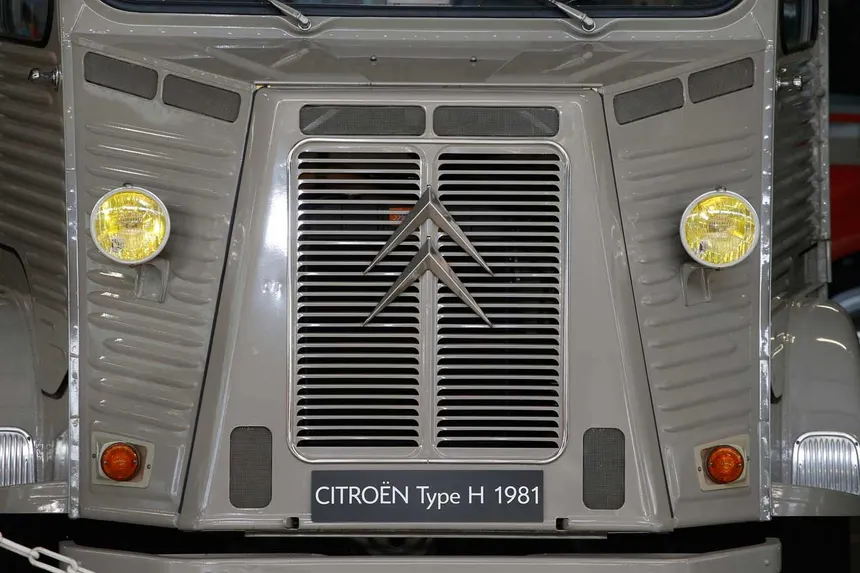
- Headlamps: 2CV.
- Speedometer: Traction first, then Ami 6.
- Brakes: fully hydraulic (genuinely modern for 1947), six-stud drums lifted from the Citroën 11 CV.
- Front suspension: double torsion bars, fully independent. The Traction Avant idea adapted to commercial-vehicle loads.
- Rear suspension: conventional semi-elliptic leaf springs.
- Drivetrain: front-wheel drive. In a 1947 commercial vehicle, that was science fiction. The vast majority of European competitors were still rear-wheel drive with the engine up front, or rear-engined (the VW Type 2, arriving in 1950).
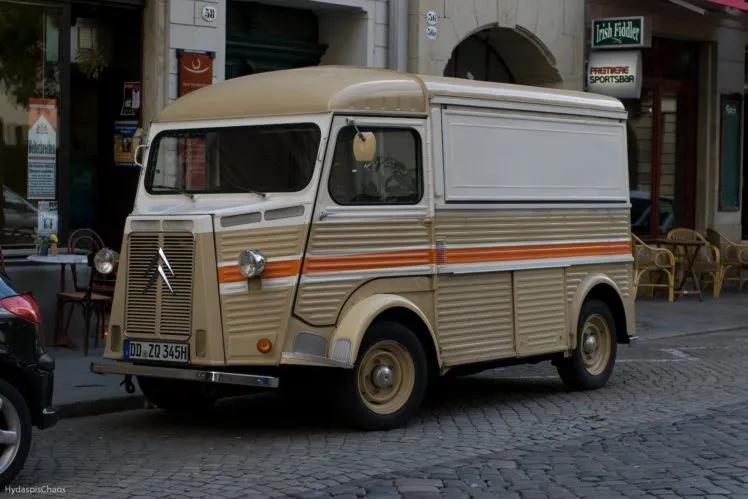
And then there are the doors. The cab doors are suicide doors — hinged at the rear, opening against the direction of travel. They stayed that way until production ended in 1981. In the Netherlands, from 1968, conventionally hinged doors were available because of local safety rules. Citroën left the rest of the world’s Type H with suicide doors for thirty-three years. There was a practical reason: the delivery driver could leap out the moment he hit the brakes without the open door fouling the next open door. Removing the central pillar also meant a man could enter or leave sideways with almost any object in his hands.
The numbers, in context
To place the Type H in its real environment, you have to compare it to the rivals it actually faced:
- Citroën Type H (1947): 1,911 cc, 35 hp, unibody, front-wheel drive, sliding side door, loading height 35 cm, interior height 180 cm, payload 1,200 kg, usable volume 7.3 m³.
- Renault 1000 kg / Galion (1947, French rival): separate ladder chassis with bolted body. Rear-wheel drive. Stated payload 1,000 kg.
- Volkswagen Type 2 (1950, German rival): 1,131 cc air-cooled rear flat-four, 25 hp. Initial payload around 750 kg. Rear-engined, rear-driven.
- Morris J Type (1949, British rival): 1,476 cc side-valve engine with cylinder bores cut directly into a soft cast-iron block. Separate chassis, rear-wheel drive, 500 kg payload, less than half the Type H’s usable volume.
It took British vans forty years to ship three things the Type H had at launch in 1947: front-wheel drive, rack-and-pinion steering, and a sliding side door.
Why it lasted 34 years: the economics of standing still
The Type H was built from June 1948 to December 1981. Four hundred and seventy-three thousand two hundred and eighty-nine units, exactly. The last one, chassis number 473289, rolled off the Aulnay-sous-Bois line in December 1981 and sits today in the Conservatoire Citroën HERITAGE.
Thirty-four years of production with virtually no fundamental changes. The question isn’t why it lasted so long. The question is: why would Citroën have changed it?
The Type H was designed to amortise its tooling at maximum efficiency. Cheap presses (corrugated steel doesn’t need complex dies, just roll-forming machines). Recycled mechanicals from the existing parts bin. Modular design: the platform took short or long wheelbases, short or long rear overhangs, and external coachbuilders (Heuliez, Currus, and many others) turned it into ambulances, mobile shops, school buses, horse transports, refrigerated trucks, fire vehicles, and basically anything someone needed. Some HY ambulances were even fitted with hydropneumatic rear suspension borrowed from the DS — a mash-up of engineering only Citroën would have allowed.
When the new Aulnay-sous-Bois facility came online in the seventies and started building modern Citroëns, the Type H kept selling. They kept it alive because the unit cost was negligible and the industrial margin was rock-solid. The replacement only arrived with the C25 in 1981, jointly developed with Peugeot and Fiat under the Sevel project and sold in parallel as the Peugeot J5 and Fiat Ducato. That move into the Sevel consortium marks the end of Citroën as an autonomous van manufacturer. The Type H was the last commercial vehicle they designed alone. And it outlasted everything its rivals threw at it.
What the industry still hasn’t learned
Look at a current Mercedes Sprinter. A Ford Transit. A Renault Trafic. A small fortune to build. Multi-phase steels, brutally complex stampings, FEM simulation on every panel, robotic spot-welding. Brilliant technology. Result: vans that weigh more than the Type H did and that won’t survive 34 years of hard commercial use without the bodyshell rotting out at twelve.
The Type H rusted, of course. Like every car of its era. But when the steel was sound, the structure didn’t quit. Aulnay-sous-Bois turned out vehicles that are still on French roads fifty years later, working roads Boulanger never imagined. And it did it with corrugated plain-carbon steel and welded omega sections. Not one gram of aluminium. Not one laser weld bead. Not one structural adhesive.
The lesson the industry still hasn’t learned is that toughness doesn’t come from the material. It comes from geometry, applied correctly. Hugo Junkers grasped that in 1915. Pierre Franchiset transferred it to the road in 1947. Boulanger defended it against the Plan Pons that same year and, again, was right. Today, in 2026, watching a Type H rumbling down a French country road with a chef inside flipping crêpes is watching a living fossil that still teaches engineering lessons to vehicles designed on supercomputers.
One last thing
A footnote. The van is often miscalled the “Citroën Tube”. It isn’t. The Tube was the TUB of 1939, its immediate predecessor — only about 1,748 units of which were built before war and German requisitions shut production down. The TUB introduced the sliding side door, the low floor, and front-wheel drive. But it had a separate chassis, was heavy, and tended to tip forward under hard braking when running empty. Franchiset looked at that vehicle and thought: I can do this properly. So he scrapped it and started from scratch.
The Type H is called H simply because it was the eighth utility-vehicle project in the design office’s docket. Eighth letter of the alphabet. Citroën saved money even on the names.
Check you’re still alive.
1 thought on “CITROËN TYPE H”