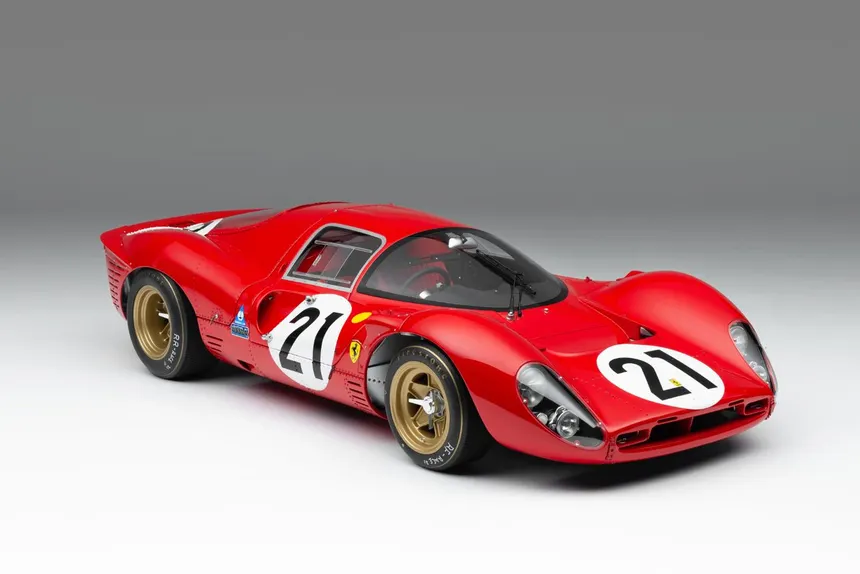
Ferrari 330 P4: The Most Perfect Reply To a Humiliation
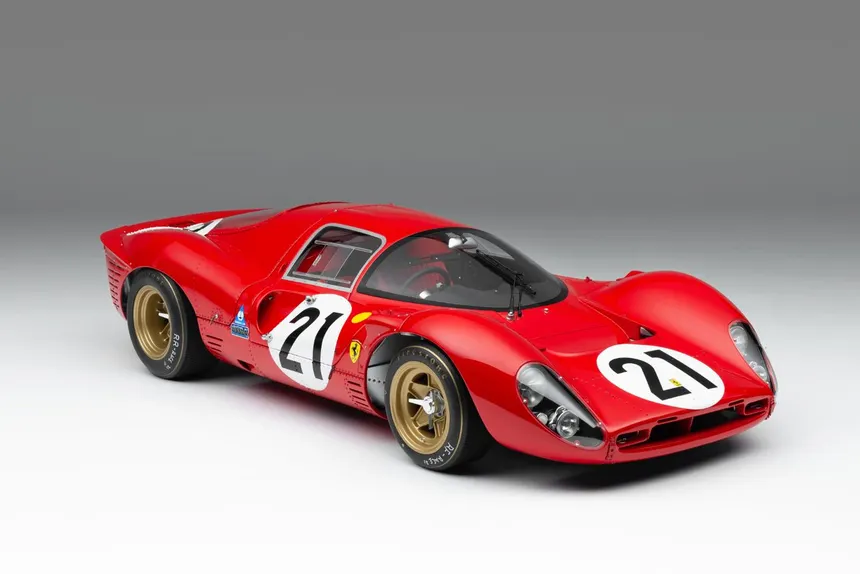
Ferrari never answered Ford with words.
Ferrari answered with a photograph.
Daytona, 5 February 1967, half past three in the afternoon. Three red cars crossing the finish line side by side, shoulder to shoulder, drivers revving their engines like men spitting in their rivals’ faces. The American press shot it. The European press reprinted it the next morning. And in some office in Dearborn, Henry Ford II opened the morning paper and found his own Le Mans 1966 photograph posted back at him with Italian licence plates.
It wasn’t an accident. It was revenge calculated to the millimetre.
And it was signed off by a four-litre V12 with Formula 1 cylinder heads designed in six months by a thirty-year-old engineer named Mauro Forghieri, in a Maranello factory that the year before had been humiliated live, in colour, in front of 300,000 spectators and the entire Ford Motor Company marketing department.
This is the 330 P4.
This is what happened when Italy decided enough was enough.
The Part Of The Story You Already Know
Let’s get through what you already know quickly. If you’ve seen Mangold’s film with Damon and Bale, if you’ve read any book on the Ford GT40, if you’ve been into this for more than two years, you can skip this section. But somebody has to write it, because without it, what comes next doesn’t make sense.
May 1963. Henry Ford II, president of Ford Motor Company, sends a team of lawyers to Maranello to buy Ferrari. The deal is essentially closed. On the table: 18 million dollars for control of the company. Enzo reads the contract and stops on a clause. On all matters relating to Formula 1 competition, Ford reserves the right to approve or veto Ferrari’s decisions. Enzo closes his pen, looks at the American team, and shows them the door before he finishes the sentence.
Henry Ford II finds out and orders what enters history as the most expensive personal-pride project ever launched: build a car that destroys Ferrari at Le Mans. Not for the money. Not for commercial strategy. To make a small-town Italian pay for daring to throw his lawyers out.
The result was the Ford GT40. Four years of development. Tens of millions of dollars. Parallel teams in England and the United States. Carroll Shelby running the American programme. And on 19 June 1966, on the Tertre Rouge bend at Le Mans, three GT40 Mk IIs crossed the line together in combat formation. The photo went around the world. Henry Ford II framed it. Enzo Ferrari didn’t reply.
Not in public.
In private, he called an engineer called Mauro Forghieri and said one sentence to him. I’ll get to that later.
That’s everything you need to know about context. The rest, what comes now, is what almost nobody tells you properly.
The Sentence Enzo Said To Forghieri
Mauro Forghieri was 31 years old when he inherited Ferrari’s technical leadership after the palace revolt of October 1961. By June 1966, he’d been running the department for five years. He’d built the 330 P3, raced against the GT40 Mk IIs at Le Mans, and watched live as those heavy but relentless American battleships left his cars without fuel and without pride.
The legend, recorded in his own memoirs published years later, says Enzo called him into his office at the end of June 1966, sat him down, and gave him one instruction.
“Mauro, I’ll give you six months and all the money you need. Come back to Daytona with a car that walks all over them.”
No introduction. No team meeting. No committee. The Ferrari culture of the 1960s condensed into one sentence: the problem, the deadline, the budget, all in one line, and one man responsible.
Forghieri walked out of that office and locked himself in the technical department. He had until the end of January 1967 to put the car on a Florida circuit with two Italian drivers behind the wheel.
Six months.
What He Pulled Off In Six Months
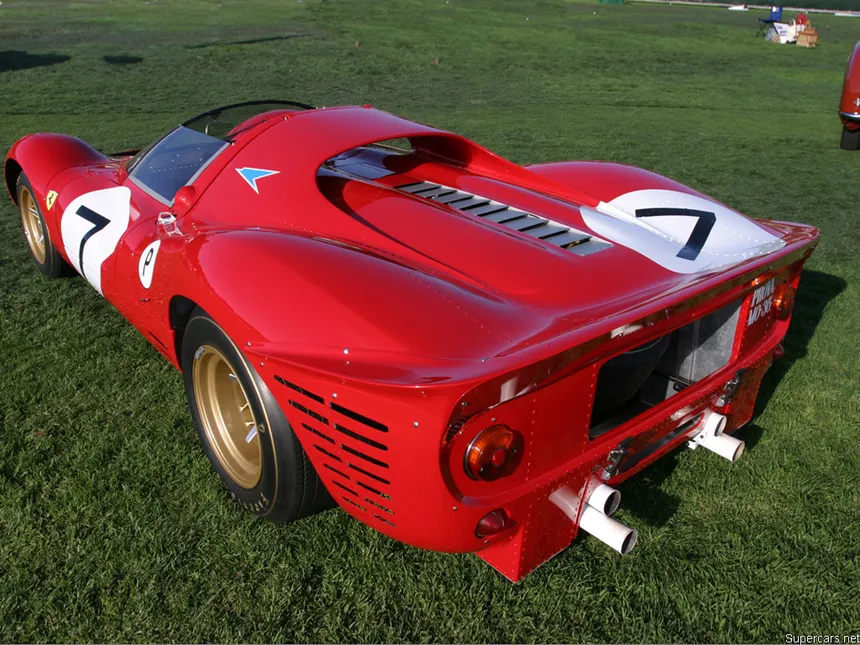
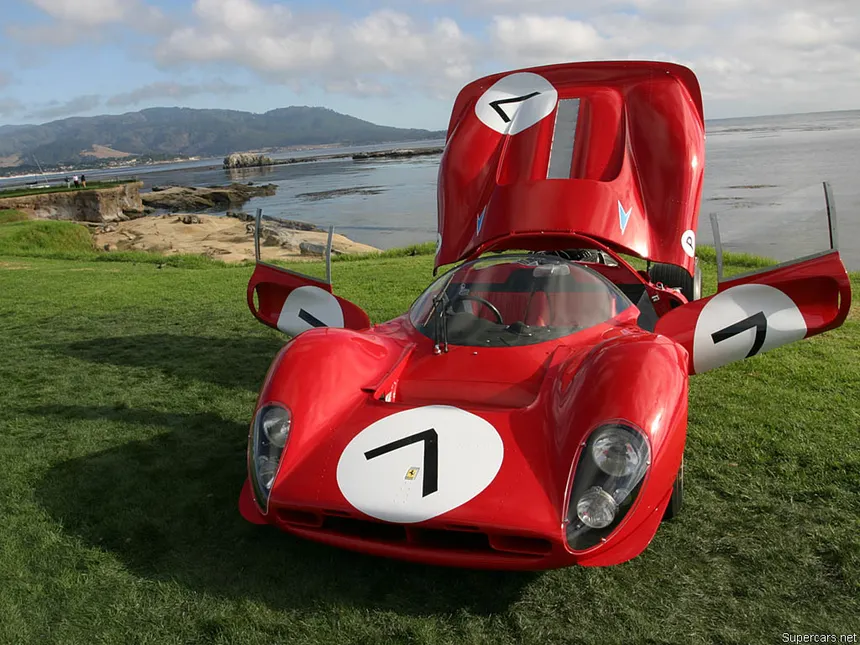
Forghieri didn’t design the 330 P4 from scratch. That would have been impossible in the time available. What he did was take the existing 330 P3 and rebuild it from the cylinder heads to the rear bodywork, leaving intact only what already worked.
The engine got the heaviest surgery. The P3’s V12 was a 4.0-litre with two-valve-per-cylinder heads. Forghieri redesigned the heads to a three-valves-per-cylinder architecture — two intake, one exhaust, 36 valves total — directly derived from the heads of the Ferrari Formula 1 car with which Ludovico Scarfiotti had won the 1966 Italian Grand Prix at Monza. The Lucas injection was updated. Compression went up. Result: 450 horsepower at 8,000 rpm, against the P3’s 420.
But the real revolution wasn’t the engine.
It was the gearbox.
The 330 P3 had used a German ZF Tipo 593 transmission. A good gearbox on paper, problematic in practice. At Le Mans 1966, several P3s had broken gearboxes mid-race. Forghieri made a brutal strategic call: build the gearbox in-house. Ferrari developed a brand-new transmission internally, more reliable, lighter, sized exactly to the new engine. It’s one of those details engineers understand and the public skips over. But that decision, taken in July 1966 and delivered in four months, is what won Daytona six months later. The Fords broke transmissions at Daytona. Ferrari didn’t.
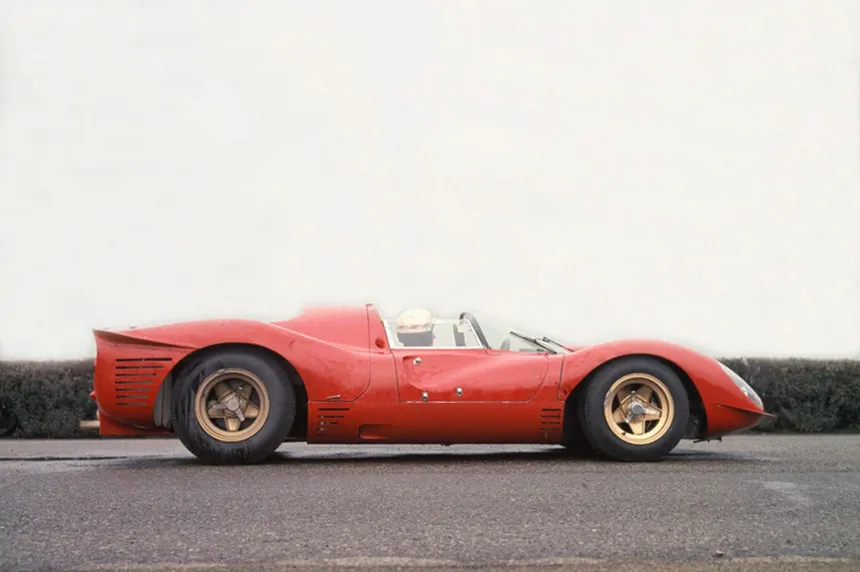
The chassis was reinforced. The aerodynamics were redesigned from scratch in the Pininfarina wind tunnel and, pay attention, in the wind tunnel of the Stuttgart Polytechnic. Yes, you read that right: Ferrari went to Germany, to the city of Mercedes and Porsche, to test its Daytona car. The Italians weren’t stupid. Stuttgart had better aerodynamic facilities than anywhere in Italy, and Forghieri needed absolute precision. Result: the P4’s signature long nose, a redesigned tail with less lift, better stability above 320 kilometres per hour.
New suspension. Magnesium Campagnolo wheels, lighter. Wider Firestone tyres for Daytona, where the banking demands something different. Disc brakes redesigned with new cooling.
On 25 December 1966 — Christmas Day — two prototypes of the new P4 were loaded onto a cargo plane bound for Florida for a test session at Daytona International Speedway. Forghieri travelled with them. He spent Christmas in Florida.
Six months from Enzo’s sentence. Deadline met.
The Daytona Grid, 4 February 1967
Saturday 4 February 1967, three in the afternoon local time, 59 cars rolled away from the Daytona 24 Hours start. The race was the opening round of the International Constructors’ Championship, what we now call the World Endurance Championship.
What was on that grid was an open declaration of war.
Ford brought six factory GT40 Mk IIs, split between Shelby American and Holman & Moody. Three cars per team. 7.0-litre V8 engines, 530 horsepower, recently redesigned with reinforced T-44 transmissions and bumped-up power outputs. Ford’s philosophy was the same as ever: put as many cars on the grid as possible and let statistics handle the rest. Pole position for the GT40 Mk II of Dan Gurney and A.J. Foyt with a 1:55.1.
Chaparral ran two 2Fs with Chevrolet 7.0-litre engines. Phil Hill, 1961 F1 World Champion, behind the wheel of car number 15. He qualified second, two tenths off Gurney. A serious threat to both main contenders.
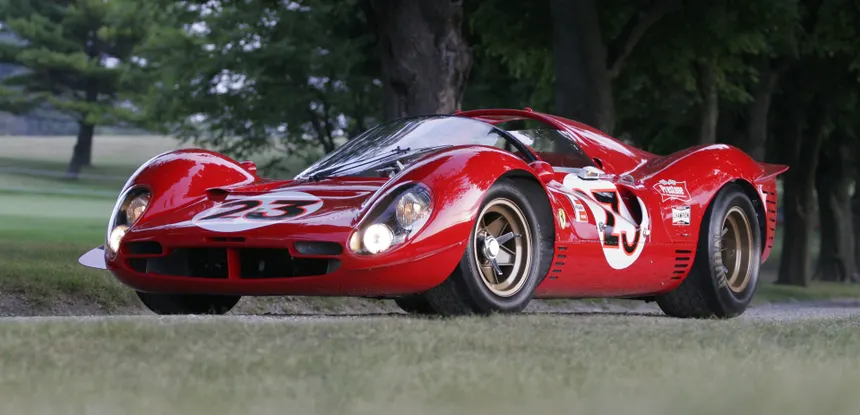
Ferrari brought two factory cars: chassis 0846, a 330 P3 updated to P4 specification at the end of 1966 (officially designated P3/4), Spider version, race number 23, for Chris Amon and Lorenzo Bandini. And chassis 0856, a pure 330 P4, closed Berlinetta version, race number 24, for Mike Parkes and Ludovico Scarfiotti. Backing them up came three cars from allied private teams: Luigi Chinetti’s NART 412 P (chassis 0844, number 26) for Pedro Rodríguez and Jean Guichet; the Ecurie Francorchamps 412 P for Mairesse and Beurlys; and David Piper’s private 365 P2/3.
The Chris Amon signing deserves its own paragraph. Amon, a New Zealander, had been part of the Ford team that won Le Mans 1966. He’d lifted the trophy with Bruce McLaren. And six months later, here he was sitting in the other trench, dressed in red, ready to answer the previous year’s broadside. Ferrari didn’t sign at random. Ferrari signed the man who’d been inside the enemy.
The Race, Hour By Hour
The start. Phil Hill in the Chaparral 2F immediately overtakes Gurney’s Ford on the first corner. Three seconds clear by the end of the opening lap. The Ferraris start conservatively. Controlled pace. Forghieri and Ferrari sporting director Franco Lini have given the order: hit target lap times, don’t chase, wait.
First half-hour. Hill pulls out twenty seconds. Ferrari stays calm. Ford and Ferrari, according to contemporary sources, agree not to push the pace unless the Chaparral gap goes over five laps. It’s a 24-hour race. You have to last.
Three hours in. Hill’s Chaparral spins and breaks. Out of the race. When the dust settles, the number 24 Ferrari 330 P4 of Parkes and Scarfiotti moves into the lead.
Six hours in. The Ford disaster begins. The T-44 gearboxes Ford had reinforced to handle the V8’s 530 horsepower start to fail. One after another. Defective seals. Broken transaxle input shafts. The factory Mk IIs roll into the pits for long stops, come out, roll back in. Holman & Moody and Shelby American mechanics swap transmissions out in the open Florida air. It’s a haemorrhage.
Twelve hours. Only one factory Ford GT40 Mk II is still in contention, the number 1 of Bruce McLaren and Lucien Bianchi, and it’s suffering overheating issues. It will have to slow significantly. It finishes seventh, 73 laps behind the winner.
Eighteen hours. The three factory and semi-factory Ferraris hold the top three overall positions. Forghieri and Lini start talking.
Twenty-three and a half hours. The order goes out to the three lead drivers to slow down and form up for the finish. Lini, the sporting director, has had the idea. He wants to recreate the same photograph Ford had taken at Le Mans 1966. But in reverse.
Half past three on the afternoon of 5 February 1967. The three Ferraris cross the line shoulder to shoulder, in combat formation, exactly the way the GT40s had eight months earlier. 0846 first (Amon-Bandini, P3/4 Spider). 0856 second (Parkes-Scarfiotti, P4 Berlinetta). 0844 third (Rodríguez-Guichet, NART 412 P).
The American photographers shoot. The picture appears the next day on every front page in the country. And in the Maranello office, somebody frames it and hangs it on the wall of Enzo Ferrari’s office.
That photograph stayed there until the day he died in 1988.
Twenty-two years.
Why The Fords Broke and the Ferraris Didn’t
Here’s where the official story tip-toes past the issue and NEC stops to look.
Ford’s defeat at Daytona 1967 wasn’t accidental. It was the direct consequence of each manufacturer’s industrial philosophy. And understanding that difference is understanding why the P4 matters more now than ever.
Ford had built the GT40 Mk IIs as power projects: 7-litre V8, 530 horsepower, high weight, reliability bolted on with budget and development hours in the United States. The philosophy was American to the bone: if power is enough, everything else can be compensated for. And for Daytona, the Mk IIs arrived carrying the additional weight of new safety cages fitted after driver Ken Miles died in the Ford J-Car prototype accident in August 1966. Each Mk II at Daytona weighed over 1,400 kilos with driver and fuel.
Ferrari had built the P4 as a balance project: 4-litre V12, 450 horsepower, low weight, technical solutions refined lap after lap. Italian philosophy to the bone: if the car is light and reliable, you don’t need brute power. A P4 weighed around 800 kilos. Six hundred kilos less than a Mk II.
On Daytona’s banked corners, that weight difference shows on every lap, every braking zone, every corner exit. Driver Chris Amon said it plainly in the post-race press conference: “We were lighter than the Fords. We could take them accelerating out of the tight curves, and run with them on the straights.” Luigi Chinetti, owner of NART, was even more direct: “Four-hundred and five-hundred horsepower is foolish. Only about five drivers in the world can handle that kind of horsepower to full advantage on a short course.”
But the real differential was in the transmission. Ford’s freshly designed T-44s, built to handle the V8’s 530 horsepower, didn’t last the race. Five of the six factory Mk IIs retired with gearbox or engine problems. The Ferrari transmission, built in-house by Forghieri in four months, lasted 24 hours without a single failure on the three factory and semi-factory cars that finished.
Ford’s philosophy lost Daytona because reliability isn’t bought with budget. It’s built with time. And Ferrari, despite having only six months, used them better.
Le Mans 1967: The Honourable Defeat
This needs telling, and it needs telling properly.
Daytona was an absolute Ferrari victory. But Daytona wasn’t Le Mans. The Sarthe was still the main theatre of the Ford-Ferrari war. And on 11 June 1967, with the Mulsanne still chicane-free and over five kilometres of flat-out straight, Ferrari had to return to the scene of the previous year’s crime.
Here’s what happened at Le Mans 1967. Ferrari brought five 330 P4s in factory and semi-factory trim, three 412 Ps privately entered, and a 365 P2 from David Piper’s team. Ford answered with four Ford GT40 Mk IVs, a complete evolution of the Mk II with aluminium honeycomb chassis and 7.0-litre engines. Plus three Mk IIBs and three private Mk Is.
The Mk IV was a different car from the Mk II Ferrari had crushed at Daytona. Lighter, better aerodynamics, reliability addressed in the weeks before the race. Dan Gurney and A.J. Foyt started in car number 1, the same pair who’d taken pole at Daytona and broken transmission.
The race was decided in the early hours after the start. Gurney and Foyt set off at a punishing pace Ferrari decided not to match. The Ferrari strategy, dictated by Lini, was the same as Daytona: controlled pace, wait for failures, last. But the Mk IV didn’t break. It stayed in the lead for 24 hours.
Final result: Gurney/Foyt’s Ford GT40 Mk IV, first. Scarfiotti/Parkes’ Ferrari 330 P4 chassis 0856, second, four laps down. Privately entered Ferrari 330 P4 number 22, third.
Le Mans 1967 was a Ferrari defeat. But it was a different defeat from 1966.
In 1966 Ferrari had walked out humiliated, with all factory cars out of the race and the GT40s crossing the line in formation. In 1967 Ferrari finished second and third, on track until the end, with a car that set the all-time record for distance covered by a Ferrari in Le Mans history (5,180 kilometres, Scarfiotti/Parkes mark still on the ACO archives today). They lost, yes. But they lost competing.
And at the year’s end, when the International Constructors’ Championship was settled, Ferrari took the title over Ford. The full season — Daytona, Monza, Spa and the rest — went Ferrari’s way. Le Mans went Ford’s way. The championship went to Maranello.
That’s the story Mangold’s film doesn’t tell you.
The Fourth Chassis: The Open War of 0846
So far, the official history. What comes next is where NEC walks into ground others prefer to step around.
Of the four chassis built to P4 specification by Ferrari at the time, three were full P4s from the factory: 0856, 0858, 0860. And a fourth, 0846, which started the season as a P3/4 — a 330 P3 chassis modified at the end of 1966 to take the P4 engine. That 0846 is the car that won Daytona 1967 with Amon and Bandini.
What happened to that car?
Ferrari’s official version, repeated by Maranello for decades, says 0846 was damaged in a Le Mans 1967 accident, suffered fire damage, was disassembled and sent to the customer service department for eventual use, and was subsequently scrapped. In other words: that chassis no longer exists.
The version told by James Glickenhaus, New York collector, founder of Scuderia Cameron Glickenhaus, says something very different.
Glickenhaus bought a car in July 2000 from British driver and constructor David Piper. Piper had previously commissioned three replica P4 chassis from a specialist constructor in the 1960s. Glickenhaus bought one of those chassis believing it to be a replica. But after studying it in detail, he discovered something: the chassis showed damage compatible with two historic 0846 accidents, one from Sebring 1966 and one from Le Mans 1967. The transmission, the cylinder heads and the steering rack carried Le Mans scrutineering marks. And the chassis builder told Glickenhaus he’d received the original 0846 chassis from Ferrari’s scrap yard, restored it, and sold it to Piper as one of the three replicas.
Glickenhaus spent two decades and a fortune researching the provenance. In November 2017, the Fédération Internationale des Véhicules Anciens (FIVA) issued an identity certificate recognising the car as Ferrari 330 P3/4 chassis 0846. Ferrari, in its own official publications, has included photographs of the Glickenhaus car labelled as 0846.
And then Mauro Forghieri entered the picture.
In an email dated 10 May 2016, Forghieri himself — the engineer who designed the P4, the man who took the prototypes to Daytona in December 1966 — described Glickenhaus’s car as a “falsa P4”. A fake P4. Forghieri held that the rear of the Glickenhaus chassis is entirely new, that the engine mounts don’t match those of the original 0846, and that period photographs taken by journalist Karl Ludvigsen prove the chassis isn’t the original.
In 2026, the debate is still open. Ferrari maintains officially that 0846 was scrapped. Glickenhaus maintains his car is 0846 based on the FIVA certification and the forensic trail of the chassis. Forghieri died in November 2022 holding that the car was a fake. And the international Ferrari community is split into two camps that don’t speak to each other.
NEC takes no side. NEC documents.
What can be stated without dispute is this: the car Glickenhaus bought from Piper in 2000 served, six years later, as the basis of the Ferrari P4/5 by Pininfarina — a project Glickenhaus commissioned from Pininfarina, led by designer Jason Castriota, presented in 2006 and built on Ferrari Enzo mechanicals. And that P4/5 was the first step in the founding of Scuderia Cameron Glickenhaus, the independent manufacturer Glickenhaus has been racing at Le Mans for years now, developing the SCG 003 and the 007 LMH, and competing on equal terms with the major factory teams.
If you’ve read our piece on Scuderia Cameron Glickenhaus, you already know the rest. If you haven’t, you should. Because the line that runs from 0846 to today’s SCG 007 LMH is exactly the line that defines what happens when a collector with judgement ends up holding a piece of the most beautiful car Ferrari ever built.
The rest, history leaves for whoever wants to look.
Why The P4 Matters More Now Than Ever
There are faster Ferraris. There are more modern Ferraris. There are Ferraris that have won more races. But none of them answer the question the P4 settles in one shot.
What does a manufacturer do when it gets humiliated live, in colour, in front of 300,000 spectators and an entire American marketing department?
The question isn’t rhetorical. It happens to every manufacturer eventually. And most of them answer with press releases, news conferences, marketing counter-attacks. Ferrari answered with a car.
It gave a 31-year-old engineer six months. It gave him the budget he needed. It told him to come back with something that would walk all over the rest. And Forghieri came back in six months with a V12 carrying Formula 1 cylinder heads, a gearbox built in-house, a chassis run through two wind tunnels and an aerodynamics package that’s still taught in design schools today.
Then they got on the plane, flew to Florida, and posted the previous year’s photo back to its sender.
That’s the only kind of answer that counts in motorsport.
Check you’re still alive.