
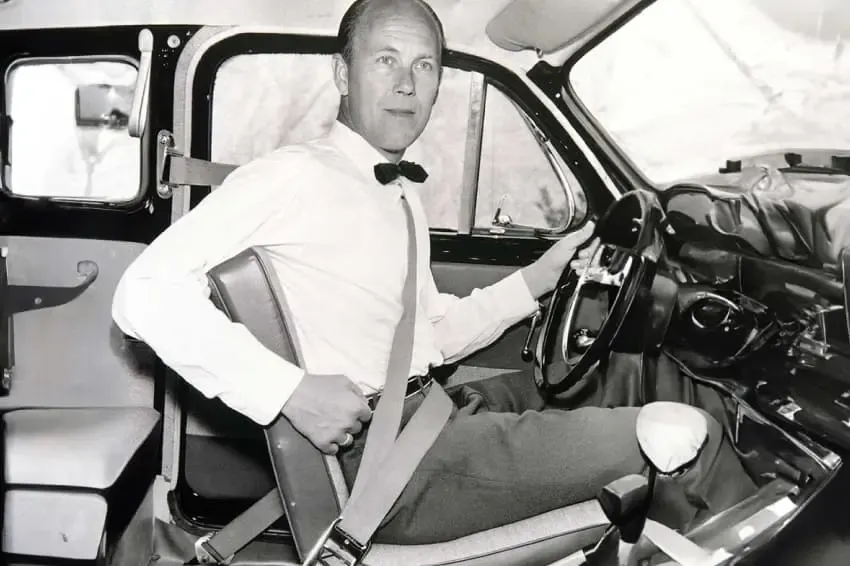
The three-point seatbelt: Volvo’s most expensive decision and the patent that saved a million lives
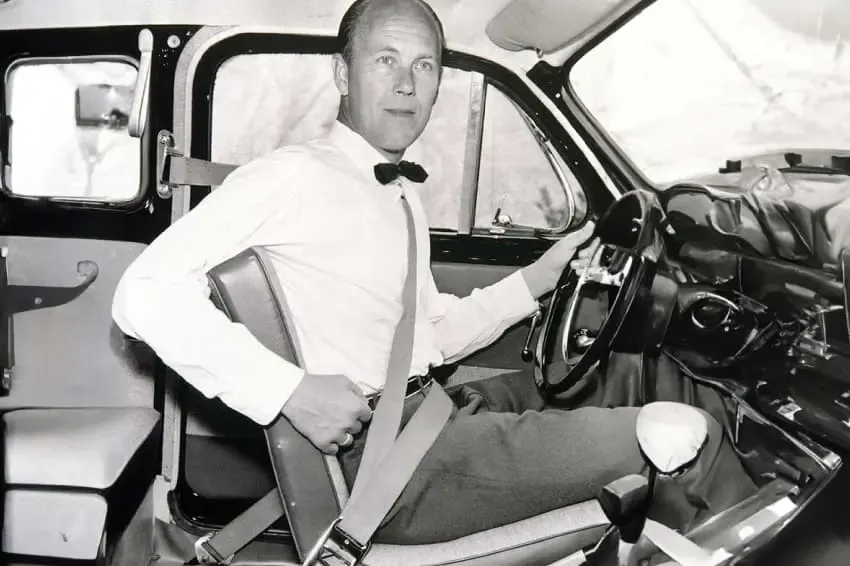
You’re alive because of a Swede who designed ejection seats
Look down. Right now. The strap across your chest, the buckle by your hip, that V-shape that pins you to the seat without breaking your ribs. That’s the work of one man. His name was Nils Ivar Bohlin and you’ve probably never heard of him.
Bohlin spent sixteen years at Saab designing ejection seats. Sixteen years thinking about a single problem: how to keep a human alive when the air itself is trying to kill him. How to fire a 165-pound body out of a fighter cockpit at 500 mph without snapping the spine. How to harness pilots of the Saab J29 Tunnan, Sweden’s first jet fighter with an ejection seat, so they came down in one piece. He wasn’t a car guy. He didn’t draw door panels or pick leather samples. He kept humans intact under brutal forces. That was his trade.
In 1958, Volvo’s president Gunnar Engellau hired him as the company’s first chief safety engineer. But the original idea didn’t come from Engellau. It came from his wife.
The physiotherapist who changed the car industry
Margit Engellau worked at the Sahlgrenska hospital in Gothenburg. She was a physiotherapist. Her job was to rehabilitate people who arrived with broken necks, crushed sternums, ruptured abdomens, twisted spines. Sweden in the 1950s was a small country with narrow roads and increasingly fast cars, and the Gothenburg hospital saw every week what those two variables produced when they met at 50 mph.
Margit came home and told Gunnar what she’d seen. This wasn’t an occasional anecdote. It was the steady drip of a woman who put her hands on what cars were doing to the human body. Steering-column injuries to the sternum. Cervical displacements from whiplash. Abdominal trauma from the two-point lap belts that some manufacturers were starting to fit. Ribs caved in against dashboards.
This information landed on the president of Volvo’s dinner table every night for years. And Gunnar Engellau, unlike most automotive executives of his era, listened. He did two things. He convinced Volvo’s board that safety could sell. Then he poached Bohlin from Saab.
Remember Margit Engellau. She’ll come back to this story several times. Every time Volvo took a leap forward in passive safety over the next two decades, Margit was behind it, telling her husband what she’d seen at work that week.
The state of the art in 1958 was a sick joke
To understand what Bohlin walked into, you need to know what passed for safety in 1958. Most cars had nothing. Some American models offered, as a paid extra, a two-point lap belt — a horizontal strap across the abdomen with a buckle in the middle. Cribbed wholesale from World War II aircraft. Untouched.
It worked for one thing: keeping the occupant from being thrown clear of the car. At highway speeds it was a torture device. In a 35-mph frontal impact, that lap belt concentrated the deceleration of the entire body into the soft tissue of the abdomen. American emergency physicians coined a phrase for what they kept seeing on autopsy tables: the seat belt syndrome. Ruptured spleens, lacerated livers, perforated intestines. People died strapped neatly to their seats.
There were alternatives, all worse. The four-point harness from competition was incompatible with everyday driving — claustrophobic, slow to fasten, impossible without help. In 1955 American physician Roger Griswold patented a Y-shaped three-point belt. The geometry was almost right but the buckle landed where it shouldn’t, on the abdomen, hammering into soft organs at impact. Griswold had the right principle and the wrong execution.
That was the landscape when Bohlin walked into the Gothenburg engineering office.
A year. That’s all it took.
He had less than twelve months. The budget was a rounding error compared to what Volvo today spends on a single trim panel. Bohlin didn’t invent anything new in the strict sense. What he did was solve the geometry.
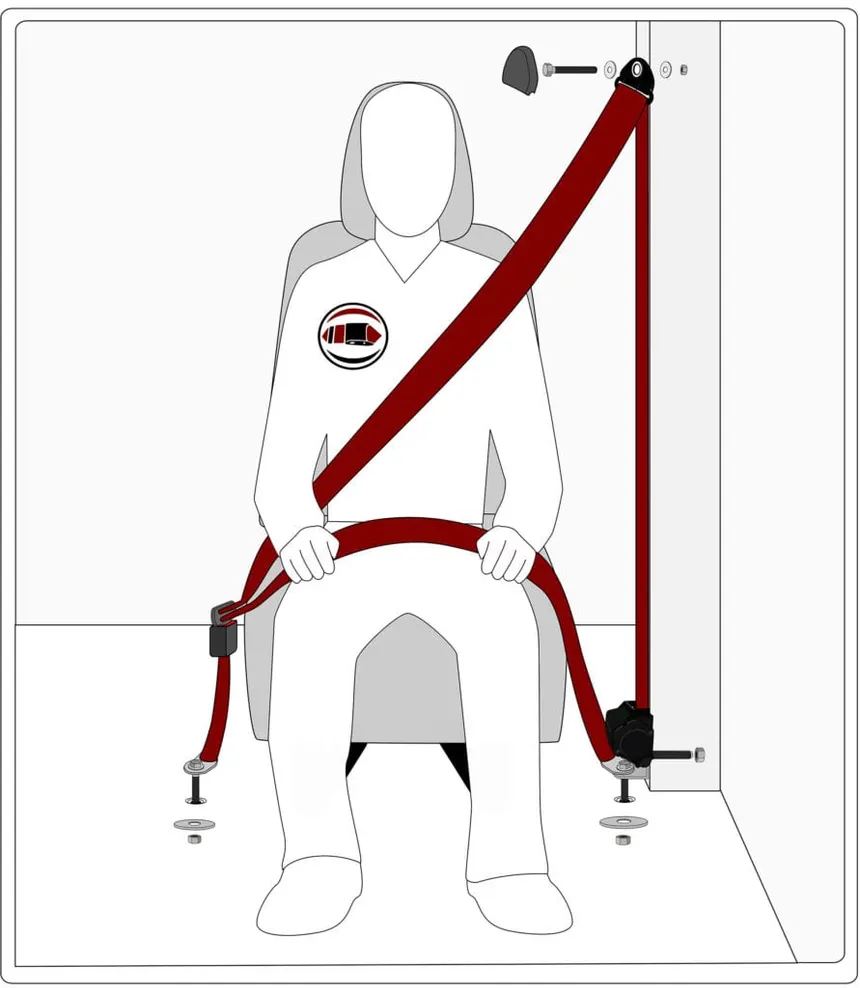
His U.S. patent number 3,043,625, with priority filed in Sweden on August 29, 1958, and the U.S. application submitted on August 17, 1959, describes a system with four key properties: a lap belt and a diagonal chest belt; both anchored at a low point beside the seat; a V-shaped geometry with the vertex pointing toward the floor; and a configuration that stayed in place during impact.
The difference with Griswold wasn’t aesthetic. It was pure physics. By anchoring the buckle low, on the side of the hip, Bohlin distributed the entire crash load across the two strongest skeletal structures in the human body: the sternum and the pelvis. Bone, not viscera. The buckle stayed clear of the abdomen and could be fastened with one hand while holding a coffee.
Put it in context. In 1958, a Cadillac Eldorado Brougham cost more than a Rolls-Royce Silver Cloud and came with a vanity bar, gold combs and a thermometer. No seatbelts. The previous year’s Mercedes-Benz 300 SL Gullwing, the world’s first modern supercar, hit 155 mph on the autobahn and offered its occupants nothing in a crash beyond the aristocratic poise of the driver. Bohlin was building something none of those cars had and nobody thought they needed.
The first production car in the world to come fitted as standard with the three-point belt was the Volvo PV544, delivered on August 13, 1959. Soon after, the Amazon (120) as well. Two unassuming Swedish cars — one egg-shaped, one rectangular — were the first vehicles in history to come with a seatbelt that actually worked.
The decision that turns this story into something else entirely
Here’s where Volvo stops being a car company and becomes something the industry hasn’t reproduced since.
Bohlin held the patent. Volvo owned it. In any standard corporate scenario, the next move was obvious: collect royalties from every manufacturer on Earth for the next twenty years. Hundreds of millions of dollars in today’s money. A perpetual revenue stream from a near-mandatory device.
Volvo released the patent. Free. To everyone. No licensing fees, no royalty agreements, no conditions.
The internal reasoning was simple and quietly monstrous: the belt would save more lives if every car on Earth had one than if Volvo kept it locked up. That’s it. A moral calculation no other manufacturer has made with the same clarity. Porsche didn’t release ABS. Mercedes didn’t release the airbag. McLaren didn’t release the carbon monocoque. Volvo, a small company from a Nordic country with fewer people than Florida, decided their best invention was worth more in everyone’s hands than in their patent vault.
The German patent registry lists Bohlin’s belt, alongside Benz, Edison and Diesel, as one of the eight patents with the greatest significance for humanity between 1885 and 1985. That’s the company. That’s the league.

A million lives nobody counts
Volvo and regulators credit the three-point safety belt with saving at least a million lives worldwide. The figure is conservative. Other academic studies push it considerably higher when serious injuries prevented (not only deaths avoided) are included. But stick with the million. A million people right now eating dinner, arguing with their partner, picking up their kids from school or reading this article, instead of being dead.
And here’s the cruelest part: hardly anybody knows who Nils Bohlin was. Ask in the street. Ask a mechanic. Ask a motoring journalist. Almost no one. He saved more people than any single doctor, engineer or politician of the twentieth century and he died in 2002 of a heart attack at 82, in Sweden, without the state funeral that any mediocre footballer gets today.
There’s a plaque at the Volvo museum in Gothenburg. He was inducted posthumously into the U.S. National Inventors Hall of Fame. The German patent office put him next to Karl Benz. That’s the public memorial of a man who outsaved penicillin in countries with similar populations.
Why people refused to wear it
Here’s the part nobody tells you. Volvo fitted the belt as standard from 1959. People hated it.
They said it was uncomfortable. It wrinkled their suits. It made them feel trapped. It chafed their neck. Usage rates in the early years were embarrassing. In the United States, where seatbelt use wouldn’t be legally mandated in any state until 1984 (New York was first), entire campaigns were organised by drivers who saw the belt as government overreach. People sewed fake belts to fool the warning sensors when cars started getting them. They invented clips to keep the buckle latched without putting the strap across their body. The American libertarian wing fought wearing it for thirty years.
To this day, with sixty-seven years of medical evidence behind it, drivers still get into cars and don’t buckle up. Bohlin built the tool. The choice not to use it has always been ours.
Detroit in 1965: the parallel universe where none of this mattered
While Volvo was delivering PV544s with belts as standard and Margit Engellau was still bringing hospital cases home to her husband’s desk, the American car industry was doing the exact opposite on the other side of the Atlantic.
In 1965 a 31-year-old lawyer named Ralph Nader published Unsafe at Any Speed. The book was a forensic demolition of safety practices across Detroit, with an entire chapter dedicated to the Chevrolet Corvair and its swing-axle rear suspension, which under certain loading and speed conditions caused uncontrollable oversteer and rollover. Nader documented deaths. Many of them. And he showed, with internal GM memos surfaced in lawsuits, that the company had known about the problem before the car launched in 1960.
GM’s response was to hire private detectives to tail Nader, tap his phone, and try to manufacture a sex scandal that would discredit him. When the operation was exposed, GM’s president had to apologize publicly before the United States Senate. Nader won a substantial settlement and used the money to found the Center for Auto Safety, one of the most influential consumer-advocacy organizations of the twentieth century. The Highway Safety Act and the National Traffic and Motor Vehicle Safety Act were both signed into law in 1966 in direct response to his book. American federal vehicle-safety regulation exists because of a book Detroit tried to silence with private detectives.
Six years later, in 1971, came the Ford Pinto. A subcompact, a commercial hit, with a fuel tank placed between the rear axle and the rear bumper. In low-speed rear-end collisions the tank punctured against the rear-axle bolts and the car caught fire. Ford knew before launch. Internally they ran a calculation now known as the Pinto Memo: redesigning the car to fix the problem would cost $137 million; paying out the deaths and injuries was estimated, by Ford itself, at $49.5 million. The difference — $87.5 million dollars — was the acceptable margin of dead bodies.
The memo leaked. The state of Indiana eventually prosecuted Ford Motor Company for reckless homicide, the first time in American history a corporation faced criminal charges for the design of a product. Ford technically won the case, but the reputational damage was permanent. Mother Jones published the full breakdown of the Pinto Memo in 1977. The American industry was caught red-handed.
Compare that to Sweden. Volvo didn’t calculate how many dead bodies its balance sheet could absorb. Volvo, in 1959, released the most valuable patent in its portfolio so competitors could use it for free. The ethical distance between Gothenburg and Detroit during this period is enormous. And it doesn’t close until the American federal regulator forces Detroit to behave, two decades late.
What Volvo did next, and why it still matters
Don’t let anyone sell you the line that Volvo stopped there. The company turned safety into its industrial DNA, and every milestone here deserves a proper look — none of them was cosmetic.
1964. Rear-facing child seat. The world’s first in a production car. The idea came from Bertil Aldman, an engineer at the Karolinska Institute, who studied how astronauts in the Mercury program braced for launch G-loads: in fetal position, backs facing the direction of force. Aldman applied the principle to a child in the rear seat. The biomechanics are simple and brutal: a child under four doesn’t have a fully developed cervical spine to resist the inertia of its head, which weighs proportionally far more than an adult’s. In a frontal crash with a forward-facing seat, the neck gives. In a rear-facing seat, the force distributes across the entire back of the child against the seat shell. Volvo fitted one in a 142 in 1964. The rest of the world took forty years to catch up. Margit Engellau, once again, had brought the hospital data home.
1967. Inertia-reel retractors. A direct evolution of Bohlin’s belt. The 1959 belt was static: you adjusted it and it stayed tight. Uncomfortable on long drives. The inertia retractor introduced a deceleration-locking mechanism: in normal use the webbing reels in and out freely, but under sharp acceleration a pendulum or weighted ball triggers a pawl that instantly locks the spool. Comfortable in everyday use, rigid in impact. The entire industry copied it within five years.
1969. Bohlin takes over Volvo’s Central Research and Development Department. Not just safety. All R&D. The company institutionalizes Bohlin’s vision at executive level. Think about that: in 1969, a European company puts a man whose only documented obsession is not killing the occupants of cars in charge of its entire R&D pipeline. Detroit that same year was arguing about which color vinyl to glue to the roof of the Cadillac Eldorado.
1970. Standard headrests. Enter Margit Engellau again. She’d been documenting whiplash cases from rear-end collisions for years. The physiotherapist saw the victims after the cars had stopped making the news: chronic cervical pain for life, C5-C6 injuries that disabled the patient from physical work. The headrest does two things: it limits hyperextension of the neck in a rear impact, and it reduces the energy transmitted to the cervical column. Volvo fitted them as standard in 1970, with no regulator forcing it. European legal mandates didn’t arrive for decades.
1972. Pyrotechnic seatbelt pretensioner. This is where things get serious. A standard belt has “slack” — webbing that hangs loose, clothing between body and strap, the occupant slightly off the seatback. In an impact, that slack lets the body travel several centimeters before the belt loads up. Those centimeters become additional force on the belt when it finally goes tight. The pyrotechnic pretensioner is a small explosive charge (yes, explosive, like an airbag) that retracts the belt and pulls it against the occupant’s body in milliseconds, before the main impact loads arrive. Result: the body loads against the belt with no slack, energy distributes from millisecond one, and peak force on the sternum drops dramatically. Volvo fitted the first one in 1972. Mercedes and BMW took years to follow.
1991. SIPS (Side Impact Protection System). This is not a sensor or an airbag. It’s a structural architecture of the body itself. Side impacts are the deadliest crashes for a simple physical reason: in a frontal you have a meter or more of crumple zone between the occupant and the obstacle. In a side impact, you have the door. Twenty centimeters. SIPS redesigned the entire lateral structure of the Volvo 850 with high-strength steel reinforcement bars in the doors, a reinforced cross-member under the dashboard, specific anchor points in the B-pillars, and a calculated transfer of impact energy toward the floor and roof of the car, away from the occupant. The 850 was the first car in the world with lateral architecture designed in from the start, not bolted on later. When Euro NCAP arrived in 1997, the 850 already comfortably met what the rest of the industry was just discovering would be mandatory.
1998. Inflatable curtain head airbags. Frontal airbags of the 1990s protected the chest and face in a frontal crash. They did nothing in a side impact. Volvo developed a curtain bag running along the entire inside roofline of the car, from A-pillar to C-pillar, deploying downward in milliseconds when a side impact was detected. The curtain protects the head against pillars, window frames, and exterior objects that might penetrate the cabin (poles, T-bone collisions with other vehicles). By 1998 the industry was following Volvo, not the other way around.
Every one of those systems saved lives and most of them spread across the industry. Volvo didn’t release every subsequent patent with 1959 generosity, but its philosophy set the pace. When Euro NCAP started publishing crash test results in 1997, Volvo didn’t need to change anything. The brand had been doing for forty years what the rest of the industry was now being forced to copy.
The belt you’re using today
Look at your car’s seatbelt right now. Pick it up. Touch it. That polyester webbing, that buckle, that anchor below your hip, that V-geometry. It’s Bohlin’s patent 3,043,625. Almost unchanged since 1959. We’ve added pyrotechnic pretensioners, load limiters, tension sensors, inertia retractors. But the master idea — the geometry that distributes a 30 g impact across sternum and pelvis — is still his.
Every time you start the car and click the buckle in, you’re obeying, without knowing it, an engineer who was designing ejection seats for Swedish jet fighters in the 1950s, a physiotherapist in Gothenburg who saw every week what cars did to the human body, a Volvo president who actually listened to her, and a small company in a small country that decided not to charge for its best invention.
That belt is the most expensive and most generous corporate decision in the history of the automobile. Nobody has done anything like it since. Probably nobody ever will.
Check you’re still alive.