

Before Crash Test Dummies, They Used Human Corpses. Here’s the Full Story

Every time you get into a car and buckle your seatbelt without thinking, you’re using technology that was developed with real human corpses. Not mannequins. Not computer simulations. Dead people. People whose bodies ended up in university laboratories to be slammed against walls at controlled speeds so that engineers could measure exactly when bones break and skulls crack.
Before you close this tab thinking this is cheap sensationalism, you need to understand something: without those tests, your three-point seatbelt wouldn’t exist. Neither would your crumple zone. Or the collapsible steering column that prevents the shaft from driving through your chest in a frontal collision. Everything that stands between you and death in a car crash traces back to basement laboratories in American universities in the 1950s, where researchers bought donated bodies and subjected them to impacts no living person could survive.
This is the story the car industry would rather you never heard. And you’re about to read all of it.
When the dead saved the living
The 1940s. World War II is over, cars are flooding American highways, and people are dying in traffic accidents at a rate that would be unthinkable today. But nobody knows exactly why. There is no scientific data on what happens to the human body in an impact at 50, 60, or 100 km/h. No tolerance curves. No deceleration limits. Nothing. Just bodies on the road and car designers working blind.
The answer came from a place that would turn your stomach today: the biomechanics laboratories at Wayne State University in Detroit, Michigan. Throughout the 1950s and 60s, Wayne State became the world’s epicenter for human impact research. Their researchers acquired cadavers through legal donation programs and subjected them to controlled crash tests. They attached accelerometers. They measured chest compression forces. They recorded the exact point at which a skull fractured, how much pressure ribs could withstand, at what rate of deceleration the brain began to suffer irreversible damage.
It was science. It was legal. And it was absolutely necessary, because without that data, it would have been impossible to design anything that could protect you inside a car.
From those laboratories came the Wayne State Tolerance Curve — the first scientific reference defining how much deceleration the human skull can absorb before suffering brain injury. That curve remains a fundamental reference today. It’s used to design helmets, calibrate airbags, and define the force limits a seatbelt can exert on your body without causing more damage than it prevents. Every time a passive safety engineer opens a human tolerance table, they’re consulting data obtained from real cadavers over sixty years ago.
The controversy came later, when the general public discovered how those standards had been developed. But by then, the dead had already done their work. And the living were already safer because of them.
And while the university labs worked with the dead, one man decided that corpses weren’t enough. Someone had to put themselves in the line of fire.
The man who crashed on purpose
His name was John Paul Stapp. Colonel in the United States Air Force. A surgeon by training. And completely incapable of asking another human being to take a risk he wasn’t willing to take himself first.
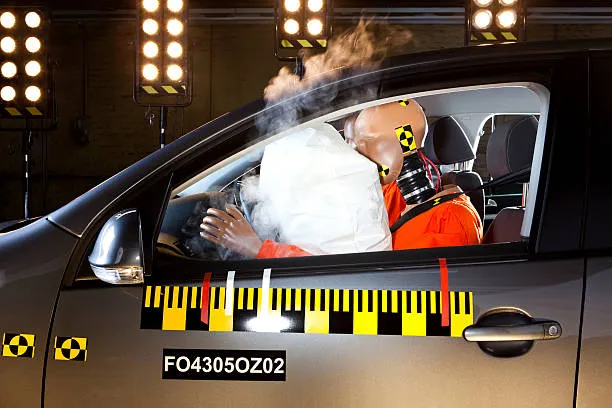
On December 10, 1954, at Holloman Air Force Base in New Mexico, Stapp strapped himself into the Sonic Wind No. 1 — a rocket-propelled sled on rails — and accelerated to 1,017 km/h. Faster than a rifle bullet. Faster than any human being had ever traveled on the Earth’s surface at ground level. And then he stopped. In 1.4 seconds.
His body absorbed 46.2G of deceleration. To put that in perspective: a trained fighter pilot starts losing vision at 9G. At 46.2G, the blood in Stapp’s body rushed into his eyeballs with such force that it burst the capillaries. He was temporarily blinded. The doctors thought he had lost his sight permanently. He recovered hours later.
Stapp survived. And his data — obtained from his own body — defined the tolerance limits the car industry still uses to design seatbelts and restraint systems today. When Nils Bohlin designed the three-point seatbelt at Volvo in 1959, the force limits that belt could apply to the body were calculated using the tables Stapp had generated by risking his own life.
Nobody remembers John Paul Stapp. Everyone uses what he proved. That’s the history of car safety in one sentence.
The plastic dead
By the late 1940s, the industry knew it couldn’t keep relying on cadavers and suicidal volunteers to test safety systems. It needed something that could crash a thousand times without dying, that could measure forces with precision, and that resembled a human body closely enough for the data to be useful.
The first attempt was called Sierra Sam. Built in 1949 by Sierra Engineering Company for the United States Air Force, his original job had nothing to do with cars — he was designed to test ejection seats in fighter jets. He weighed about 95 kilograms, had basic joints that reproduced human movement in a very rudimentary way, and measured absolutely nothing. He carried no sensors. His only function was visual: to show what happened to a body during an ejection or impact so engineers could observe and take notes.
Sierra Sam was primitive. But he opened a door that would never close again.
The decades that followed were a race to build the perfect dummy. A mannequin that could replicate the human body with enough fidelity that crash test data would be as valid as what you got from a real cadaver, but without the ethical problem of destroying a human body every time you needed to test a new design.
That race was won by the Hybrid III.
Developed in the late 1970s by General Motors and adopted as the federal standard by NHTSA — America’s road safety agency — in the 1980s, the Hybrid III is the most important crash test dummy in history. It’s the one you’ve seen in every crash test video you’ve ever watched. And it’s a masterpiece of biomechanical engineering.
It contains over 100 internal sensors measuring chest compression forces, head acceleration, neck loads, femur forces, and abdominal pressure. Its spine is an aluminum piece with interspaced rubber discs that replicates the real behavior of the human spine under load. Its ribs are steel and deform in a controlled manner to mimic human thoracic response. Each unit costs over half a million euros. And it has a useful life of approximately 100 impacts before needing complete recalibration.
But the Hybrid III had a problem that the industry took decades to acknowledge. A problem that still costs lives today.
The dummy that doesn’t look like you
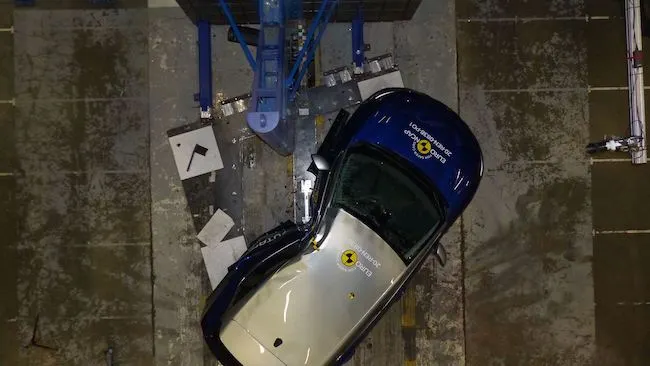
For decades, the vast majority of crash tests worldwide were conducted with a single type of dummy: the male 50th percentile Hybrid III. That means a mannequin representing an average-height, average-weight adult male. All the passive safety engineering of the entire global car industry was designed, tested, and certified using a body that represented neither women, nor children, nor the elderly, nor anyone with a physique outside the average.
The consequences were real and measurable. Studies have shown that women face a significantly higher risk of serious injury in a car accident at the same impact level as a man, and the primary reason is structural: the seatbelts, the airbags, the side reinforcements, the crumple zones — everything was calibrated for a male body standing 1.77 meters tall and weighing 78 kilograms. If your body doesn’t fit that template, the car protects you less.
This is engineering. But it’s also politics. And if you connect the dots with what happens inside the FIA and the agencies that regulate vehicle certification, the picture gets considerably darker than it appears. If you’ve read the MA-FIA series, you already know what I’m talking about.
Today there’s a complete family of dummies trying to correct decades of single-body-centric design. The Hybrid III has versions at the 5th percentile (small adult female) and 95th percentile (large adult male). There are pediatric dummies representing everyone from a newborn to a 10-year-old child. There’s THOR — Test device for Human Occupant Restraint — the most advanced dummy in the world, with over 150 sensors and a far more faithful replica of the human musculoskeletal system. And there’s THOR-F, the female version, which finally allows testing of how a woman’s anatomy responds in a real impact.
And there’s MAMA. Maternal Anthropomorphic Measurement Apparatus. A pregnant female dummy with an instrumented internal fetus, designed specifically to test how seatbelts and airbags affect a pregnant woman. Because before MAMA existed, nobody had ever tested what happens to a pregnant woman in a car crash. Nobody. Millions of pregnant women drove every day, and the industry didn’t have a single data point on how to protect them.
When safety kills
And since we’re talking about protection that fails, let’s talk about airbags.
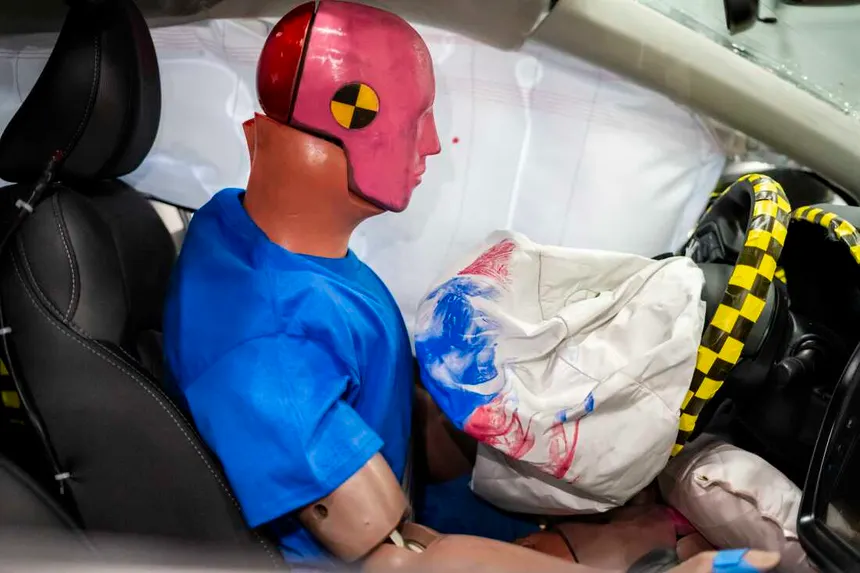
The first production airbags installed in cars in the 1990s had a serious problem: they killed people. Specifically, they killed children and short-statured women. The reason was as simple as it was brutal — the inflation system was calibrated with too much force. An airbag deploying at over 300 km/h directly into the face of a child sitting in the front seat or into a woman of 1.50 meters whose body sits closer to the steering wheel doesn’t protect. It destroys.
The manufacturers knew. And they took years to fix it. Years during which children and women died from a system supposedly designed to save their lives.
But if you think that’s the worst airbag story, you haven’t heard about Takata.
Takata Corporation was a Japanese safety systems manufacturer that supplied airbags to virtually the entire global car industry. For years, their inflators used an ammonium nitrate-based propellant that degraded over time from moisture and temperature changes. When the airbag activated, the inflator didn’t deploy — it exploded. It sent metal fragments directly at the driver or passenger at the speed of a fragmentation grenade.
The result was the largest recall in automotive history. Over 100 million vehicles recalled worldwide. At least 27 confirmed deaths from defective inflators. The difference between a safety system and a lethal weapon turned out to be an unstable chemical compound that nobody bothered to test sufficiently under real aging conditions.
That’s what happens when the industry cuts corners on safety. And that’s exactly what gets investigated in depth in the SAFETY section at NEC.
Digital ghosts
Today the frontier of safety testing is no longer in crash test laboratories. It’s on servers.
In the 1990s, Toyota developed THUMS — Total Human Model for Safety — the first complete digital model of the human body designed specifically to simulate traffic impacts. THUMS isn’t a virtual dummy. It’s a digital replica of the human body at a level of detail no physical mannequin can match. The original model contained over 80,000 finite elements representing bones, cartilage, muscles, internal organs, skin, and blood vessels. More recent versions multiply that figure several times over.
What THUMS and similar digital models — including those developed through European research initiatives — can do is something a half-million-euro Hybrid III simply cannot: predict internal injuries. Liver rupture in a side impact. Aortic tear from sudden deceleration. Rotational brain injury from skull acceleration — the type of injury that kills racing drivers and that no sensor on a physical dummy can measure with real precision.
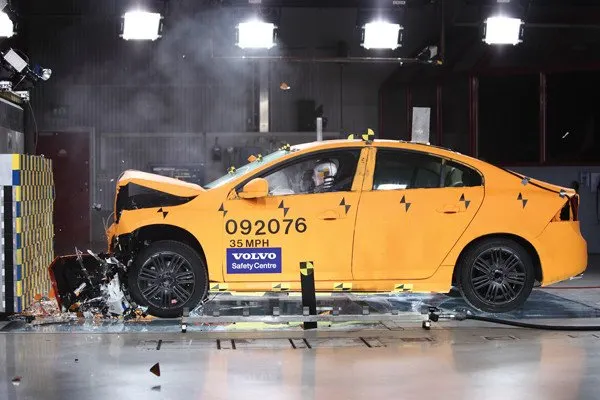
A physical crash test costs between 500,000 and one million euros. It involves destroying a complete car, preparing a calibrated dummy, setting up a high-speed facility with cameras, instrumentation, and post-analysis. And it tests a single configuration. One angle, one speed, one type of occupant.
A digital simulation can test 10,000 variants of the same accident in the time a physical crash test takes to run one. It can change the impact angle degree by degree. It can configure the occupant at any age, weight, height, and pre-existing medical condition. It can simulate a pregnant woman, an elderly person with osteoporosis, a teenager slouched in the posture of someone staring at their phone. And it costs a fraction of what it takes to destroy a real car.
This doesn’t mean physical crash tests are disappearing. They’re still necessary to validate digital models, for legal certifications, and for cases where simulation can’t yet replicate reality with sufficient precision. But the direction is clear: the future of automotive safety is tested on servers, not against concrete walls.
The chain you don’t see
There’s a straight line connecting a cadaver in a Wayne State basement in 1955 to the airbag that didn’t break your nose this morning. A line that runs through a colonel who let his own eyes burst at 46G to prove what the human body can withstand. Through a plastic-and-aluminum mannequin that costs more than your car and has taken a hundred impacts on its steel ribs. Through an airbag scandal that killed 27 people because someone decided a cheaper propellant was acceptable. And all the way to a digital model that can simulate the death of 10,000 virtual people in an afternoon so that no real person has to die on the road.
That chain is invisible. They don’t tell you about it in the ads for cars with five Euro NCAP stars. It doesn’t appear in the dealership brochures. But it exists. And every link cost something — money, ethics, real lives — so that today you can get into a car and have a genuine chance of getting out in one piece after a crash.
If you’ve read this far, you probably never thought about any of this before. Now you know. And the next time you buckle your seatbelt and hear that click, maybe you’ll remember that behind that sound there are seventy years of science, sacrifice, and decisions nobody wanted to make but somebody had to.
Check you’re still alive. And drive like you know what it cost for you to be.