Colombo V12: The V12 Drawn on a Garden Table That Stayed Inside a Ferrari for Forty-Two Years
Some engines get designed in proper engineering departments. Glass-walled offices, slide rules, scheduled meetings, espresso machines, the lot. And then there’s this other one, which was sketched in pencil in Milan, in August nineteen forty-five, while Italy was still pulling itself out of the rubble and every single bridge over the Po river was lying in pieces.
That sketch is the first Ferrari engine in history. And the block drawn that summer kept being manufactured, with the same basic architecture, all the way into the late nineteen-eighties.
Forty-two years of the same idea. That doesn’t happen to many engineers.
The man with the pencil
Before we get to the engine itself, we need to spend a minute on the man who drew it. Otherwise none of what follows makes any sense.
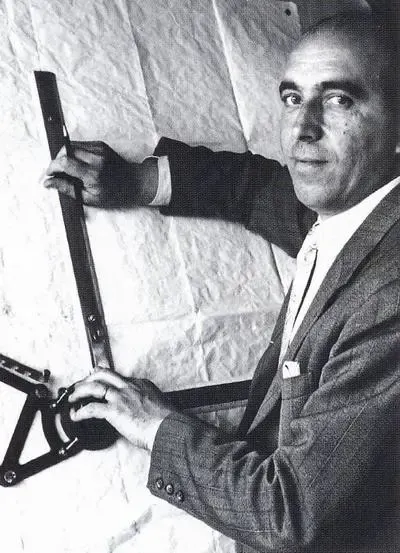
Gioacchino Colombo was born in Legnano in January nineteen-oh-three. Small town northwest of Milan. Working-class family, no money, normal childhood. The only odd thing about him is that by the age of fourteen he was already employed as a technical draftsman at Officine Franco Tosi, a company that built large diesel engines, steam turbines, and submarines. Fourteen years old. Drawing submarine internals. While you were at fourteen complaining about homework.
That apprenticeship is the bit that matters. Colombo learnt to draw big, complex machines where every millimetre had to fit. He learnt that an engine is not a concept — it’s a physical object that has to slot in, cool itself, lubricate itself, balance itself, and survive thousands of hours running without splitting in half. That discipline never left him.
In nineteen twenty-four, aged twenty-one, he joined Alfa Romeo as an apprentice under the great Vittorio Jano — the man about to draw the P2 with which Alfa would start eating Europe alive. Three years later, aged twenty-five, Colombo was head of Alfa Romeo’s technical department. Twenty-five. If that doesn’t impress you, think back to what you were doing at twenty-five.
In nineteen thirty-seven, Colombo designed the Alfa Romeo 158 engine — the Alfetta. A 1.5-litre supercharged inline-eight, Elektron magnesium block instead of cast iron, dual overhead camshafts, Roots-type supercharger. Around two hundred horsepower out of an engine that weighed less than today’s average gearbox. That motor would go on to win the first two Formula One World Championships in history, in nineteen-fifty and nineteen fifty-one, in the hands of Farina and Fangio. Colombo had drawn it thirteen years earlier.
That’s when Enzo Ferrari, then running the Scuderia satellite team to Alfa, took proper notice. And filed the name away for the day he might need it.
The Ferragosto phone call
Summer of nineteen forty-five. The war had been over for barely two months. Italy was a broken country. Enzo Ferrari, forty-seven years old, was finally out of the leonine contract he had signed with Alfa Romeo back in nineteen thirty-nine — a clause stopping him from putting his own name on competition cars for four years — and he had one very specific idea in his head. He wanted to build engines. He wanted to build his own engines. He wanted twelve cylinders.
He picked up the phone and called Colombo. Asked him to come to Modena. Colombo recalled years later, in his memoirs — Le origini del mito, published in Italian in Florence in 1985 and translated into English two years later by Haynes/Foulis as Origins of the Ferrari Legend — how complicated the trip was. The Po bridges had been blown up by partisans, Germans and Allies, each in their turn, and to cross it you had to climb onto small flat-bottomed boats that carried one or two cars per trip.
When he arrived, Enzo greeted him with the phrase Colombo would carry with him forever: “Voglio tornare a fare macchine da corsa.” I want to go back to making racing cars.
He asked Colombo how he would lay out a 1,500cc engine. Colombo answered without hesitation, in a single sentence that contains the entire genealogy of the Ferrari V12 ever since: “Maserati has a first-rate four-cylinder. The British have the ERA six. Alfa has its eight. You have to build a twelve.”
Right there, in that line, sits everything that would follow. Because Colombo wasn’t telling him to do a bigger version of what other people were doing. He was telling him: if you want to exist, you have to be above.
He went back to Milan. Took out his pencil and his grid paper. Started drawing through Ferragosto — the mid-August national break that shuts down all of Italy every single year.
What came out of that paper is the engine Ferrari would manufacture for the next forty-two years.
What he came up with that August
Here’s where you stop and look at the engine with the calm of a workshop bench. Because the decisions Colombo took that afternoon were not arbitrary. They were the ones that would allow this block, without anyone in that garden suspecting it yet, to outlive every single one of its contemporaries.
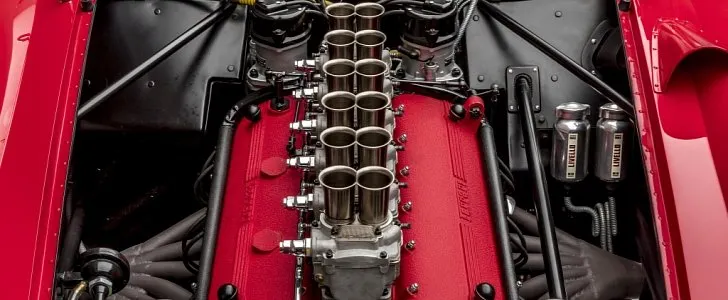
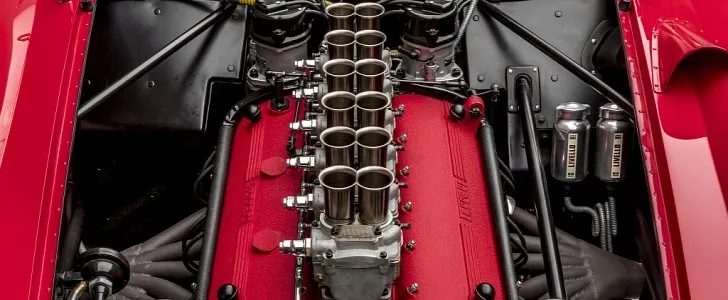
A V12 at sixty degrees. Twelve cylinders, two banks of six, sixty exact degrees between banks. Why sixty? Because at sixty degrees a V12 has perfect first- and second-order balance. No extra counterweights. No balancing shafts. It vibrates less than any other configuration. It’s the geometry the engine asks you for if you listen.
Tiny pistons. Bore 55 millimetres, stroke 52.5 millimetres. Each cylinder displaces 124.73cc. Times twelve, that’s 1,496.77cc. That’s where the 125 name comes from: it’s the cubic capacity of each cylinder, not of the whole engine. Very Italian way of naming things.
Bore wider than stroke. This is the bit anyone who has held a flywheel in their hand will recognise immediately. A “square” or “oversquare” engine (bore equal to or larger than stroke) revs up faster because the pistons travel less distance per cycle. Less distance means lower piston velocity at any given rpm. Which means you can push the revs without snapping a connecting rod. Which means an engine that breathes like a racing engine. Colombo was drawing, from the very first line, an engine that knew how to rev.
Aluminium block. In nineteen forty-five. While almost everyone else was still casting iron blocks because that’s what was cheap and known, Colombo drew an aluminium block with wet, bolt-in cylinder liners. Aluminium because it weighs one-third of cast iron. Wet liners because they let you replace the friction zone without scrapping the entire block. Anyone who has rebuilt an engine on a bench knows what it’s worth to be able to refit liners and leave the block as new. In nineteen forty-five that was forward thinking on another level.
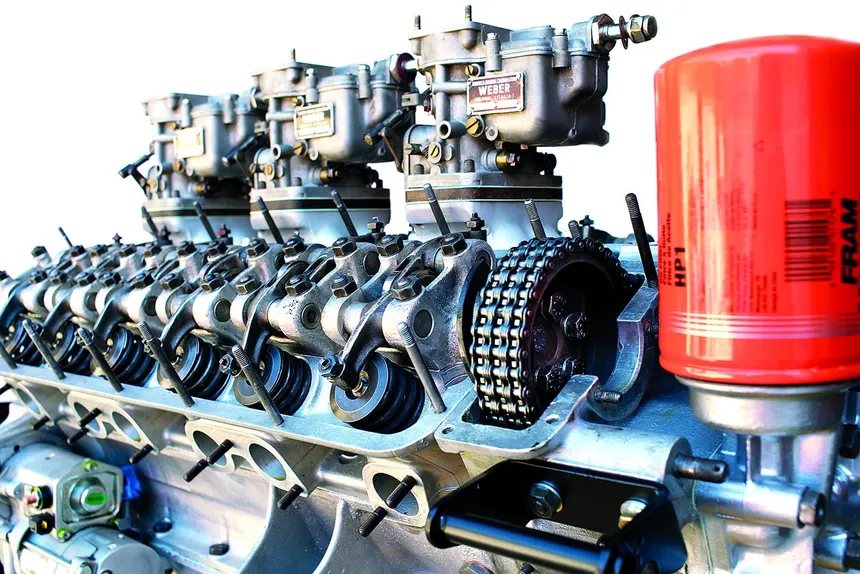
Single overhead camshaft per bank. SOHC. Two valves per cylinder. Here Colombo was conservative, and he was right to be. Dual overhead cams were complex to manufacture in post-war Italy, where suppliers were working with prewar machinery hammered back into shape. He kept it simple. He knew that if the engine worked, there would be time later to add a second cam per bank. And add it they did — that’s the story of the late sixties.
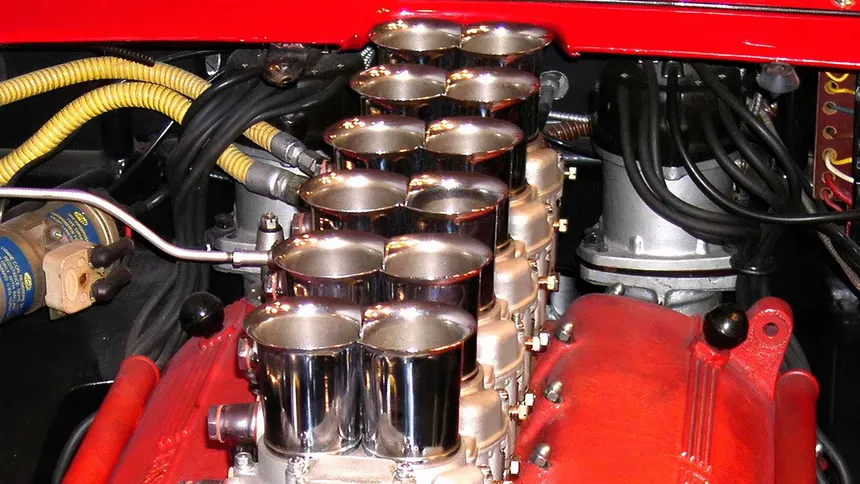
Three Weber 30DCF carburettors. Twin-choke, feeding pairs of cylinders. Weber precision in nineteen forty-five was already what set Italian engineering apart from the rest. Carburation that fine-grained is what allowed those tiny cylinders to receive the right air-fuel mix at the right time, which is how you get a clean rev profile out of a small-displacement V12.
And then the most invisible and biggest decision of all: bore centre spacing of 90 millimetres. Nobody at the time thought it mattered. In nineteen forty-seven the engine was 1.5 litres and nobody imagined it would ever need to be larger. But Colombo, on purpose, left room between cylinders. A lot of room. For what — for what comes next.
The displacement motorway
When you draw a V12 with bore centre spacing of 90 millimetres and a piston diameter of 55 millimetres, you’re leaving an enormous amount of metal between cylinders. Thirty-five millimetres of block material between cylinder walls. In bench language, that’s “having room to grow.”
And grow they did.
The 125 of nineteen forty-seven is born at 1,497cc.
By October of that same year, displacement is up to 1,903cc and the car is renamed 159.
A few months later, the 166 arrives at two litres. Same stroke, larger bore. That’s the car Luigi Chinetti drives to victory at the 1949 Le Mans 24 Hours. First Ferrari win at Le Mans. With Colombo’s second iteration of the engine.
By nineteen fifty-two, the engine is at three litres. Bore 73 millimetres, same 58.8-millimetre stroke. Twenty per cent more displacement than the original, basically double the capacity of the first version. It’s called the 250 — because each cylinder displaces 250cc. And now we’re in serious territory. The 250 family covers the 250 GT California, the 250 GTO, the 250 LM, the 250 Testa Rossa. Cars that today sell at auction for sums of money that look like phone numbers. More than ten years of evolution of the 250 series, all with the same basic Colombo block.
Nineteen sixty, the 400 Superamerica. First major leap. Bore 77, stroke 71, 3,967cc. The “square” original is finally broken. It’s the first time the Colombo stroke moves away from 58.8 millimetres. Once changed, never changed back.
Nineteen sixty-three, the block is internally redesigned. Same architecture — still a Colombo — but the bore centre spacing widens from 90 to 94 millimetres. A change that looks small on paper. On the bench, it’s enormous. It opens room for capacities the original drawing never contemplated. It’s the long-term investment Colombo had quietly built into the first version in nineteen forty-five, paying dividends eighteen years later.
Nineteen sixty-seven, the 275 GTB/4 introduces dual overhead cams per bank. DOHC. 3.3 litres, 330 horsepower at 8,000 rpm, six Weber 40 DCN 9 carburettors. Colombo’s engine, now with its face lifted, looks back at the bench and says “I’m not done yet.”
Nineteen sixty-eight, the 365 GTB/4 Daytona arrives. 4.4 litres, 81 mm bore, 352 horsepower. Zero to sixty in 5.3 seconds. Top speed 174 mph. We’re now in 1968. Twenty-one years have passed since Piacenza, and the engine is still architecturally the same block Colombo drew in his sister’s garden.
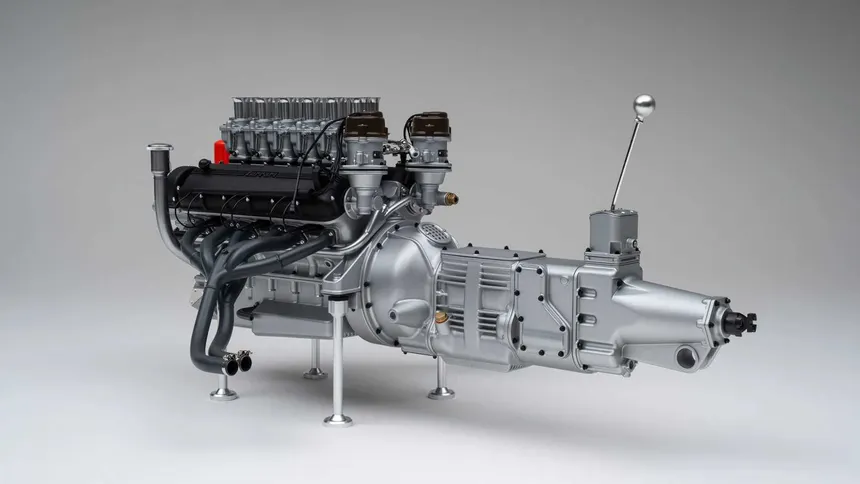
Nineteen seventy-one, flat version — 180 degrees between banks — for the 365 GT4 BB. Colombo’s block is laid down because the mid-engine fashion demands a lower centre of gravity. It’s still the same engine. They just put it on its side.
Nineteen seventy-six, the 400 GT. 4.8 litres. Bore 81, stroke 78. Automatic transmission as an option. This was a four-seat front-engine Ferrari meant for a wealthy gentleman to drive to Saint-Tropez without breaking his back. But inside, the same Colombo heart was still beating.
Nineteen eighty-five, the 412. Final chapter. 4,943cc — almost five litres — 340 horsepower, Bosch fuel injection. Bore 82, stroke 78. Same block, same idea, almost four decades of evolution. It’s the last front-engine V12 road-going Ferrari until the 456 of 1992, which moves to a completely new architecture.
Forty-two years from that Ferragosto in Legnano. One single engine. Thirteen different road cars, not counting all the competition variants. Dozens of international victories. And a block that went from 1.5 litres to 4.9 litres without ever changing its identity.
What gets left out
Here’s the part Wikipedia either doesn’t cover or buries in a half-paragraph.
Colombo didn’t get along with Enzo Ferrari. Almost nobody did. By nineteen-fifty, after the supercharged 125 F1 had been comprehensively beaten by the very Alfa 158 Colombo himself had designed years earlier (the irony deserves its own article), Enzo decided to hedge his bets and brought in Aurelio Lampredi — a younger engineer — to design a completely different V12 architecture: the so-called “long block”, with a longer stroke, designed for big displacements from day one. Lampredi told Enzo what any engineer looking at the drawings would have told him: Colombo’s block is too short, too light, it won’t stand the displacements you want to chase.
He was technically right. And completely wrong about what mattered.
Because Lampredi’s “long block” was used by Ferrari until nineteen fifty-nine. Twelve years. Colombo’s “short block” ran until 1989. Forty-two years. The engine that technically wouldn’t survive lasted three decades longer than the engine designed to survive.
Why? Because of the 90-millimetre bore centre spacing, later widened to 94. Because of the aluminium block. Because of the ease of swapping liners. Because of the clean geometry that accepted DOHC, supercharging, fuel injection, dry-sump lubrication, whatever you threw at it without the block saying enough.
And one more, less technical reason. Because Ferrari, after many years, figured out that road-car customers were paying for the sound. And the sound of a Colombo V12 isn’t a metaphor — it’s documented. Riverside, October nineteen fifty-eight, Los Angeles Times Grand Prix. Phil Hill behind the wheel of the 412 MI with a four-litre Colombo, fighting the Scarab-Chevrolets of Lance Reventlow. There are forty-three cars roaring out there at the same time. The race report later published by Forza Magazine settled the whole question in a single line: the Ferrari V12 could be heard above the other forty-two starters. “Unimaginably loud”, the journalist wrote. Unimaginable because, technically, it shouldn’t have been able to physically drown them out. But it did.
That’s the sonic signature of the Colombo. The output of a geometry — sixty degrees between banks, twelve small cylinders spinning toward the ceiling, six Webers gulping at full throat — that produces a timbre period recordings still preserve. If you want to hear it without dropping a million on a 250 GTO, find a recording of the 250 Testa Rossa at Le Mans. And turn it up.
Colombo left Ferrari in nineteen-fifty. Went back to Alfa Romeo to run their racing operation — and won the first two F1 World Championships in history with cars he had designed himself before the war. In nineteen fifty-two he moved to Maserati and there designed the 250F, the single-seater in which Fangio would win his fifth title in 1957. In 1955 he was at Bugatti, working on the Type 251. And from 1957 to 1970, at MV Agusta, designing motorcycle engines that would win ten consecutive constructors’ championships.
In other words, this man designed championship-winning engines at four different companies. Four. Any engineer would sign their entire career for one.
He died in Milan on the twenty-seventh of April 1987, aged 84. His engine outlived him by two years, until production of the 412 ceased in 1989.
What a mechanic learns from this engine
If life ever puts a Colombo in front of you to strip down — and if it does, don’t waste the chance — three things will jump out at you.
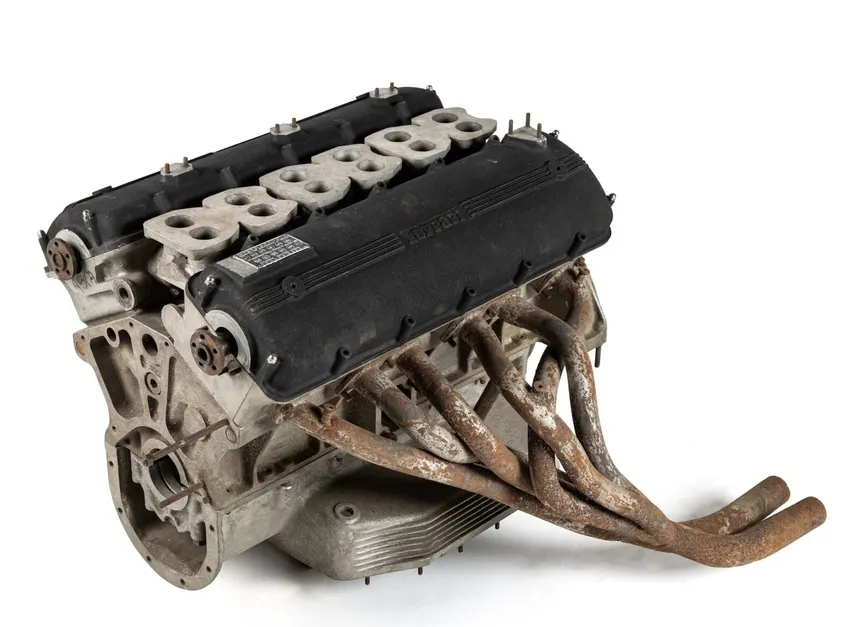
The first. The sheer number of parts. Seventy per cent more machining time than a contemporary inline-six, according to factory notes. Fifty per cent more components. Each engine was almost a bespoke commission, with every component having passed through several hands and several benches. You feel it in the workshop. The parts have marks of manual polishing where you don’t expect them. They have tolerances that show you someone measured them with a caliper, not with an automatic micrometre.
The second. The cylinder head geometry. Intake ports arrive into the chamber almost straight. Which means air enters the cylinder with very little redirection, with a clean trajectory, which lifts volumetric efficiency at high rpm. This is the decision of a designer who was thinking about the track from the first minute. Contemporary road-car heads twisted their ports to fit them into tight spaces. Colombo’s didn’t. Colombo’s ran like straight corridors.
The third. The crinkle-finish red rocker covers. They first appear on the 1957 250 Testa Rossa. Ferrari kept them as an aesthetic detail on its V12s for decades. It’s the only cosmetic decision that survived every technical change. The signature of an engine that already knew, around 1957, that it was going to be in the history books.
The question that closes this
How many engineers have ever designed an engine that outlived its own design forty-two years, inside a company whose main competitive edge is renewing the product every five?
Short answer: one.
Colombo drew this engine on a garden table, in August of forty-five, with Italy in pieces, and nobody in that garden could have imagined that the sketch was going to be sitting inside the last front-engine Ferrari V12 ever built before Schumacher walked into Maranello.
Next time you hear a 1970s Ferrari V12 echo off a tunnel wall, remember that afternoon in Legnano. The table. The pencil. And the man who drew engines because he didn’t know how to do anything else.
Check you’re still alive.