The Cobra Mercury Is the Last Real 1950s Kustom That Walked Into an Eighties Action Movie and Walked Back Out as a Cult Icon. Nobody Outside the Trade Knows Who Built It.
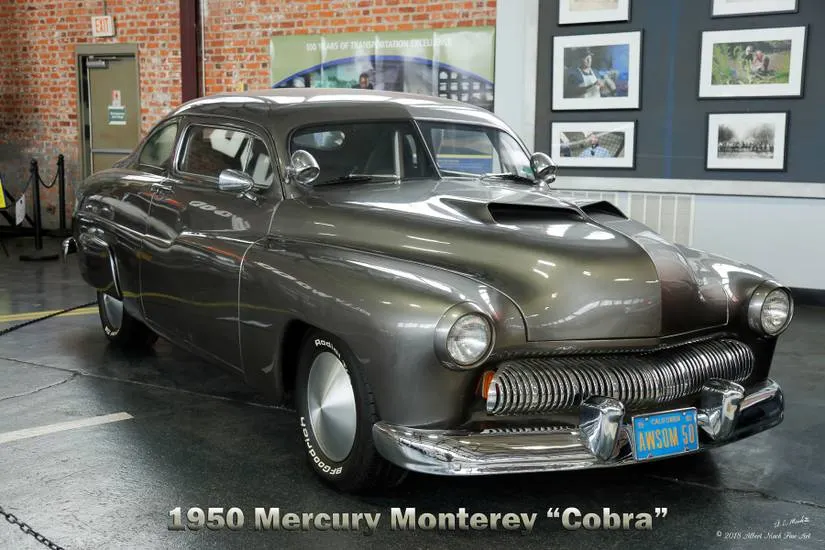
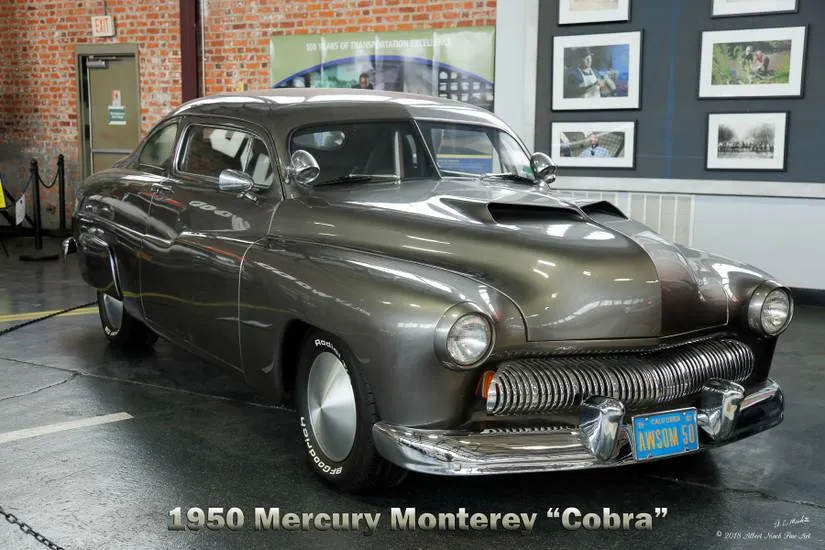
Eddie Paul cranked out four chopped 1950 Mercurys for Sylvester Stallone in 1985, dropped a blown small-block Chevy into each, stamped them AWSOM 50 and rolled cameras. Three got destroyed on set. One got stolen from Stallone’s garage in 1994. And the man who built all four remains anonymous outside the workshop world.
Top Gear’s old line about famous car builders had a kind of truth to it: there are the names that car enthusiasts can rattle off without thinking, and then there are the names that did most of the actual work. The first category is George Barris, Dean Jeffries, Ed Roth, Gene Winfield, Boyd Coddington. The Batmobile, the Munster Koach, the Monkeemobile, the Surf Woody, the Aluma Coupe. The customizers whose names rolled off magazine covers in Hot Rod and Car Craft through the 1960s and 1970s. They became brands. They sold die-cast models. They wrote books.
The second category is the workshop people. The fabricators who actually got most of Hollywood’s metalwork done. The guys nobody outside the production trade remembers.
Top of that second category, Eddie Paul.
Eddie Paul, born in San Francisco in 1948, owner and founder of E.P. Industries in El Segundo, California, built more cars for the American film industry across four decades than any living customizer in his prime. John Travolta’s 1947 Ford in Grease. Dennis Stewart’s two black ’49 Mercury “Hell’s Chariots” in the same picture. Forty-eight cars in fourteen days, just to open the account. The time-travelling DeLoreans for Back to the Future. The two rescue vans in E.T. the Extra-Terrestrial. The General Lee Dodge Charger for The Dukes of Hazzard television series. Animatronic horses for The Mask of Zorro. Eighty-six stunt cars for the original The Fast and the Furious. Two hundred more for 2 Fast 2 Furious in a month. The GTOs for Vin Diesel’s xXx. Stunt cars for Walking Tall. Full-size driveable versions of Lightning McQueen, Mater and Sally Carrera for the Pixar Cars promotional tour. Animatronic sharks built for Jacques Cousteau that were literally attacked by real sharks in open water, the real sharks mistaking the fake for a rival. Plus a patented pump engine (US patent 6145429) sold to fire departments across the country.
He died in 2016 at the age of 67. Someone could have made a perfectly good four-season documentary out of Eddie Paul’s CV. Nobody did.
Sitting somewhere in the middle of that catalogue is one of the most recognisable cars in 1980s American cinema: the chopped 1950 Mercury from Sylvester Stallone’s Cobra (1986). The last real 1950s American kustom to walk into an action movie of that decade and walk back out as a cult icon.
This piece is about that car. And about the man who built it.
What a Chopped 1950 Mercury Actually Is
Before Eddie Paul, before Stallone, before Cobra, there is the Mercury Eight 1949-1951. Three model years of one car that quietly changed American automotive culture.
The Mercury Eight sat in the middle of the Ford Motor Company catalogue between the entry-level Fords and the Lincoln luxury cars. A three-box body with bulbous shoulders, a heavy chrome grille, recessed round headlamps, a long bonnet and gently curved rear haunches. The trade press of the day called the styling bulbous. Street enthusiasts within a couple of years renamed it shoebox. The factory motor was a flathead 4.2-litre V8 (255 cubic inches) with side valves, 110 brake horsepower gross-rated, mated to a three-speed manual gearbox with optional overdrive. Kerb weight about 3,250 pounds (1,475 kg). Rear-wheel drive, independent front suspension, live rear axle on leaf springs. Three-speed manual gearbox.
That was the technical portrait the car deserved. What the car actually became in American culture was something else entirely.
In 1949, Sam Barris (older brother of the more famous George) drove his own 1949 Mercury into his bodyshop in Lynwood, California, and cut the roof off. He dropped the A-pillar and the C-pillar by approximately four inches each. He welded. He filled. He painted. The car rolled out of the shop with a new proportion: low roof, long bonnet, heavy body, headlamps nearly at street level. The silhouette that would shortly be christened the lead sled (named after the lead that filled the seams between modified panels, before plastic body filler became standard).
Sam Barris’s chop on his ’49 Mercury is generally credited as the first roof-chopping operation performed on a postwar American street car. Other West Coast customizers (Westergard, Bertolucci, Ayala, Hirohata later) took the recipe to baroque levels through the early-to-mid 1950s: even lower chops, frenched headlamps, grilles transplanted from luxury cars, leaded smoothing across every body seam, pearlescent paint applied in multiple coats. The chopped Mercury 1949-51 became the visual signature of West Coast kustom kulture in its first wave. When rockabilly music, hot rodding and the low-and-slow aesthetic converged into what later got branded as kustom kulture, the chopped Merc was the reference car.
Sam Barris died young in 1967. His brother George inherited the media presence and built the Barris Kustoms brand. But the chopped Mercury was Sam’s invention, and Not Enough Cylinders will name him here.
Thirty-five years after Sam Barris’s first chop, that same car (1950 bodywork, chopped roof, traditional kustom school) was still the visual icon of classic American custom culture. And then Sylvester Stallone showed up with a screenplay.
How a Screenwriter Called Stallone Ended Up Phoning a Workshop in El Segundo
Stallone originally wrote Cobra as a rewrite of the Beverly Hills Cop script. In Stallone’s draft for Cop, the lead was a hard-nosed Los Angeles cop named Axel Cobretti who drove a fifties classic. The Paramount studio rejected his rewrite for being too violent and too expensive to shoot. Stallone took the concept, rewrote it as an original screenplay, and sold it to Cannon Group’s Menahem Golan and Yoram Globus. Warner Bros. handled domestic distribution. Budget: $25 million. Box office: $160 million. Director: George P. Cosmatos, fresh off Rambo: First Blood Part II. Co-star: Brigitte Nielsen, then Stallone’s wife. Production: October 1985 to January 1986, shot in Los Angeles, Long Beach and Piru, California.
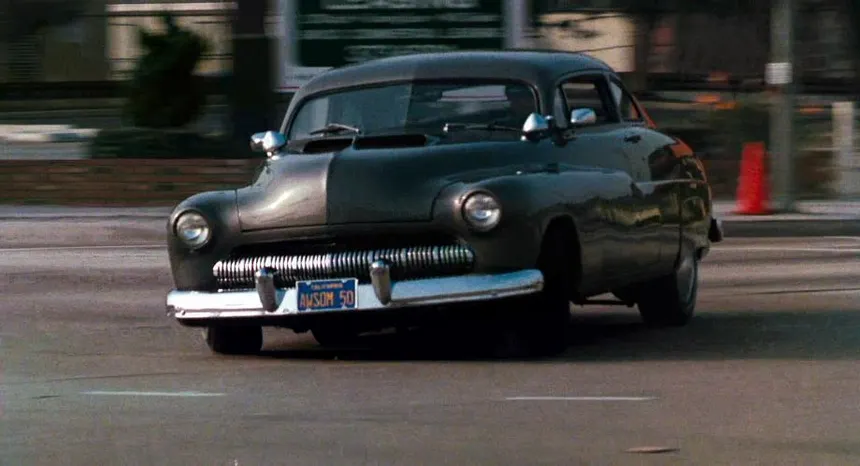
But before any of that, the car needed to exist. Cobretti was supposed to drive a fifties kustom, but not a Pebble Beach Concours kustom that could only leave the trailer on Sundays. The screen car needed to be a functional kustom: capable of 0-60 in four seconds, capable of 180-degree dry-pavement slides, capable of holding speed through LA freeway chase sequences, and capable of being wrecked into an articulated lorry in the film’s climax without making the insurance broker throw himself off a building. Three contradictory requirements simultaneously: authentic kustom heritage, working stunt vehicle, sacrificial prop. The only way to satisfy all three was multiple identical cars built in parallel.
Stallone’s transport coordinator (working through Cannon’s production office) called the El Segundo workshop. Eddie Paul picked up.
Eddie Paul, in later interviews with local El Segundo press, recalled being initially sceptical about the brief. He wasn’t sure he could even find four 36-year-old Mercurys in decent shape. But a friend with a West Coast junkyard had four 1950 Mercurys delivered to the E.P. Industries shop in El Segundo within forty-eight hours. From there the work began.
The Recipe: 1.5-Inch Chop, Small-Block Chevy, Weiand Blower, NOS
Here’s where this article gets its hands dirty, because the technical work matters.
The four 1950 Mercurys that came through Eddie Paul’s doors got the same base package:
- 1.5-inch roof chop (38 mm). Roof line dropped by just over an inch and a half, a far more conservative chop than the four-inch chops of the classic Sam Barris-school 1949-51 Mercurys. Enough to deliver the menacing silhouette on screen without making the car uninhabitable for Stallone behind the wheel.
- Twin scoops welded into the bonnet (not bolted, not bonded, properly welded into the steel).
- Frenched headlamps and tail lamps, original chrome trim removed or smoothed flush (the classic 1950s smoothing recipe taken to its extreme).
- Full roll cage of welded steel tube fitted internally, mandated by both insurance and stunt coordinator.
- Four-wheel disc brakes (modern hardware, not the original drum brakes of the 1950 Mercury).
- Turbo-Hydramatic 400 automatic transmission with a shift kit, replacing the original three-speed manual.
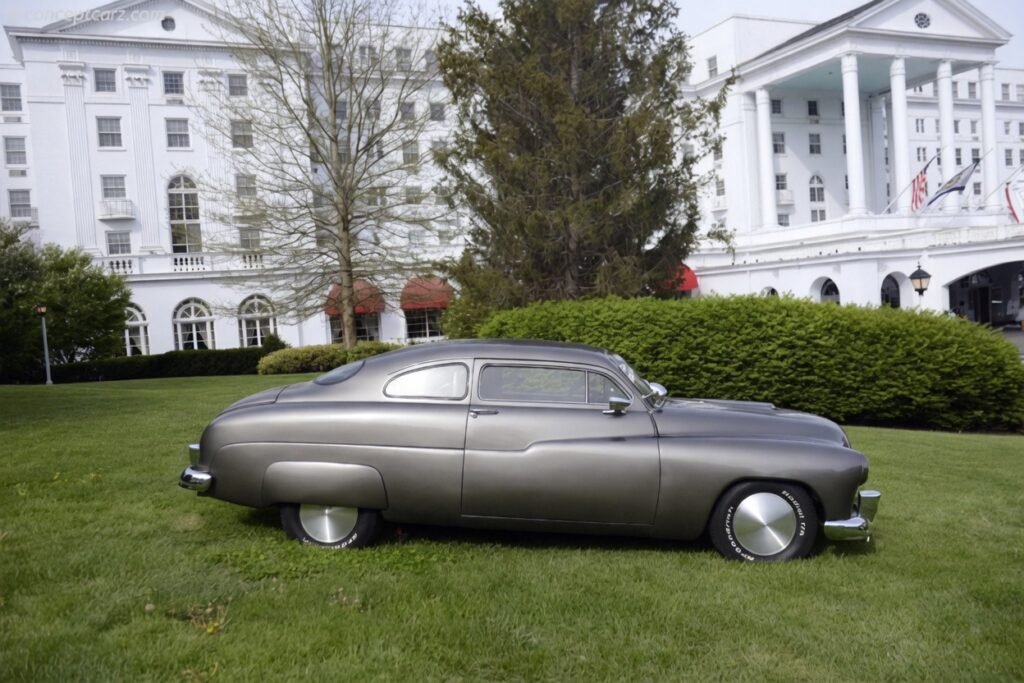
- Matt black paint, with some sources describing the finish as colour-shifting under light (variously gray, near-black, almost purple-aubergine on screen). No high-gloss polish: the paint was meant to absorb light rather than reflect it.
The heart of the build, however, was not a Mercury motor. It was a Chevrolet.
Each car got a 350 cubic-inch Chevrolet small-block V8 (5.7 litres) in place of the original Mercury flathead. On top of the small-block: a Weiand 144 supercharger (a Roots-type blower with a displacement of 144 cubic inches per revolution) mounted directly above the engine to force air into the cylinders. Carburettor: a Holley four-barrel with an integrated NOS (nitrous oxide) system. The NOS wasn’t decorative. It was plumbed, charged and operational on the stunt cars, and could be injected during fast-acceleration sequences to deliver visible launch effects on camera.
The American Film Institute Catalog, the most authoritative published source for American film production records, documents the declared performance figures: 0-60 mph in 4 seconds (roughly equivalent to 0-100 km/h), top speed 140 mph (225 km/h). For a 36-year-old body shell pushed past 3,500 pounds (1,590 kg) thanks to the roll cage and the upgraded driveline, those numbers put it firmly into contemporary American muscle-car territory. A 1986 Ford Mustang GT 5.0 of the same model year claimed 200 hp and 0-60 in 6.7 seconds. The Cobra Merc beat it on both metrics.
The exact gross horsepower at the time of filming isn’t documented in a verifiable build sheet. Later sources, basing their figures on Eddie Paul’s restoration work after the car was recovered, quote 600+ horsepower with nitrous, but those numbers include modifications added during the restoration. The shooting-period horsepower was more likely in the 450-500 bhp gross range from the blown small-block, a figure consistent with the documented 0-60 time.
Above the entire mechanical package sat the final signature: the AWSOM 50 California number plate. Five characters reading Awesome 50. The car’s model year and a marketing adjective in stamped metal. Stallone insisted on the plate. Eddie Paul fitted it.
Four Cars: One Hero, Three Stunt
There’s confusion between secondary sources about which car was which. Cross-referencing the AFI Catalog, conceptcarz, the Ozrodders forum threads and Eddie Paul’s own later interviews, the breakdown was as follows:
- One hero car: the clean car for close-ups, dialogue scenes with Stallone behind the wheel, publicity stills and studio promo. The car that appeared on the film posters. Stallone drove it personally in static and low-speed shots.
- Three stunt cars: functionally identical to the hero but kitted for hard action work. Reinforced roll cages, Recaro competition seats fitted in place of the original interior, extra safety bracing, uprated suspension. Driven by professional stunt drivers.
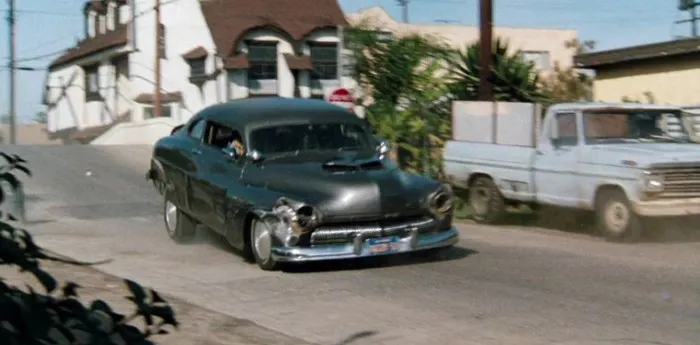
During the shoot, three of the four Mercurys were destroyed in action sequences. Freeway chases through LA, dry-pavement slides, the climactic crash sequence in which the car is wrecked against an articulated lorry. The exact distribution of destroyed cars across the three stunt vehicles isn’t documented with precision: three of the four went, one survived. The sources agree that the survivor was the hero car, the least-abused vehicle through filming.
Stallone kept the hero car when production wrapped. He garaged it in a Los Angeles storage facility. And that’s where the next chapter starts.
The 1994 Theft and the 2009 Online Auction
Stallone kept the Mercury in a rented storage garage in Los Angeles. In 1994, somebody stole it. Stallone reported the theft to the LAPD. The car, a one-off custom build with the recognisable AWSOM 50 plate visible in every close-up, should have been impossible to move on the open market. It disappeared anyway for fifteen years.
In 2009, Stallone happened across an online auction listing offering the Cobra Mercury. It was his car. Fifteen years on, the apparent owner was a company that rented out classic vehicles to film productions. Stallone contacted the owner asking for the car back. The owner refused.
Stallone, through his attorney Marty Singer, filed in LA County Superior Court in December 2009. The lawsuit opened with a direct quote from the film: “Crime is a disease. Meet the cure.” Cobretti’s signature line from the screen, now the opening citation of a civil complaint. Stallone demanded the car’s return plus three million dollars in damages for unauthorised use of his image to promote the auction. The valuation stated in the suit itself: $250,000.
In March 2011, almost seventeen years after the original theft, Stallone reached an out-of-court settlement with the company and recovered ownership of the Mercury. The settlement terms were not disclosed. Whether money changed hands is unclear. What is documented is that Stallone got the car back.
The Mercury was then restored once again by Eddie Paul personally. By that point Paul had effectively retired from active film work but still owned the El Segundo workshop. The restoration returned the car to what Paul described as “movie condition.” It was during this restoration, by Paul’s own statement, that the modifications were added which produced the contemporary 600+ horsepower figure.
The car has since been displayed at the Petersen Automotive Museum in Los Angeles, in the Hollywood Customs: Modified for Movies exhibition. The exhibit label identifies it as Stallone-owned, though some sources speculate the car may have changed hands again since. What is certain is that it remains the sole surviving original of the four built by Eddie Paul.
Why This Car Earns Its Slot in the Movie-Car Canon
Cobra is a mediocre film. Cannon Group 1980s action, Stallone screenplay, Cosmatos direction, plenty of fire, plenty of knives, plenty of black trench coats and not much subtext. Brigitte Nielsen doesn’t elevate the material. Reni Santoni does what he can. The contemporary critics (Ebert, Maslin, Kael) crucified it. Today it’s a VHS-era cult film, not a cinematic landmark.
But the car is something else entirely.
The Cobra Mercury is one of the very few examples in American cinema where a 1950s kustom emerges from the heritage culture of Sam Barris, George Barris, Joe Bailon and the Hirohata Merc, and lands in a major studio 1980s action production without losing its leadsled identity. It isn’t an 1980s car dressed up as a 1950s kustom. It’s a 1950s car, built using 1950s American customization techniques (chop, smoothing, frenching, tucking), retrofitted with available 1980s drivetrain hardware (small-block Chevy with mechanical blower, NOS, modern disc brakes).
It works on screen because the difference between Cobretti and the bad guys (neo-Nazi bikers in leather waistcoats and chrome) isn’t only ethical: it’s aesthetic. Cobretti belongs to classic American kustom culture. The bad guys belong to 1980s subcultural fashion. The chopped Mercury, on screen, is the visual argument that Cobretti is old school and old school still works.
Eddie Paul, in his El Segundo workshop, executed that aesthetic argument with four actual 1950 Mercurys, a 1.5-inch chop, a blown small-block Chevy, a working NOS system, an AWSOM 50 plate and a Hollywood-standard delivery schedule that demanded four functional cars in a handful of weeks.
When Eddie Paul died in 2016, the obituaries in Make Magazine, Easy Reader & Peninsula Magazine and Hot Rod Magazine all reached for the same phrase: “Hollywood’s best-kept secret.” Builder of forty-eight cars in two weeks for Grease, eighty-six stunt cars for The Fast and the Furious, the time-travelling DeLoreans for Back to the Future, the chopped Mercurys for Cobra. More American film cars than any living customizer of his moment. And outside the workshop trade, almost nobody could pronounce his name.
Not Enough Cylinders names him.
Check you’re still alive.