
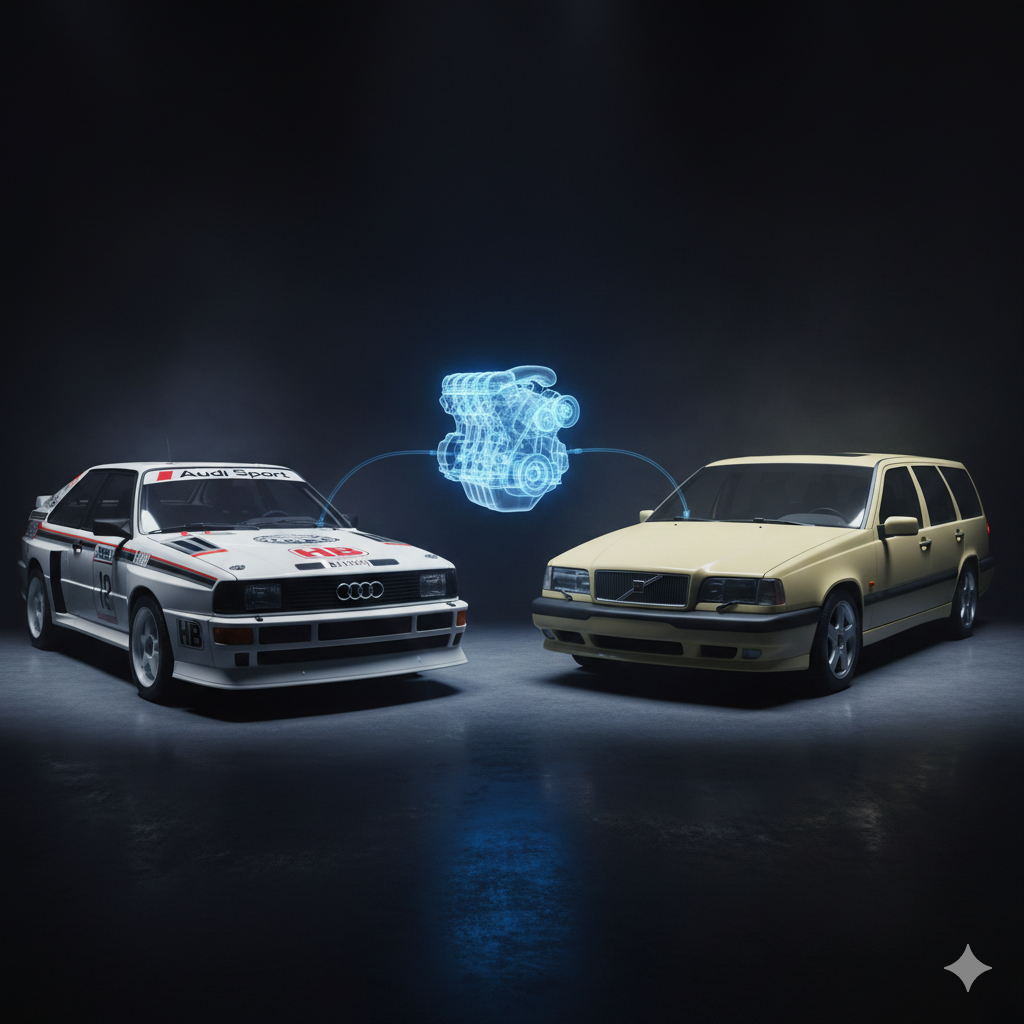
The 5-Cylinder Engine: The Configuration That Should Never Have Worked… But Sounds Like Glory

Some engines are born from pure logic. Four cylinders: compact, cheap, gets the job done. Six cylinders: balanced, smooth, refined. Eight cylinders: because America needed something that made traffic lights tremble.
And then there’s the five-cylinder.
The engine that makes no sense on paper. An odd number that textbook engineers looked at sideways. The mechanical bastard that was born because someone had the guts to say: “What if we add one more cylinder to the four but don’t go all the way to six?” And ended up producing one of the most addictive sounds ever to come out of an exhaust pipe.
Sit down. This is a story about mechanical rebellion.
The Origin: When a Four Wasn’t Enough and a Six Was Too Much
The 1970s. Oil crisis. The world burns. Manufacturers need more power than a four-cylinder can deliver but without the weight and fuel consumption of a six. Mercedes-Benz was the first to take the leap.
In 1974, Stuttgart introduced the OM617: a 3.0-liter five-cylinder diesel fitted to the W115 240D. The first production five-cylinder engine in history. The idea was as pragmatic as it was German: take a proven four-cylinder, add a fifth piston using most of the existing components, and get more torque and thrust without the complexity of an inline-six.
Three years later, in 1977, Audi introduced the first gasoline five-cylinder: a 2.1-liter in the Audi 100. And that, friends, is where one of the most beautiful stories in automotive history began.
Audi had done their homework. An inline-six didn’t fit in their platforms without destroying weight distribution. A four wasn’t enough for their sporting ambitions. The five was the missing piece. And when in 1980 they bolted a turbocharger onto it and married it to all-wheel drive in the Ur-Quattro… they changed the history of motorsport forever.
The Engineering: Why a Five-Cylinder Works So Damn Well
This is where things get interesting. Because a five-cylinder isn’t “a four with an extra cylinder.” It’s a completely different mechanical concept with its own rules and its own personality.
The Firing Order: 1-2-4-5-3
In a four-cylinder, each piston fires every 180 degrees of crankshaft rotation. In a five-cylinder, that interval drops to 144 degrees. What does that mean in practice? Before one power stroke finishes, the next has already begun. There’s a 36-degree overlap where two cylinders are pushing simultaneously.
And you can feel it. Oh, you can feel it.
Power delivery is smoother, more continuous, more progressive than any inline-four. Less jolting, more constant thrust. The crankshaft spins with a fluidity that a four simply cannot match, especially in the mid-range — which is where you drive 90% of the time.
The Perfect Size
An inline-five is shorter than an inline-six. That allows it to be mounted transversely in engine bays where a six simply won’t fit. Volvo exploited this brilliantly: the five-cylinder allowed them to run front-wheel and all-wheel drive platforms without compromising the frontal crumple zone. More passive safety AND more performance. Swedish engineering at its finest.
Smoother than a four. More compact than a six. The perfect middle ground that nobody asked for but a few had the wisdom to appreciate.
The Torque
Five-cylinders produce brutal, sustained mid-range torque. The overlap in power strokes, combined with turbocharging, turns these engines into machines that shove you back in your seat from low revs. You don’t have to wring them out to feel the force. Step on it and it pushes. That simple. That addictive.
THE SOUND: The Mini-V10 That Gives You Goosebumps
And here we leave engineering and enter emotional territory. Because the sound of a five-cylinder can’t be explained. It has to be felt.
A five-cylinder sounds like a half-scale V10. And that’s no coincidence: the firing order and crankshaft angles are identical when you double the cylinder count. What comes out of the exhaust is an asymmetric, raspy, irregular growl with a texture that has absolutely nothing in common with any other configuration.
It’s not the deep thunder of a V8. It’s not the high-pitched scream of a racing four. It’s something entirely its own. Musicians among you will recognize a major third interval climbing in parallel with the rev range. Those of you who aren’t musicians just need to hear a Group B Audi Quattro attacking a dirt stage to understand. Or a Volvo 850 T-5R without its airbox coming out of a corner. Or a current RS3 opening the taps in a tunnel.
It’s addictive. It’s visceral. It’s the sound that gives you chills without needing 500 horsepower.
The Heroes: The Cars That Made the Five-Cylinder Great
Mercedes-Benz OM617 (1974-1991) — The Indestructible Patriarch
The engine that started it all. A diesel that could hit 500,000 km on basic maintenance without breaking a sweat. A 1976 Mercedes 240D with this engine racked up 4.6 million kilometers doing taxi duty in Greece. That’s not a typo. Four point six million kilometers. If that’s not engineering, tell me what is.
Audi Ur-Quattro / Sport Quattro S1 (1980-1991) — The Rule Breaker
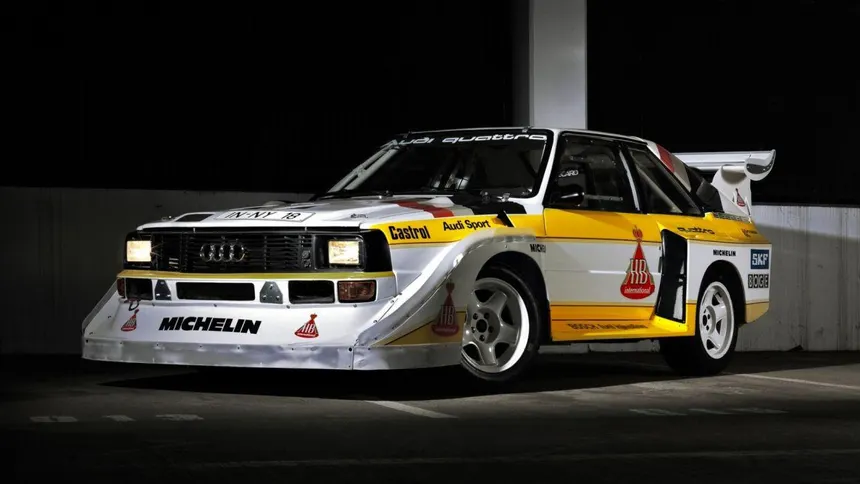
From the initial 200 hp to the 1,000 hp that the factory team squeezed from the block in 1987. Audi’s turbo five-cylinder didn’t just win rally championships: it redefined what was possible in competition. Group B without the Quattro wouldn’t have been Group B. Period.
Audi 2.5 TDI (1989-1997) — The First TDI Ever Built (and the One Volvo Borrowed)
Let’s set the record straight: the first TDI engine in history was a five-cylinder. Period. In 1989, Audi introduced the 2.5 TDI in the Audi 100 — the first turbodiesel with direct injection and full electronic control ever fitted to a production car. 120 hp and 265 Nm from a cast-iron 2.5-liter block that could nearly hit 200 km/h while sipping less than 6 liters per 100 km. By 1994, power climbed to 140 hp with a variable geometry turbocharger.
And here’s the fact most people don’t know: when Volvo launched the front-wheel-drive 850 and wanted to offer a diesel in Europe, they didn’t build their own engine. They borrowed Audi’s 2.5 TDI. From 1996 to 2001, the Volvo 850 TDI and its successors ran the Ingolstadt five-cylinder diesel under the bonnet. Volvo didn’t develop their own five-cylinder diesel (the D5) until 2001.
The early 2.5 TDIs — the cast-iron block ones with the Bosch VP37 distributor injection pump — were absolute tanks. Simple, robust, easy to maintain and tune. Ludicrous mileage on basic servicing. But here’s the catch: the later aluminum-block versions with Pumpe Duse unit injection (2004 onwards) were a different story entirely. Plasma-coated cylinders with no liners — if they scored, you couldn’t rebore them. Head gasket issues, camshaft problems, injector seal failures. The aluminum version sacrificed the original’s legendary durability on the altar of weight savings. Newer isn’t always better.
Audi RS2 Avant (1994) — The First RS
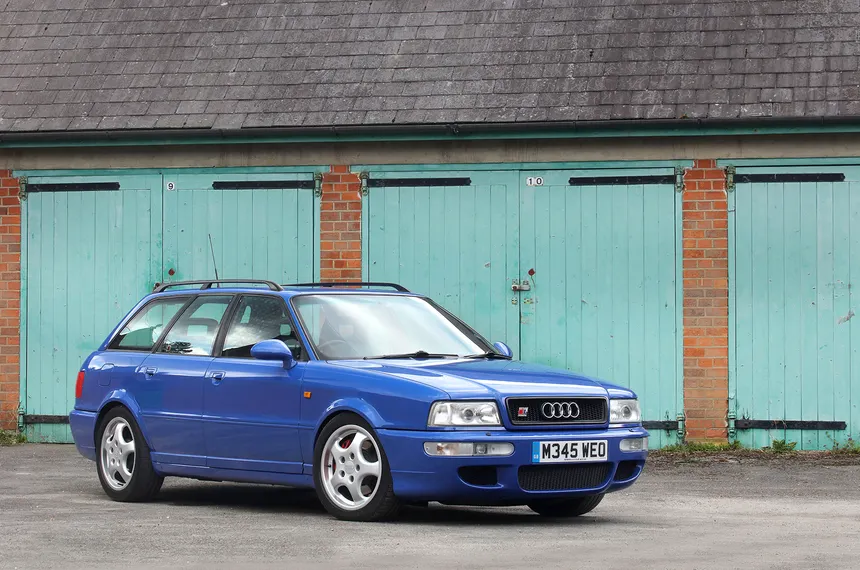
The first RS ever built. A wagon co-developed with Porsche, packing a 2.2-liter turbo five putting out 315 hp. First Audi to break the 250 km/h barrier. A wagon. With five cylinders. Tuned by Porsche. If that doesn’t stir something in you, you’ve got antifreeze in your veins.
Volvo 850 T-5R / 850R (1995-1996) — The Killer Brick
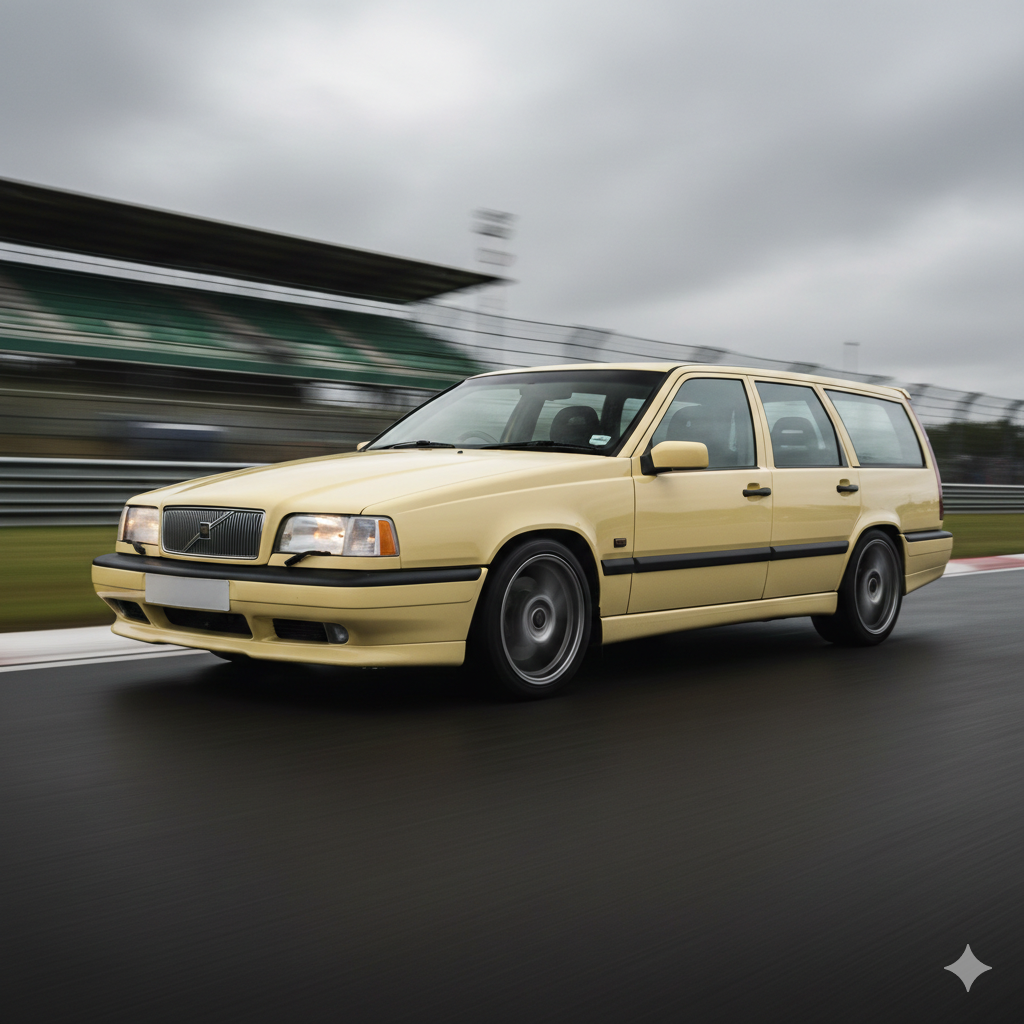
The ultimate sleeper. A Swedish brick with a 2.3-liter turbo five pumping out over 240 hp. But the legend wasn’t forged on the road. It was forged when Volvo had the audacity to enter a wagon in the BTCC. A wagon. In a touring car championship. That yellow 850 bouncing over curbs, with the five-cylinder howl echoing through the grandstands, burned itself into the collective memory of an entire generation of petrolheads.
Fiat Coupe 20V Turbo (1993-2000) — Italy Being Italy
Engine derived from the Lancia Delta Integrale. Five-cylinder turbo. 220 hp. Design that cut through the air like a blade. Centro Stile Fiat beat Pininfarina themselves in the exterior design competition. Pininfarina got the interior as consolation. The result: an Italian coupe with a rally heart and a sound that made heads turn on every street in every city.
Audi RS3 / TT RS (2009-present) — The Last of Its Kind
Audi’s 2.5 TFSI is probably the last great production five-cylinder we’ll ever see. 400 hp, hand-built at the Gyor plant in Hungary. 21 manual assembly stations. Each engine undergoes both a cold and a hot test before leaving the factory. In a world of robots and mass production, this engine is built the way things used to be built: with human hands and craftsman’s pride.
Land Rover Td5 (1998-2007) — The Adventurer
The five-cylinder diesel of the Defender and Discovery Series II. Born from “Project Storm” — one of the most epic codenames in engine development history. A 2.5-liter turbodiesel that, after some early teething problems, proved itself bombproof reliable. If your Defender has crossed deserts and jungles, it probably had a Td5 under the bonnet.
Volkswagen 2.5 EA855 — The Silent Hero
The five-cylinder VW fitted to the Golf, Jetta, Beetle, and Passat in the North American market. Nothing spectacular on paper, but with legendary reliability and durability that put the group’s turbo fours to shame. Hundreds of thousands of kilometers on minimal maintenance. And with some simple intake mods, the sound it produced could convert anyone.
Fiat 2.4 JTD / Multijet (1997-2012) — The Italian Five-Cylinder Nobody Expected
When you think five-cylinder diesel, you think Audi or Mercedes. But Fiat had their own ace up the sleeve. The 2.4 JTD was born from the cast-iron block of the old 2.4 TD that powered the Fiat Marea and Lancia Kappa — an honest, solid engine that was given common-rail injection and a variable geometry turbo. The result was a five-cylinder diesel that found its way into some of the most interesting cars of the era: Alfa Romeo 156, 166, 159, Brera, Spider, Lancia Lybra, Lancia Thesis, Fiat Croma.
The 10-valve version started at 130-150 hp. The 20-valve Multijet evolution climbed to 175 hp, and the final version in the 159 and Brera reached 200-210 hp with 400 Nm of torque. For a transverse five-cylinder diesel in an Alfa Romeo, those numbers were nothing to scoff at. Distinctive sound, linear delivery, generous mid-range torque. The quintessential five-cylinder diesel: no drama, but plenty of character.
Yes, it was too long and tall to fit in other group platforms — that was its Achilles heel. But in the cars where it did fit, it did its job with Italian dignity.
Volkswagen VR5 (1997-2006) — The Oddball That Sounded Like a VR6
And here we arrive at one of the strangest and most fascinating engines ever to emerge from Wolfsburg. The VR5 wasn’t a conventional inline five-cylinder. It was literally a VR6 with one cylinder chopped off.
Two staggered rows of cylinders — three on one side, two on the other — with just a 15-degree angle between banks. A single shared cylinder head for all five cylinders, just like the VR6. Cast-iron block, as compact as an inline-three. 2.3 liters producing 150 hp in the 10-valve version and 170 hp in the 20-valve version with variable timing.
It found its way into the Golf Mk4, Bora (Jetta in the US, though the V5 was never sold there), Passat B5, New Beetle, and SEAT Toledo. VW marketed it simply as the “V5,” dropping the R, but purists know what it really was: a VR5.
And the sound. The VR5’s sound was something entirely unique. It didn’t sound like a normal inline five — that asymmetric growl we’ve been describing. The VR5 had a peculiar burble, almost like a VR6 with hiccups, caused by the unequal lengths of the intake and exhaust runners between the two cylinder banks. Something that sounded like nothing else. Fit a Milltek exhaust to a Golf V5 and you’ve got one of the most bizarre and addictive sounds in the entire VAG world.
The VR5 was a brilliant experiment that died young. Too expensive to manufacture for what it offered versus a simpler, more tunable 1.8T. But for those lucky enough to have known it, it was an engine with a personality that no turbo four will ever replicate.
Why It Disappeared (And Why That’s a Tragedy)
The death of the five-cylinder can be summed up in two words: turbo and downsizing.
When modern turbocharging became reliable and cheap, the industry discovered it could extract five-cylinder power from a smaller, lighter turbo four. Why bother with five cylinders, their balance shafts, their longer blocks, their specific manufacturing costs, when a turbo four gives you the dyno numbers?
Besides, a five-cylinder doesn’t play well with carburetors — the uneven fueling of an odd number of cylinders was always a problem until electronic fuel injection came along. And in a world obsessed with emissions reductions and homologation, an engine with inherent balancing challenges doesn’t fit the accountants’ spreadsheets.
Mercedes stopped making them. Volvo abandoned them. Fiat buried them. Honda forgot they’d ever made them. GM used them for a while and moved on. Only Audi keeps the flame alive with the RS3, and we all know its days are numbered.
My Final Word
And here’s where I need to say what I’m thinking. Because yes, the numbers say a turbo four is more efficient. Cheaper to build. Lighter. Easier to homologate.
But numbers don’t tell the whole story. They never do.
A modern turbo four is a tool. It does its job. It complies. But it has no soul. It doesn’t put a smile on your face when you start it up. It doesn’t give you goosebumps when you open the taps in a tunnel. It doesn’t make you FEEL anything.
The five-cylinder does.
Every time I hear that asymmetric growl, that unique rasp rising in pitch like an animal waking up, I remember why I fell in love with cars. It wasn’t for the fuel consumption figures. It wasn’t for the milliseconds in the 0-100. It was for the EMOTION. For that visceral connection between machine and human being that no spreadsheet can quantify.
The automotive industry has decided that emotion isn’t profitable. That it’s easier to produce millions of identical, apathetic, interchangeable four-cylinders. Engines without personality, without character, without their own voice. Cars that drive themselves and all sound the same: like office silence or electric hum.
And the question I always come back to is the same: how much are we willing to lose in the name of efficiency?
The five-cylinder wasn’t perfect. It was better than perfect. It was UNIQUE. And in a world where everything is being homogenized, where every new car looks like a photocopy of the last one, what’s unique is what has value. What’s unique is what we remember. What’s unique is what makes us feel alive.
So the next time someone tells you a turbo four “does the same thing,” remind them that a synthesizer can also reproduce the notes of a Steinway grand piano. But nobody has ever cried listening to a synthesizer.
The five-cylinder is the Steinway of motoring. And they’re taking it away from us.
Don’t let us forget.