
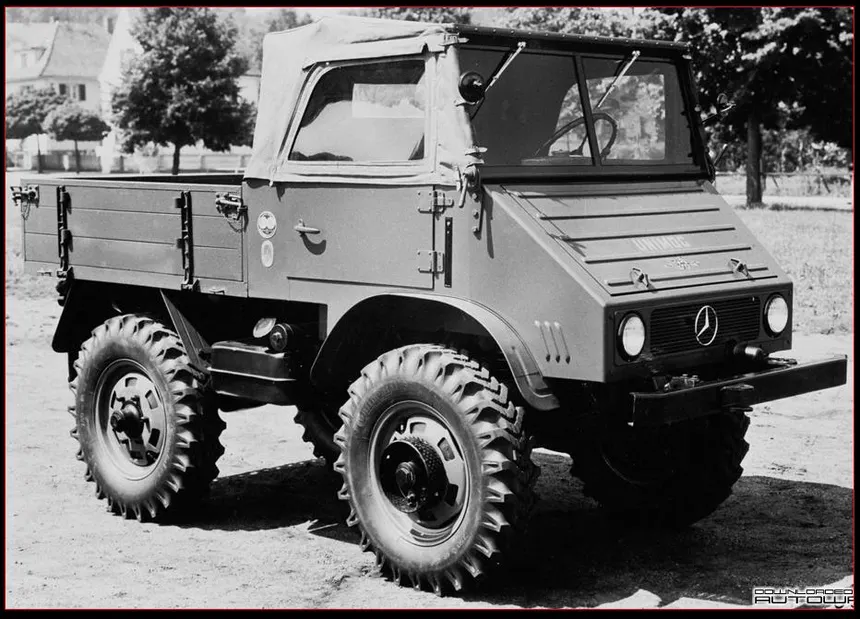
The Unimog Was Built to Straddle Two Rows of Potatoes (and Ended Up Crossing Deserts)
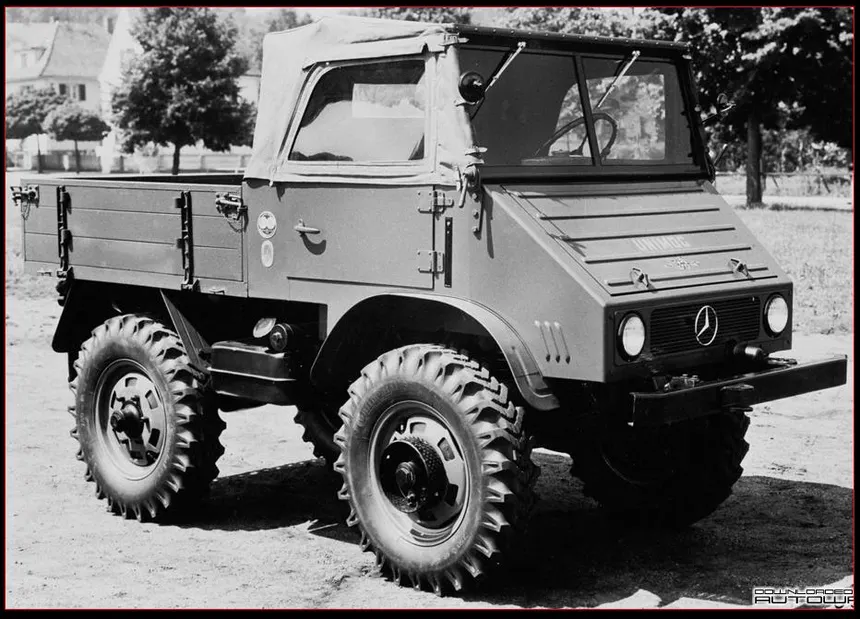
Jeremy Clarkson once drove a Unimog through a brick wall on Top Gear and seemed genuinely surprised when the wall lost. That’s the Unimog in one image: a vehicle so absurdly overbuilt that demolishing a house feels like a Tuesday. But here’s the thing nobody mentions when they’re filming it flatten things for entertainment. This machine wasn’t built for war, or for stunts, or for crossing the Sahara. It was built to drive over a potato field without crushing the crop.
That single fact explains everything about the Unimog. It’s a tractor in a truck’s clothing that accidentally became the best expedition vehicle on the planet. And the story of how a piece of post-war German farm equipment ended up hauling homes across the Empty Quarter is far better than that of any purpose-built military off-roader.
An aircraft engineer who started thinking about potatoes
To understand the Unimog you have to understand who fathered it, and when. Albert Friedrich had been head of aero-engine design at Daimler-Benz. This was a man who thought about aircraft propulsion, not ploughs. But the Second World War ended, Germany lay in ruins, and with the Morgenthau Plan bearing down on German industry, an aircraft engineer didn’t have many aircraft left to design.
So Friedrich looked at the land. His first sketches of an agricultural vehicle date to the autumn of 1945. The idea was a compact, all-wheel-drive machine making around 25 horsepower that could serve as a tractor, as a stationary power unit to run saws and harvesters, and as a delivery vehicle all at once. Rebuild the agriculture of a flattened country with a single do-everything tool.
He assembled a team, brought in Heinrich Rößler, who knew farm machinery, and talked the Erhard & Söhne works in Schwäbisch Gmünd into building the prototypes, a firm that had never touched a tractor in its life. In October 1946 they finished the first prototype, still running a 1.7-litre four-cylinder petrol engine because they didn’t yet have a decent diesel. They didn’t even have a name for the thing, which was neither truck nor tractor. A team member coined it: Universal-Motor-Gerät für die Landwirtschaft. Universal motorised unit for agriculture. Unimog.
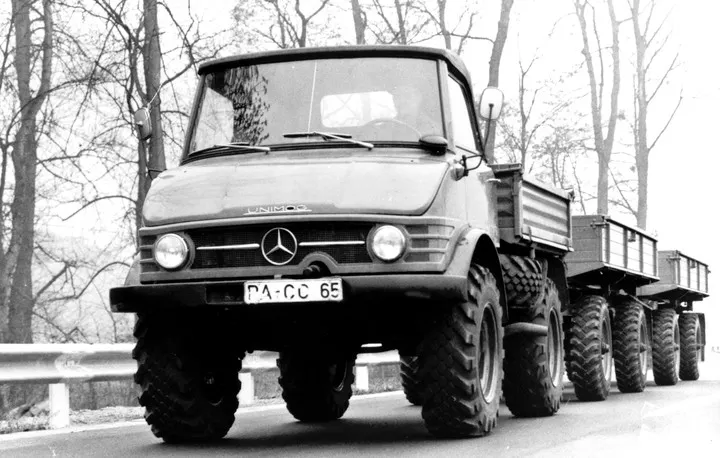
The revolution was underneath
From the outside it looked like an odd tractor with two seats. Underneath it was something else.
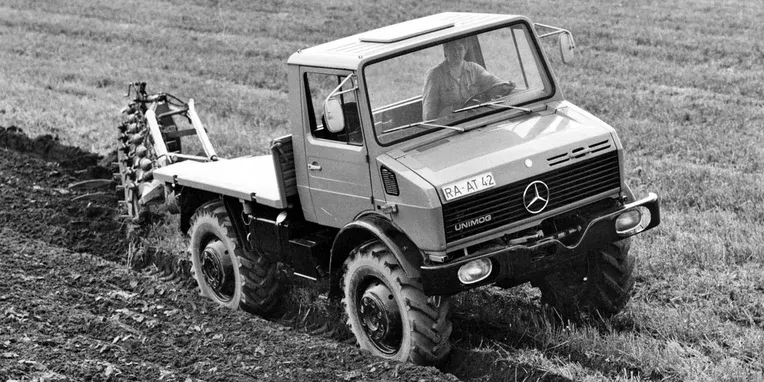
Friedrich didn’t want just another tractor. He wanted a machine that could work a field like a tractor but then hit the road and run at 50 km/h like a truck, unthinkable for a farm tractor of the era that crawled along at walking pace. To pull it off he gave it four equal-sized wheels instead of the small-front, huge-rear arrangement of the classic tractor. All-wheel drive. Coil-spring suspension instead of unsprung rigid axles. And portal axles.
Time to explain the part, because it’s the Unimog’s signature just as it’s the signature of its Austrian cousin. A normal axle carries the differential in the centre, level with the hub, and that hanging diff is the first thing to snag on a rock or a furrow. A portal axle sends the power higher, then a set of gears inside the hub steps it back down to the wheel. The result? The diff sits well above the wheel centre, you gain an enormous amount of ground clearance, and the hub gears multiply torque for hauling hard at low speed. Exactly what a tractor needs. Exactly what an expedition vehicle needs.
And one more thing: implements could mount front and rear. A classic tractor only hitched tools at the back. The Unimog had power take-offs everywhere. That modularity, the ability to bolt anything on top, is pure DNA, and it’s precisely what would later let someone bolt a house on it.
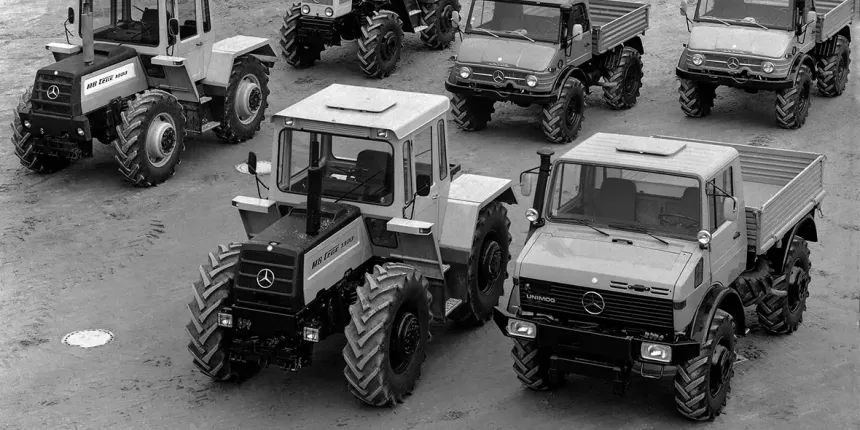
From the ox-head badge to the star
In 1948 the Unimog was shown at the German Agricultural Society fair in Frankfurt. It was the first time anyone had seen a tractor with two seats, a load bed, all-wheel drive, sprung axles and the ability to do 50 km/h. It went down very well.
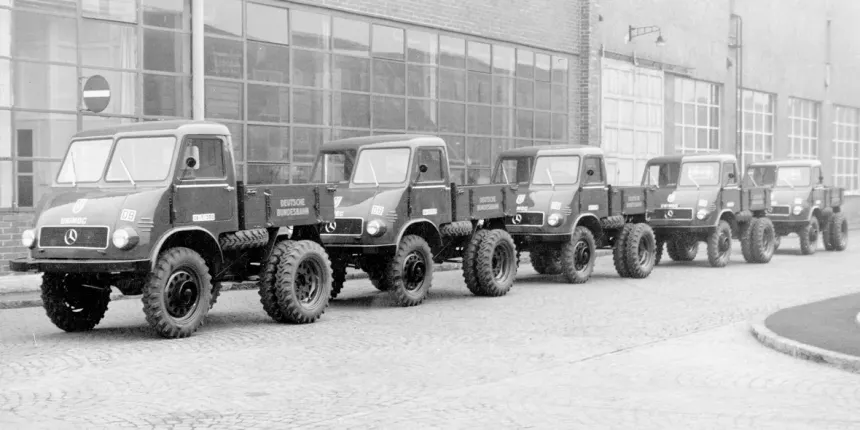
That same year series production began at the Boehringer factory in Göppingen. The first model, the 70200, ran a Daimler-Benz OM 636 diesel of about 25 horsepower and wore an ox-head logo. Around 600 were built. More than a hundred survive today, many still working.
But the Unimog was such a hit, at home and abroad, that the Boehringer plant ran out of capacity almost immediately. In 1951 Daimler-Benz took over production and moved it to Gaggenau, optimising the vehicle for mass manufacture. The three-pointed Mercedes-Benz star didn’t appear on a Unimog until 1953, replacing the old ox head. From that point on, the tractor nobody knew what to call became a Mercedes.
The chassis that twists on purpose
And here we reach what truly sets the Unimog apart from anything else, including any other off-roader with portal axles. It isn’t the ground clearance. It’s what the chassis does.
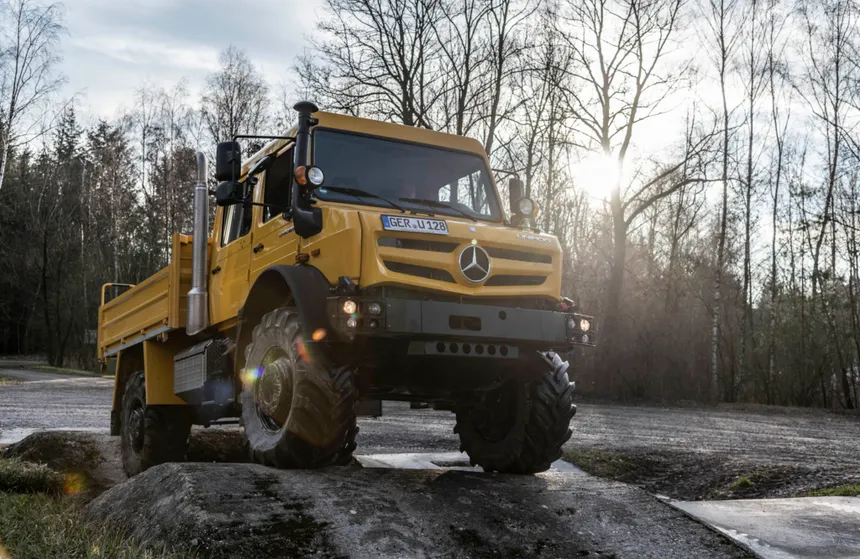
Most trucks have a frame built to be as rigid as possible. That makes sense: you want the structure not to move. The Unimog does the exact opposite. Its frame is designed to twist. It’s flexible on purpose, torsionally flexible, to the point that a modern Unimog allows up to 600 millimetres of diagonal twist. Six hundred. The front wheel can rise more than half a metre relative to the opposite rear wheel, and the frame wrings itself to follow rather than fight.
Why would you want that? Because articulation is what keeps all four wheels planted on broken ground. When a rigid axle lifts a wheel, that wheel stops driving. When the Unimog’s frame twists, the wheels each follow the terrain on their own, and all four keep pushing. Add the three-point mounting of the engine, transmission and cab, the torque-tube technology that isolates the driveline, and you have a machine that folds itself over rocks like a living thing.
It fords up to 1.2 metres of water. It climbs gradients of up to 45 degrees. It has half a metre of ground clearance because, on top of the portal axles, every major assembly is mounted above the lower edge of the frame. There’s nothing left to snag.
The problem that creates its greatest virtue
Now for the good part, the bit that links all that engineering to the idea of living inside one.
That frame twisting 600 millimetres is a marvel for never getting stuck. But think about it for a second: if you bolt a rigid living box, with its walls, windows, door and furniture, straight onto a frame that wrings itself half a metre out of true, you destroy the box. The racking forces the chassis feeds into the structure burst door frames, crack windows and split panel joints. The virtue becomes the enemy.
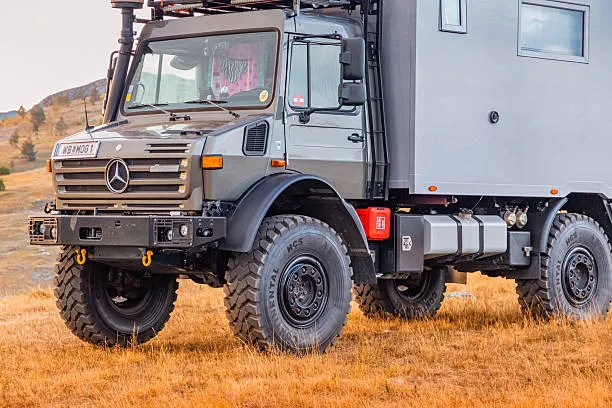
That’s why no serious Unimog camper conversion bolts the box straight to the frame. The answer is a torsion-free subframe, usually a three- or four-point mounting system. The idea is elegant: two fixed points and one pivot (or the reverse) that let the frame twist beneath while the living box floats above, stable and level. The chassis does its job of articulating and gripping the terrain. The box never feels it. Your bed, your kitchen and your windows survive the off-road because they’re decoupled from the twist.
It’s a beautiful engineering solution precisely because it’s born of a conflict. The Unimog is this capable because of the very thing that most threatens whatever box you put on top. And solving that conflict, the floating subframe, is what turns a farm tractor into an expedition home that survives years of trail.
Why it ended up crossing deserts
Put it all together. Portal axles for clearance. A flexible frame for articulation. All-wheel drive with diff locks so it never loses grip. Absurd fording ability. Modularity to mount anything on top. And the reliability of mechanicals designed so a farmer could fix them in the middle of a field.
None of that was designed with expeditions in mind. All of it was designed to work the land of a ruined country. But it turns out the virtues of a good off-road tractor are exactly the ones a vehicle needs to cross jungle, mountain or desert: go slow with force, climb over everything, don’t break, and carry whatever you need.
Models like the U1300L, the U1550 and the more modern variants became the dream expedition base not because anyone planned it, but because the qualities of an extreme tractor and those of an end-of-the-world explorer turned out to be the same list. The Unimog never sought adventure. Adventure found it.
It’s worth pausing on why a Unimog specifically, and not just any large 4×4 truck. The difference lies in the gearing and the load philosophy. A Unimog isn’t built to carry as much weight as a normal truck of its size; it’s built to carry a sensible load anywhere. Its gearbox runs a stack of short ratios meant for hauling slowly and forcefully, the exact opposite of a motorway truck that lives in tall gears. That tractor mindset, torque down low and speed only when you need it, is what lets you crawl up a dry riverbed at walking pace and then string together 300 kilometres of trail without drama. For an expedition home that isn’t a footnote: it’s the whole proposition.
Then there’s the geometry. A Unimog’s approach and departure angles, what it can attack climbing a rock step and descending one without burying the bumper or the tail, are in another league compared with almost anything you can register for the road. That geometry comes free from the design: a short nose because the engine sits well back, minimal overhangs, everything concentrated between the axles. Exactly what Friedrich drew when he placed the engine between the axles in one of his earliest 1946 sketches. Moving the powerplant inboard wasn’t about looks: it was so the vehicle could work a field without grounding on every furrow. Decades later, that same decision is what lets it attack a dune.
The tractor that became a legend by accident
The Pinzgauer was born military and ended up a camper. The Unimog walked the opposite, prettier path: born to plough, it ended up crossing continents. That difference of origin says everything about why the two feel so unalike despite sharing portal axles.
The Unimog doesn’t have the narrow aggression of a troop carrier. It has the patient robustness of a work tool, the machine built to graft every day for decades without complaint. And that patience is exactly what you want under your feet when there are five hundred kilometres of nothing between you and the next town.
Friedrich wanted a contraption that could straddle two rows of potatoes without flattening them. What he built was a machine capable of going anywhere on earth. Sometimes the most straightforward engineering, the kind that only tries to solve a humble, specific problem, is the kind that ends up travelling the furthest.