All-in-one platforms: the car is already an appliance
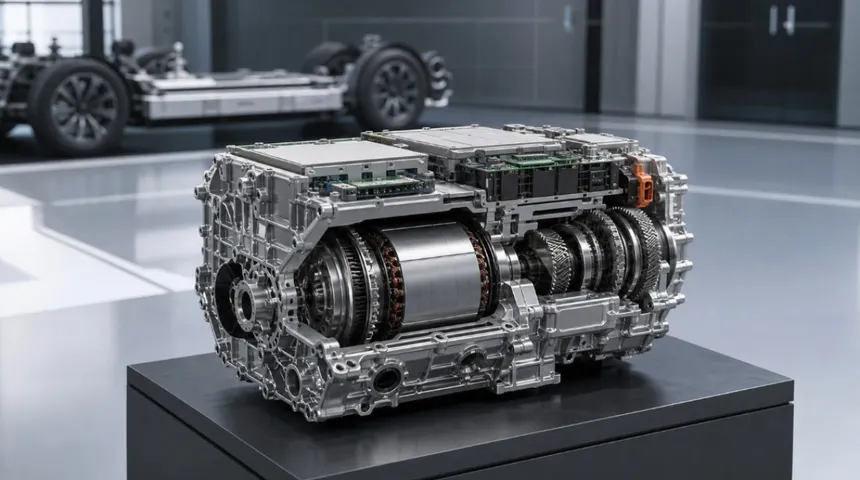
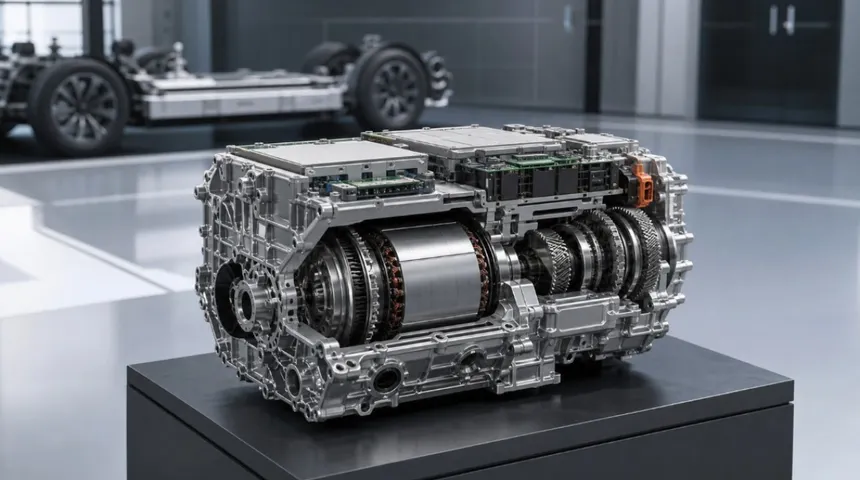
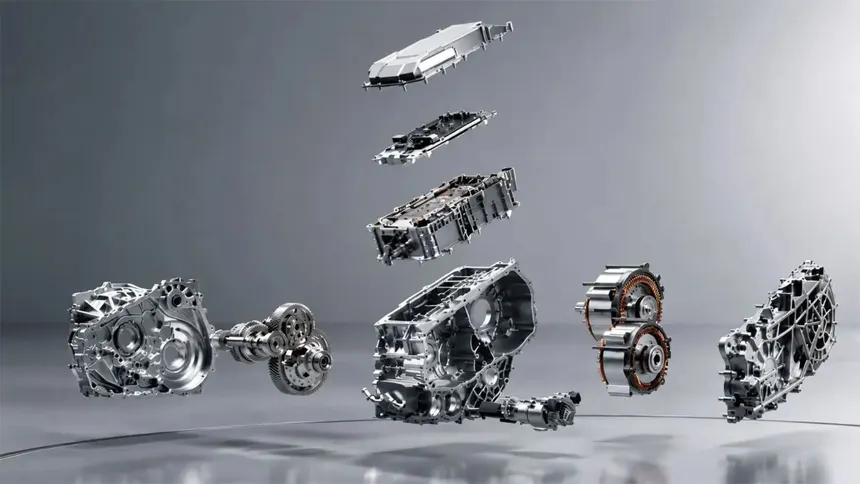
On July 16, 2026, Geely packed sixteen functions into a 75-kilogram box and called it Thunder. Twelve are hardware — motor, controller, reducer, DC-DC converter, onboard charger, power distribution, high- and low-voltage battery management, vehicle control, thermal management, active pre-charge and power-domain gateway — and four are software: energy management, charging management, motion control and system health diagnostics. All of it inside one block. A single part.
It was developed by InfiMotion, the Geely subsidiary that builds what everyone else buys. The headline number was 93.8% comprehensive efficiency on China’s CLTC cycle, presented as a mass-production record. It debuts in the Galaxy TT, a near-five-meter sedan with 245 kW rear-drive or 425 kW all-wheel drive and a 3.8-second 0–100 km/h. First deliveries in the third quarter, with the updated Lynk & Co 02 as the first car to carry it, per CarNewsChina on July 17.
That’s the press release. Now let’s talk about what it means to put sixteen functions in a box you’ll never get a single one back out of.
Why an American reader should care
None of these cars is landing at a U.S. dealer. Tariffs and the Commerce Department’s connected-vehicle rule slammed that door shut. Easy, then, to file this under news from a market that isn’t yours.
That’s a mistake, and the reason is named Valeo. The French supplier — which sells to Ford, GM and Stellantis — has already announced a 6-in-1 eAxle. The integration race isn’t a Chinese quirk that stops at the Pacific. It’s a supplier phenomenon, and suppliers are global. What the Chinese are doing fast today, your manufacturers are doing slower down the exact same road.
And there’s a domestic precedent that makes the point better than any import: Tesla’s structural battery pack in the Model Y. The pack became part of the car’s structure, and insurers started totaling cars over damage that would’ve been a bolt-on repair on anything conventional. That’s not a forecast from China. That already happened here, in your driveway, to your neighbor.
What disappears when you integrate
Geely says Thunder wipes out more than 180 redundant components. It cuts high-voltage wiring by 30% and low-voltage by 15%. It weighs 75 kg, 15% under the industry average. It fits under 325 mm tall and frees up 28 liters of trunk. Magnesium housing. Motor, reducer and mounts in one integrated design.
What the company sells as its breakthrough is the One-Chip control architecture: instead of controllers scattered across the car, the whole power domain runs on a single computing platform. Geely says that drops response latency from an industry-average 40 milliseconds to under 2, and real-time torque deviation from 3% to 1%. Cooling runs through 54 directional channels over stator, rotor and magnetic steel, which the company claims doubles heat dissipation and shaves 15°C off peak temperature. A Galaxy TT logged 8.20 kWh/100 km at Qinghai Lake — a showroom number. The rated CLTC figure is 10.7, and that’s the one that shows up on your power bill.
Every one of these is a manufacturer claim. Not one verified by anyone on the outside, because the system is a week old and there isn’t a car on the road. Hold the applause until somebody opens the box.
Geely didn’t start this race
Nobody should sell you the 16-in-1 as a bolt from the blue. Integration has been climbing step by step for years, and Geely is the latest rung, not the first.
The industry lived a long time on the 3-in-1: motor, inverter, reducer, done. BYD blew through that ceiling in September 2021 with e-Platform 3.0 and its 8-in-1 — the first at that level built at scale, 89% claimed efficiency, eight parts in one block. With a detail that says everything: BYD builds all eight in-house. Chang’an and Leapmotor are running 7-in-1 systems. Valeo — European, not Chinese, worth repeating — announced a 6-in-1 eAxle. And Geely itself has two different “11-in-1” products with the same name: one electric at 400 volts, and one that isn’t electric at all but a dedicated hybrid transmission, the E-DHT.
That recycled name for two different things is no slip. It’s proof this isn’t an EV story. The same thing is being done to the hybrid. What’s being integrated isn’t a propulsion technology. It’s the whole car, whatever engine it happens to carry.
What the manufacturer walks away with
No tricks here: integration works. Denying it would be as dishonest as the press release that tells you half the story.
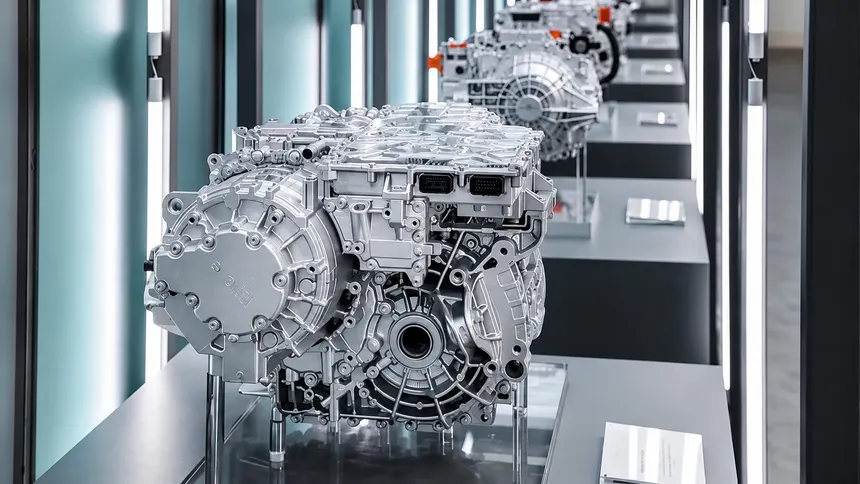
Fewer parts means fewer part numbers to buy, fewer suppliers to beg, fewer connectors working loose, less wire to route, fewer line-minutes per car. Yole SystemPlus — the French consultancy that took BYD’s 8-in-1 and cut it open — logged the numbers BYD brags about: 16% more compact, 10% lighter, cheaper in materials and assembly. And the number that actually matters: BYD supplies at least 40% of material cost from its own plants, and Chinese suppliers make up 79% of the total. When you integrate the functions and also build the parts you’re integrating, you stop depending on anybody. That’s the real prize, and it’s industrial long before it’s technical. They aren’t building better cars. They’re building the supply chain everyone else will depend on.
And you? You gain something too, and it deserves the same plain talk. Less weight is less to move. Fewer losses is more miles per kilowatt-hour. Less volume is 28 more liters of trunk. An integrated car is more efficient and packages tighter. That’s not marketing, it’s physics, and physics doesn’t lie.
What lies is the assumption that any of that saving reaches your wallet.
What the person paying loses
The system doesn’t fail at how it works. It fails at what happens the day it stops. And that day always comes.
Yole, in part two of its BYD teardown, listed the downsides of ultra-integration with no makeup on: a layout built around one bulky lump, demanding thermal management, electromagnetic interference, and a higher overall failure rate. That’s not some guy at a bar. That’s the outfit that opened the box, counted the bolts and benchmarked it function by function. Higher overall failure rate. Read it twice, because it’s exactly what no promo video will ever show you.
Chinese technical press — the market building this, not outsiders — went at it from the same side. Automotive Commercial Review, cited by CarNewsChina, asked out loud how you’re supposed to maintain components with different service lives when they’re welded into one architecture. And catch the nuance, sharper than the easy headline: the problem isn’t that it can’t be repaired. It’s that nobody has yet explained how you diagnose and service a block where the charging electronics, the power distribution and the drivetrain all live fused together. Nobody. And the one asking isn’t an enemy of the technology. It’s the press in their own backyard.
There’s a piece of arithmetic that needs no source because it’s shop-floor day one. A charger, a distribution unit and a motor don’t wear at the same rate or fail for the same reasons. In twelve boxes, one breaks and you swap one. In one box, that box is the only point of failure the car has. Doesn’t matter how reliable it is: the question isn’t how often it dies, it’s what you throw in the dumpster the day it does. And what you throw out is all of it.
Price, where the mask slips
Geely will launch Thunder on models above 250,000 yuan — around $34,400 — before it trickles down to the rest of the range.
Stop there a second. The technology that erases 180 parts, trims wiring, cheapens the bill of materials and speeds up assembly lands first on the expensive cars. The factory saving exists, it’s quantified, it’s bragged about at the podium. The price cut for the buyer is nowhere to be found. Surprise: zero.
You don’t need a conspiracy to explain it, and I won’t reach for one. New tech amortizes where the margin is, period. But put the fact on the table as-is, because the official line sells integration as the road to a cheaper car, and the first car wearing it is one of the pricey ones. The saving stays upstairs. Same as always.
Aftermarket, the question nobody answers
No manufacturer has published a parts policy for these blocks. None. Not one piece of paper says whether Geely’s 16-in-1, its 11-in-1 or BYD’s 8-in-1 will be sold in pieces, whether there’ll be reman programs, whether an independent shop can get a hand inside the block, or whether swallowing full replacement through the factory network is the only way out. Anyone telling you otherwise is making it up, and we don’t make things up here.
What is documented is the ground this lands on — and Americans know this fight from the other side. Massachusetts passed a right-to-repair law and the automakers went to court over it. Sealed modules, diagnostic access only the dealer network holds. Integration doesn’t create that problem. It removes the last physical way out of it, because when there’s nothing separable inside the box, data access stops being the bottleneck — there’s simply nothing left to open.
So: will parts exist? Enough of them? At what price? On what timeline? And at ten years, with the model long dead and the maker already selling four newer ones on top of it? Nobody has said. And nobody will until it’s too late.
The argument
What follows is Not Enough Cylinders’ opinion. I could be wrong, and you’re entitled to think the opposite. But I think it, and I’ll sign it.
And I don’t need to show you the future, because you already ate this years ago and most people never noticed. Think about the steering column. The turn-signal stalk, the wiper stalk, the airbag clockspring, the steering-angle sensor and the switchgear used to be separate parts — a couple bucks each, replaced one at a time. The contact in your turn-signal stalk went bad, you swapped the stalk and moved on. One day they decided to fold it all into a single assembly. So now what happens when that same little contact fails? You don’t replace the stalk. You eat the whole module — clockspring, angle sensor, switchgear, all of it — plus dealer coding. A couple bucks becomes several hundred for the exact fault you used to fix with a nothing part. And the worst part isn’t the price: it’s that you don’t find out the car works this way until the bill lands. Nobody told you when you bought it. You find out the day it breaks, quote in hand, with no alternative.
That’s the whole thing. The 16-in-1 invents nothing: it takes that same steering-column move and hauls it from the dash to the entire drive unit. Integration isn’t the technology arriving with Geely. It’s the one they already put inside you without a heads-up, now served in 75-kilo format.
The car spent a century being the opposite. A car was a pile of parts you could change one by one, and that’s why a whole world grew around it: independent shops, remanufacturers, salvage yards, aftermarket parts, makers who’d sell to anyone. That world wasn’t a market accident. It was the direct consequence of the car being modular. The day you kill modularity, you kill that world, and nobody has to sign the order. It falls on its own.
Here’s my thesis, tagged as exactly that. I don’t think this is an accident. No manufacturer has ever owned up to planned obsolescence and none ever will, and proving it means going case by case, which I can’t do here. But a maker that swaps its whole lineup every nine or ten months has zero reason to guarantee you parts for a model fifteen years out. And a block only its maker can touch is priced at whatever the hell they feel like charging. Those two things together need no secret meeting behind drawn blinds. Doing nothing is enough. Just let the current carry it.
And that’s the part that should actually cost you sleep: you don’t need malice to end up here. Competition pushes toward integration on its own, because whoever doesn’t integrate loses range, margin and packaging — and whoever loses margin disappears. Nothing slows the machine down, because the regulators measure emissions, consumption and crash safety, but they don’t measure whether the car can be fixed or how long it lasts. Your phone has a right to repair. Your car’s electric drivetrain doesn’t. That gap isn’t my opinion: it’s a fact, and it’s wide open.
The car that’s coming will be more efficient, lighter and probably cheaper to build. And at the same time harder to maintain, more expensive to fix and quicker to scrap. All of it at once, no contradiction. The people who build it win on the first three. You, who pay for it, lose on the last three. Run the math on who comes out ahead and you’ll see it isn’t you.
And something’s lost that shows up on no cost sheet: a person’s ability to understand and fix the machine they drive. That went on for a century. It doesn’t have long left. And the day it’s fully gone, there’ll be no manual, no shop, no salvage yard that brings it back.
The play is right there on the table, and you don’t need a tinfoil hat to see it: cars cheap to build, expensive to repair, designed so you swap them every few years without stopping to ask how we got here. And we haven’t even touched autonomous driving yet. Because if the plan is a car that doesn’t last and can’t be fixed, the next question asks itself: do they not want you driving it either?
Check you’re still alive.