The Wankel’s Scream: How Mazda Conquered Le Mans and Built the Cult of the RX-7
When the rest of the automotive world gave up on the rotary engine, Mazda doubled down and chased glory. Against all odds, they turned the Wankel into the beating heart of one of the most revered sports cars in history. This is the story of the engine the industry tried to kill—and the fans who refuse to let it die.
An Engine Nobody Wanted… Except Mazda
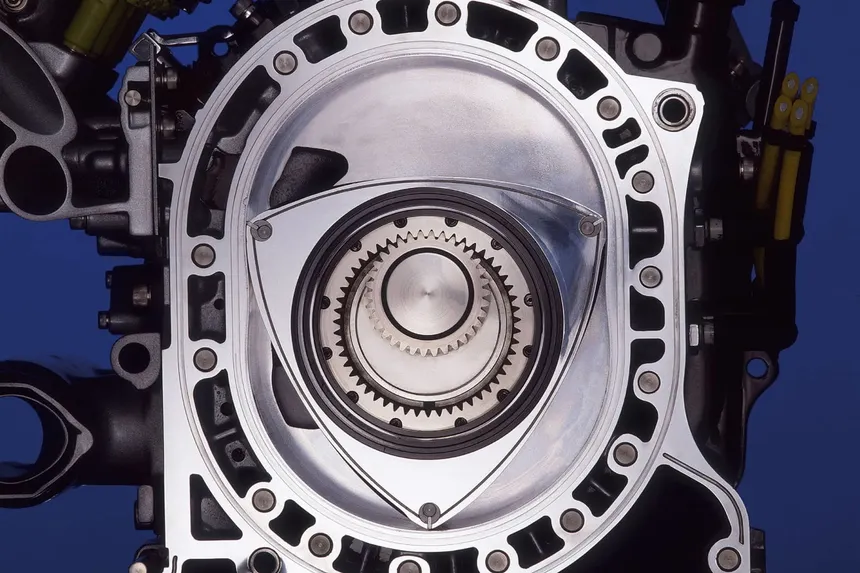
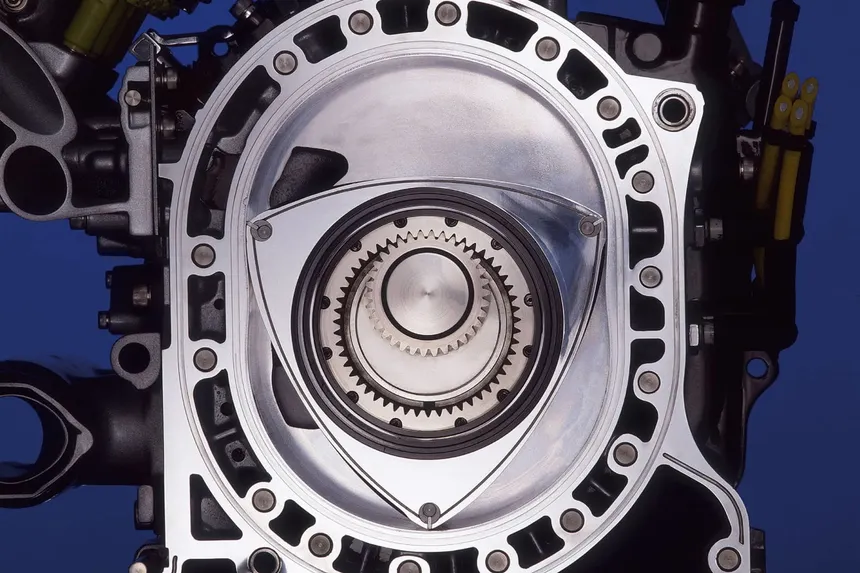
Felix Wankel patented his rotary engine in 1929. On paper, it was a stroke of genius: eliminate the reciprocating mass of pistons and replace them with a triangular rotor spinning inside an epitrochoidal chamber. This design achieves a full four-stroke cycle in every revolution of the eccentric shaft. It meant fewer moving parts, zero vibration, higher power-to-displacement ratios, and a weight so low it made piston engines look like boat anchors.
NSU was the first to go to market with the Spider in ’63 and the Ro80 in ’67. Citroën took a shot with the GS Birotor in ’73. Even General Motors was convinced it would replace the piston engine in everything from the Vega to the Corvette. Mercedes-Benz dumped massive R&D into it.
They all failed. The hurdles were always the same: apex seals—the parts that seal the three tips of the rotor—suffered brutal wear. NSU engineers called them “the devil’s fingernails” (Teufelskratzspuren). Excessive oil consumption, high emissions, and poor thermal efficiency compared to conventional blocks finished the job.
By 1977, NSU and its rotary were dead. Citroën went bankrupt partly due to the Birotor. Then the ’73 oil crisis hit, sinking anything that wasn’t fuel-efficient. Every brand walked away from the Wankel. Everyone except one.
The 47 Samurai of Hiroshima
Kenichi Yamamoto, the head engineer at Mazda, led the rotary charge. He formed a squad of 47 engineers—dubbed “The 47 Samurai” in a nod to Japanese legend—dedicated solely to fixing the Wankel. Yamamoto’s orders were clear: “From now on, the rotary engine must be on your minds at all times, whether you are awake or asleep.”
In 1963, one of those samurai cracked the code. He developed a unique apex seal made of a carbon-aluminum alloy that made the engine commercially viable. In 1967, the Mazda Cosmo Sport became the brand’s first production twin-rotor car. To prove its grit, Mazda entered two nearly stock Cosmos in the Marathon de la Route—an 84-hour endurance torture test at the Nürburgring. One lasted 82 hours; the other finished 4th overall. The message was sent: This engine can take a beating.
The Le Mans Obsession
Mazda first hit the grid at Le Mans in 1970 with a rotary-powered Chevron B16. Throughout the ’70s and ’80s, Mazda returned year after year. They earned respect and showed flashes of speed, but the top step of the podium remained elusive. The 767 and 767B prototypes of the late ’80s showed promise, but mechanical gremlins always crashed the party.
In 1990, the 787 debuted with the new R26B four-rotor engine. Reliability issues cut their run short. Then came the news that changed everything: the FIA announced that 1991 would be the final year rotary engines could compete at Le Mans. The 1992 regs would mandate 3.5L piston engines, like Formula 1. For Mazda, it was now or never.
June 22, 1991: The Day the Wankel Made History
The R26B inside the 787B was an engineering masterpiece. Four rotors, 2.6L equivalent displacement, a revolutionary continuously variable intake system, three spark plugs per rotor, and ceramic apex seals. In race trim, it put down between 650 and 700 hp at 9,000 rpm. In qualifying, with the limiter bumped, it could scream past 900 hp.
The car weighed a mere 1,830 lbs. We’re talking over 800 hp per ton. Mazda successfully dodged 440 lbs of ballast by arguing their engine wasn’t “large displacement” under the equivalency rules.
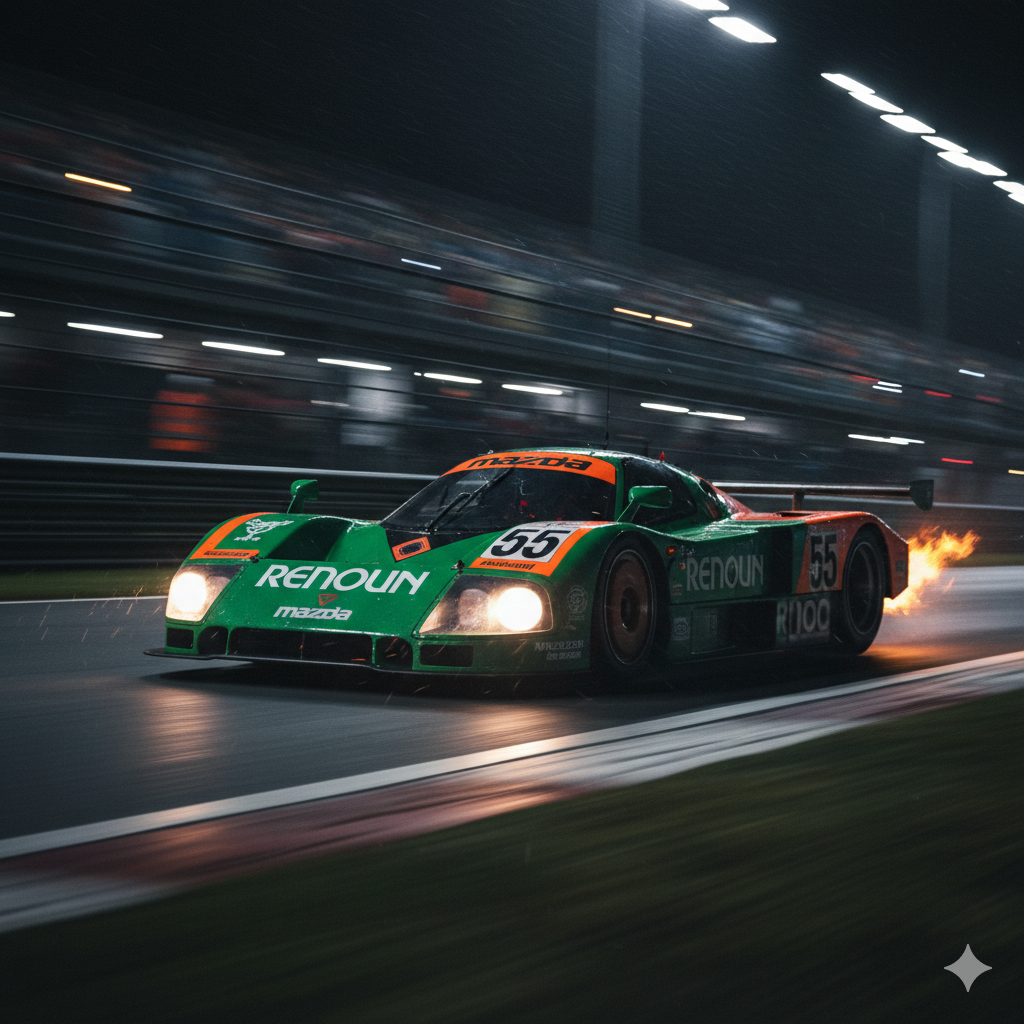
In qualifying, the #55 car—rocking that iconic orange and green “Charge” livery by Renown—started in a modest 19th place. On paper, it was outclassed by the Sauber-Mercedes C11s (driven by a young Michael Schumacher), the Jaguar XJR-14s, and the Peugeot 905s. But Le Mans isn’t won on paper.
Mazda’s strategy was conservative yet brilliant. The team director ordered the drivers to go flat-out once he saw how reliable and fuel-efficient the 787B was during practice. Mazdaspeed engineers had deliberately capped the revs at 8,500 rpm to prioritize reliability over peak power.
Early on, the 787B cruised while the favorites set the pace. But one by one, the giants fell. The #11 Mercedes went off-track and suffered gearbox issues. The leading Mercedes slowed down to save fuel. The Jaguars faced their own mechanical nightmares. At the 22nd hour, the #55 took the lead.
Johnny Herbert, Volker Weidler, and Bertrand Gachot hammered it for 24 hours. At the final pit stop, Herbert refused to get out, wanting to bring the 787B home. He crossed the finish line two laps ahead of the second-place Jaguar. Herbert was so dehydrated he couldn’t walk to the podium.
When Mazda engineers tore down the R26B after the race, they found every part in perfect condition. They claimed the engine could have run another 500 km without breaking a sweat.
What It Meant (and What It Didn’t)
The 787B’s win was historic. It was the first win for a Japanese manufacturer at Le Mans—a record that stood until Toyota won in 2018. To this day, it remains the only win for a non-piston engine in Le Mans history.
But there’s a bitter irony. Mazda didn’t milk the victory for marketing. Their reasoning was almost quintessentially Japanese in its modesty: they won under yesterday’s rules, so they put the win in the record books and sent the 787B to the museum in Hiroshima. The following year, Mazda returned with a conventional 3.5L piston engine. It was a failure. They stopped competing the year after that. 1991 was the high-water mark for Mazda at Le Mans and for the rotary in racing. The Wankel’s 9,000 rpm scream echoed through La Sarthe one last time, and then there was silence. But not forever.
The RX-7: Three Generations of Mechanical Heresy
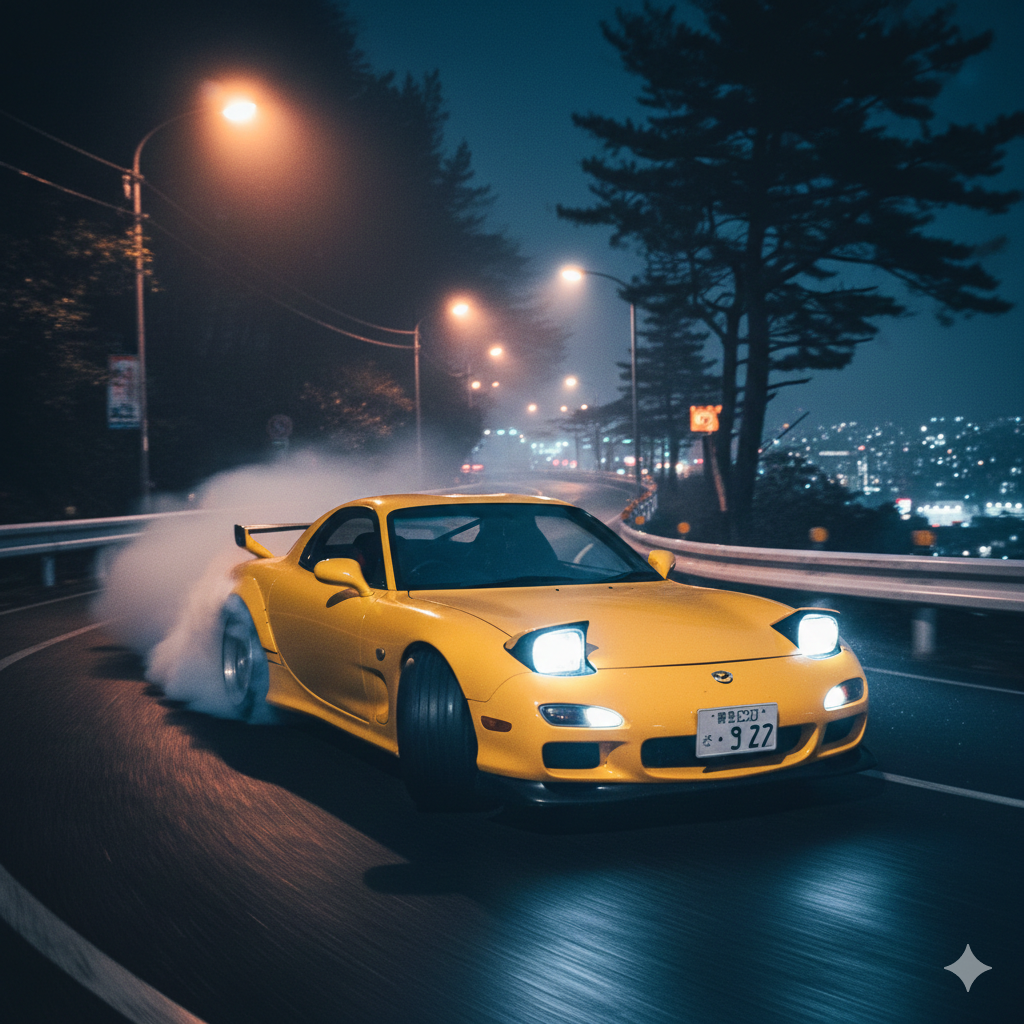
If the 787B was the Wankel’s peak glory, the RX-7 was its daily life. For 24 years and three generations, Mazda proved that an engine the world called “unviable” could be the soul of one of the most celebrated sports cars ever built.
First Generation: SA/FB (1978-1985) – The Origin Story
Matsaburo Maeda designed the first RX-7 as a lightweight sports coupe with a radical premise: front-mid engine layout for optimal weight distribution. Because the Wankel was so compact, the nose could be low and aerodynamic, featuring those iconic pop-up headlights.
The 12A twin-rotor engine put out a modest 113 hp, but the car weighed just over 2,200 lbs. The result was an agile, fun, and—crucially—affordable sports car. In 1984, the GSL-SE introduced the 1.3L 13B engine with EFI and 135 hp. Even fully loaded, it stayed under 2,500 lbs.
In racing, the FB dominated. Seven straight IMSA GTU class wins between ’80 and ’87. A class win at the ’79 Daytona 24 Hours in its first try. Back-to-back BTCC championships. With half a million units sold, it was the best-selling RX-7 by far.
Second Generation: FC (1985-1992) – Coming of Age
The FC was a massive leap. It was bigger, heavier (by about 530 lbs), and more sophisticated. The design by Akio Uchiyama took clear cues from the Porsche 944; Japanese media dubbed it “the Japanese Porsche.”
It featured a revised 13B with 146 hp, electric power steering, and optional adaptive suspension. MotorTrend named it Import Car of the Year in ’86. But the real game-changer was the 1987 Turbo II: 182 hp and a 0-60 in under 7 seconds.
In Japan, the limited “Infini” editions were the holy grail—600 units a year, rear seat deletes, aluminum hoods, and 212 hp. The very last special edition was the “Winning Limited” in September ’91, built to celebrate the 787B’s Le Mans victory. It was the perfect bridge between the track legend and the street.
Third Generation: FD (1991-2002) – The Masterpiece
The FD is, for many, the absolute pinnacle of the RX-7 and one of the purest sports cars ever made. Built during Japan’s “bubble economy” when money was no object, it was a “no compromises” machine.
The design was a masterpiece of “bio-design” from the ’90s—organic, fluid, and impossibly low. The 13B-REW engine was the first mass-produced sequential twin-turbo system exported from Japan. A small turbo for low-end punch, and a big one that kicked in at 4,500 rpm to pull all the way to redline.
At 2,780 lbs, 50:50 weight distribution, front-mid engine placement, and double-wishbone suspension, the FD was a surgical tool. 0-60 in under 5 seconds. Road & Track called it “the purest, most exhilarating sports car in the world.”
But the market was cruel. Prices spiked, the Japanese economy crashed, and emissions regs tightened. 1995 was its last year in the US. In Japan, it survived until 2002 with the “Spirit R”—the final 1,504 units that represent the ultimate evolution of the model.
The Curse of the Apex Seals (And Why Nobody Gets It)
The rotary’s reputation as a “mechanical time bomb” is both unfair and earned. Apex seals are the segments of the rotor, and they live in hell: extreme temps, constant pressure, and brutal friction.
By design, a rotary burns oil to lubricate these seals. This kills emissions and makes modern compliance a nightmare. The reality? A well-maintained, naturally aspirated RX-7 can easily clear 100k-120k miles. The turbos are more demanding, often needing a rebuild between 50k and 90k miles.
The problem is that the RX-7 is a driver’s car. Owners who push them to the limit, slap on huge turbos without upgrading the seals, or ignore oil levels are the ones who fuel the “reliability” myths.
Why Only Wankel Fans “Get It”
There is a fundamental split in the car world between those who love rotaries and those who don’t. It comes down to one word: Character.
A piston engine is logical. More displacement equals more torque. A V8 pushes you into the seat at 2,000 rpm. The Wankel? Under 5,000 rpm, it feels like a sewing machine. Then you hit the threshold, the engine screams to life, and the power delivery is linear and smooth as silk. The sound goes from an industrial hum to a 9,000 rpm wail that is pure addiction.
Then there are the physics: half the weight of a 4-cylinder, a lower center of gravity, and better weight distribution. The car just rotates better. But it’s a high-maintenance relationship. It’s an engine for the devoted. It’s a mechanical religion.
Legacy: The Engine That Won’t Die
Mazda killed the RX-7 in 2002. The RX-8 was a brave attempt, but it lacked the raw power fans craved. In 2015, the RX-Vision Concept sparked hope, but today the rotary only exists as a range extender in the MX-30 EV.
Yet, the rotary community is more alive than ever. FD prices are through the roof. 4-rotor swaps are the JDM holy grail. When the 787B is rolled out for demo runs today, the crowd goes silent—not for nostalgia, but to hear that scream one more time.
Mazda conquered Le Mans with an engine nobody else wanted. They built a sports car that, 30 years later, generates more soul than almost anything on a showroom floor today. Not bad for an engine declared dead in 1977.
Are you a rotary believer, or do you think an engine needs pistons to be real? Let us know in the comments. If you’ve ever sat behind a 13B at 8,000 rpm, you know there’s no going back.
5 thoughts on “WANKEL”