
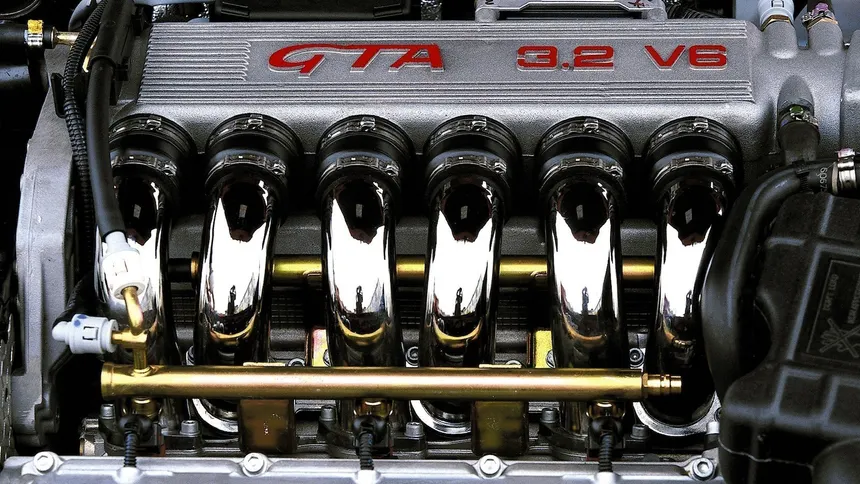
The Alfa Romeo Busso V6: The Engine That Sounds Like God Gargling

27 Years of Mechanical Poetry
Between 1979 and 2005, Alfa Romeo produced an engine so sonically transcendent that automotive journalists have exhausted their thesauruses trying to describe it.
The Busso V6—named after its creator Giuseppe Busso—wasn’t the most powerful engine of its era. It wasn’t the most efficient. It wasn’t even the most reliable. What it was, unquestionably, was the best sounding production engine ever fitted to a road car.
This isn’t hyperbole. This is the hill we die on.
Giuseppe Busso: The Man Behind the Music
Giuseppe Busso spent nearly his entire career at Alfa Romeo, joining in 1939 and retiring in 1977. In those 38 years, he contributed to some of the greatest engines in Italian automotive history.
But his masterpiece came after retirement.
The V6 that bears his name was actually finalized after Busso officially left Alfa Romeo. He continued consulting on the project, refusing to let his life’s culminating work be completed by lesser hands.
The engine that emerged reflected everything Busso had learned over four decades: the importance of balance, the necessity of over-engineering, and the understanding that an engine’s character matters as much as its specifications.
Busso died in 2006, one year after his V6 finally ceased production. He lived just long enough to see enthusiasts recognize his engine for what it was: the last gasp of an era when Italian engineers built machines for the soul.
The Technical Foundation
The Busso V6’s specifications seem unremarkable on paper:
- Configuration: 60-degree V6
- Displacement: 2.0L to 3.2L across variants
- Valvetrain: Single overhead cam per bank (early) / Dual overhead cam per bank (late)
- Construction: Aluminum block and heads
- Power output: 130 to 250 horsepower depending on variant
Nothing about those numbers suggests the sound this engine produces.
The 60-degree bank angle was critical. Unlike 90-degree V6s, which require balance shafts to smooth inherent vibrations, a 60-degree V6 achieves natural balance with appropriate crankshaft design. This allowed the Busso to rev freely without mechanical harshness.
The single-cam design in early variants (1979-1992) contributed to the engine’s distinctive character. Single-cam engines typically produce less power per liter but create different harmonic frequencies than dual-cam designs. Many enthusiasts argue the original SOHC Busso sounds better than the later DOHC versions—more raw, more organic.
The aluminum construction kept weight manageable, contributing to the excellent weight distribution in cars like the GTV6 and later the 166 and GT.
The Sound That Defies Description
Here’s where language fails.
The Busso V6 produces a sound that sits somewhere between a Ferrari V12’s wail and a mechanical turbine’s whistle. At idle, it chatters with mechanical purpose. At 3,000 RPM, it growls with increasing urgency. At 6,000 RPM and beyond, it achieves a timbre that causes grown men to weep.
Describing this sound is like describing a color to someone blind from birth. You can use analogies, comparisons, technical explanations—and none of them capture the experience of hearing a Busso V6 at full song.
What can be said objectively:
- The sound has organic, almost biological quality. It doesn’t sound purely mechanical—it sounds alive.
- The induction noise and exhaust note harmonize in ways that more modern engines cannot achieve.
- There is genuine variation in tone throughout the rev range. The engine doesn’t simply get louder; it changes character.
- Even poorly maintained Busso engines sound remarkable. This is inherent to the design, not dependent on perfect tuning.
Enthusiasts debate whether the 12-valve SOHC or 24-valve DOHC variants sound better. Both sides have compelling arguments. What nobody debates is that both sound better than virtually any other production engine ever made.
The Applications
The Busso V6 appeared in numerous Alfa Romeo models across its 27-year lifespan:
Alfa 6 (1979-1986): The Busso’s debut, in a flagship sedan few remember. The engine was the best part of an otherwise forgettable car.
GTV6 (1981-1986): The application that made the engine famous. The GTV6’s chassis perfectly matched the engine’s character, creating one of the great driver’s cars of the 1980s.
75 (1985-1992): The final “real” Alfa sedan, with rear-wheel drive and the 3.0L Busso available in top trims. Underappreciated in period, now gaining collector recognition.
164 (1987-1997): Alfa’s transition to front-wheel drive still included the Busso V6 in various displacements. The car was compromised; the engine remained magnificent.
Spider/GTV (916, 1995-2006): The final home for the Busso, available in 3.0L and 3.2L forms. These cars offered genuine sports car dynamics with the legendary engine, though front-wheel drive disappointed purists.
166 (1998-2007): Alfa’s final flagship sedan, with the Busso V6 available through 2005. A comfortable grand tourer that happened to contain one of history’s great engines.
GT (2003-2010): The final new model to receive the Busso, though it was discontinued from the GT’s options list in 2005 when production ended.
Why It Ended
The Busso V6 died in 2005 for reasons that had nothing to do with its quality.
Emissions regulations had tightened beyond what the design could accommodate without fundamental changes. The engine’s age made development investment impractical. Fiat’s financial pressures demanded consolidation around newer, more versatile engine families.
From a corporate perspective, killing the Busso made sense. The engine was expensive to produce, limited in application, and couldn’t meet future requirements without redesign.
From an enthusiast perspective, its death marked the end of an era. The replacement engines—the JTS four-cylinders and later turbocharged units—were perfectly competent. None of them made you feel anything.
The Collector Reckoning
Today, any Alfa Romeo with the Busso V6 commands a premium over four-cylinder equivalents.
The market has finally recognized what enthusiasts knew for decades: these engines offer something irreplaceable. You cannot buy a new car that sounds like a Busso V6. You will never be able to buy one.
This has driven prices accordingly:
- GTV6 values have tripled in the past decade
- 3.2L Spider/GTV (916) models command significant premiums over 2.0L versions
- Even the unloved 164 is gaining recognition simply because of its engine
The challenge is finding well-maintained examples. The Busso V6 itself is remarkably durable, but the Italian cars surrounding it typically are not. Rust, electrical failures, and deferred maintenance have claimed many examples that would otherwise remain viable.
Maintenance Realities
The Busso V6 rewards proper maintenance with remarkable longevity. Engines with 200,000+ kilometers are not unusual—if serviced correctly.
What they need:
- Regular valve adjustments (hydraulic lifters only in later variants)
- Timing belt service at manufacturer intervals (critical)
- Quality oil and filters at appropriate intervals
- Attention to cooling systems in hot climates
What they don’t tolerate:
- Neglected timing belt service (catastrophic failure results)
- Cheap oil or extended intervals
- Deferred maintenance of any kind
The parts situation varies by market. In Europe, specialist suppliers maintain reasonable availability. In North America, some components require European sourcing. Globally, the engine’s long production run means core mechanical parts remain findable—the challenge is trim, accessories, and model-specific items.
Rebuilding a Busso V6 is expensive but straightforward. The engine’s design is conventional enough that competent machine shops can handle the work. Finding machine shops that understand the importance of maintaining the engine’s character while rebuilding is another matter.
The Legacy
The Busso V6 represented the final expression of a philosophy that Italian automakers have largely abandoned: engines should move the soul, not just the car.
Modern turbocharged engines are more powerful, more efficient, and more responsive. None of them sound like anything special. The sounds they produce are byproducts of combustion, not carefully orchestrated mechanical music.
Giuseppe Busso understood something that modern engine development has forgotten: people don’t just drive cars with their hands and feet. They drive them with their ears. An engine that sounds magnificent makes every journey memorable in ways that mere performance numbers cannot capture.
The Busso V6 was never the most powerful, most efficient, or most sophisticated engine of its era. It was simply the most special.
And for those of us who have heard one at full song, that’s more than enough.
Have you heard a Busso V6 in person? Is it really as special as the legends suggest? Share your acoustic experiences in the comments.
9 thoughts on “BUSSO V6”