
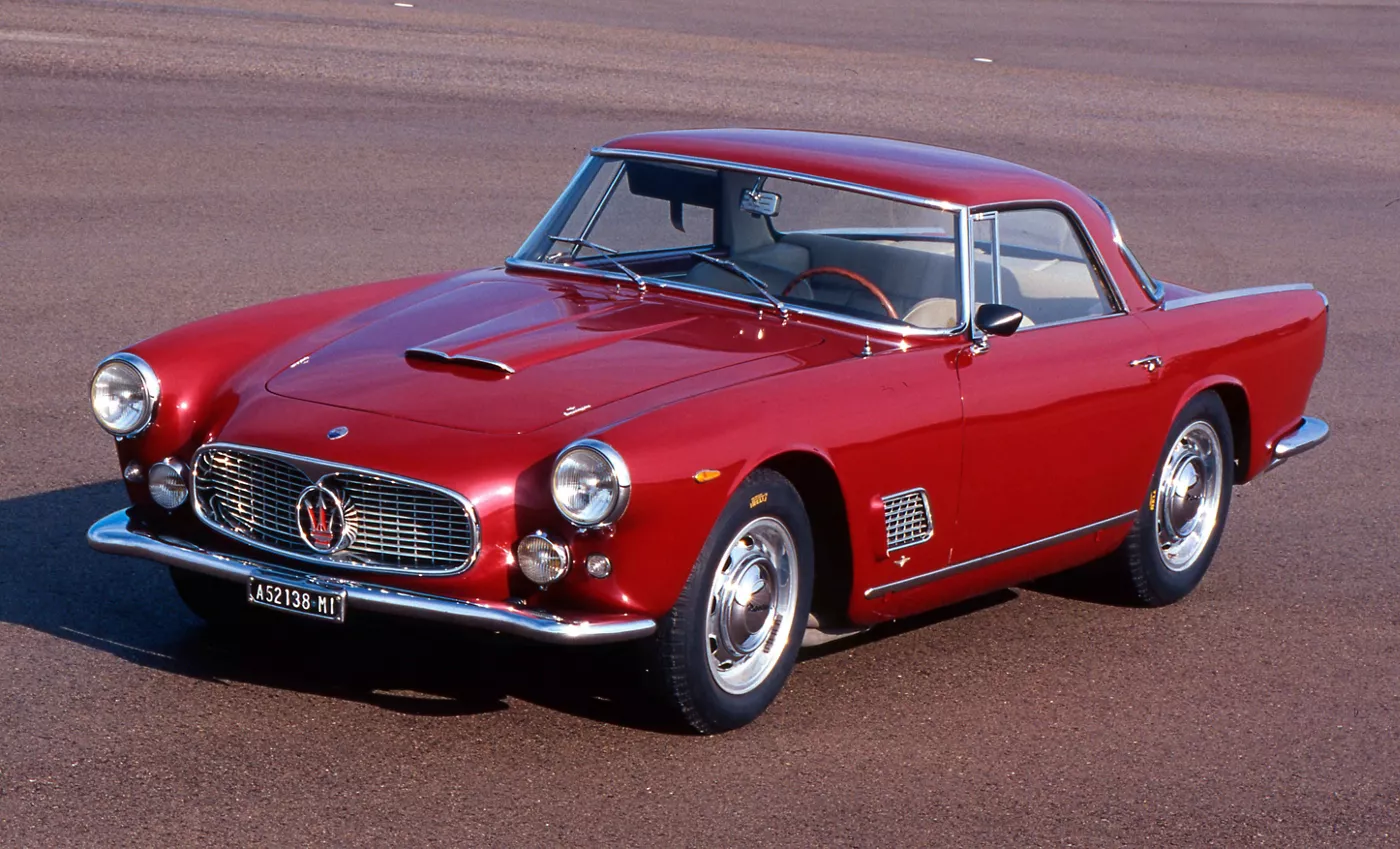
Maserati 3500 GT: The Car That Saved Maserati From Bankruptcy
On April 14, 1958, TIME ran a short business item under the headline “Maserati Off the Track.” Its American readers had spent the previous season watching the trident dominate: Juan Manuel Fangio had just taken the Formula 1 World Championship in a 250F, and the 450S had finished fourth in the World Sportscar Championship. TIME told them the company behind those cars had just had its assets impounded.
The state-owned bank Credito Italiano had petitioned to have Adolfo Orsi declared bankrupt. Orsi owed the bank $15,600 and had written a check with no funds behind it. The Orsis, TIME reported, had gone into hiding.
Fifteen thousand six hundred dollars. That was the trigger that nearly ended Maserati.
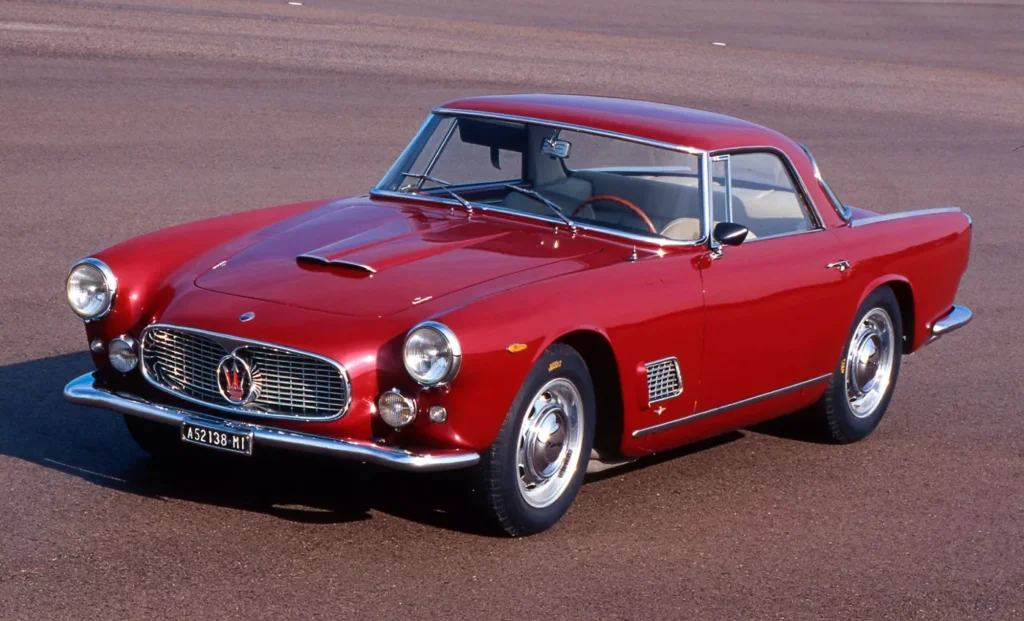
The magazine also told American readers what the company was betting on: an $11,000 Gran Turismo capable of 143 mph. That car is the subject of this piece, and if you want to understand why Maserati still exists in 2026, this is where you look. Not the 250F. Not the Birdcage. This one.
Two governments stiffed them
Americans tend to assume Italian sports car companies went broke building race cars. Maserati went broke building machine tools.
Adolfo Orsi bought Officine Alfieri Maserati in 1937 as an addition to a scrap-iron and farm-equipment empire, and turned the plant into the base of a machine-tool business. Racing was the marketing department. By 1957 the combined operation was pulling in around $3 million a year.
Then Argentina happened. In 1954, according to that same TIME report, Juan Perón — a racing enthusiast and Fangio‘s patron — handed Orsi a $3 million machine-tool order to accelerate Argentine industrialization. Orsi gave him three years to pay and borrowed against it from Italian banks.
Perón was overthrown in 1955. Argentina had paid a fraction, and had paid it in wheat to the Italian government, which never converted it into cash for Maserati. Perón’s successors had no intention of covering the rest.
TIME adds a second creditor that almost never makes it into the English-language histories: Orsi had also taken on a $437,500 machine-tool order from the Spanish government. Spain didn’t pay either. Between the two, the Orsis ended up owing subcontractors roughly $300,000.
So when Maserati officially quit factory racing at the end of 1957, it wasn’t a strategic pivot toward road cars. It was a company that couldn’t make payroll being told by its bankers to stop spending money on Grand Prix cars.
Fangio nearly bought half the company
Before surrendering to the bank, the Orsis made an offer that reads like something a screenwriter would be told to cut for being too on-the-nose: they offered Fangio 50 percent of Maserati for $625,000.
Fangio had a profitable General Motors distributorship in Buenos Aires. Per TIME, he could raise only half the money. The deal collapsed, and with it the possibility that the five-time World Champion would have spent the 1960s as co-owner of the factory in Modena.
Maserati went into court-supervised administration for a year instead. Everything then rested on a car that had been on sale for a few months and had built exactly eighteen examples.
Alfieri turned a race engine into something you could commute in
Giulio Alfieri had run engineering since 1953. His logic was straightforward: the A6GCM’s twin-cam two-liter six had already been stretched to three liters for the 300S, so the next step was a purpose-built 3.5. He designed it for endurance racing, and it debuted in the 350S in 1955 — a car of which exactly three were built.
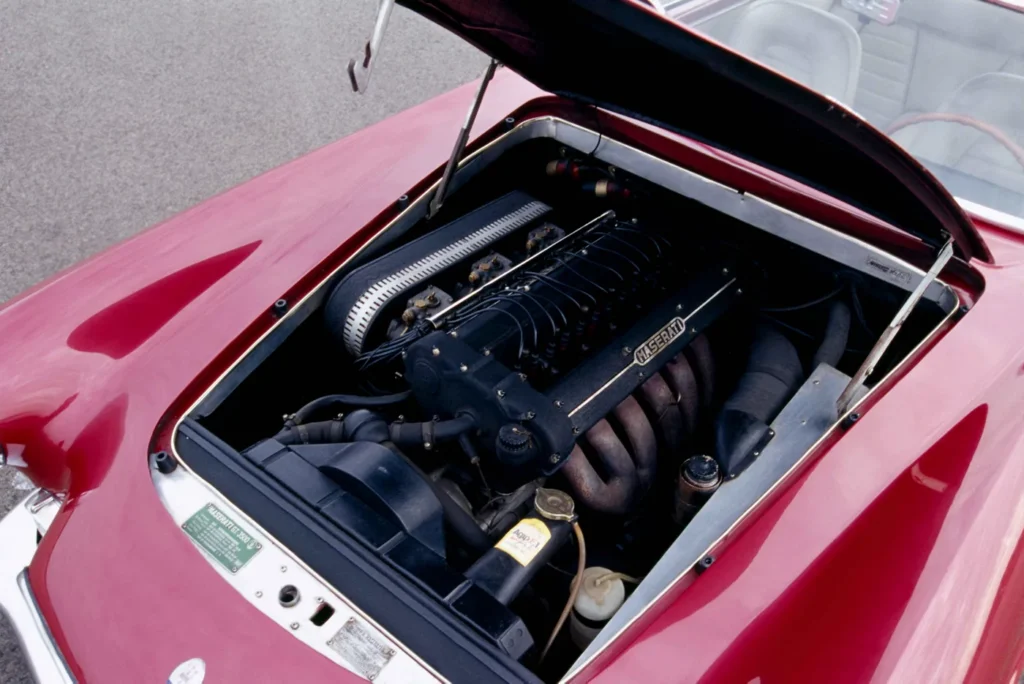
The specification is period exotica of the highest order. Inline six, 3,485.29 cc, 86 mm bore by 100 mm stroke, aluminum block with cast-iron liners, aluminum head, hemispherical combustion chambers, twin overhead cams, dual ignition with two Marelli distributors and two plugs per cylinder, seven-bearing crank. Chrysler had put the first Hemi into production for 1951; Alfieri was working in the same conceptual territory, at a fraction of Detroit’s scale.
Converting it for the street is the part that matters. He moved from dry sump to wet sump, dropped the compression ratio, changed the accessory drive, and retuned it to pull from low revs rather than scream at the top. On three twin-choke Weber 42 DCOE carburetors it made 220 hp at 5,500 rpm.
This is not a race motor with a muffler bolted on. It’s a race motor genuinely re-engineered to start on a cold morning and idle in traffic — which, in 1957 Italy, was not a solved problem.
An Italian car full of British parts
Here’s the fact that punctures the romance, and it’s fully documented.
Alfieri made repeated business trips to the United Kingdom specifically to find component suppliers. The reason was structural: Italy’s tax system and industrial layout forced manufacturers to design every part in-house, which was impossible at Maserati’s scale. Italy had no supplier ecosystem to buy from. Britain did.
So the first series-production Maserati in history was assembled with a Salisbury rear axle, Girling brakes, Alford & Alder suspension components, a hydraulically actuated Borg & Beck single-plate dry clutch, Lucas electrics and Jaeger instruments. The gearbox was German — a ZF S4-17 four-speed, later a ZF S5-17 five-speed. Italy supplied the Webers, Marelli ignition and Borrani wire wheels.
Now flip it around. In 1958, Aston Martin launched the DB4 with bodywork designed by Carrozzeria Touring of Milan, built under license to Touring’s Superleggera patent. The British were buying Italian bodies while the Italians were buying British hardware, and the same Milanese coachbuilder was working both sides of the deal simultaneously.
The image of the postwar European GT as the work of isolated craftsmen in a Modena workshop is marketing. It was an international supply chain built out of catalogs, airline tickets and phone calls.
Geneva 1957: the White Lady wins
The connection to Touring didn’t come from inside Maserati. By Carlo Felice Bianchi Anderloni’s own account, it was Commendatore Franco Cornacchia — a major Ferrari dealer — who introduced Omer Orsi to the Milanese carrozzeria. A Ferrari salesman found Maserati the coachbuilder that saved the company. In Modena, that detail lands hard.
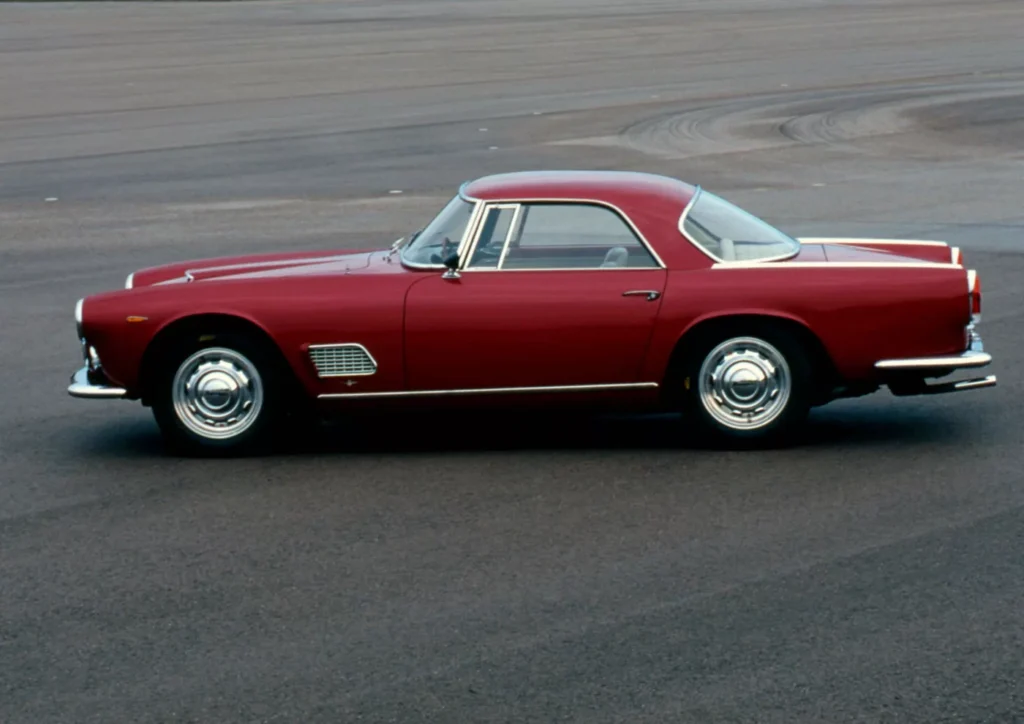
Touring’s first prototype was a 2+2 in Superleggera construction, finished in white, and the factory nicknamed it Dama Bianca — the White Lady.
At the Geneva Motor Show in March 1957, Maserati showed two prototypes side by side: the Dama Bianca and a rival proposal from Carrozzeria Allemano. Both rode a 2,600 mm wheelbase on 6.50-16 Pirelli Stella Bianca tires with aluminum bodywork. Touring won with minimal changes, the main one being a considerably bolder grille.
Underneath sat a tubular platform chassis using square, round and elliptical section tubing. Front suspension was double wishbones with coil springs, hydraulic dampers and an anti-roll bar. The rear was a Salisbury live axle on semi-elliptic leaf springs with an anti-roll bar and a longitudinal torque arm. Steering was recirculating ball.
And the brakes were 12-inch finned Girling drums, front and rear. That deserves calling out rather than glossing over: a 220-hp car good for over 130 mph launched on four drums. Front discs became optional in 1959 and standard in 1960; rear discs weren’t standard until 1962. Jaguar had put discs on a Le Mans winner in 1953. Maserati was late.
Production began in late 1957 with eighteen cars, the first handful leaving the factory before Christmas.
Vignale, Michelotti, and the convertible America wanted
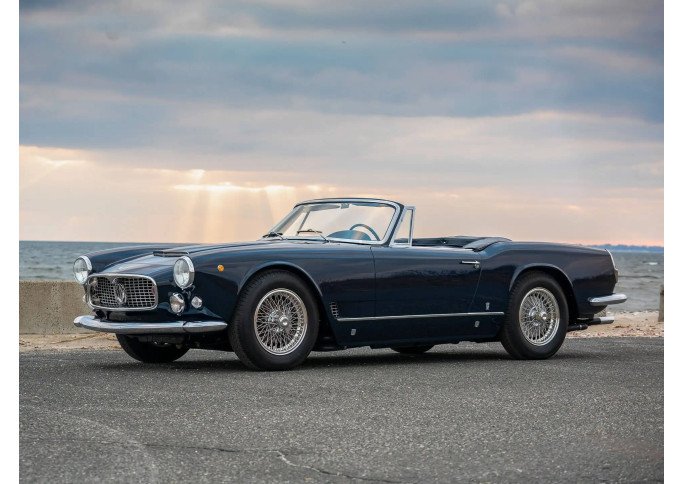
Touring tried a convertible prototype at the 1958 Turin show. It didn’t take.
What did take was a Carrozzeria Vignale proposal styled by Giovanni Michelotti, shown at the Paris Salon in 1959. That became the production 3500 GT Spyder, and it’s a meaningfully different car: no Superleggera, but a steel body with aluminum hood, trunk lid and optional hardtop, on a wheelbase 100 mm shorter at 2,500 mm, weighing 1,380 kg.
Sources put Spyder production at either 242 or 245 units, and we’re not going to pretend one of those is settled. Either way, that scarcity is why an open 3500 today trades at multiples of a coupe.
The Lucas injection gamble
A fuel-injected prototype appeared at Geneva in March 1960. After a substantial development program, 3500 GTi production began in early 1961, making it what is generally credited as the first fuel-injected Italian production car.
The system was Lucas mechanical injection — British again — good for 235 hp at 5,500 rpm with more midrange torque. The five-speed, optional since 1960, became standard. The body was revised with a lower roofline, slightly greater length, a new grille, new taillights, vent windows and Pirelli Cinturato 185VR16 radials.
The part the brochures skipped: the system was troublesome enough that converting back to Weber carburetors was, in the words of a Bonhams auction description for a car in this family, a common in-period modification. Plenty of cars titled as GTi have been running Webers since the Kennedy administration.
Genuine technical leadership. Genuine early-adopter tax.
The numbers nobody puts side by side
This is where the 3500 GT stops being a pretty car and becomes an industrial event.
Between 1957 and 1964, Maserati built 2,226 coupes and convertibles. The first full year, 1958, accounted for 119 cars. The best year, 1961, produced 500. Of the total, 1,981 were Touring coupes.
Set that against Maserati’s entire prior road car output: 61 A6 1500s from 1947 to 1950, 16 A6G 2000s, and 60 A6G/54s from 1954 to 1956. Roughly 137 road cars across a decade. The 3500 GT beat that in a good quarter.
Then set it against the direct competition, which is where the received wisdom falls apart. Aston Martin built 1,204 DB4s in total from 1958 to 1963, including 75 DB4 GTs and 19 Zagatos. Ferrari built 353 250 GT Coupés by Pinin Farina, and roughly 954 250 GTE 2+2s from 1960 to 1963.
Maserati outsold all of them. Supercar Nostalgia’s analysis puts the 3500’s margin over the 250 GT Coupé at close to three to one, and credits the Maserati’s success with pushing Ferrari to launch a direct four-seat rival in 1960 — the 250 GTE.
Read that again. In the late-1950s European GT market, the commercial pace-setter wasn’t Ferrari. It was a company in court-supervised administration.
Who actually bought them
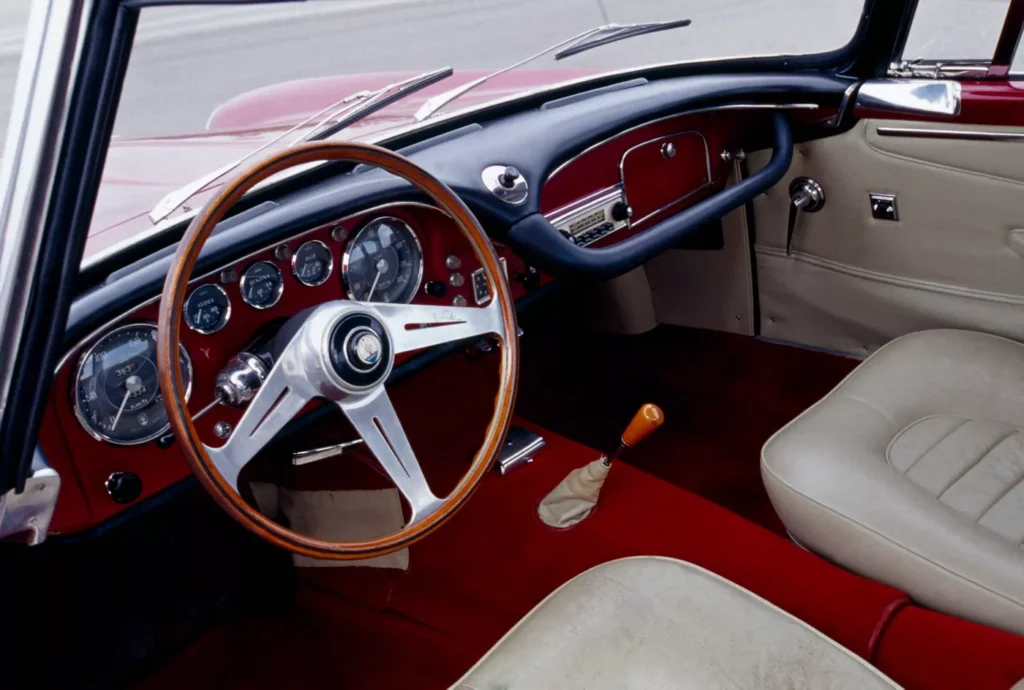
The period owner list runs about how you’d expect: Prince Rainier III of Monaco, tenor Giuseppe di Stefano, Alberto Sordi, Tony Curtis, Stewart Granger, Rock Hudson and Anthony Quinn. A 1958 3500 GT also turns up in Charade(1963).
America mattered enough to Maserati that the follow-up car was named for an American race. The Sebring, built from 1962 on 3500 mechanicals, took its name from Maserati’s 1957 win at the 12 Hours of Sebring and was aimed squarely at the U.S. grand touring buyer. 593 were built through 1969.
What the 3500 GT paid for
The 3500 GT’s chassis underpinned the 5000 GT of 1959 — the car the Shah of Iran commissioned after driving a 3500 GT and asking for something with the 450S V8 in it. Its mechanicals produced the Sebring. After that came the Mistral, the Quattroporte and the Ghibli.
None of those cars exist without 2,226 invoices from this one. Every Maserati anyone romanticizes from the 1960s was funded by the six-cylinder GT that people now treat as the entry-level option.
Touring didn’t get to enjoy it for long. The Milanese coachbuilder closed in 1966, wiped out by the industry’s shift to unitary construction. Many of its workers went to Carrozzeria Marazzi, which carried on building bodies for Maserati. The hands that shaped the White Lady kept working for the trident under a different name on the door.
The NEC case
The 3500 GT is the most consequential Maserati ever built and it is currently the cheapest one to buy. Hagerty has been flagging the anomaly for years: hand-formed Touring aluminum, a twin-cam twin-plug six derived from a sports racer, and values running at a fraction of an equivalent DB4 or 250 GT.
The market punishes it for the exact quality that saved the company. Two thousand two hundred and twenty-six cars makes a coachbuilt grand tourer “common,” and collectors pay for rarity rather than significance. That is a genuinely stupid way to price a machine.
And the way this story usually gets told needs correcting. The official mythology sells you isolated artisans in a Modena workshop. What actually happened is that Alfieri got on a plane, went shopping in England for axles, brakes and gauges, farmed the bodywork out to a third party in Milan, and assembled an international supply chain. Maserati wasn’t saved by purity. It was saved by industrial pragmatism, by giving up on making everything in-house, and by accepting that a car you sell two thousand times is worth more than a car you sell sixty times.
Purity is a luxury for companies that aren’t one $15,600 check away from having the bailiffs take the building.
Next time you see one parked on a street, go look at the engine. That’s what’s left of a company that got stiffed by two governments, offered Fangio half the business, and survived by selling grand tourers to Hollywood actors.
Check you’re still alive.