Ford Coyote 5.0: The Detroit Roar Nobody Saw Coming

There was once a Ford Mustang with a 4.6-liter V8 that produced 300 horsepower. It was a decent, respectable car that did its job well. But in the high-performance ecosystem of the late 2000s, 300 horsepower was no longer enough to make the kind of impression the Mustang had historically made. GM had the new Camaro SS with the 426-horsepower LS3. Dodge had the Challenger SRT8 with the 392 Hemi. Ford needed to respond.
The answer arrived in 2011. It was called the Coyote, displaced 5.0 liters, and produced 412 horsepower in its first iteration. It wasn’t just more powerful. It was fundamentally different: the first V8 in the Mustang family to use variable valve timing, the first to have dual overhead camshafts per bank, the first to approach the mythology of the modern high-performance engine that Japanese and European rivals had been cultivating for years.
The Coyote didn’t just answer the challenge. It raised it. And in the process, it inaugurated a new era of the American high-performance V8.
The Context: Why the Coyote Was Necessary
To understand the importance of the Coyote you need to understand what preceded it. The 4.6-liter “Modular” engine that equipped the Mustang GT from 1996 onward was a correct but uninspiring motor. In its basic two-valve-per-cylinder form, it produced power figures that fell short of the Mustang’s own mythology.
The Cobra and Mach 1 had more powerful four-valve versions, but they were expensive exceptions. The everyday Mustang GT — the car most people actually bought — had to settle for an engine its owners described with words like “reliable” and “adequate.” Not exactly the vocabulary of performance.
Ford’s engineers knew they needed something completely new. Not an evolution of the 4.6, but a complete reimagination of what a Mustang V8 could be. The brief they gave themselves was unambiguous: build an engine that makes the Mustang GT a serious performance car again, that uses modern technology, and that can form the foundation for the next generation of Ford high-performance products.
The Engineering: What Makes It Different
The Coyote 5.0 was designed from scratch with ambitious and specific goals: exceed 400 horsepower from the factory, use variable valve timing, meet fuel economy and emissions regulations without compromise, and create a foundation that could scale toward higher-power variants.
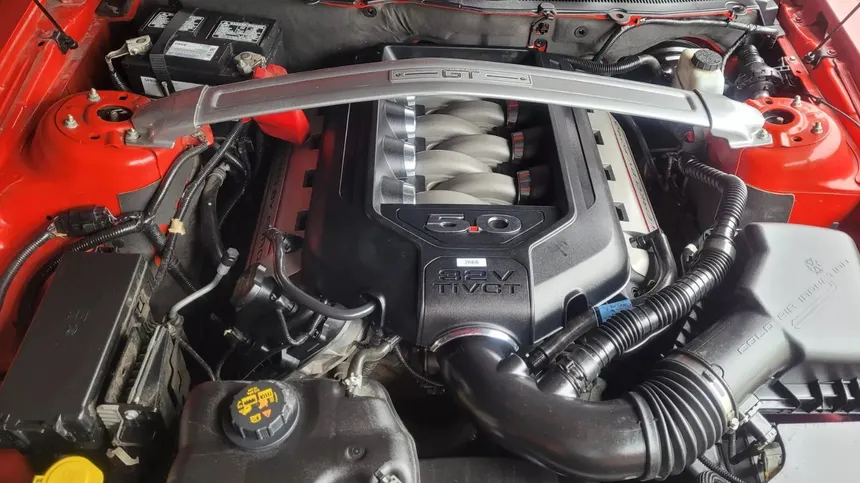
The result is a 5.0-liter engine with 32 valves, dual overhead camshafts per bank (DOHC), and the Ti-VCT system — Twin Independent Variable Cam Timing — that allows independent adjustment of both intake and exhaust cam timing based on operating conditions. This was not a simple or cheap system to engineer. Ford committed to it because it was the only way to achieve the combination of low-end torque, high-rpm power, and fuel efficiency the brief demanded.
The Ti-VCT system is key to understanding why the Coyote behaves differently from traditional American V8s. At low rpm, the engine optimizes for efficiency and torque, giving strong pull from low in the rev range. At high rpm, it shifts toward maximum power, allowing the engine to breathe deeply and continue building output well past where most pushrod V8s begin to run out of ideas. The result is a remarkably flat power curve — abundant torque from low speeds, power that continues building to 7,000 rpm and beyond.
The cylinder heads deserve specific attention. With 32 valves and high-efficiency intake ports, the Coyote can breathe deeply at high revs in a way that traditional American V8s simply couldn’t. This is what allows the engine to make peak power at 6,500 rpm in standard tune — a figure that would have been unthinkable for a V8 of this displacement in the pre-Coyote era.
The block is aluminum with cast iron cylinder liners, resulting in an engine lighter than its predecessors and lighter than GM’s iron-block truck LS variants, with the durability required for mass production and the kind of hard use Mustang owners are known to subject their cars to.
The Coyote Generations: Constant Evolution
The Coyote has not stood still since 2011. Each generation has pushed the philosophy further, extracting more from the same fundamental architecture.
Gen 1 (2011–2014): 412 horsepower. The original, the rule-changer. Even in its first version it established that the Mustang GT was a serious performance car again. The 5.0 badge returned to the Mustang fender after an absence of years, and it meant something real this time.
Gen 2 (2015–2017): 435 horsepower. Ford refined the electronic management, improved the cylinder heads for greater flow, and added direct fuel injection to the existing port injection system. The resulting dual-injection system — port plus direct — improved both power output and fuel efficiency, a combination that had previously seemed contradictory. The GT’s exhaust note also became significantly more characterful, a conscious engineering decision by Ford’s acoustic team.
Gen 3 (2018–2023): 460 horsepower. The third generation is arguably the most complete expression of the standard Coyote. With the dual-injection system perfected, revised cylinder heads, and continuous refinements throughout, the Gen 3 in the standard Mustang GT produced 460 horsepower. In the Shelby GT350, the related Voodoo variant with flat-plane crankshaft was producing 526 horsepower of pure naturally aspirated output while spinning to 8,250 rpm. Two very different engines sharing the same DNA.
Gen 4 (2024–present): With the arrival of the seventh-generation Mustang S650, Ford raised the stakes again. The current Coyote produces 486 horsepower in the standard GT, with the supercharged GT500 variants pointing considerably higher. The architecture that began at 412 horsepower in 2011 has grown by nearly 75 horsepower in standard tune over 13 years, with no signs of reaching its limits.
The Shelby GT350 and the Voodoo: The Apex of the Architecture
No article about the Coyote is complete without the GT350 and its Voodoo engine. If the standard cross-plane Coyote is exceptional, the flat-plane Voodoo is a mechanical work of art — and arguably the most technically impressive naturally aspirated V8 Ford has ever produced for a production road car.
The flat-plane crankshaft is a configuration more typically associated with Formula 1 engines and European supercars like Ferrari. Unlike the cross-plane crankshaft used in virtually all American V8s, the flat-plane design has two pairs of cylinders firing at equal intervals rather than the unequal intervals of a cross-plane. The result is a dramatically different exhaust pulse pattern, which allows for more aggressive exhaust scavenging, better cylinder filling at high rpm, and the ability to spin more freely as engine speed climbs.
The acoustic consequence is equally dramatic. The GT350’s exhaust note is unlike any other American production V8 — a screaming, European-flavored wail that builds to an intensity at high revs that leaves onlookers uncertain whether they’re listening to a race car or a road car. That sound is not incidental to the engineering; it’s a direct consequence of the crankshaft architecture.
Ford took the 5.0-liter displacement of the standard Coyote, expanded it slightly to 5.2 liters in the Voodoo, and combined the flat-plane crank with specific cylinder heads, a revised intake, and a camshaft profile tuned for the high-rpm operating range the architecture enables. Peak power arrives at 7,500 rpm. The redline sits at 8,250 rpm. For a naturally aspirated American V8 in a production road car, those are extraordinary figures.
The GT350 converted the Mustang into something different from any Mustang that came before it: a high-performance car with technical credentials that could be discussed in the same conversation as contemporary Ferraris and Porsches. Not because it was faster than those cars necessarily, but because the engineering philosophy behind it came from the same place — prioritizing driver engagement and mechanical purity over outright acceleration numbers.
The GT500 and the Predator: When the Coyote Needs Help
The naturally aspirated Coyote has its limits. For those who need more, Ford developed the Shelby GT500 around the Predator engine — technically a supercharged variant of the Coyote architecture, fitted with a 2.65-liter Eaton supercharger that elevates output to 760 horsepower in the 2020–2023 GT500.
760 factory horsepower, with a dealership warranty. In a Mustang. The Predator demonstrated that the Coyote’s fundamental architecture — its block strength, its cooling capacity, its ability to handle elevated cylinder pressures — could scale in ways its original designers may not have fully anticipated.
In the aftermarket, supercharged and turbocharged Coyotes with third-party forced induction systems have produced 800, 1,000, and beyond on production-based engine internals. The block’s robustness and the accessibility of the factory electronics make these builds achievable in a way that surprises even experienced engine builders coming from other platforms.
The Coyote in Competition
The Coyote’s impact on American motorsport has been rapid and deep. In GT4 production-based racing, the Mustang GT4 equipped with a competition-specification Coyote has proven extraordinarily competitive against European rivals with longer motorsport traditions. The engine’s combination of power, torque, and reliability under sustained competition conditions has made it a trusted platform from the moment it arrived.
In IMSA WeatherTech Championship competition, Mustang GT3 and GT4 entries running Coyote-derived engines have demonstrated that the architecture can maintain competition pace over the kind of multi-hour stints that genuinely test durability. This is not a simple thing to achieve with a production-derived engine.
In drag racing, the Coyote community has grown into one of the most active performance platforms in the American market. Turbocharged Coyote builds running nine-second quarter miles on street-registered cars are now common enough at weekend drag events that they no longer attract the kind of attention they would have a decade ago. The ecosystem of Coyote performance parts — while younger than the LS aftermarket — has matured quickly.
Why the Coyote Belongs in the Engine’s Syndicate
The case for the Coyote in the Engine’s Syndicate doesn’t require elaborate argument. It did something that very few engines manage: it arrived at exactly the moment it was needed, fulfilled every promise made for it, and then exceeded those promises across multiple generations.
Ford needed an engine in 2011 that would return the Mustang GT to the front rank of accessible American performance. The Coyote didn’t just accomplish that — it opened a new chapter in American V8 development. It combined the variable valve technology that European engineers had been using for decades with the large-displacement, direct-natured philosophy that defines American engine character.
The result is an engine that can be discussed seriously in conversations about the best naturally aspirated V8s produced anywhere in the world. The Voodoo in the GT350 is a demonstration of how far the architecture can go when given the engineering resources and creative freedom to reach its potential.
It’s not the oldest engine in the Syndicate. It doesn’t have the longest history. But in the context of what American performance needed in 2011, the Coyote was exactly right at exactly the right moment.
That earns a seat at this table.
Welcome to the Engine’s Syndicate, Coyote.
4 thoughts on “FORD COYOTE 5.0”