Ford Torino Talladega: The Car That Fired the First Shot in NASCAR’s Aero Wars

When people talk about NASCAR‘s Aero Wars, they always mention the Plymouth Superbird and the Dodge Charger Daytona. The massive wings. The cone-shaped noses. The silhouettes that looked like something from a science fiction movie.
But they forget who started the war.
It wasn’t the Mopar guys. It was Ford. And their weapon was called the Torino Talladega.
A car that existed for barely a few weeks of production. Approximately 750 units built. Three available colors. One engine option for the street. And a track dominance so absolute that it forced Chrysler to respond with the two most famous winged cars in American motorsport history.
If the Superbird and the Daytona are the answers, the Torino Talladega was the question. And nobody asks the right questions about the car that started it all.
The Context: When Ford Humiliated Mopar With a Body Shape
To understand the Talladega, you need to rewind to 1968. That year, Ford introduced the new Torino with its “SportsRoof” body — a fastback silhouette that wasn’t just attractive, but incredibly efficient in the wind tunnel. While Dodge and Plymouth kept relying on the brute horsepower of the 426 Hemi to win races, Ford discovered something that would change the game forever: on superspeedways, aerodynamics matter more than horsepower.
The 1968 Torino fastback, powered by Ford’s aging 427 engine, demolished the Mopars on high-speed circuits. David Pearson won 16 races and the Grand National championship driving a Ford. Not with more power. With less air resistance.
Chrysler’s teams realized they had a serious problem. Their initial answer was the Dodge Charger 500: a Charger with a flush-mounted grille and a modified rear window to reduce turbulence. It was an improvement, but not enough.
Because Ford didn’t sit still.
The Birth: Holman-Moody and the Michigan Wind Tunnel
Ralph Moody, half of the legendary Holman-Moody partnership — the same team that had helped Ford conquer the 24 Hours of Le Mans with the GT40 — was tasked with making the Torino even faster. Together with Ford engineers, he used the corporate wind tunnel in Michigan to design a series of modifications that transformed the Torino from a fast car into a projectile.
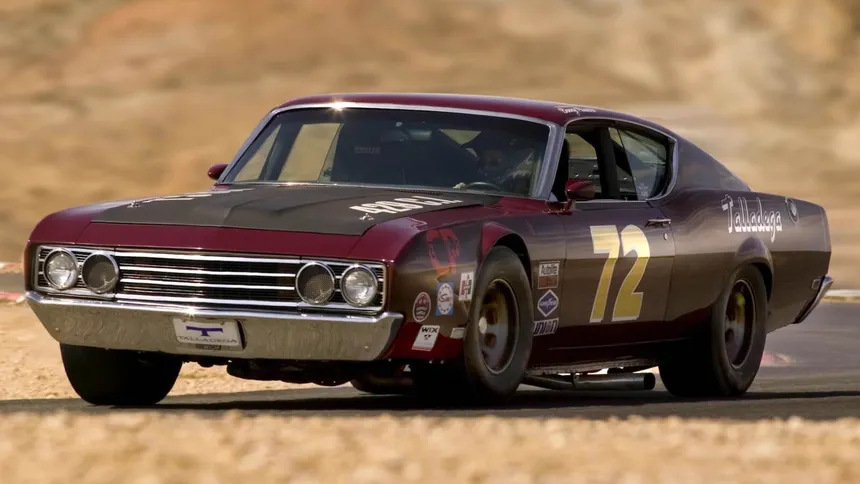
The changes were subtle but devastating. The nose was extended by six inches with new front fenders, handcrafted at Holman-Moody’s workshops. The grille was mounted flush with the headlights, eliminating the recessed gap that created aerodynamic drag on the standard Torino. A Fairlane rear bumper was narrowed, cut, and mounted on the front as a primitive but effective air dam. The rocker panels were re-rolled to allow the car to sit one inch lower without violating NASCAR’s minimum ride-height regulations.
From the outside, a Talladega looked like a normal Torino. But it wasn’t. Every modification was calculated to reduce the coefficient of drag. Holman-Moody estimated that the extended nose added 5 mph to top speed — the equivalent of 75 additional horsepower. Without touching the engine.
The name was Bill France Sr.’s idea. He had just opened Talladega Superspeedway in Alabama, and was delighted that Ford would christen their new race car after his newest circuit.
The Homologation: When Ford Fooled Bill France
NASCAR required a minimum of 500 street-legal units to homologate a race car. Ford needed at least 100 ready before the start of the 1969 season. The problem: they had only built 40.
Here enters one of the most memorable anecdotes in stock car history. According to Ralph Moody himself, they sat Bill France down at the factory and asked him to count the Talladegas as they drove past him, one by one. What France didn’t realize was that the cars were circling around and driving past him again. And again. France counted the same cars three times without noticing.
Ford received approval and began the season. By February 1969, they had built approximately 750 units. The Talladega/Spoiler Registry has identified 738 production cars, plus 9 prototypes and 5 pilot cars. All production was carried out at Ford’s Atlanta, Georgia plant during the first weeks of 1969.
Three Colors, One Engine, No Options
The street Talladega was an exercise in industrial minimalism. Ford didn’t want to make a muscle car for the mass market. They wanted to fulfill the homologation requirement as quickly and cheaply as possible so they could go racing.
Three available colors: Wimbledon White (286 units), Royal Maroon (258 units), and Presidential Blue (199 units). Black vinyl and cloth interior with a bench seat. C6 automatic transmission with column shift. Ford 9-inch differential with 3.25:1 ratio. AM radio as the only additional option.
The standard engine was the 428 Cobra Jet: a 7.0-liter V8 producing 335 horsepower and 440 lb-ft of torque. A brutal street engine, capable of launching the car from 0 to 60 in 5.5 seconds and running the quarter-mile in under 15 seconds. But it wasn’t a racing engine. The Cobra Jet was designed to produce torque at low RPMs, not to scream at 7,000 rpm for hours on a superspeedway.
Race cars initially used the Ford 427 “side oiler,” the racing engine Ford had been running since 1963. Later in the season, teams switched to the Boss 429, which Ford homologated separately in the Mustang Boss 429 — an unusual move that many experts interpret as a strategy to fast-track the Talladega body’s homologation while the Boss 429 wasn’t yet in sufficient production.
1969: Total Domination
The Torino Talladega did exactly what Ford hoped. The 1969 Grand National season was a blue massacre.
David Pearson, “The Silver Fox,” piloted the No. 17 Holman-Moody-prepared Talladega with surgical precision. Pearson was the first driver to break the 190 mph barrier at Daytona, qualifying at 190.029 mph. He won 11 races, accumulated 42 top-5s and 44 top-10s in 51 starts. He completed 14,270 laps that season — the all-time record for most laps in a single NASCAR Cup season. He won the championship by a 102-point margin.
Richard Petty, who had left Plymouth because Chrysler refused to give him a Dodge Charger Daytona, switched to Ford and drove a Talladega all season. He won 10 races and finished second in the championship. It was the only year in his entire career that Petty didn’t drive a Chrysler product.
In total, Ford won 26 of 54 races that season. Ford claimed the manufacturer’s championship. The Talladega won 29 Grand National races across 1969 and 1970 — more than any other model of the era.
The Dodge Charger 500, Chrysler’s initial response, was clearly inferior on superspeedways. Chrysler needed to develop the radical Dodge Charger Daytona — with its cone nose and towering rear wing — just to compete against a car that Ford had built by simply extending a nose six inches.
1970: No Factory Support, Same Dominance
At the end of 1969, something unexpected happened. Congressional hearings questioned Ford about the costs of racing research and development versus investment in fuel efficiency and safety. Ford, under political pressure, abandoned all its competition programs starting in 1970.
Teams running Talladegas found themselves without factory support overnight. But when they tested the new 1970 Torinos that Ford had designed as replacements, they discovered they were aerodynamically worse. The King Cobra prototype, intended to evolve the Talladega concept, failed during testing.
So the teams did the most logical thing: they kept racing their 1969 Talladegas. Year-old cars, with no factory backing, competing against the brand-new Dodge Charger Daytona and Plymouth Superbird with full Chrysler support. And they kept winning races.
The Death: When NASCAR Killed the Aero Cars
For the 1971 season, NASCAR decided the aero era had gone too far. The cars were too fast. The speeds were dangerous. And the advantage of aero cars over standard-body vehicles was too great.
The solution was brutal: all five aerodynamic models — Torino Talladega, Mercury Cyclone Spoiler II, Dodge Charger 500, Dodge Charger Daytona, and Plymouth Superbird — were restricted to engines of 305 cubic inches maximum. Standard-body cars could continue running 426, 427, and 429 cubic-inch engines.
It was a death sentence. No car with a 305 cubic-inch engine could compete against one running a 426 Hemi. The aero cars vanished from competition overnight.
The Forgotten Soldier of the Aero Wars
Here’s the injustice that drives me insane as a mechanic.
The Plymouth Superbird fetches over a million dollars with a Hemi engine at auction. The Dodge Charger Daytona has also skyrocketed into six and seven-figure territory. Both are icons of muscle car culture.
The Torino Talladega, which started the war that caused both of them to exist, can be found for under $100,000.
It’s rarer than a Superbird. It won more races. It won the championship. It attracted Richard Petty — the most famous driver in history — to change brands for the first and only time in his career. And yet, it’s the aero car nobody remembers.
The explanation is simple but absurd: the Talladega was too subtle. It didn’t have a three-foot-tall wing. It didn’t have a cone nose that looked like a rocket. Its modifications were elegant, integrated, nearly invisible to the naked eye. And in a world where visual spectacle sells better than technical effectiveness, subtlety is a sentence of oblivion.
My Final Word
The Ford Torino Talladega is the soldier who fired the first bullet in the most fascinating war NASCAR has ever seen. Without it, there’s no Charger Daytona. Without it, there’s no Superbird. Without it, Richard Petty never leaves Plymouth. Without it, aerodynamics doesn’t become the decisive factor in stock car racing a decade earlier than it would have naturally.
750 cars built in a few weeks during January and February 1969. Three colors. One engine. No options. A design that won 29 Grand National races and both the driver’s and manufacturer’s championships.
And then, silence. Ford abandoned racing. NASCAR banned the aero cars. The Talladega became a footnote in history, eclipsed by the winged cars it forced into existence.
If that isn’t the definition of irony, I don’t know what is.
The Torino Talladega didn’t need a massive wing to be the best car on the track. It just needed six inches of extra nose and Ralph Moody’s genius. And in my book, that’s worth more than all the wings in the world.
1 thought on “FORD TORINO TALLADEGA”