Dale Earnhardt: The Intimidator Who Died Protecting His Son on the Final Lap at Daytona
There are names in sport that transcend numbers. Names that mean something deeper than victories and championships. Names that divide the history of a sport into a before and an after.
Dale Earnhardt is that name for NASCAR.
76 victories. Seven championships, tied with Richard Petty and Jimmie Johnson for the all-time record. A Daytona 500 conquered on his twentieth attempt. And a death on the final lap of that same race, three years later, that split NASCAR into two halves: everything that happened before Earnhardt, and everything that happened after.
The black number 3 isn’t a race car. It’s a symbol. Of an era. Of an attitude. Of a type of driver that no longer exists and probably never will again.
Kannapolis: Gasoline in the Veins
Ralph Dale Earnhardt was born on April 29, 1951, in Kannapolis, North Carolina, an industrial town outside Charlotte that lived off textile mills. His father, Ralph Earnhardt, raced stock cars on dirt tracks through the 1950s and ’60s. He wasn’t a national star. He was a local legend. He won over 350 races in his career and built a reputation as a relentless driver who never gave quarter.
Dale grew up in his father’s garage. Not with toys. With wrenches, welders, and dismantled engines. Racing wasn’t a hobby for the Earnhardts. It was their daily bread. Literally.
At 15, Dale started racing at local tracks. At 16, he dropped out of high school to pursue racing full-time. He had no money. He borrowed to keep his cars running, and paid debts with whatever he won. When his father died of a heart attack in 1973 while working on a race car in his own garage, Dale was 22 years old with a determination that bordered on obsession.
1979-1980: Rookie to Champion in Two Seasons
Earnhardt made his Cup Series debut in 1975 at the World 600 in Charlotte, driving a Dodge for Norman Negre’s small team. He finished 22nd. Over the next three years, he raced only eight more times, always in borrowed cars or with minor teams.
The turning point came in 1979, when owner Rod Osterlund offered him a full-time ride. Driving a Chevrolet, Earnhardt won his first race at the Southeastern 500 at Bristol. He finished the season seventh, with 17 top-10s, and was named Rookie of the Year.
What he did next has no precedent: in 1980, his second full season, he won the Winston Cup championship. Five victories. He led the standings from virtually the second race to the finish. He became the first driver — and remains the only one — to win Rookie of the Year and the championship in consecutive seasons.
Richard Childress and the Birth of Number 3
Earnhardt’s early career was chaotic. Osterlund sold his team in 1981. Earnhardt passed briefly through Richard Childress Racing, then to Bud Moore, where he drove Fords for two seasons (1982-1983) with decent results but no championships.
In 1984, Earnhardt returned to Richard Childress Racing. This time, to stay. And to build a legend.
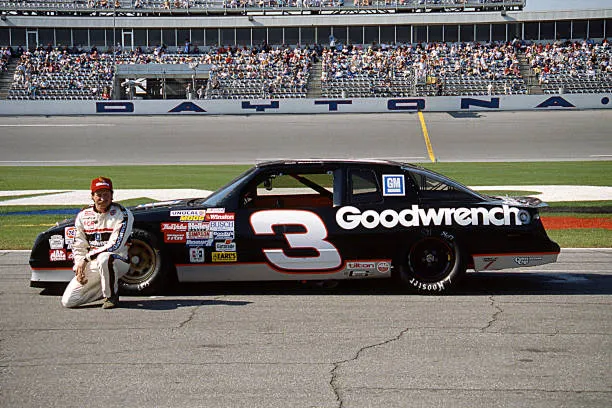
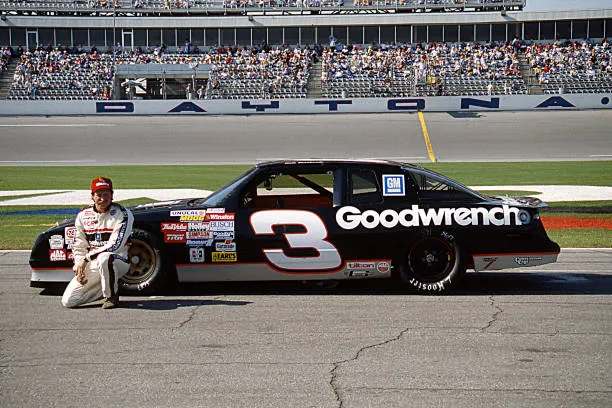
The black No. 3 Chevrolet, painted in GM Goodwrench colors, would become the most recognizable and feared car in the history of American stock car racing. Childress provided the cars. Earnhardt provided what no engineer can manufacture: a competitive instinct that bordered on the supernatural.
The Intimidator: Seven Championships and a Unique Style
Earnhardt’s nicknames say it all. “The Intimidator.” “Ironhead.” “The Man in Black.” They weren’t marketing inventions. They were literal descriptions of how he drove.
Earnhardt didn’t pass his rivals. He moved them. He pushed them. He intimidated them. His reputation was so fierce that many drivers admitted the mere sight of the black number 3 in their rearview mirror made them commit mistakes. NASCAR officially warned him to modify his reckless on-track behavior. Earnhardt didn’t flinch.
The championships came in waves. 1986, 1987, 1990, 1991, 1993, 1994. Six more titles added to his 1980 crown. Seven total, tying Richard Petty’s record that had stood untouched since 1979.
The 1987 season was his masterpiece: 11 wins and the championship by a margin of nearly 500 points. At Talladega he was a god: he won 10 Cup Series races there, a record that not even his son Dale Jr. (with 6 wins) has matched.
His style polarized. Those who loved him — and there were millions — saw in him the blue-collar worker who was self-made, the anti-hero who never apologized and never backed down for anyone. Those who hated him considered him a bully on wheels who didn’t respect the unwritten rules of the pack.
But everyone respected him. Because Earnhardt was the purest version of what NASCAR claimed to be: a tough, small-town guy who drove better than anyone and wasn’t afraid of anything.
1998: Twenty Years Chasing the Daytona 500
The great paradox of Dale Earnhardt’s career was the Daytona 500. The most dominant driver of his generation couldn’t win the most important race on the calendar.
For 19 years, Earnhardt suffered a biblical curse at Daytona. Four runner-up finishes. Flat tires on the final lap. Impossible mechanical failures. Strategy blunders. The Daytona 500 resisted as if it had a will of its own.
On February 15, 1998, on his twentieth attempt, Earnhardt finally won the Daytona 500. He was 46 years old. It was his 71st career victory. When he reached Victory Lane, crew members from virtually every team — including his rivals — came out to pit road to shake his hand in an impromptu line that stretched from Turn 4 to the winner’s circle. Nothing like it had ever been seen in NASCAR.
Earnhardt celebrated by carving a “3” with his car in the infield grass. The image is one of the most iconic in American sports.
February 18, 2001: The Final Lap
Three years after his greatest triumph, Daytona took him.
The 2001 Daytona 500 started like any other. Earnhardt, at 49, was competing at the highest level. He had finished second in the 2000 championship with two wins. He had participated in the Rolex 24 at Daytona for the first time alongside his son Dale Jr. Optimism about an eighth championship — which would have broken the record he shared with Petty — was real.
On lap 173, a massive crash eliminated 18 cars. Earnhardt survived. In the final laps, he was running third. Ahead of him: Michael Waltrip in first and Dale Earnhardt Jr. in second. Both drove cars for Dale Earnhardt Inc., Earnhardt’s own company. The father was blocking the pack to protect his son and his driver.
On the final lap, in the final turn, Earnhardt’s car made contact with Sterling Marlin. He lost control. Turned right. Hit Ken Schrader’s car. Slammed head-on into the outside wall in Turn 4.
From the outside, the impact looked minor. NASCAR had seen far more spectacular crashes without serious consequences. But Earnhardt suffered a basilar skull fracture. He was transported to Halifax Medical Center, just outside Daytona International Speedway. He was pronounced dead shortly after.
He was 49. Two months short of his 50th birthday.
Michael Waltrip won his first Cup Series race that day. Dale Jr. finished second. Neither celebrated.
The Legacy: The Safety Revolution
Earnhardt’s death was the catalyst for the greatest safety revolution in NASCAR history.
In October 2001, barely eight months later, NASCAR mandated the HANS (Head and Neck Support) device for all drivers. SAFER barriers of steel and foam replaced bare concrete walls at every oval. Cars were redesigned with more protective seats, improved harnesses, and impact-absorption structures.
Since Earnhardt’s death, no driver has died in any of NASCAR’s three national series. More than two decades. Millions of miles of competition. Zero fatalities. Ryan Newman survived a devastating crash at the 2020 Daytona 500 that, in the pre-Earnhardt era, would have been fatal without any doubt.
Dale Earnhardt died so that others would live. Not by choice. By consequence. But the result is undeniable: every driver who climbs into a NASCAR car today is safer because Earnhardt wasn’t.
Dale Earnhardt by the Numbers
The Intimidator’s stats: 76 Cup Series wins (eighth all-time). 7 championships (1980, 1986, 1987, 1990, 1991, 1993, 1994) — tied with Petty and Johnson. 1 Daytona 500 (1998). 676 races entered. 281 top-5s. 428 top-10s. 22 pole positions. Over $40 million in prize money. 10 Talladega wins (record). 4 IROC titles (record). 1979 Rookie of the Year. First driver to earn over $30 million in prizes. Only driver with wins in four consecutive decades (1979, ’80s, ’90s, 2000). NASCAR Hall of Fame inaugural class (2010).
My Final Word
I’m going to say something I know will anger a lot of people: Dale Earnhardt should not have died that day.
Not for philosophical reasons. For technical ones.
The HANS device had existed since 1986. Patrick Jacquemart had invented and tested it. It worked. It would have saved Earnhardt. Several drivers were already using it voluntarily. But NASCAR didn’t make it mandatory because “drivers complained it was uncomfortable.”
Uncomfortable.
A piece of plastic and Kevlar that holds the head to the body during an impact was too uncomfortable to mandate. And Dale Earnhardt died of a basilar skull fracture — exactly the injury the HANS prevents — because the organization governing his sport decided that comfort mattered more than safety.
Adam Petty died in 2000 from the same injury. Kenny Irwin died in 2000 from the same injury. Tony Roper died in 2000 from the same injury. Three drivers killed by basilar skull fractures in less than a year, and NASCAR still hadn’t mandated the HANS.
It took the death of the sport’s biggest star to make them act.
That’s not a safety legacy. It’s a disgrace that became a safety legacy because they had no other choice.
Earnhardt deserved better. Every driver who died before him deserved better. And the most important lesson NASCAR taught us wasn’t that cars are dangerous. It was that the organizations governing sports only act when the price of inaction becomes impossible to ignore.
The black number 3 no longer races. But its shadow covers every race, every SAFER barrier, every HANS device a driver straps on before heading out to the track.
And if that doesn’t make you furious and grateful at the same time, you’re not paying attention.
2 thoughts on “DALE EARNHARDT”