Software Defined Vehicle: The Judgment Day Car
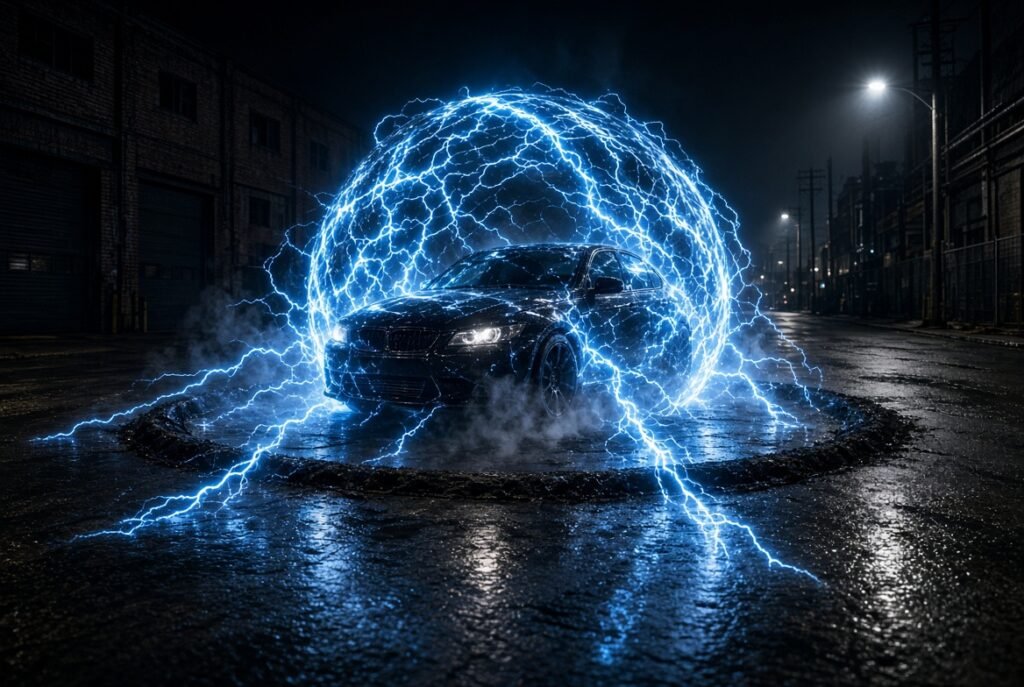
It arrives naked, at night, inside a ball of light that burns a circle into the pavement. It walks up to some guys drinking at an overlook and asks for their clothes. One of them laughs. Ten seconds later one is dead and the other is running.
What still makes that scene work four decades on isn’t the violence. It’s that the thing looks like a man. Skin, hair, sweat, blood, smell. Underneath sits a chassis of servomotors and titanium alloy, but nobody sees that until the flesh burns off. The system wasn’t built to kill better. It was built to infiltrate — so you don’t recognize it until it’s too late.
That’s The Terminator, James Cameron, 1984. It is also, frame for frame, the interior of almost any car you can buy today.
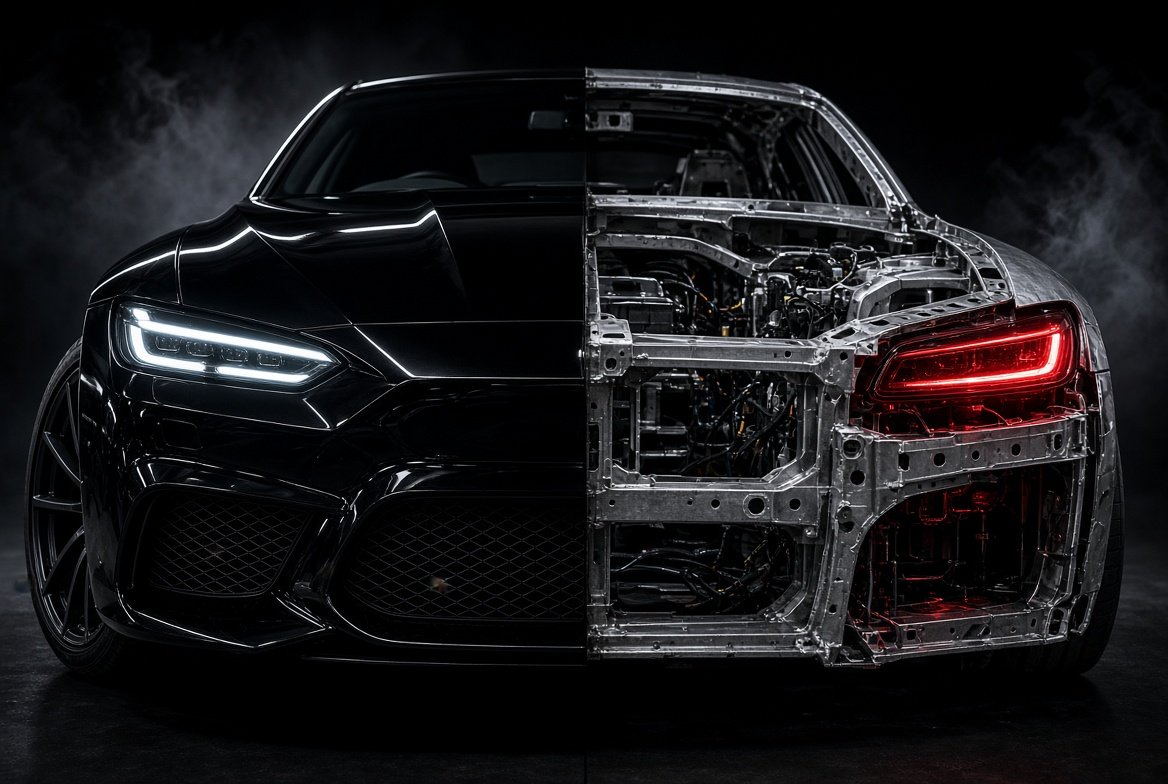
Servos everywhere. Synthetic skin on top. Wood that isn’t wood. Carbon that’s plastic with a carbon pattern printed on it. Engine noise piped through the speakers. And underneath, running all of it, a computer that decides how much of the road you’re allowed to feel.
The saga tells the whole story. The first film is how the machine takes control. The second is what happens when a rival manufacturer studies that machine and builds a better one. Together they spell out an ending Detroit and Europe still haven’t wanted to read: the one who saves you is the old model. The obsolete one. The one nobody builds anymore.
Let’s assign the roles.
The cast
Skynet, the system that switches on one day and can’t be switched off, is the software running the car.
The T-800, flesh over metal, an infiltrator, is the modern interior: the screen, the servo, the fake leather and the exhaust note coming out of a woofer.
The arm and the chip that survive the hydraulic press — the wreckage Cyberdyne locks in a vault and reverse-engineers for years — are the Chinese joint ventures of the 1980s.
Miles Dyson, the decent engineer working on those remains without knowing what he’s building, is every engineer at every legacy automaker.
The T-1000, liquid metal that copies by touch, is the Chinese car.
The T-1000’s cop uniform is the European badges under Chinese ownership.
Sarah Connor, locked in Pescadero for warning people about something nobody wanted to hear, is everyone who spent a decade saying a steering wheel should be attached to the wheels.
John Connor, the kid who doesn’t yet know there’s anything worth defending, is the average driver.
And the reprogrammed T-800 of the second film, the outdated model reactivated to fight on the other side, is everything mechanical.

Act I: the day Skynet came online
In the film the apocalypse has a date: August 29, 1997, two weeks after the system starts learning at a geometric rate. The military try to pull the plug and can’t.
Cars got no date. Cars got convenience, which is a far more effective way to take a building than the front door.
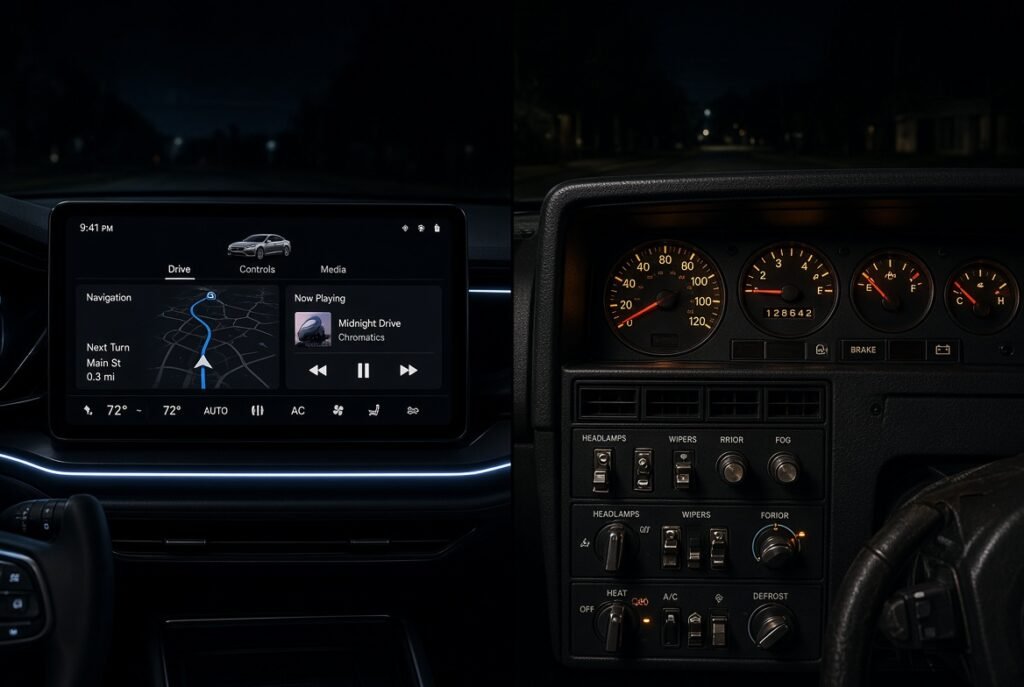
The buttons went first. Climate, lights, wipers, all buried in a menu, all sold as clean design and cutting-edge tech. And here’s the detail that collapses the whole story, and it comes from inside the industry: programming a line of code into a digital interface is far cheaper than designing, manufacturing and wiring physical switches, relays and quality knobs. What you were sold as the future was a cost sheet.
It got bad enough that the safety authorities stepped in. As of January 1, 2026, Euro NCAP will not award five stars if turn signals, hazard lights, wipers, the horn and the emergency call depend on a touchscreen alone. Matthew Avery, the organization’s director of strategic development, put it plainly: moving essential controls onto screens raises the risk of distraction crashes.
Be precise here, because half the internet is getting it wrong: Euro NCAP has banned nothing. It’s a voluntary program, not legislation. A manufacturer can keep everything on the screen and still sell that car. All that’s at stake is the star rating it puts in the ad. That the correction had to come through marketing rather than through law tells you how this business actually works.
Then the steering wheel went. The Tesla Cybertruck is one of the first passenger vehicles on sale with no mechanical connection between the wheel and the front tires. Lexus fits steer-by-wire as standard on the RZ 550e F Sport in Europe and Japan — US-spec cars keep a conventional rack for regulatory reasons, per RZ chief engineer Yasuyuki Terada — and Mercedes now offers it on the EQS with redundant dual-path signaling. Lexus advertises the benefit openly: the system filters out unwanted vibration.
Read that again. A manufacturer is bragging that its steering decides which road information is undesirable for you. You’re not driving the car anymore. You’re asking the car for a summary of the road.
Then the horsepower went. In April 2025, software version 1.7.0 left Xiaomi SU7 Ultra owners with roughly 900 hp out of the 1,548 they paid for, and getting the rest back required going to an approved circuit and setting a benchmark lap through something called Qualifying Mode — plus a 60-second wait before launch control would arm. Xiaomi reversed it after the backlash, but the precedent stands: your horsepower lives on a server.
Mercedes already charges rent for it. The Acceleration Increase subscription takes an EQS 450 from 265 to 330 kW without touching a single part, because the car could already do it the day it left the plant.
Nobody saw any of this as a takeover. It arrived wrapped in over-the-air updates and big screens. Skynet didn’t come in shooting either.
The arm in the vault
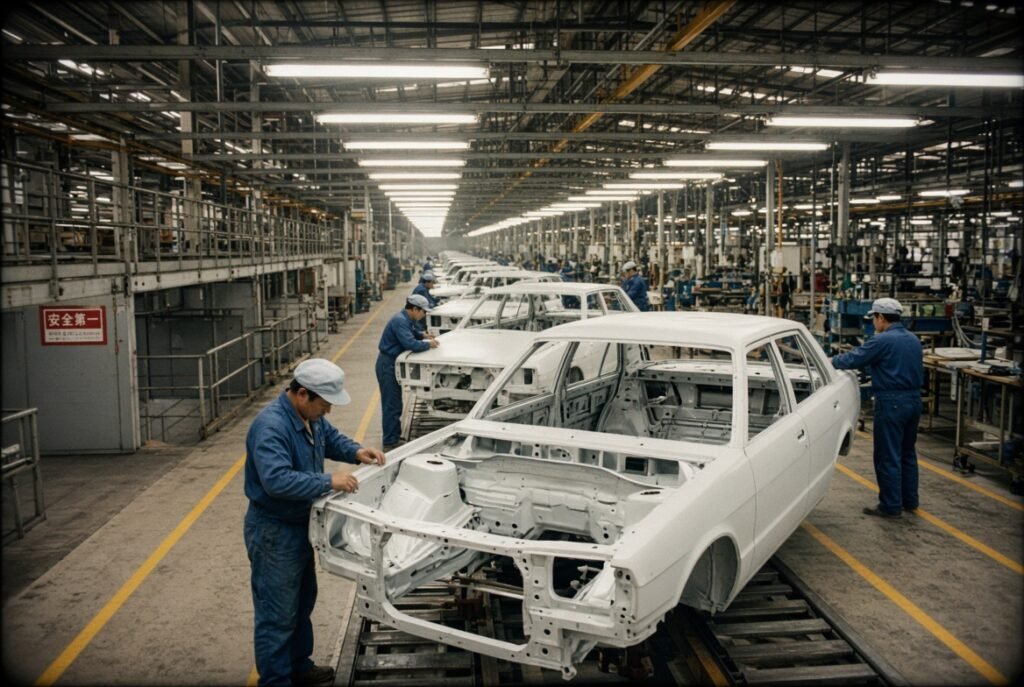
The second film opens with the revelation that rewrites the first one. Skynet doesn’t come from the future. It gets built here, out of the wreckage from the press: an arm and a chip that Cyberdyne keeps under lock and takes apart for years until it understands them.
The auto industry has its own press and its own vault, and the paperwork is on file.
China passed its first foreign joint-venture law in 1979, and the formula that took hold required anyone wanting to build passenger cars there to do it with a local partner, typically capped at 50 percent foreign ownership. The first significant deal was American: the 1983 agreement that created Beijing Jeep. Volkswagen followed in 1984, signing with Shanghai Automotive in the Great Hall of the People to build the Santana. Then came GM, Toyota, Honda, Nissan, BMW and Mercedes-Benz.
What happened next doesn’t make the anniversary press releases. In 1986, with ten thousand Santanas built, local content was under 6 percent — German parts assembled on site. In 1987 Beijing put the ultimatum in writing: hit 40 percent localization within three years or the plant closes. By 1995, local content was 89 percent.
That wasn’t a car being built. That was a components industry being built from zero, off someone else’s blueprints, on a government deadline. Every foreign automaker walked in with its arm and its chip on the table, each one certain it was the smart one because it had been handed the world’s biggest market.
Forty years of tuition paid in market access. Cyberdyne needed less time than that.
Act II: the T-1000 doesn’t build mechanisms, it copies surfaces
The T-1000 beats the T-800 at everything you can see. It shows up later, more advanced, and it doesn’t need a biker jacket because it can be anyone. It touches something and reproduces it: shape, color, texture, voice.
But the movie takes the trouble to spell out its limitation, and that limitation is this whole article. The T-1000 cannot form complex machines — nothing with moving parts or chemicals. Only solid metal shapes. Knives, hooks, things for stabbing. If it needs a real weapon or a vehicle, it has to take one that already exists.
It copies the surface. Never the mechanism.
That sentence describes with surgical accuracy what now gets sold as technology and as luxury on a show stand. The thirty-inch screen copies. The synthetic leather copies. The printed wood copies. The chrome plastic pretending to be aluminum copies. The horsepower figure copies, because in an EV output is largely calibration and thermal management. Thirty-color ambient lighting copies in an afternoon.
What doesn’t copy by contact is anything with moving parts that tells you something: steering that reports what the front axle is doing, a chassis tuned over years, an engine with character, a transmission you can feel. That doesn’t scan. That gets learned by making mistakes for decades.
Let’s be clear, because the nuance matters: this is not saying Chinese cars are bad. They aren’t. Plenty of them drive well, are better finished than half of what Europe builds, and land at a price nobody here knows how to hit anymore. The point is different: what gets sold as innovation is surface mimicry, and anyone who mistakes thirty inches of screen for luxury has never sat in an actual luxury car. Luxury used to be measured by what a part cost to make, not by how many pixels it had.
The T-1000 impresses because it’s flawless on the outside. Which is exactly why its entire arsenal is knives.
The cop uniform
The smartest call in the 1991 script isn’t the liquid metal. It’s that the T-1000 shows up dressed as a police officer. It doesn’t disguise itself as a threat, it disguises itself as the institution you’d call for help. Nobody runs from a uniform.
In Europe the uniform is in plain sight and almost nobody looks at it. Geely, headquartered in Hangzhou, owns Volvo — bought from Ford in 2010 — plus Polestar, Lotus, Lynk & Co and Zeekr, and holds half of Smart alongside Mercedes-Benz. MG, a badge that sounds like Abingdon and British roadsters, belongs to the state-owned SAIC group, the same partner from that 1984 signing in Beijing.
It works. Chinese groups have gone from 0.5 percent of the European market in 2021 to 9.5 percent in the first half of 2026, brushing 10 percent in June, already ahead of Ford and Nissan there.
The average buyer isn’t buying a Chinese car. He’s buying a Volvo. Which is precisely the point.
Miles Dyson isn’t the villain
There’s a scene in the second film people tend to misremember. Sarah Connor breaks into Miles Dyson’s house to kill him, rifle up, and she can’t pull the trigger.
She can’t because Dyson isn’t a villain. He’s a brilliant engineer, proud of his work, playing with his kid in the living room, with no idea that the chip he’s developing is going to end the world. Nobody told him. They handed him salvage and a budget and told him to do research.
Worth stating plainly, because when a piece like this gets shared the blame always lands in the wrong place. The engineer who calibrated the steer-by-wire didn’t decide to delete the mechanical link. The one who coded the simulated shift didn’t decide a shift needed simulating. The 3,000 people who walked out of Audi’s Brussels plant in February 2025 didn’t sign off on any strategy.
The decisions that got us here were made by a very thin layer of people who were paid bonuses for making them, in rooms where the most repeated word was margin. And funnily enough, those people drive cars with the steering wheel bolted to the wheels on weekends.
Act III: the old model comes back online
Then comes the turn that makes Terminator 2 a different film from the first: the machine that shows up to save the kid is the exact same model that came to kill him in 1984. Same face. Obsolete, slower, outclassed in every measurable way by the T-1000. And it’s the one that wins.
In the car business that’s already happening, and the evidence is from this year.
Europe’s safety body is forcing physical buttons back into cabins. Stellantis reversed its decision to kill the Hemi V8. And the American market has passed sentence on the electric muscle car with unusual brutality: the Dodge Charger Daytona, up to 670 hp with a synthetic exhaust called Fratzonic capable of 126 decibels, delivered 534 units in the first half of 2026 against 4,299 in the same period a year earlier — down 88 percent — while the gas Charger, which doesn’t even have the V8 yet, moved 4,583. Edmunds sold its long-term test car after a year and roughly $50,000 in lost value, and its editors dismissed the fake exhaust as an insult to V8s.
A giant speaker imitating an engine. The T-1000 doing an impression of the T-800.
At the other end of the market, demand points the same way. Kimera Automobili, a small outfit in Cuneo, Italy, rebuilt the Lancia 037 with Claudio Lombardi, the engineer behind the original: supercharged four-cylinder, a bit over 500 hp, under 2,200 pounds, rear-wheel drive, manual gearbox, €480,000 to start. All 37 cars sold, and they had to open an extra run of seven.
And in the real world, Mazda sold 27,669 MX-5 Miatas worldwide in 2024 — 132 or 181 hp, six-speed manual, over 1.2 million built since 1989, and the Guinness record for the best-selling two-seat roadster in history.
Sarah Connor spent a decade warning people and they kept her sedated in Pescadero, explaining in a soft voice that her memories were a fantasy. The people who’ve spent ten years saying cars should weigh less and communicate more got called nostalgics, dinosaurs and enemies of progress. Now the safety body agrees with them in writing, analog production runs sell out before they exist, and the model that held Porsche together through its worst recent year was a rear-engined combustion sports car designed in the 1960s.
Nobody owes them an apology. But it’s worth noting who was right.
The thumb
The end of the second film isn’t a shootout. It’s a decision.
The T-800 can’t self-terminate, so it asks to be lowered into the molten steel. It knows its chip is the seed of everything that follows, and that as long as one piece of that technology exists somebody will find it and try again. It sinks slowly. The last thing visible before the metal closes over is a thumbs-up.
That’s the scene the industry has spent fifteen years avoiding, so let’s say it whole: the message of Terminator 2 is not that technology is the enemy. The chip was never the enemy. The enemy was the people who chose to build on someone else’s salvage without asking what they were building, and then sold that laziness as inevitable, as progress, as what the customer wanted.
The customer never asked to have the horn taken off the steering wheel. Never asked to rent horsepower that was already inside the car. Never asked for steering that filters the road down to the comfortable part. A finance department asked for that, a board signed it, and then it got wrapped in the word technology, which is the finest gift paper ever invented.
Whatever survives of the mechanical car ten years from now won’t survive out of nostalgia. It’ll survive because a stubborn few — in a garage, in a shop, in a track day session, in a comment thread — refused to accept that a disconnected steering wheel is the future.
No fate but what we make, the film said.
Check you’re still alive.