Toyota Celica Pikes Peak: The Dirt Record Nobody Will Ever Break
Forty Seconds. On Dirt. With a Car Nobody Had Seen Before. And a New Zealander America Never Saw Coming.
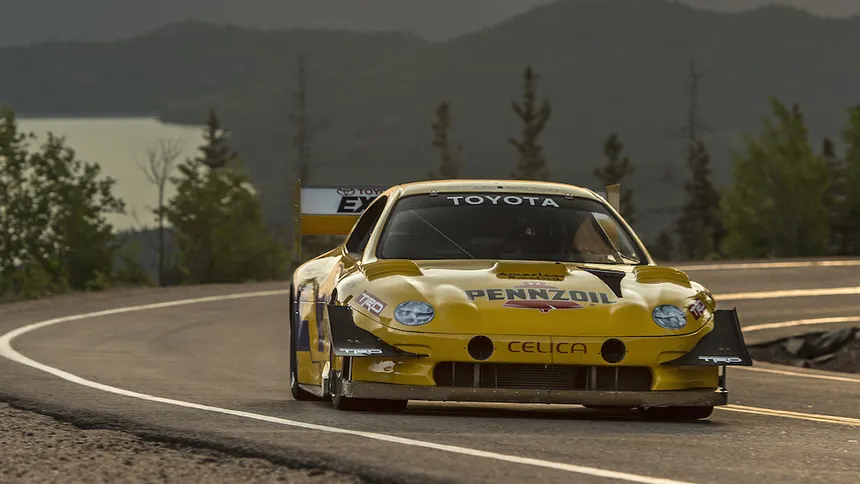
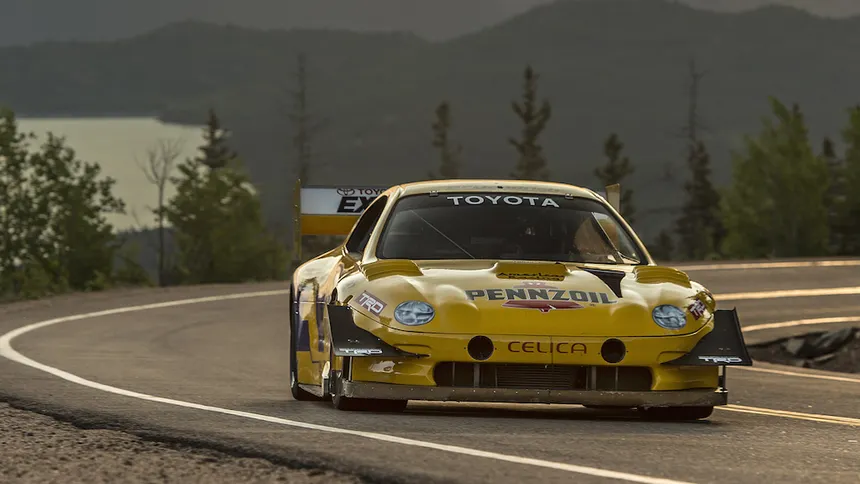
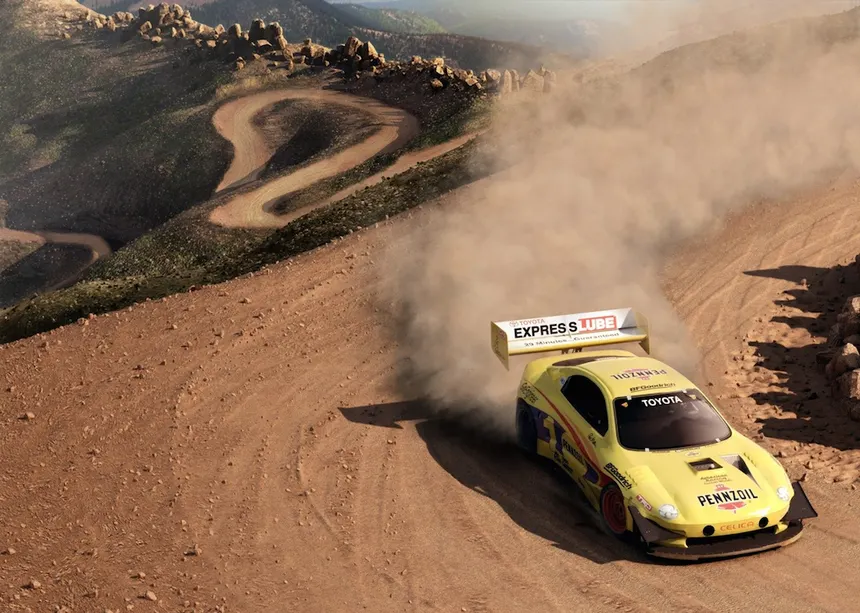
On June 30, 1994, Rod Millen arrived at the Pikes Peak start line with something the rest of the paddock stared at without quite knowing what they were looking at. It looked like a Toyota Celica. It had the Celica’s silhouette, Toyota’s logo on the nose, the team’s colors. But those who got close enough realized this was no production Celica. It was something else. Something that shouldn’t have existed on a Colorado dirt road.
Millen climbed the 19.99 kilometers in 10 minutes and 4 seconds (10:04.06 official). The previous record was 10:47.77, set by Vatanen and the Peugeot 405 T16 in 1988 — the same Climb Dance from the previous episode in this series. Six years of Pikes Peak, and Millen erased it by exactly 40 seconds. He didn’t improve it. He didn’t polish it. He demolished it.
And he did it on dirt. Without a single meter of asphalt. In conditions impossible to replicate today because Pikes Peak no longer has gravel.
Millen’s 1994 record still stands. Forever. Not because nobody has been capable of surpassing it. But because nobody will ever be able to try under the same conditions again.
The Man: Rod Millen, the New Zealander Who Read About Pikes Peak as a Child and Decided He Was Going to Win It
Rodney Kenneth Millen was born on March 22, 1951, in Auckland, New Zealand. He grew up on a farm. His father built him a kart, and from there it all started. In his teens he competed in local hillclimbs and grass track races in a buggy he modified himself, fitted with a Ford V6. He was fast — very fast — and people noticed.
Three consecutive New Zealand Rally Championships — 1975, 1976 and 1977 — in Mazda cars put him on his country’s radar. In 1977 he finished fifth in the Rally of New Zealand, a WRC round, as the top Kiwi in the event. And in 1978 he made the decision that would define the rest of his career: he moved to the United States.
He started competing with Datsun, then Mazda, building a reputation as one of the most complete drivers in American rallying. He won the North American Race and Rally Championship in 1979 and 1980. Five SCCA ProRally championships across the 1980s, including three consecutive from 1987 to 1989. In 1989 he also won the FIA Asia-Pacific Rally Championship and the GTU class at the 24 Hours of Daytona alongside Al Bacon and Bob Reed — a versatility few drivers of his era could match.
In 1991 he joined Toyota’s racing program in the United States. What followed was pure domination in the Mickey Thompson Stadium Series, an indoor stadium off-road series: twelve event victories and three consecutive Grand National Sport Truck championships in 1992, 1993 and 1994. The only driver in the series’ twelve-year history to achieve that.
But Millen had something else in mind from much earlier. “I grew up in New Zealand reading about Pikes Peak,” he told the Los Angeles Times years later. “And it really is the ultimate hillclimb.”
The first time Millen climbed Pikes Peak was in 1989, winning in the Division C category. In 1991 he won the Open Class in a Mazda RX-7. In 1992 the Showroom Class. Each year, accumulating knowledge of the mountain, of the corners, of how a car reacts at altitude in dirt. And while he learned the mountain, at MillenWorks — the competition workshop he’d founded in California — something was being built that would change the race forever.
The Car: A Celica That Shares a Name and a Windshield With the Road Car. The Rest Is Science Fiction.
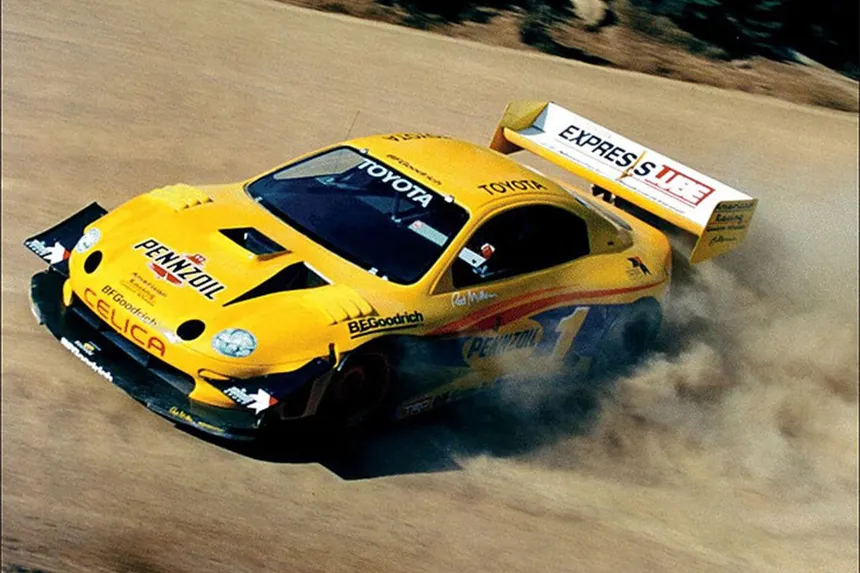
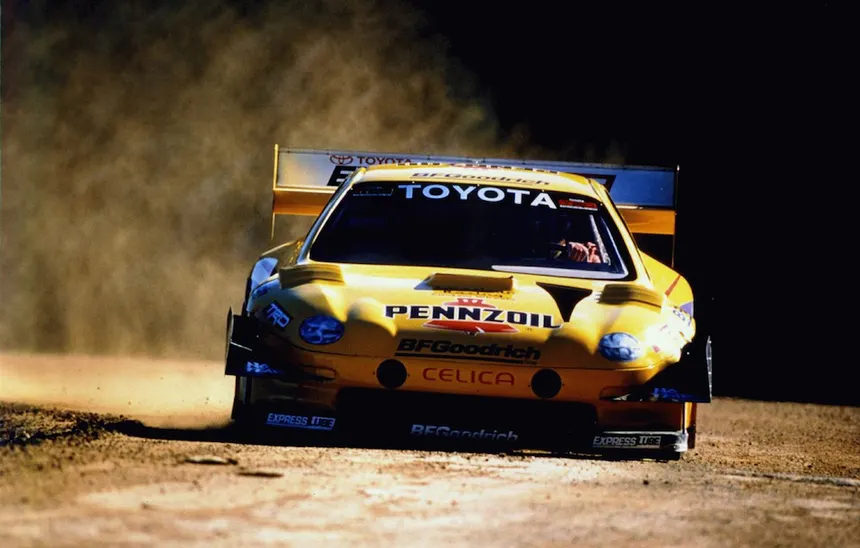
Calling this car a Toyota Celica is stretching it, and Millen knows it. In the interview Toyota UK conducted with him years later, he explained it without ambiguity: the car shared exactly one thing with the road Celica: the windshield. The windshield and the approximate silhouette of the carbon body. Everything else came from scratch at the Rod Millen Motorsports workshop in California.
The chassis: tubular steel, built from zero, with no reference whatsoever to the production Celica’s chassis. Pure competition structure, designed specifically to handle the aerodynamic loads and forces that would appear at Pikes Peak.
The body: a single carbon fiber piece that vaguely resembles the road Celica but shares no panel with it. Light, rigid, and designed to work with the aerodynamic package.
The engine: here’s where the car gets genuinely interesting. Millen didn’t use a conventional Toyota engine. He used a 2,100 cc turbocharged inline-four developed by TRD — Toyota Racing Development — for the IMSA GTP prototypes of Dan Gurney’s All American Racers. The same engine that had raced at Le Mans. The same one that had competed in the 24 Hours of Daytona in the prototype category. An engine with history in top-level endurance racing, known as the 503E or 3S-GTM depending on the source, producing 850 CV and approximately 1,500 Nm of torque.
To contextualise those numbers: a Ferrari F40, the most extreme car Ferrari offered to the public in 1994, made 478 CV. Millen’s Celica had nearly double that. In a car weighing 885 kilograms.
The aerodynamics: the element that really changed the race
This is the chapter most people don’t know about the Pikes Peak Celica and which says the most about Millen’s mindset as a constructor.
In a race that until then was dominated mainly by adapted rally cars — where aggressive aerodynamics was an option, not a priority — Millen arrived with a car where aerodynamic downforce was the central element of the setup. Not the engine. Not the transmission. The aerodynamics.
He hired an IndyCar aerodynamics engineer — whose name he never revealed — and together they developed a complete package: rear diffuser, venturi channels under the floor, and an industrial-scale rear wing. The car had genuine ground effect, something that in 1994 was the exclusive territory of Formula 1 cars and Le Mans prototypes.
Millen described it in detail later: they did high-speed aerodynamics testing on a dry lake bed in Southern California, using the lake itself as a full-scale wind tunnel. “We were never going to see more than 140 mph at Pikes Peak, so the aero package had to work between about 70 mph and 140 mph. I couldn’t drive it like a traditional rally car on a dirt road, it had to be a lot straighter and more controlled so the aero package could give the maximum effect.”
The result of those tests: 2,000 pounds of aerodynamic downforce at 100 mph — nearly 910 kilograms of downforce at just 160 km/h. On a gravel road. In dirt. At altitudes where the air is 30% less dense than at sea level, meaning those 2,000 pounds required even more surface area than they would have at sea level to generate.
This was a solution nobody had applied with that sophistication at Pikes Peak. Ground effect in dirt, on an irregular road without asphalt, with gravel that could block the venturi channels in any corner. A calculated risk that Millen and his team had analysed with a methodology that had nothing to envy from Formula 1 teams.
The drivetrain: four-wheel drive throughout, non-negotiable. Without it, 850 CV in dirt at Pikes Peak was simply smoke.
The Preparation: Years Learning the Mountain
One of motorsport’s myths is that great records are achieved with the most powerful car. At Pikes Peak, knowledge of the course is worth as much as horsepower. And Millen had spent years accumulating that knowledge.
From 1989 to 1994, Millen climbed Pikes Peak at every edition, winning in different categories, learning every corner in dirt. The 156 guardrail-free corners are not a layout you can memorize in a week. There are rhythm changes, surface changes, spots where the dirt is more compacted and spots where loose gravel can send you into the void. There are corners where the car flies and corners where you need margin. All of that is learned through years.
In 1993, the year before the record, Millen finished second in the Open category. Second, in essentially the same car that a year later would win by a 40-second margin. The difference between the two years wasn’t only the car — which evolved significantly. It was also that additional year of data, of reference points, of corners memorized at a level that only repetition provides.
The Record Run: 10:04.06 on Dirt, Forever
On June 30, 1994, on gravel, on dirt, with the void centimeters away at every corner and not a single guardrail across the 19.99 kilometers, Rod Millen did 10:04.06.
Vatanen’s previous record — 10:47.77 — fell by 43 seconds. This is not an incremental improvement. It’s an anomaly. In high-level motorsport, improving an established record by several seconds is news. Ten seconds is historic. Forty-three seconds in a ten-minute race only happens when someone arrives with a technological approach of a completely different dimension at a competition where nobody expected what was about to happen.
Millen wasn’t just faster. He drove the race differently: with the car glued to the ground via ground effect, straighter through corners than conventional rally drivers, exploiting aerodynamic downforce in fast sections instead of sliding in dirt like everyone else. It was a driving philosophy imported from Formula 1 and applied to an unasphalted mountain road.
The time was so dominant that Millen himself acknowledged years later he hadn’t expected that margin. “We knew the car was very fast, but we didn’t expect that.”
The Tacoma: When a Pickup Truck Defeats a Race Car
In 1996 and 1997, Millen returned to Pikes Peak with the Celica and won again — his times were 10:13.64 and 10:04.54 respectively, never improving the 10:04.06 of 1994. The mountain was beginning to be paved in some sections, changing conditions year by year.
For 1998, Millen and MillenWorks made a decision that surprised the paddock: they replaced the Celica with a Toyota Tacoma. A pickup truck. The Toyota Tacoma Pikes Peak Special was a carbon fiber-bodied pickup on a tubular chassis, with the same ground effect concept and four-wheel drive as the Celica but with a longer wheelbase, which in theory gave more stability in the fast corners.
The commercial logic was obvious: Toyota sold Tacomas to the American public, not racing Celicas. A Tacoma victory at Pikes Peak was worth millions in direct advertising in the pickup market, America’s most important vehicle segment. And the manufacturer backed the project.
The result: Millen won with the Tacoma in 1998 and 1999, making him the driver with the most consecutive overall victories at Pikes Peak during that period. But his best time with the Tacoma was 10:07 — he never bettered the Celica’s 10:04.06. The truck was more stable in the fast sections but lost time in the slow corners where the Celica was more agile.
By the end of the 1999 edition, Millen had five overall Pikes Peak victories in his record: 1994, 1996, 1997, 1998 and 1999. And a dirt record nobody had managed to beat.
The Record Nobody Can Beat Because the Race No Longer Exists
In 2007, Nobuhiro Tajima climbed Pikes Peak in 10:01.408 with the Suzuki XL7 Hill Climb Special, officially superseding Millen’s 10:04.06. Contemporary accounts recorded it as the end of the record.
But there’s a nuance that changes everything: by 2007, part of the road had already been paved. Not the entire course — full asphalt came in 2011 — but significant sections that radically changed conditions. Tajima’s time wasn’t set under the same conditions as Millen’s.
The ORMHOF — Off-Road Motorsports Hall of Fame — acknowledged this when inducting Millen in 2024: “He won his first crown at Pikes Peak in 1994, setting a record for the fastest time ever recorded on the all-dirt course, a record that will never be broken, as portions of the course were paved the following year.”
Millen’s dirt record of 10:04.06 still stands. Not because nobody is capable of surpassing it. But because the race where it could be attempted no longer exists. Pikes Peak has been fully paved since 2011. The 10:04.06 is eternal by default.
The Debate: Is Millen’s Record the Most Legitimate in Pikes Peak History?
Here’s the question without an easy answer, and which for exactly that reason deserves asking.
Loeb did 8:13 in 2013. Dumas did 7:57 in 2018. Stratospheric times on asphalt in cars designed for asphalt, on asphalt tires, with the grip and predictability that only tarmac allows.
Millen did 10:04 on gravel. On loose dirt. With the risk of stones blocking the ground effect’s venturi channels, mud if it had rained, blinding dust kicked up by earlier starters. On dirt tires on an irregular road where a wrong line wasn’t a loss of tenths but the real possibility of going off the edge.
Are they comparable? Technically they occurred at the same event. In practice, they’re two different sports driven on the same mountain.
What nobody can answer — and which makes the 10:04.06 the most unsettling data point in Pikes Peak history — is this: if Millen had had asphalt in 1994, what time would he have set? With that ground effect, that power and that knowledge of the corners, would he have broken nine minutes before anyone imagined it possible? Would he have been the first man under eight minutes twenty years ahead of Dumas?
We’ll never know. And that makes the 10:04.06 the most beautiful mystery in this race’s history.
The Legacy: The Man Who Thought About Pikes Peak Like an Engineer
Millen’s 1994 victory wasn’t just a sporting result. It was a paradigm shift in the way a car is prepared for Pikes Peak.
Until 1994, the dominant mindset was that of the adapted rally car: more power, better traction, drivers with dirt experience. What Millen did was import the Le Mans prototype philosophy — ground effect, aerodynamics as a priority, wind tunnel simulations — and apply it to a guardrail-free mountain road in Colorado.
That approach is what all the great Pikes Peak cars since then have followed. Loeb’s Peugeot 208 T16, the Volkswagen ID.R, the Ford SuperTruck: they all share an obsession with aerodynamics that before Millen wasn’t the norm at the race. He didn’t verbalize it as a revolution. He simply built the car he thought he needed to win, with the methodology of someone who had competed at Le Mans level and knew that engineering could overcome pure bravery.
What he did on June 30, 1994, on dirt, remains. A time with no possible competitor. A record forever, for reasons that go beyond sport.
Verified Technical Sheet: Toyota Celica Pikes Peak (1994)
| Data | Value |
|---|---|
| Engine | Inline-4, 2,100 cc, TRD turbo (503E/3S-GTM) |
| Power | 850 CV |
| Max torque | ~1,500 Nm |
| Weight | 885 kg |
| Body | Carbon fiber (Celica silhouette) |
| Chassis | Tubular steel, built from scratch |
| Drivetrain | 4WD |
| Aerodynamics | Real ground effect, 2,000 lb downforce at 100 mph |
| Pikes Peak 1994 time | 10:04.06 (outright dirt record, still stands) |
| Improvement over previous record | 43 seconds |
| Driver | Rod Millen |
| Total Millen Pikes Peak victories | 5 (1994, 1996, 1997, 1998, 1999) |
Next episode: Peugeot 208 T16 — When Loeb came to the mountain and made it his in 8 minutes and 13 seconds.