Volkswagen Beetle: The Käfer That Motorized the World and Survived Everything
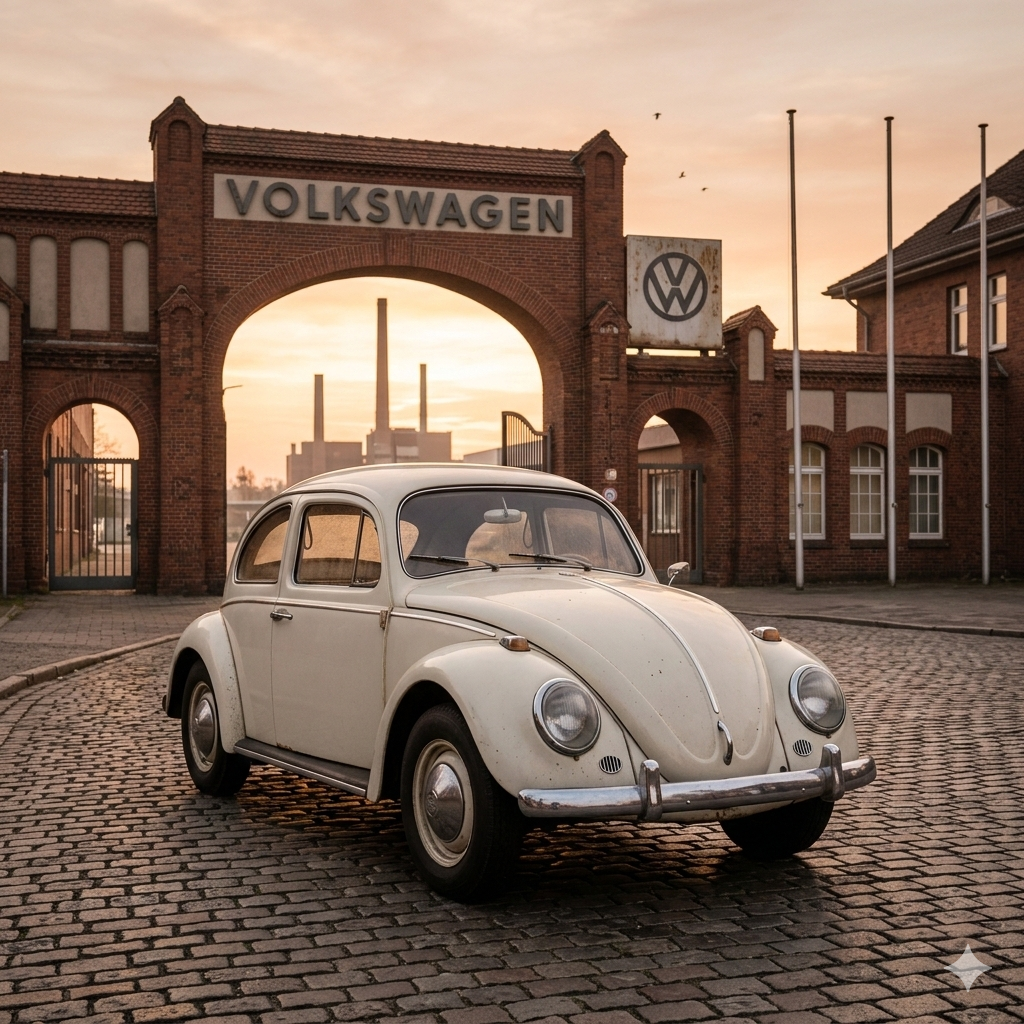
Twenty-one million five hundred thousand units. 21,529,464, to be exact. The Volkswagen Käfer, known worldwide as the Beetle or Bug, isn’t just the most produced car in history on a single platform. It’s the vehicle that defined mass motorization, survived Europe’s darkest regime, symbolized the counterculture of the sixties, became an icon of industrial design, and proved that a car can be simple, honest, and eternal.
Its history is so complex, so full of contradictions, and so profoundly human that no other car comes close.
The Dark Origins: Hitler’s People’s Car
You cannot tell the Beetle’s story without starting with its most uncomfortable chapter. In 1934, Adolf Hitler commissioned Ferdinand Porsche to design a “Volkswagen,” literally a “people’s car.” The specifications were clear: it had to carry two adults and three children, reach 100 km/h, consume less than 7 liters per 100 km, and cost less than 990 Reichsmarks, a price affordable to a German worker.
Porsche had been working on the concept of a small, affordable car for years. His designs for NSU and Zündapp in the 1920s and 30s contained many elements that would end up in the Beetle: rear-mounted air-cooled engine, rounded aerodynamic bodywork, and simple, robust construction. The contribution of other engineers like Josef Ganz, who developed similar prototypes earlier, remains a subject of historical debate.
In 1938, the Wolfsburg factory was created specifically to produce the KdF-Wagen (Kraft durch Freude, “Strength through Joy”), as it was originally called. German citizens began paying weekly installments to reserve their car. More than 300,000 people saved to buy a KdF-Wagen. None of them received their car. When World War II broke out in 1939, the factory was converted to produce military vehicles, including the Kübelwagen and Schwimmwagen.
It’s a brutal irony: the people’s car became the war’s car. And the savings of hundreds of thousands of workers evaporated into the Third Reich’s war machine.
The Rebirth: Major Ivan Hirst and the Wolfsburg Miracle
When British troops liberated the Wolfsburg factory in April 1945, they found a building devastated by Allied bombing, with partially destroyed machinery and a population of displaced workers with no future. The factory was scheduled to be dismantled as war spoils.
This is where one of the most unknown heroes in automotive history enters: Major Ivan Hirst, a British officer from the Royal Electrical and Mechanical Engineers. Hirst recognized the small car’s potential and convinced his superiors that the factory could produce vehicles for the British occupation army.
Hirst got the factory running with incredible determination. He organized machinery repairs, established production lines, found materials in a devastated country, and managed a workforce composed largely of refugees and displaced persons. In December 1945, the first postwar Volkswagen rolled off the assembly line, painted in military olive green.
The early years were precarious. The car was offered to several international manufacturers, and all rejected it. A Ford evaluation team examined the offer and concluded that the factory and the car held no commercial value. The UK’s Rootes Group was equally dismissive. The French showed no interest. Nobody wanted the ugly duckling of the German automotive industry. History would prove them all spectacularly, embarrassingly wrong.
Heinz Nordhoff: The Man Who Made the Beetle a Global Phenomenon
In 1948, factory administration passed to German hands, and Heinrich Nordhoff was appointed managing director. Nordhoff was an engineer with experience at Opel who understood something fundamental: the Beetle didn’t need to be reinvented, it needed to be perfected.
Nordhoff implemented a philosophy of continuous improvement that predated by decades what the Japanese would later make famous with the concept of kaizen. Under his leadership, the Beetle underwent more than 78,000 individual modifications between 1948 and his death in 1968, yet at no point did the car undergo a visible radical redesign. Every change was incremental, invisible, focused on improving quality, durability, and manufacturing efficiency. More powerful engines appeared progressively, interior materials improved, safety features were added, production processes were refined, but the basic silhouette remained untouched and instantly recognizable.
This philosophy had enormous advantages. Parts were interchangeable between model years, allowing owners to upgrade older Beetles with components from newer models. Workshops accumulated decades of experience with the same fundamental design. The service network spread worldwide because any mechanic who knew how to repair one Beetle could repair any Beetle, regardless of vintage.
While American manufacturers practiced planned obsolescence, deliberately making last year’s model look dated to drive new sales, Nordhoff bet on the exact opposite: make the same car better every year without making the previous owner feel their car was outdated. This approach built extraordinary customer loyalty and trust that was as much a part of the Beetle’s success as its engineering. By the time of Nordhoff’s death in 1968, Volkswagen had become the largest non-American car manufacturer in the world, selling the Beetle in over 150 countries.
The Boxer Engine: Engineering the Essential
The Beetle’s heart was a masterful exercise in functional minimalism. The air-cooled flat-four boxer engine, rear-mounted in overhang, eliminated at a stroke the need for a liquid cooling system, radiator, water pump, hoses, and all associated failure points. In extreme climates, from the Sahara’s scorching heat to Alaska’s polar cold, the Beetle kept running when other cars overheated or refused to start with frozen radiators.
The postwar engine displaced 1,131cc and produced 25 hp. Porsche’s original 1938 design used a 985cc engine, but by the time serious production began at Wolfsburg under British management, displacement had already been increased. Over subsequent decades, the engine grew progressively: 1,192cc (34 hp), 1,285cc (40 hp), 1,493cc (44 hp), and finally 1,584cc (50 hp) in the last German-produced versions. It was never powerful by the numbers, but always sufficient for the car’s purpose. And reliability was the true star: a well-maintained engine could exceed 200,000 kilometers without major issues, unheard of by period standards.
Suspension used torsion bars instead of conventional springs, another simplification reducing components and increasing durability. The unibody construction eliminated the need for a separate body-on-frame chassis, saving weight and simplifying production. The electrical system ran on 6 volts until 1967, then upgraded to 12V. The heater used warm air from the engine directed to the cabin through ducts — a primitive system requiring no additional components that, in fairness, was rather inefficient in truly cold climates.
Everything in the Beetle was designed to be repaired with basic tools by anyone with minimal mechanical knowledge. The owner’s manual included maintenance instructions that would be unthinkable in a modern car, because Volkswagen assumed owners would actively participate in their car’s upkeep.
America and the Counterculture: Think Small
The Beetle’s conquest of America is one of the great stories of modern marketing and twentieth-century counterculture. In a country obsessed with large, powerful, chrome-laden cars, Volkswagen decided to do exactly the opposite with an advertising campaign that broke every mold.
The “Think Small” campaign, created by the Doyle Dane Bernbach agency in 1959, is considered one of the greatest advertising campaigns in history and a turning point in modern commercial communication. Instead of hiding the Beetle’s limitations, they celebrated them with self-deprecating humor and refreshing honesty in an era of bombastic advertising. “Think Small.” The ads were minimalist: tiny photographs of the car against enormous white backgrounds, clever copy that didn’t treat consumers as idiots.
The result was spectacular. The Beetle became one of the best-selling imported cars in the United States. But beyond sales figures, it became the official vehicle of the 1960s and 70s counterculture. Hippies adopted it as their transport of choice. Its low price, mechanical reliability, ease of maintenance, and friendly, non-threatening design made it perfect for a generation rejecting rampant consumerism and Detroit’s corporate status symbols.
Beetles were painted with flowers, decorated with peace symbols, and driven to music festivals worldwide. Herbie, the Beetle star of Disney’s film series beginning with “The Love Bug” in 1968, cemented its status as an absolute pop culture icon. The irony couldn’t have been more profound: the car born as a Nazi regime project became, thirty years later, a universal symbol of peace, love, and individual freedom.
Production: A Record That Took Decades to Fall
On February 17, 1972, the Beetle surpassed the Ford Model T as the most produced car in history, with 15,007,034 units. Production continued in Germany until 1978, but factories in Brazil and Mexico kept building Beetles for decades more, adapting them for local markets.
The last factory to produce the classic Beetle was the Puebla plant in Mexico, where the “Vocho” remained a popular and affordable car, frequently used as a taxi in Mexico City. The last original Beetle rolled off the production line on July 30, 2003, bearing number 21,529,464.
Brazil ceased production of its Beetle version (called “Fusca”) in 1996, though there was a brief and interesting resurgence between 1993 and 1996 driven by a personal campaign from President Itamar Franco, a declared fan of the car who promoted its reintroduction as an accessible people’s vehicle.
Legacy: Beyond the Automobile
The Beetle transcended its condition as transportation to become something entirely different: a universal cultural symbol. It’s instantly recognizable in any corner of the planet. It has appeared in more films, songs, artworks, and photographs than any other car in history.
But its deepest legacy is philosophical. The Beetle proved that a car doesn’t need to be big to be important. It doesn’t need to be fast to be loved. It doesn’t need to be luxurious to be respected. It needs to be honest, reliable, and accessible. It needs to solve a real problem for real people.
Ferdinand Porsche designed a car. Ivan Hirst saved it. Heinz Nordhoff perfected it. And the world adopted it as its own. The Beetle is, in essence, the purest demonstration that simple engineering, executed with integrity, can change the world.
Volkswagen attempted to capture Beetle nostalgia twice with retro models. The 1998 New Beetle, designed on the Golf IV platform, worked commercially but never captured the original’s mechanical essence. Pretty outside, conventional underneath. The 2011 Beetle tried a more masculine, less playful approach, but the market had moved on and Volkswagen discontinued it in 2019. Neither possessed what made the original special: radical simplicity, mechanical honesty, the sense that every component served exactly its necessary function and nothing more.
Today, classic Beetles in good condition are collector’s pieces experiencing steady appreciation. The most sought-after models are Split Windows with divided rear window produced until 1953, Oval Windows until 1957, and Karmann-built convertibles. A restored Split Window can easily exceed €50,000, with exceptional examples reaching considerably higher at specialized auctions.
Twenty-one million cars. Eighty years of history. A design that never needed to change because it was born perfect for what it had to do. The Käfer isn’t just a car. It’s the most elegant answer the automotive industry has ever given to the question: what do people really need?
10 thoughts on “VOLKSWAGEN BEETLE”