
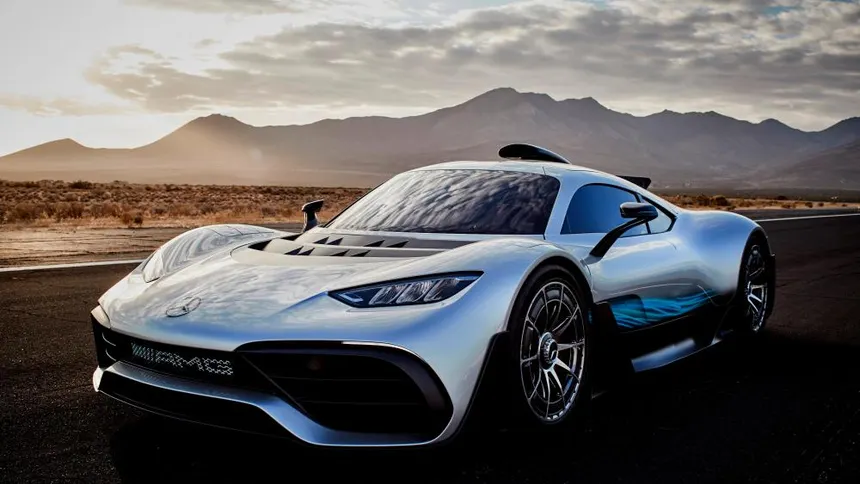
Mercedes-AMG One: The Day Mercedes Put a Formula 1 Engine in a Road Car
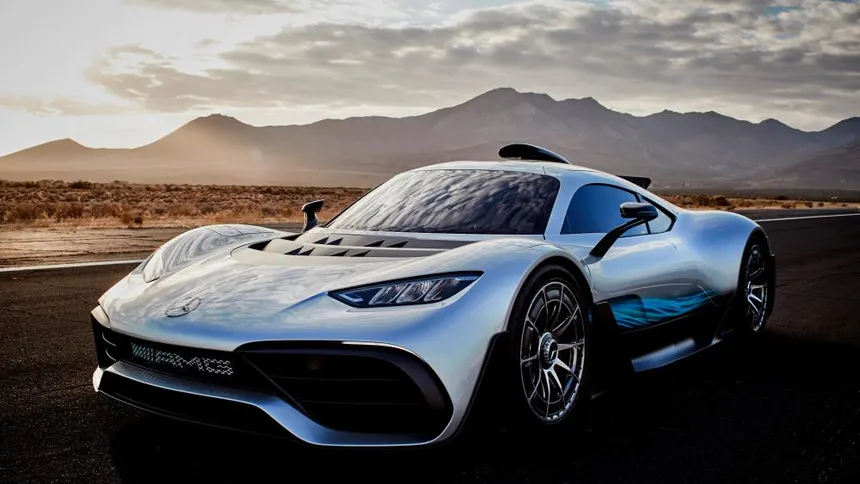
And Almost Lost Their Minds Doing It
Every major car manufacturer has made a promise at some point: “We’ll put our race engine in a road car.” Most of them are lying. Or they water it down so much that the connection to racing becomes purely marketing.
Mercedes-AMG actually did it. They took the 1.6-liter turbocharged V6 from their 2016 Formula 1 World Championship-winning car — the same engine that powered Lewis Hamilton to titles — and shoved it into a road-legal hypercar.
It nearly destroyed them.
The Mercedes-AMG One is simultaneously the most ambitious, most delayed, most criticized, and most fascinating car of the 21st century. And now that it exists, now that it has broken lap records at every major circuit in Europe, the question isn’t whether it was worth it. The question is whether anyone will ever be brave enough — or crazy enough — to try it again.
The Promise: Project One (2017)
When Mercedes-AMG unveiled the “Project One” concept at the 2017 Frankfurt Motor Show, the automotive world lost its collective mind.
The specifications read like science fiction: a Formula 1-derived hybrid powertrain with over 1,000 horsepower, capable of revving to 11,000 rpm, in a road-legal carbon fiber chassis. Lewis Hamilton stood on stage next to the car, grinning. Deliveries were promised for 2019. Price: approximately $2.7 million. Production: limited to 275 units.
Every single one was sold before the paint was dry on the concept.
The Reality: Five Years of Pain (2018–2022)
Then the nightmare began.
The fundamental problem was deceptively simple to state and almost impossible to solve: a Formula 1 engine is designed to run for approximately 7 race weekends before being rebuilt. A road car engine needs to last years. Decades, potentially. Making an F1 powertrain survive the demands of road use — idle in traffic, cold starts on winter mornings, air conditioning loads, emission regulations — was an engineering challenge that pushed Mercedes to its absolute limits.
The 2019 delivery date came and went. Then 2020. A global pandemic hit. Supply chain disruptions multiplied. Noise regulations became an unexpected obstacle — making an 11,000 rpm V6 meet European sound standards without neutering its character required creative solutions that hadn’t been invented yet.
Internally, the project became so difficult that Mercedes CEO Ola Källenius later admitted the board must have been intoxicated when they approved it. He was joking. Mostly.
The production version was finally unveiled on June 1, 2022. Deliveries began in late 2022, with the first car reaching its owner on January 16, 2023 — nearly four years behind schedule.
The Machine: Engineering Without Precedent
The Powertrain
The heart of the AMG One is a mid-mounted 1.6-liter turbocharged V6 — essentially the same architecture as the Mercedes-AMG F1 W07 Hybrid that dominated the 2016 season. It revs to 11,000 rpm (limited from the racing unit’s higher ceiling) and produces 566 hp on its own.
But the V6 is only part of the story. Four electric motors work in concert with the combustion engine:
- MGU-K (120 kW): Connected to the crankshaft, recovers energy during braking — exactly as in F1
- MGU-H (90 kW): Mounted to the turbocharger, eliminates turbo lag by keeping the turbine spinning at low engine speeds and recovers waste energy from the exhaust
- Two front axle motors (120 kW each): Drive the front wheels independently, enabling torque vectoring and all-wheel drive
Combined output: 1,049 hp. The system can also run in pure electric mode for approximately 18 km, making this land missile technically a plug-in hybrid with an 8.4 kWh battery pack.
The seven-speed automated manual gearbox was developed specifically for this car. No existing transmission could handle the unique characteristics of an F1-derived powertrain.
The Chassis
The AMG One sits on a carbon fiber monocoque — not a steel tub with carbon panels bolted on, but a genuine racing-specification carbon structure. Total weight: 1,695 kg, which is heavy for a hypercar but remarkable considering the complexity of the powertrain and the requirement for full road-legal equipment including air conditioning, an infotainment system, and electric windows.
The Aerodynamics
This is where the AMG One gets truly exotic:
- Active front diffuser flaps adjustable through multiple driving modes
- Moveable slats in the front wheel arches — a feature specifically developed for this car
- Two-part extendable rear wing with an electronically controlled center section
- NACA duct openings for cooling channels throughout the body
At maximum deployment, the aerodynamic package generates enough downforce to theoretically drive the car upside down on a ceiling at sufficient speed. The numbers: up to 400 kg of downforce at 250 km/h, scaling significantly at higher velocities.
The Driving Modes
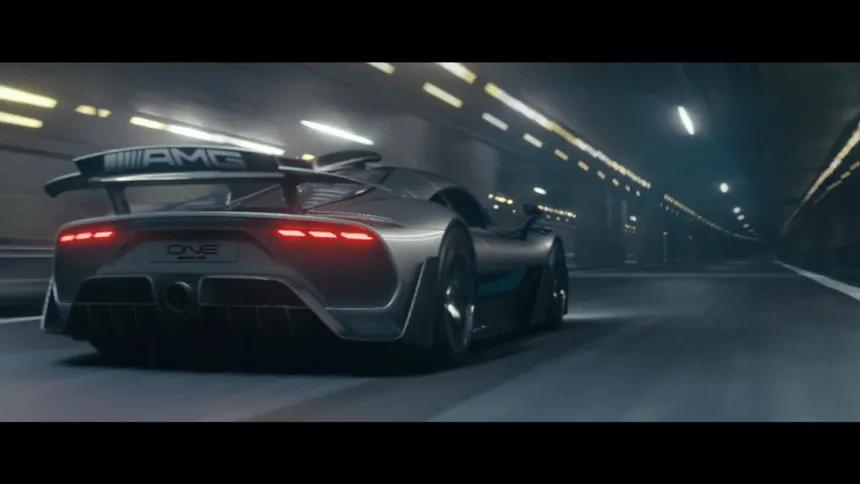
Six modes are available, escalating from civilized to certifiably insane:
- Race Safe — Prioritizes electric motors, gentle hybrid operation
- Race — Full hybrid with emphasis on battery charging
- EV — Pure electric, silent running
- Race Plus — Track-only. Activates full aerodynamics, lowers ride height by 37mm front / 30mm rear
- Strat 2 — Named after the F1 qualifying mode. Full power from all motors. Maximum attack.
- Individual — Custom configuration
“Strat 2” is the one that matters. It’s the mode that transforms the AMG One from a very fast road car into something that feels genuinely connected to a Formula 1 machine. The throttle response becomes razor-sharp. The aero elements deploy fully. The engine note changes from urgent to feral.
The Numbers: Records Fall Like Dominos
Once the AMG One was finally sorted, it went on a record-breaking rampage:
| Circuit | Lap Time | Status |
|---|---|---|
| Nürburgring Nordschleife | 6:29.09 | Production car record |
| Nürburgring GP Circuit | 1:56.096 | Record |
| Hockenheimring | 1:38.563 | Record |
| Red Bull Ring | 1:26.846 | Record |
| Monza | 1:43.902 | Record |
The Nordschleife time deserves special attention. When Maro Engel first set a time of 6:35.183 in November 2022, it was already the fastest production car lap ever, beating the AMG GT Black Series by over 13 seconds. Engel noted the track conditions were far from ideal, with damp patches requiring him to lift in several corners. Mercedes claimed the car was capable of a sub-6:30 time.
In September 2024, they proved it, setting a time of 6:29.09 — becoming the first road-legal production car to break the 6:30 barrier on the full 20.832 km circuit.
The Experience: Controlled Chaos
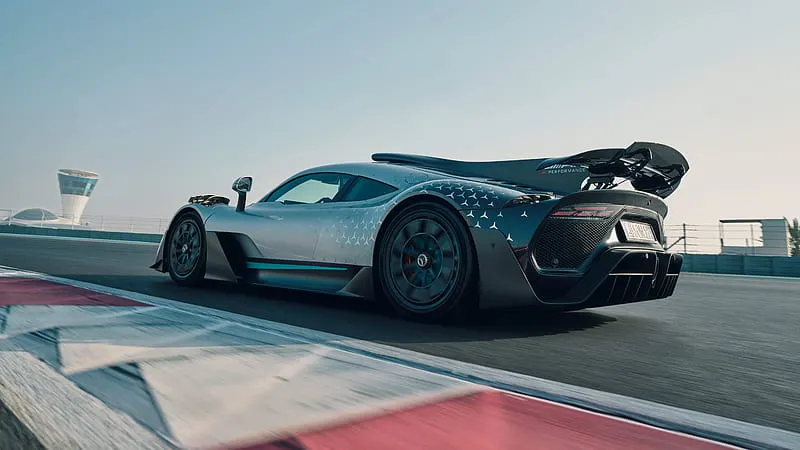
The AMG One is not a comfortable car. It is not a refined car. The 1.6-liter V6, even with all the NVH work Mercedes engineers performed, is loud. The ride is stiff. The cabin, while beautifully finished in Nappa leather and carbon fiber with a squarish F1-style steering wheel, is compact and purposeful rather than luxurious.
But when you push it — when you select Strat 2 and commit to a fast lap — the AMG One delivers something no other road car can: the genuine sensation of F1-derived technology responding to your inputs with a precision that borders on supernatural. The MGU-H eliminates turbo lag so completely that throttle response feels naturally aspirated. The front electric motors provide torque vectoring that borders on telepathic. The engine climbs to 11,000 rpm with an intensity that makes your vision narrow.
It is simultaneously flawed and magnificent. A car that probably shouldn’t exist, built by people who refused to give up, carrying technology that will never be repeated in this form.
The Market: $2.7 Million Was Just the Beginning
All 275 units were sold at approximately $2.7 million before production began. Current secondary market values are significantly higher, with the car’s Nürburgring records and historical significance as the only true F1-engined road car driving collector interest.
The AMG One will never be built again. Mercedes has been very clear about this. The engineering effort, the cost, the development hell — it was a once-in-a-lifetime project that pushed the company to its absolute limits.
And that’s exactly what makes it irreplaceable.
The Verdict
The Mercedes-AMG One is not the fastest hypercar. It’s not the lightest. It’s not the most beautiful. It’s not even the most reliable — early press cars had documented glitches that required on-the-fly replacements.
But it is the most honest. Mercedes promised an F1 car for the road, and despite five years of delays, technical nightmares, and internal doubts, they delivered exactly that. Not a watered-down marketing exercise. Not an F1-“inspired” car with a regular engine and some stickers. An actual Formula 1 powertrain, in an actual road car, that you can actually drive to get milk.
If you have $2.7 million. And one of the 275 allocation slots. And the mechanical sympathy to treat an 11,000 rpm V6 with the respect it demands.
In a world of increasing homogeneity, where every hypercar is converging toward the same formula of twin-turbo V8 and dual-clutch transmission, the Mercedes-AMG One stands completely alone. It was born from obsession, forged through suffering, and validated by records.
It is the most fascinating machine ever to wear a three-pointed star.
Would you choose the AMG One over a Valkyrie, a LaFerrari, or a Porsche 918? The debate is open — and there’s no wrong answer.