Porsche 917: The Most Terrifying Race Car Ever Built
There are fast cars, there are terrifyingly fast cars, and then there’s the Porsche 917.
This is a machine that hit 390 km/h on the Mulsanne Straight in 1971. In a car with the aerodynamic stability of a garden shed in a hurricane. With brakes that were essentially suggestions. On a public road that had been closed for a weekend.
The 917 is the car that made Porsche a motorsport legend. It’s also the car that nearly killed almost everyone who drove it. And the story of how both of those things can be true simultaneously is one of the most extraordinary chapters in the history of motor racing.
Breaking the Rules to Build a Monster
The 917 exists because of a loophole. In 1968, the FIA introduced new regulations for the International Championship of Makes that allowed 5-litre engines in cars with a minimum production run of 25 units. The intent was to bring manufacturers like Ford and Ferrari into endurance racing with production-based cars. The emphasis was on “production-based” — the FIA envisioned manufacturers homologating slightly modified road cars, not building all-out racing machines and calling them road legal.
Porsche looked at this regulation and did something audacious: they built 25 examples of an all-out race car and called it a production vehicle. The cars were lined up in the factory for FIA inspection in April 1969. Some of them were barely finished. Several reportedly lacked functioning engines. The story goes that a few were little more than shells with wheels. The inspectors counted them, shrugged, and homologated the 917.
Whether Porsche technically met the spirit of the regulations is debatable. Whether they met the letter of them is also debatable. But the FIA signed off, and the 917 was legal. Sometimes the greatest engineering achievements begin with the most creative interpretation of the rules.
The car was engineered around a new 4.5-litre flat-twelve engine — essentially two flat-sixes joined at the crankshaft, which was elegant in its conceptual simplicity and nightmarish in its practical complexity. It produced around 580 horsepower in its initial form, which would eventually grow to over 1,100 horsepower in turbocharged variants. The chassis was a lightweight aluminium space frame that weighed just 42 kilograms. The total car weight? Around 800 kilograms. With nearly 600 horsepower.
Do the maths on that power-to-weight ratio and then remember this was 1969 — before carbon brakes, before ground effect aerodynamics, before traction control, before data logging, before computational fluid dynamics, before any of the safety systems we take for granted today. These drivers were strapping themselves into an 800 kg missile with the computational support of a stopwatch and their own nervous system.
The Car That Terrified Its Drivers
The early 917 had a reputation problem: it was trying to kill its drivers.
The original longtail version — the 917 LH (Langheck) — was aerodynamically unstable at high speeds. The front end would lift, the rear would become unpredictable, and drivers found themselves piloting an 800 kg missile that periodically decided it wanted to fly. The problem was fundamental: the car’s aerodynamics generated insufficient downforce at the front and inconsistent airflow management at the rear, creating a machine that was devastatingly fast in a straight line but absolutely terrifying when you needed it to stay on the ground.
Jo Siffert described driving the early 917 as “a nightmare.” Brian Redman refused to drive it after testing, saying that it was simply too dangerous to race. Vic Elford called it “diabolical” at speed. These weren’t amateurs or nervous weekend racers — they were among the best racing drivers in the world, men who routinely risked their lives at 300 km/h in other cars without complaint, and they were genuinely frightened by this particular machine.
The problem was serious enough that Porsche risked their entire investment. A car that no one would drive was a car that couldn’t win races, and a car that couldn’t win races was a catastrophically expensive failure. Something had to change.
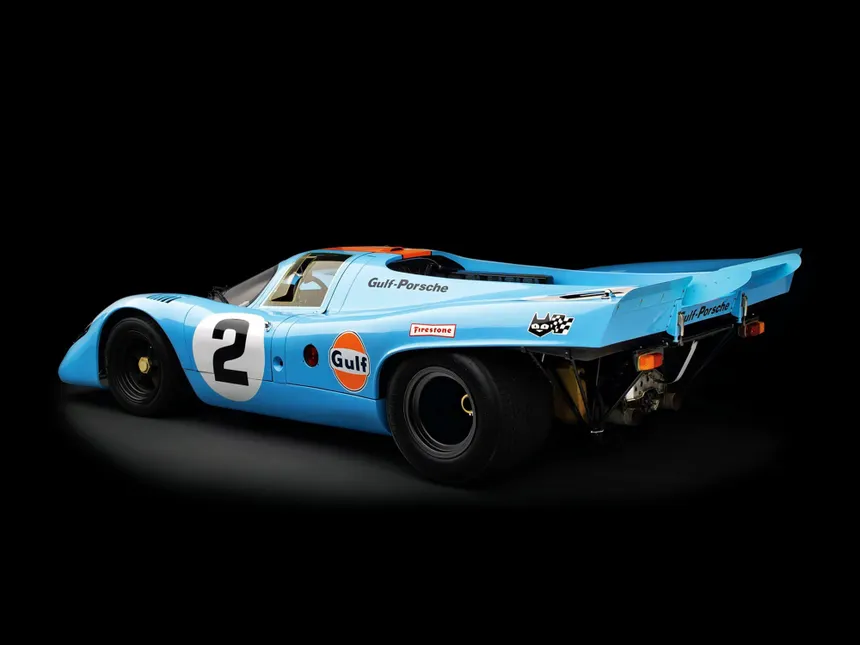
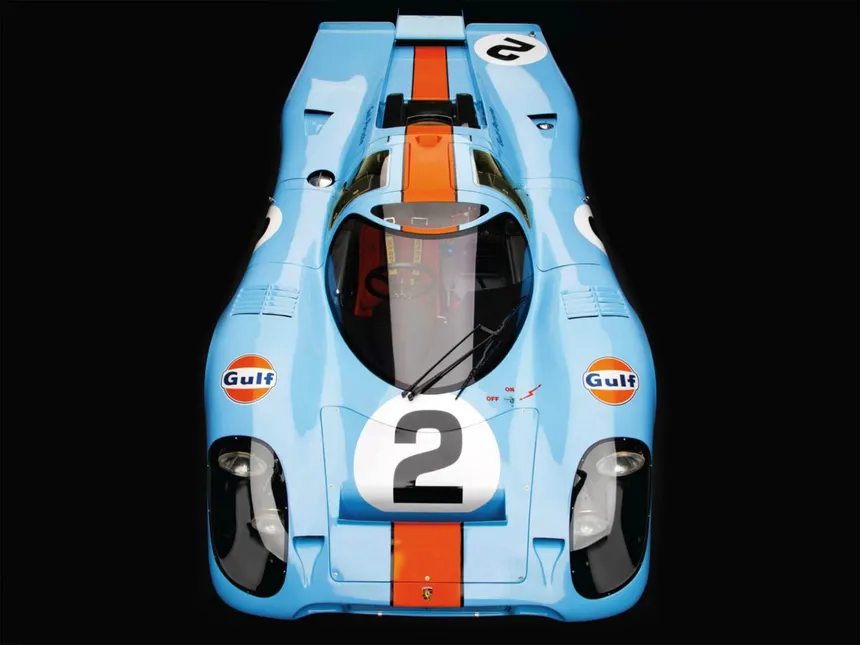
John Wyer’s Gulf-sponsored team and Porsche’s own engineers worked through 1969 developing the 917K (Kurzheck — short tail), which featured a dramatically revised rear end with a shorter, cut-off tail and a small spoiler. The improvement was transformative. The 917K was still brutally fast, but now it went where the driver pointed it. Mostly. The aerodynamic changes increased drag slightly, which cost some top speed, but the trade-off in stability and driver confidence was enormous. A fast car that drivers trust is faster than a faster car that drivers fear.
Le Mans 1970: The Victory That Changed Everything
Porsche had been chasing a Le Mans overall victory for years, coming agonisingly close multiple times. Second place in 1969 — behind a Ford GT40, no less — was particularly painful. The 917 was built specifically to end that drought, and the 1970 race would be the proving ground.
The 1970 Le Mans 24 Hours was a battle between Porsche’s 917s and Ferrari’s 512s — two of the most beautiful and powerful racing cars ever built, driven flat out for 24 hours on a circuit that included a 6 km straight where speeds exceeded 350 km/h. The entry list read like a who’s who of motorsport: Jo Siffert, Pedro Rodríguez, Brian Redman, Vic Elford, Jacky Ickx, Mario Andretti — legends driving machines that were barely controllable at full speed.
The race was dramatic, with mechanical failures and incidents thinning the field throughout the night. Hans Herrmann and Richard Attwood won in the red-and-white Porsche Salzburg 917K, completing 343 laps and covering 4,607.81 km. Porsche had its first Le Mans overall victory, and the floodgates opened.
For Herrmann, it was the perfect ending — he retired from racing after the victory, having finally won the race that had eluded him for years. For Porsche, it was the beginning of a dynasty that would see them become the most successful manufacturer in Le Mans history.
The following year, 1971, was even more dominant. The race became a showcase of Porsche superiority, with 917s filling the podium. Helmut Marko and Gijs van Lennep won in a magnesium-chassied 917K that was lighter and even more capable than the previous year’s winner. They covered a distance record of 5,335.16 km that stood for 39 years — until Audi broke it in 2010. They averaged over 222 km/h across 24 hours. On a track with minimal safety barriers and trees lining the road.
Let that sink in. Over 222 km/h average, including pit stops, driver changes, and the inevitable caution that night driving on an unlit circuit demands. The sustained pace was barely comprehensible then and remains barely comprehensible now.
The 917/30: When Porsche Lost All Restraint
If the 917K was the car that won Le Mans, the 917/30 was the car that broke Can-Am.
The Canadian-American Challenge Cup — Can-Am — was a North American racing series with minimal regulations. The rules were essentially: build the fastest car you can, and we’ll let you race it. This was like handing Porsche’s engineering department a blank cheque and telling them there were no rules. The result was predictably terrifying.
They turbocharged the flat-twelve to produce somewhere between 1,100 and 1,580 horsepower depending on boost settings and who’s telling the story. The lower figure was the “race” setting. The higher figure was what the engine could produce in qualifying trim with boost turned up to levels that made the engineers wince. Mark Donohue’s Penske-run 917/30 was so dominant in 1973 that it effectively killed the series — other teams simply couldn’t compete, and the series organisers changed the rules to ban the 917/30’s type of car.
The 917/30 was the most powerful racing car of its era. It could accelerate from 0 to 100 km/h and back to 0 in under five seconds. Donohue set a closed-course speed record of 355 km/h at Talladega in a 917/30, and the car was reputed to be capable of even higher speeds with more room to accelerate.
When one car is so dominant that an entire racing series changes its rules to stop it, you know you’ve built something exceptional. Or possibly something that shouldn’t exist. The 917/30 was probably both.
Steve McQueen and the Hollywood Factor
The 917’s legend was amplified enormously by its starring role in Steve McQueen’s 1971 film “Le Mans.” McQueen, who was a genuine racing driver and not merely a celebrity dabbling in motorsport, insisted on real racing footage and drove a 917 himself during production. The filming took place during the actual 1970 Le Mans race, with camera cars embedded in the field — a approach to filmmaking that was as dangerous as it was authentic.
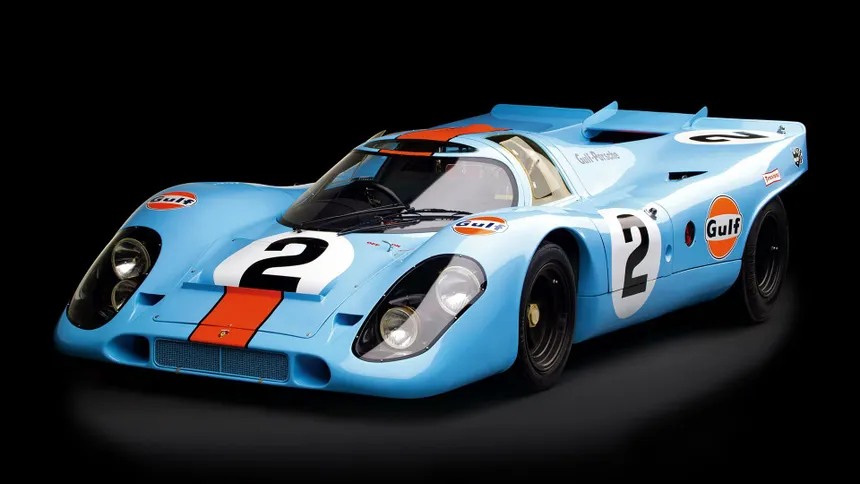
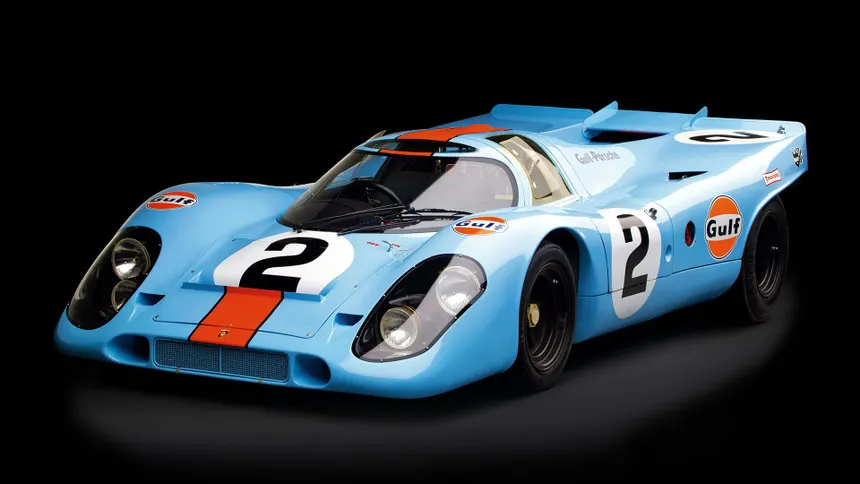
The film is slow by modern standards and has almost no dialogue, which has divided audiences since its release. But the racing sequences remain among the most authentic ever filmed, capturing the speed, the danger, and the visceral intensity of endurance racing in a way that no amount of CGI has ever replicated. The Gulf-liveried 917 from the film became arguably the most recognisable racing car in history — the combination of the light blue and orange colour scheme with the 917’s dramatic proportions created an image that transcended motorsport and entered popular culture.
McQueen later said that the 917 was “the closest thing to a fighter jet on four wheels.” Whether or not that’s an exact quote, the sentiment captures the car perfectly. The 917 was not a car you drove. It was a car you negotiated with, that you tried to convince to cooperate, and that occasionally decided to do exactly what it wanted regardless of your input.
The Human Cost
The 917 killed people. This is a fact that needs to be stated plainly, without romanticism or euphemism.
John Woolfe died in a privately-entered 917 on the first lap of the 1969 Le Mans race — the very event where the 917 was supposed to establish Porsche’s dominance. Pedro Rodríguez, one of the 917’s greatest and most fearless drivers, was killed racing a Ferrari 512M at Norisring in 1971. Jo Siffert, another 917 hero, died in a BRM at Brands Hatch that same year. The human cost of this era of motorsport is something we should acknowledge honestly rather than romanticise.
The 917 existed in a period when driver safety was an afterthought, when circuits were lined with trees and Armco barriers that were often more dangerous than the obstacles they replaced, and when the cars themselves were built with performance as the only priority. The drivers knew the risks. They accepted them. Many didn’t survive. Celebrating the 917’s achievements without acknowledging this reality would be dishonest.
Legacy: More Than Trophies
The 917 established Porsche as the dominant force in endurance racing, a position they’ve maintained on and off for five decades. The turbocharged technology developed for the 917/30 directly influenced the 930 Turbo road car — Porsche’s first turbocharged production vehicle. The engineering expertise gained from pushing the flat-twelve to its limits informed every subsequent Porsche racing programme, from the 936 to the 956/962 Group C cars to the modern 919 Hybrid.
But beyond the technical legacy, the 917 represents something that modern motorsport has largely lost: raw, unfiltered, genuinely dangerous speed. There were no driver aids, no telemetry streams to mission control, no simulation testing before the car hit the track. Engineers built the fastest car they could, drivers strapped in and hoped the physics would cooperate, and the rest was courage.
Some cars win races. The 917 conquered an era.
1 thought on “PORSCHE 917”