Renault Clio V6: the mid-engined hot hatch Americans can finally import
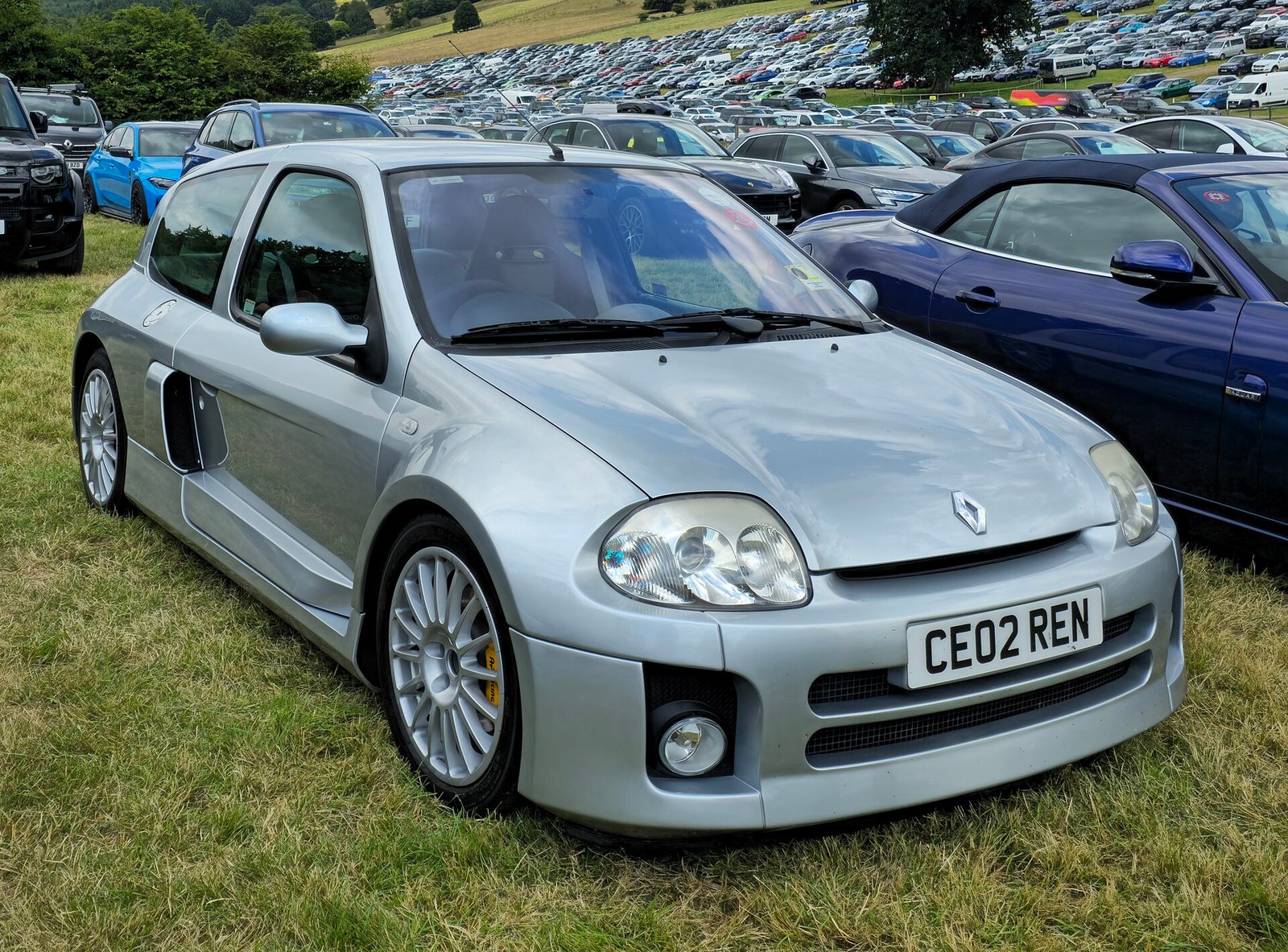
Here’s a date for American enthusiasts to circle: the first Renault Clio V6s were built in 2001, which means that in 2026 the earliest cars cross the 25-year line that lets vehicles never sold in the United States be imported without meeting federal safety and emissions standards. For a generation of Americans who only knew the car from European magazines and video games, a supermini with a V6 where the back seat should be is finally within legal reach.
If you’ve never heard of it, imagine someone at Renault taking the French equivalent of a Ford Fiesta, removing the rear seats and the trunk, and dropping a three-liter V6 behind the driver. Then selling it to the public. That’s the Clio V6.
In short: the Renault Clio V6 was a Clio with a three-litre V6 mounted behind the front seats and rear-wheel drive, born from the Clio V6 Trophy race series of 2000. TWR built the Phase 1 road cars at Uddevalla in Sweden from 2001; Renault Sport later built the improved Phase 2. In the US, the earliest cars become importable under the 25-year rule in 2026, and Phase 2 cars from 2028.
How the 25-year rule works
The rule that makes this possible is worth explaining, because it shapes the whole American market for European cars. Federal law generally bars the import of vehicles that weren’t built to US safety standards. But NHTSA exempts vehicles at least 25 years old, counted from the month of manufacture, and the EPA has a similar exemption for older vehicles. That’s why each new year brings a fresh wave of Japanese and European cars that were never sold in America, from Nissan Skyline GT-Rs to Lancia Deltas. Buyers still have to deal with state registration rules, and California is notably stricter than most. But for a Clio V6 built in 2001, the federal door opens in 2026, and Phase 2 cars follow from 2028.
Born for a race series
The road car existed because of racing. In 2000 Renault launched a one-make championship, the Clio V6 Trophy, to replace its successful Clio Williams Trophy series. The idea was outrageous: a Clio body with a mid-mounted V6 and rear-wheel drive, built purely to give spectators a show and young drivers a training ground.
To justify the race car, Renault wanted a road version, and it didn’t have the capacity to build such a radical car in small numbers itself. So it turned to Tom Walkinshaw Racing, the British group that had won Le Mans with Jaguar and built special vehicles for several manufacturers. TWR would assemble the road car, in a plant at Uddevalla in Sweden.
The Trophy: a school for young drivers
The Clio V6 Trophy ran from 2000 to the mid-2000s on circuits across Europe, and it was a spectacle. The race cars made well over 250 hp, weighed less than the road version and ran on slicks. Grids were full, cars were identical, and the difference came down to the driver. With a short wheelbase and the engine just ahead of the rear wheels, any mistake under braking or on corner entry was magnified, and the races were full of contact, spins and late lunges. Several drivers who learned to tame the Trophy cars went on to professional careers in touring cars and endurance racing. For spectators it was one of the most entertaining one-make series in Europe; for the drivers, a crash course in car control.
Phase 1: the wild one
The first version, known as Phase 1, reached customers in 2001. The engine was the L7X, a 3.0-liter, 24-valve V6 from Renault’s own catalog, the same basic engine used in the Laguna, Espace minivan and Safrane sedan. In the Clio it made around 230 PS, about 227 hp, and 300 Nm, or roughly 221 lb-ft, driving the rear wheels through a six-speed manual. The car weighed about 1,335 kg, around 2,940 lb, and Renault quoted 0 to 100 km/h in about 6.4 seconds and a top speed of 235 km/h, or 146 mph.
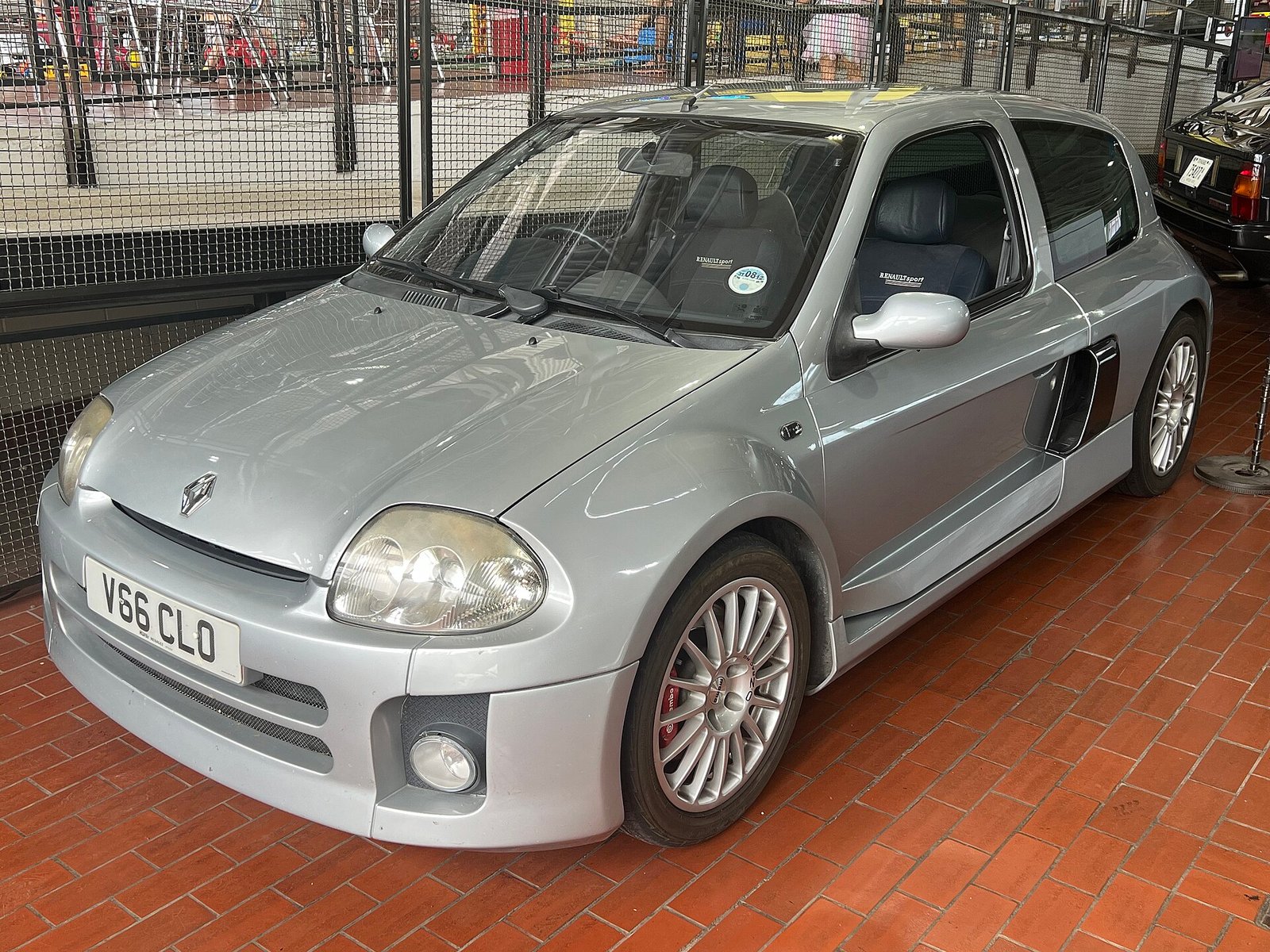
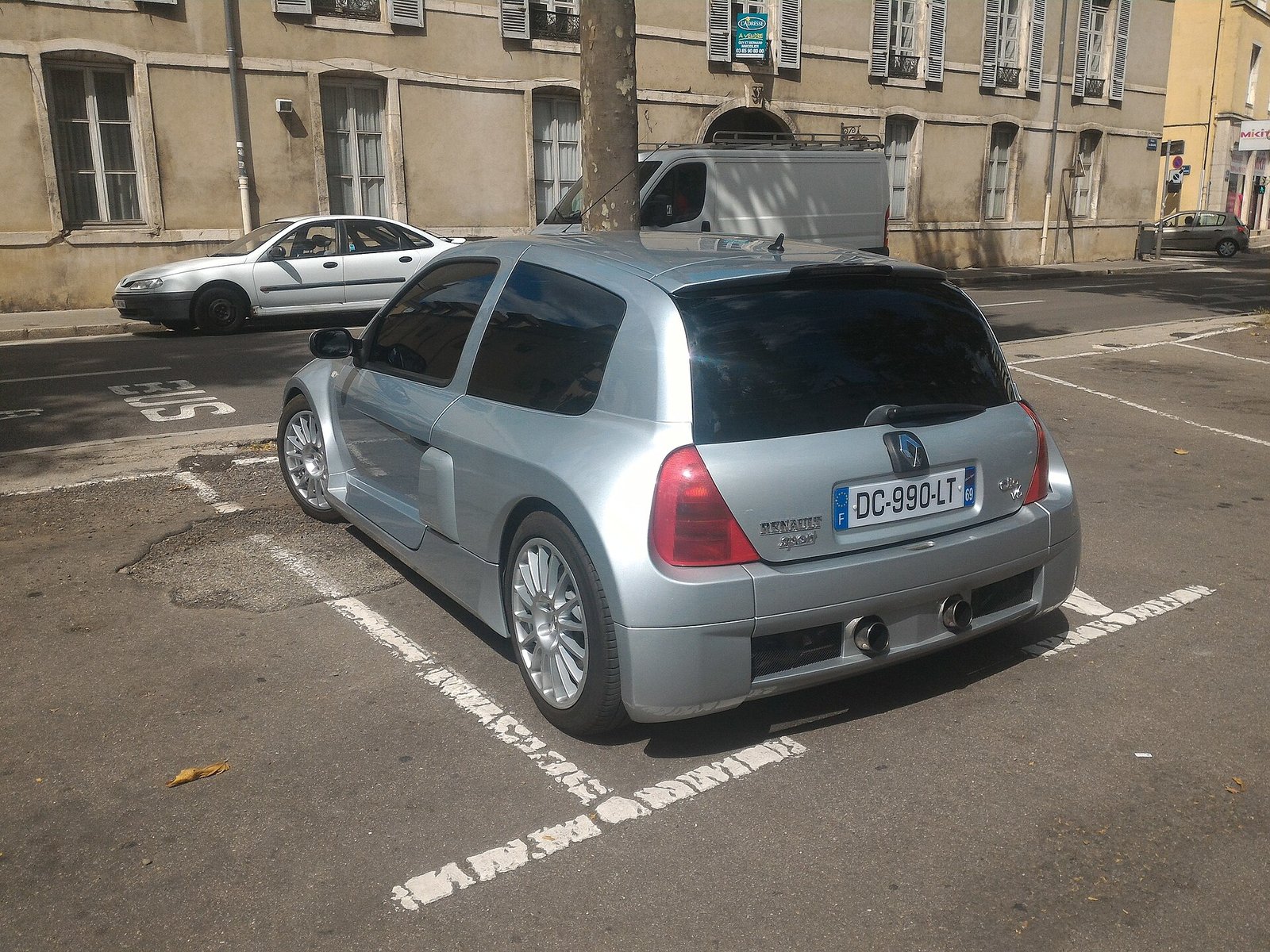
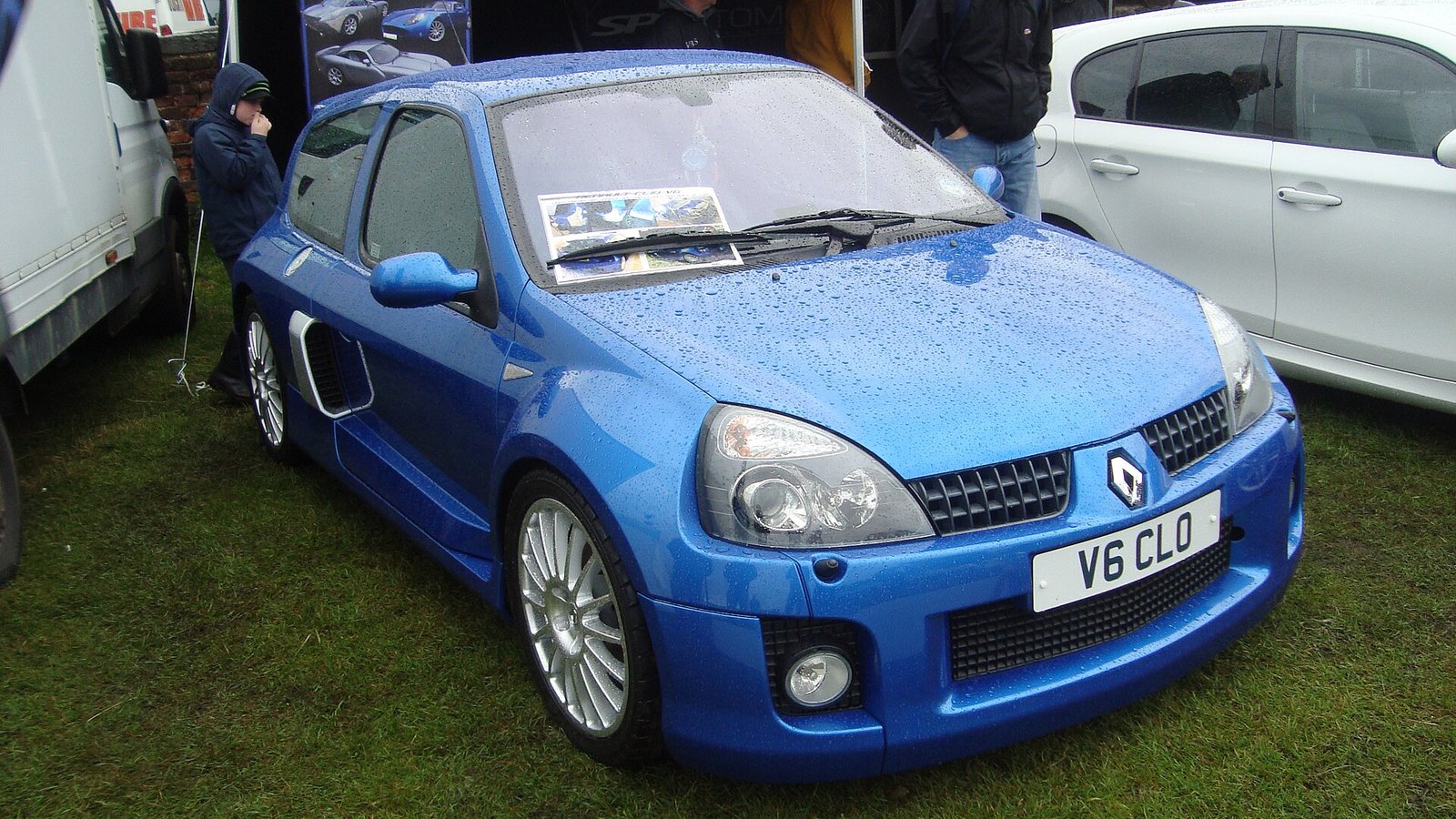
To fit all that, Renault widened the body dramatically, with huge rear fenders that looked like they belonged on a rally car and air intakes in front of the rear wheels feeding the engine. The rear structure was rebuilt to hold the V6 and its transmission. Apart from the front doors, the windshield and parts of the roof, very little was shared with a normal Clio.
The car that bit back
Phase 1 quickly earned a reputation. With a heavy engine sitting just ahead of the rear axle and a short wheelbase inherited from the Clio, the car was very sensitive to weight transfer. It could understeer into a corner and then, if the driver lifted off or braked mid-turn, snap into oversteer with little warning. Magazines warned readers. Racers in the Trophy series said it demanded total respect. It wasn’t a car for beginners.
TWR collapses
Then the builder disappeared. TWR went into administration in 2002, leaving Renault with a limited-production car and no factory. Renault moved production in-house to Renault Sport and the Alpine plant at Dieppe, in Normandy, the historic home of the Alpine A110. And rather than simply continue, it used the opportunity to fix the car.
Phase 2: the better one
Phase 2 arrived in 2003. Power rose to about 255 PS, roughly 251 hp. The rear track was widened, the suspension geometry was revised and the springs, dampers and anti-roll bars were retuned. The front end got a new look, matching the facelifted Clio, with new lights and wheels. Renault quoted 0 to 100 km/h in 5.8 seconds and a top speed around 246 km/h, or 153 mph.
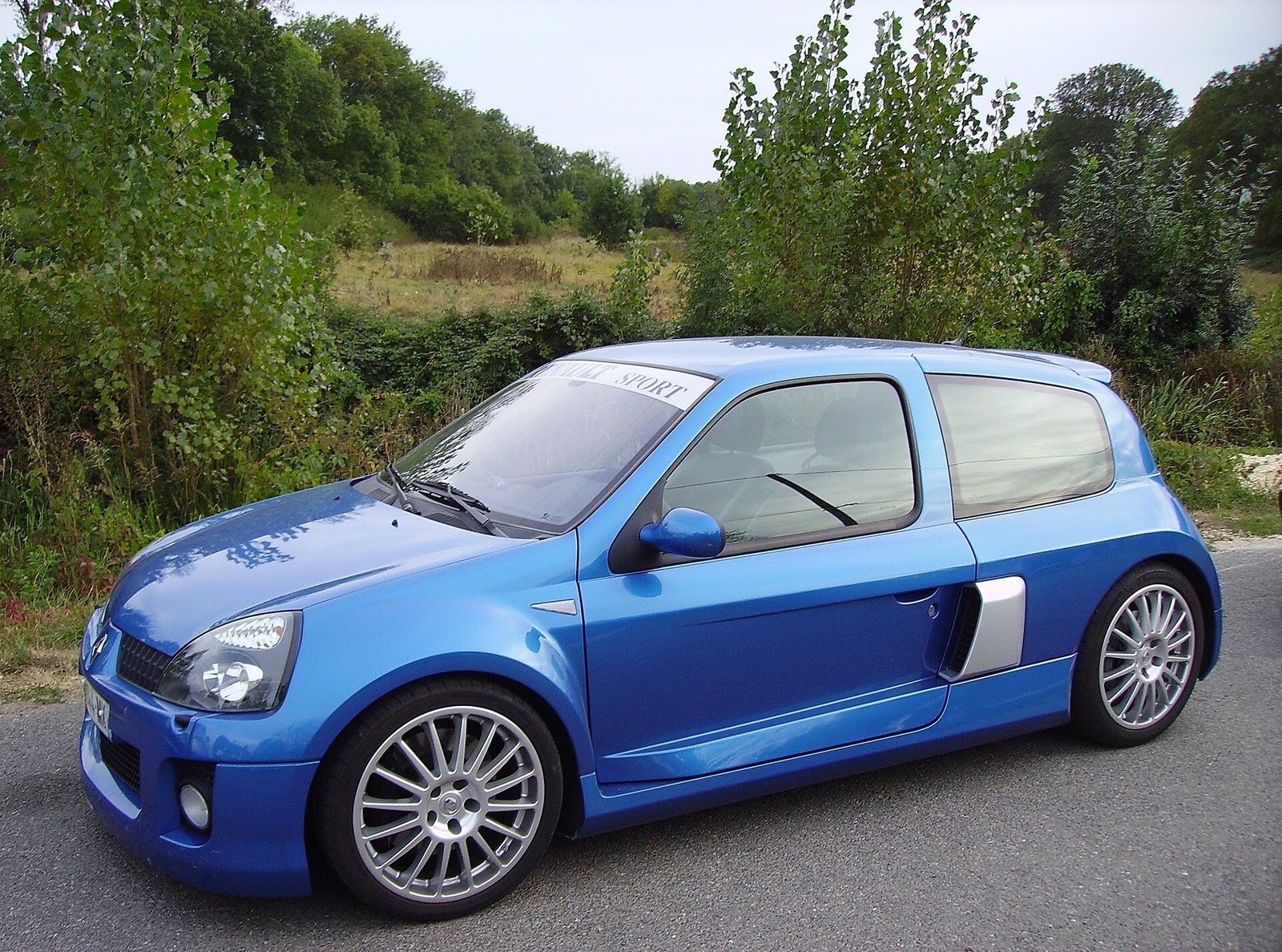
The difference was more than numbers. Phase 2 was much more progressive at the limit. It was still a demanding car, but it now warned the driver before it tried to swap ends.
How rare
About 1,500 Phase 1 cars and about 1,300 Phase 2 cars were built, fewer than 3,000 in total. Renault was building hundreds of thousands of regular Clios a year at the time. Most Renault dealers in Europe never had a V6 on the showroom floor. Britain, with its strong hot-hatch culture, was one of the car’s important markets, so right-hand-drive cars make up a meaningful share of the survivors. American buyers who want left-hand drive will mostly be looking in France, Germany and the rest of continental Europe.
How the conversion was done
Turning a Clio into a Clio V6 wasn’t a matter of squeezing an engine into a hole. The rear of the body was cut away and rebuilt around new subframes that carried the engine, transmission and rear suspension. Cooling pipes ran along the sides of the car to radiators at the front, fed by the distinctive intakes. The fuel tank was moved, the exhaust redesigned, the brakes upgraded and the wheel arches flared to cover much wider tracks. The result was about 17 centimeters, nearly seven inches, wider than a normal Clio. Each car took far longer to build than a standard Clio, which is one reason so few were made and why they were so expensive.
An American cousin: the Fiero
Americans had their own version of the "mid-engine economy car" idea two decades earlier. The Pontiac Fiero of 1984 put a small engine behind the seats of an inexpensive two-seater built from GM’s parts bin. It was cheap, quirky and plagued by early reliability problems, including engine fires on some four-cylinder cars, before GM fixed most of its flaws in 1988, its final year. Like the Clio V6, the Fiero was a reminder that putting the engine in the middle of a cheap car is easy to sketch and very hard to do well.
The difference is that the Clio V6 was never meant to be cheap. In Europe, it cost roughly as much as a Porsche Boxster S or a BMW M3 of the same period, more than twice the price of a regular Clio Renault Sport.
Why buy one instead of a Boxster
That was the question every journalist asked. For the same money, you could buy a proper sports car with better handling and a more prestigious badge. The answer was that none of those cars was a Clio V6. Nothing else offered the same combination of everyday-car shape, absurd engineering, rarity and theater. It was a car bought with the heart, not the head, and that’s exactly why it’s become collectible.
The same idea, twenty years apart
The Clio V6 had a famous ancestor: the Renault 5 Turbo of 1980. Renault took its small, front-engined city car, put a turbocharged engine behind the front seats, drove the rear wheels and went rallying. The R5 Turbo won world championship rallies and became a legend. The Clio V6 was built on the same philosophy two decades later, and both carried the same reputation: brilliant, intimidating, and not for the timid.
The minivan engine paradox
What makes the Clio V6 fascinating is that its engine wasn’t a racing unit. The L7X was designed for refinement in sedans and minivans. It had no turbo and no exotic internals. It was smooth, quiet and civilized in an Espace.
Put the same engine a few inches behind the driver’s head in a car less than four meters long, and it became something else entirely. The intake noise from the side vents, the sound bouncing around a tiny cabin, the way the whole car responded to the throttle: the context transformed it. It’s a good lesson in engineering. Sometimes the experience comes not from the parts, but from where you put them.
Renault’s other mad idea
The Clio V6 wasn’t the first time Renault did something like this in the 1990s. In 1994, to celebrate its Formula 1 success with Williams, Renault built the Espace F1: a minivan shell over a carbon-fiber chassis with a Williams F1 V10 behind the front seats. It was a one-off show car, not a production model, but it showed the same mindset: take the most ordinary family vehicle in the range and give it an engine that has no business being there. The Clio V6 was that idea made real, in a car ordinary people could buy.
Renault Sport’s golden age
The Clio V6 also belongs to a remarkable run of performance cars from Renault Sport. The Clio Williams of 1993 had already become a cult hot hatch. The Clio RS 172 and 182 of the early 2000s were among the best-handling small cars of their time, and the Mégane RS models that followed set lap records at the Nürburgring for front-wheel-drive cars. In that family, the V6 was the wild one: less practical, less precise, but more dramatic than anything else Renault sold. It showed that the engineers in Dieppe and Les Ulis were willing to try almost anything.
Living with one
Owning a Clio V6 is not like owning a regular old car. With the engine squeezed into the middle of the car, ordinary jobs become complicated. Changing the timing belt, a routine service on a Laguna, takes many more hours. The cooling system, with pipes running the length of the car, needs care. Parts specific to the V6, like the rear subframes and engine mounts, are scarce and expensive. Most owners rely on specialists rather than ordinary dealers. For an American importing one, that means finding a specialist before finding the car.
Driving one today
Modern testers who drive a well-sorted Clio V6 tend to say the same things. The driving position is high, because the seat sits on a body designed for a supermini. The steering is quick. The V6 pulls smoothly rather than explosively, with a hard-edged sound from just behind your shoulders. The gearshift is long. And the car always reminds you where its weight is. A Phase 2 on good tires is approachable and hugely entertaining on a twisty road; a Phase 1 rewards a smooth, patient driver and punishes an abrupt one. Neither feels anything like a modern hot hatch, and that’s exactly the point for the people who buy them.
What they’re worth
The market has caught up with the Clio V6’s reputation. In Europe, good Phase 1 cars regularly sell for well over 50,000 euros, and exceptional examples have gone for considerably more. Phase 2 cars, widely seen as the better car to drive, sell for similar or higher prices. For a car based on a Clio, that’s extraordinary, but the Clio V6 was never really a Clio. It was a racing car wearing a supermini’s clothes.
Why it matters
The Clio V6 is proof that fearless engineering creates the most memorable cars. It wasn’t the fastest car of its time, or the most refined. It was the craziest, the one no risk committee would approve today. Renault built a car that made no practical sense, was genuinely tricky for an average driver, and was made in numbers so small most people will never see one.
For American enthusiasts, that may finally change. Now that the 25-year rule has opened the door, a few of these cars are likely to cross the Atlantic. If you see one at a cars and coffee, take a look at the side vents, listen to the V6 behind the seats, and remember that this started as a little French grocery-getter.
Renault Clio V6 FAQ
Can you import a Renault Clio V6 to the US?
Yes, under the 25-year rule. The first Clio V6s were built in 2001, so the earliest Phase 1 cars become eligible in 2026 and Phase 2 cars from 2028. State registration rules, especially in California, still apply.
Who built the Renault Clio V6?
The Phase 1 road car was assembled by Tom Walkinshaw Racing at a plant in Uddevalla, Sweden. After TWR collapsed, Renault Sport took over for the Phase 2.
Why does the Clio V6 have its engine in the middle?
Because it was created for a one-make race series, the Clio V6 Trophy, launched in 2000. The rear seats and boot were removed to fit a three-litre V6 ahead of the rear wheels, driving the rear axle.
Check you’re still alive.
Photos via Wikimedia Commons: 2002 Clio V6, Calreyn88 (CC BY-SA 4.0); Clio V6 at the Lane Motor Museum, TaurusEmerald (CC BY-SA 4.0); Clio V6 Phase 2, Cjp24 (CC BY-SA 4.0); Clio V6, Guillaume Vachey (CC0); 2005 Clio V6 255, Kieran White (CC BY 2.0).