Renault Clio V6: The Grocery Car That Swallowed a Minivan Engine and Became a Legend

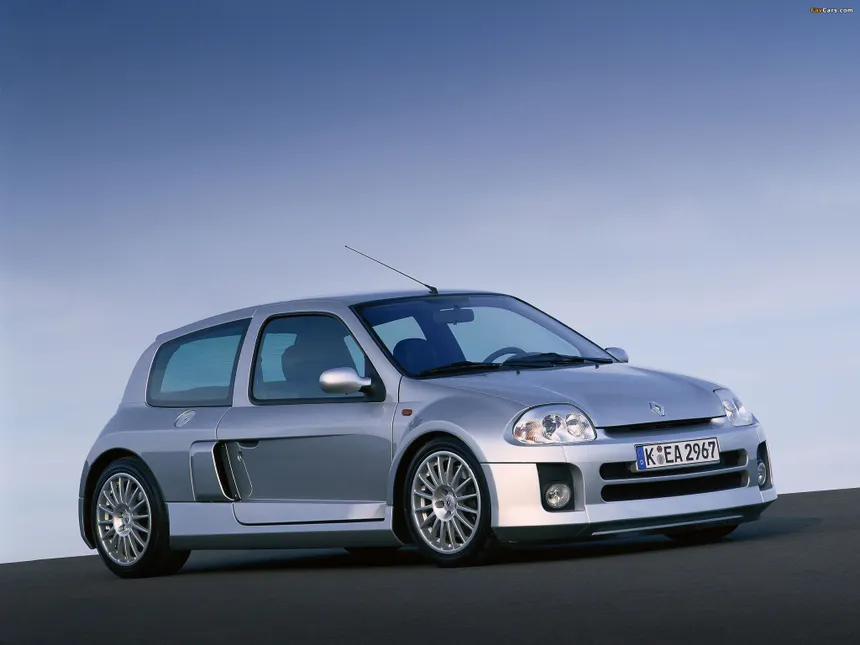
There are engineering decisions that defy logic. There are projects that should never have made it past a sketch on a napkin. And then there is the Renault Clio V6: a supermarket runabout from which someone at Renault decided to rip out the rear seats, the boot, and any trace of common sense in order to shoehorn a 3.0-litre V6 into the space behind the driver.
It was not a styling exercise. It was not a motor show concept car. It was a production vehicle that Renault sold to ordinary citizens, with a registration plate, insurance, and the very real possibility of killing yourself at the first roundabout if you did not understand what you were driving.
This is its story. And if you do not know it in full, brace yourself.
The Origin: When Racing Overrides Reason
The Clio V6 was not born as a road car. It was born as a racing car with a clear purpose: the Clio V6 Trophy, a one-make cup that Renault launched in 2000 to succeed the Clio Williams Trophy. The idea was simple in its madness: a mid-engined, rear-wheel-drive Clio II serving as a platform for a spectacular racing series.
The problem — or the stroke of genius, depending on your perspective — is that to homologate that racing car, Renault needed to produce a road-legal version. And this is where the story gets interesting.
Renault lacked internal capacity to produce such a radical car in limited numbers. The solution was to bring in Tom Walkinshaw Racing (TWR), the British outfit that had already worked with Jaguar at Le Mans and had experience in specialist vehicle production. TWR would handle the transformation of a standard Clio II into the mid-engined beast Renault had conceived.
Phase 1 (2001–2003): The Untamed Beast
The first generation Clio V6, known as Phase 1, hit the market in 2001. The numbers speak for themselves:
- Engine: 3.0-litre V6 24-valve (code L7X), transversely mid-mounted
- Power: 227 bhp at 6,000 rpm
- Torque: 221 lb-ft at 3,750 rpm
- Weight: 1,335 kg (2,943 lbs)
- Drivetrain: Rear-wheel drive
- 0–62 mph: 5.8 seconds
- Top speed: 146 mph
- Transmission: 6-speed manual
The L7X engine was the very same V6 block that Renault used in models as mundane as the Laguna, the Espace, and the Safrane. An engine designed to ferry families to the shopping centre in silence. Renault took that same engine, rotated it 180 degrees, planted it where the rear seats and grocery bags should have been, and created one of the most brutal hot hatches ever manufactured.
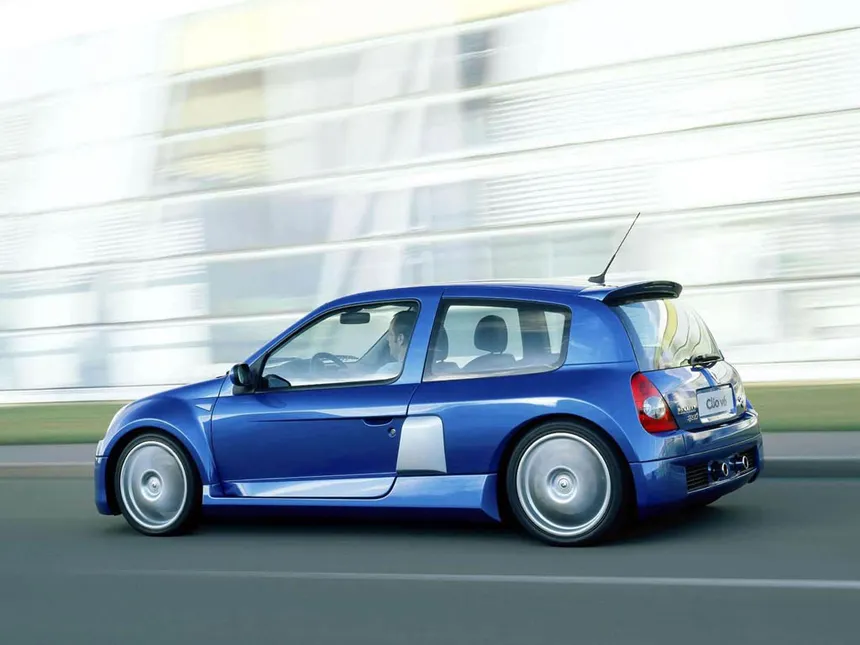
The bodywork was widened by 23 centimetres over the standard Clio II. The rear arches looked like something from a Group B rally car — bulging, aggressive, necessary to cover a rear axle that now housed an entire engine and transmission. The lateral air intakes, just ahead of the rear wheels, fed that V6 roaring centimetres from the driver’s head.
But there was a problem. A serious one.
The Car That Wanted You Dead
The Phase 1 Clio V6 quickly earned a reputation: it was a car that tried to kill you. With the heavy engine mounted behind the rear axle — in overhang — the weight distribution was rear-biased. Combined with the short wheelbase inherited from the Clio II, the result was treacherous handling dynamics.
Understeer on corner entry would transform into sudden, violent oversteer the moment weight transferred to the rear axle. Without warning. Without progressive transition. The car would go from tracking straight to attempting to spin on its own axis in an instant. Specialist journalists documented it quickly. Jeremy Clarkson crashed one during a Top Gear test. Several Trophy drivers remarked that the car demanded absolute respect.
This was not a car for inexperienced drivers. This was not a car for everyone. It was a car that reminded you, at every corner, that you had a minivan V6 mounted where the luggage should have been.
The Fall of TWR and Production Chaos
Midway through Phase 1 production, something happened that further complicated the story: TWR entered administration in 2002. Tom Walkinshaw Racing, the group that had taken Jaguar to Le Mans victory, that had produced vehicles for Holden, Volvo, and now Renault, collapsed financially.
This left Renault with a limited-production car and no manufacturer. The solution was to take production in-house, through Renault Sport and the Alpine factory at Dieppe, France. But they did not simply continue building the same car. Renault seized the opportunity to correct the Phase 1’s flaws.
The result was Phase 2.
Phase 2 (2003–2005): The Redemption
The second phase of the Clio V6 arrived in 2003 with changes that went far beyond cosmetics:
- Power: 252 bhp at 6,000 rpm (25 bhp more)
- Torque: 229 lb-ft at 3,750 rpm
- Weight: Approximately 1,400 kg (3,086 lbs)
- Wider rear track for improved stability
- Completely revised suspension with new geometry
- 0–62 mph: 5.8 seconds
- Top speed: 153 mph
The Phase 2 engineering work focused on taming the animal. The wider rear track, combined with recalibrated springs, dampers, and anti-roll bars, transformed the car’s behaviour. The sudden oversteer of the Phase 1 gave way to a more progressive, communicative, manageable character. It was still a demanding car, but now it gave warning before trying to rotate you.
Aesthetically, the Phase 2 featured redesigned bumpers, new rear lights, and different alloy wheels. But the real change was underneath: it was a fundamentally better car.
Production Numbers: Absolute Rarity
The Clio V6 was never a mass-production car. It is estimated that approximately 1,500 Phase 1 units and around 1,300 Phase 2 units were built, for a combined total of fewer than 3,000 cars worldwide.
For perspective: Renault sold hundreds of thousands of Clio IIs every year. The V6 represented a microscopic fraction of production, a car that most Renault dealers never had on their showroom floor. Each unit was essentially hand-built, in a process that required completely dismantling the rear structure of a standard Clio II to reconfigure it as an engine bay.
No Direct Rivals: A Car Without a Category
One of the most curious aspects of the Clio V6 is that it had no direct competitors. No other car on the market offered the same proposition: a compact-bodied supermini with a mid-mounted V6 and rear-wheel drive.
In the Phase 1’s price bracket — approximately €45,000 at launch — a buyer could choose a Porsche Boxster S, a BMW M3 E46, or a Lotus Elise. Legitimate sports cars, with similar or superior performance. Why would anyone choose a Clio V6?
The answer was simple: because none of those cars was a Clio V6. None offered the combination of conceptual madness, production exclusivity, and sensory brutality that the little Renault provided. Buying a Clio V6 was not a rational decision. It was a statement of identity. It was choosing experience over logic, character over numbers.
And that absence of direct competition is precisely what has made the Clio V6 so valued today. It was not a model within a category. It was a category unto itself.
The Physical Transformation: From Clio to Beast
The conversion process from a standard Clio II to a Clio V6 deserved an engineering documentary in its own right. This was not simply a matter of fitting an engine into a gap. The Clio II’s rear structure was cut and completely rebuilt to accommodate the V6 block and its transmission.
The rear subframes were bespoke components, designed exclusively for the V6. The cooling system required additional ducting running along the car’s flanks, fed by the air intakes that defined the exterior profile. The fuel tank was repositioned. The exhaust system was completely redesigned.
The result was a car that shared little more with the standard Clio II than the front doors, windscreen, and part of the roof. Everything else was specific. This manufacturing complexity is the primary reason production never exceeded a few hundred units per year, and why each Clio V6 cost three times more than a Clio RS of the same era.
The Minivan Engine Paradox
One of the most fascinating details about the Clio V6 is the provenance of its engine. The L7X was a naturally aspirated V6 designed to provide refinement and smoothness in saloons and people carriers. It was not a competition engine. It had no turbocharger, no aggressive variable valve timing, no forged internals as standard. It was a comfortable, civilised engine built for urban traffic.
And yet, mounted in the centre of a car less than four metres long, it became something entirely different. The sound changed. The response changed. At 6,000 rpm, with the lateral air intakes howling centimetres from your ear, that Espace engine transformed into something visceral.
This is the paradox of the Clio V6: it did not need a racing engine to be thrilling. It needed the right context. Position, proximity, a chassis that amplified every revolution. Placement engineering turned an ordinary engine into an extraordinary experience.
The Shared DNA: From R5 Turbo to Clio V6
The Clio V6 was not the first time Renault committed this madness. Two decades earlier, in 1980, they had done exactly the same thing with the Renault 5 Turbo: take an urban runabout and transform it into a mid-engined weapon. The philosophy was identical. The DNA was the same. Renault had an addiction: turning shopping cars into track monsters.
The R5 Turbo won rallies. The Clio V6 won one-make cups and the hearts of a generation of enthusiasts. Both paid the same price: a reputation for being difficult, dangerous cars that demanded absolute respect.
Current Market: Prices Are Skyrocketing
The Clio V6 has become one of the most sought-after collector cars of its generation. Phase 1 models in good condition regularly trade above €50,000, and exceptional examples have exceeded €80,000 at auction. Phase 2 models, considered the better car due to their dynamic improvements, fetch similar or higher figures.
For a car based on a Clio, these prices are stratospheric. But the Clio V6 was never a Clio. It was a competition car with a supermini body, and the market has taken twenty years to recognise its true worth.
The Ownership Reality: Not for the Faint-Hearted
Owning a Clio V6 is not like owning any other classic car. Maintaining the mid-mounted V6 turns every workshop operation into a logistical challenge. Changing the rear spark plugs requires accessing an engine boxed into a space not designed to house a V6. Replacing the timing belt — a routine job on a Laguna — becomes an intervention that can take twice the hours on the Clio V6.
The cooling system, with its ducting extended along the car’s flanks, is prone to leaks if not rigorously maintained. The brakes, dimensioned for a car significantly heavier than any Clio should be, require constant attention. And the suspension, particularly on Phase 1 models, needs a specialist who understands the car’s specific geometry.
Generalist Renault workshops rarely have experience with the V6. Most owners rely on independent specialists or the Renault Sport network. V6-specific components — subframes, engine mounts, cooling ducts — have limited availability and prices that reflect the car’s exclusivity.
None of this deters owners. Quite the opposite. The maintenance difficulty is part of the mystique. A well-maintained Clio V6 is a testament to its owner’s commitment. It is not a car that sits in a garage. It is a car that demands attention, dedication, and knowledge. And in return, it delivers a driving experience that no other car of its era can replicate.
What the Clio V6 Represents
The Renault Clio V6 is proof that fearless engineering produces the most memorable cars. It was not the fastest of its era. Not the most expensive. Not the most refined. It was the maddest. It was the car that no risk committee would approve today, that no legal department would let through, that no market study would recommend.
And that is precisely why it is legendary.
Because in an industry obsessed with safety, efficiency, and consensus, Renault built a car that defied all three at once. A car with no practical purpose, objectively dangerous for an average driver, manufactured in such small numbers that most people will never see one on the road.
That is not a product. That is a statement of intent.
227 bhp. Then 252. A minivan engine. A supermini chassis. Mid-mounted. Rear-wheel drive. No meaningful traction control. Fewer than 3,000 units.
The Renault Clio V6 was not a reasonable car.
It was a necessary one.
Now check you are still alive.
1 thought on “RENAULT CLIO V6”