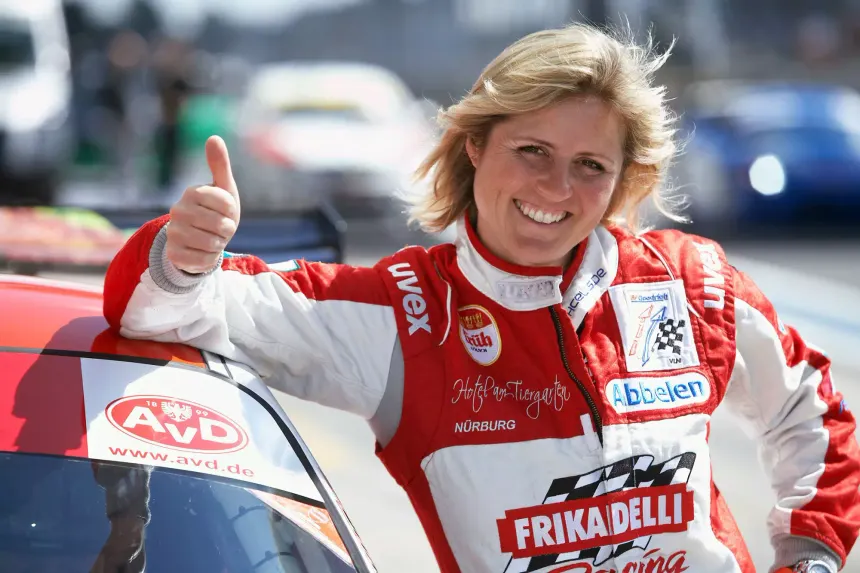
Sabine Schmitz: The Queen of the Green Hell
Over 30,000 laps of the Nordschleife. Two outright victories at the Nürburgring 24 Hours. A Ford Transit van pushing the 10-minute barrier at the most dangerous circuit on Earth. And a driver who never needed anyone to hand her anything.
Born Inside the Circuit
Some drivers discover the Nürburgring. Others are born inside it.
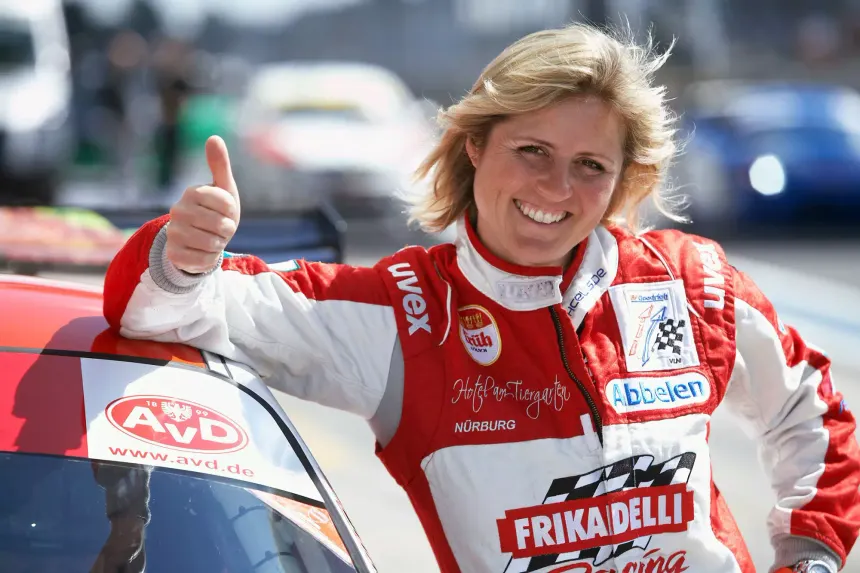
Sabine Schmitz was born on May 14, 1969, in Adenau, a small town in the Eifel region of Rhineland-Palatinate, Germany. Her family ran the Hotel am Tiergarten in the village of Nürburg, just 300 metres from the Nordschleife entrance. The hotel basement housed the Pistenklause restaurant, a regular gathering spot for Grand Prix drivers who competed at the Nürburgring when Formula 1 still visited the original layout. Alberto Ascari, Nelson Piquet, and other legendary names all sat at the family’s tables.
Sabine’s first lap of the Nordschleife came in the back seat of her father’s BMW. She was six months old. If she could have talked, she probably would have told him to go faster.
From childhood, speed was not a hobby — it was a constant. Roller skates, bicycles, horses — everything had to be fast. By 13, Sabine had already decided she wanted to be a racing driver. At 17, she took her mother’s BMW and showed up at the Nordschleife. She did not have a driving licence. She told the gate attendant she was old enough to enter. It was her first lie to the Nürburgring. It would not be the last time the circuit saw her arrive with more determination than paperwork.
All three Schmitz sisters started racing in local events. Only Sabine kept going.
The Nordschleife: 20,832 km of Unfiltered Truth
To understand Sabine Schmitz, you first have to understand where she competed.
The Nürburgring Nordschleife — the “Green Hell,” as Jackie Stewart called it — is a 20.832-kilometre track that winds through the forests of the Eifel mountains. It has 73 corners, approximately 300 metres of cumulative elevation change, and weather conditions that can shift from dry to torrential rain within a single lap. There are sections where cars go airborne. There are blind crests where the road disappears and only memory tells you where to turn the wheel.
It is not a circuit. It is a 20-kilometre exam repeated every lap, and it does not forgive a single mistake.
The Nordschleife has been open to the public since 1927. Anyone with a car and a toll fee can drive it during Touristenfahrten sessions. But driving and racing are two radically different things. And racing for 24 consecutive hours, with mixed traffic, changing light conditions, and unpredictable weather, is an entirely different category of madness.
Sabine Schmitz did not just race there. She lived there. She trained there. And she dominated the circuit like no one before or since.
The Early Years: From the Ford Fiesta to the BMW M3
Sabine professionally trained in hotel management and became a certified sommelier, following the family tradition. But the track pulled harder than any restaurant ever could.
Her first victories came in the Nürburgring Circuit Challenge (then called the Castrol-HAUGG Cup), where she won three rounds in 1990 and 1991 driving a BMW M3. In 1992, she won the overall Ford Fiesta Mixed Cup championship, a production-based series that demanded precision and consistency above all else. It was a minor category, but Sabine was already learning to extract every horsepower from whatever car was put in front of her.
In 1995, under her married name — Sabine Reck — she travelled to South Africa to compete in the AA Fleetcare Super Touring Championship with BMW SA Motorsport, driving an E36 touring car. The experience was tough: unfamiliar circuits, teammates with years of local track knowledge, and a crash at Killarney that left her with neck injuries and a damaged right knee, forcing her to miss three consecutive race meetings. She finished last in the Class A standings, with no wins, pole positions, or fastest laps.
The South African failure did not slow her down. It made her stronger. And in 1996, Sabine returned to the only place that truly mattered.
1996–1997: The First Woman to Win the Nürburgring 24 Hours
The Nürburgring 24 Hours is one of the most brutal endurance races on the planet. It is not Le Mans, where top speed and fuel strategy dominate the game. At the Nürburgring, the race is run on the combined layout that includes the full Nordschleife — over 25 kilometres per lap, with traffic from every category on track simultaneously. Day, night, fog, rain, sun. 24 hours of no rest for the car or the nerves.
In 1996, Sabine Reck — her married name at the time — teamed up with Johannes Scheid, a local veteran from nearby Kottenborn, in a BMW M3 E36 3.2-litre Group N car prepared by Scheid Motorsport. Group N is the category closest to production specification: standard engine, suspension limited to homologated modifications, standard weight. No aerodynamic tricks, no exotic engine maps. Pure driver against tarmac.
They won. Overall.
Sabine Schmitz became the first woman in history to win an international 24-hour endurance race outright. Not a category. Not a class. The overall.
In 1997, they did it again. Same team, same car, same result. Two consecutive outright victories at the Nürburgring 24 Hours. To this day, no other woman has won this race.
Think about what that means. This is an event where factory-backed teams with multimillion-euro budgets, professional drivers with decades of experience, and cars purpose-built to endure 24 hours at maximum intensity all compete. And a woman from an Eifel village, with a Group N M3 and a local mechanic, beat them all. Twice.
1998: VLN Champion
If the 24 Hours proved Sabine could win the hardest race, the 1998 season proved she could win an entire championship.
The VLN (Veranstaltergemeinschaft Langstreckenpokal Nürburgring) is the endurance series run exclusively on the Nordschleife throughout the season. The races last 4 to 6 hours, with the same mixed format and the same demands as the 24 Hours, but repeated month after month. Winning one race is hard. Winning the championship requires absolute consistency across the entire season.
In 1998, still teamed with Johannes Scheid, Sabine became the first woman to be crowned VLN champion. It was not an isolated result or a stroke of luck. It was confirmation that her mastery of the Nordschleife was real, repeatable, and sustained.
The Ring-Taxi: 30,000 Laps and a Passenger Seat
Alongside her competitive career, Sabine became one of the drivers of the legendary BMW Ring-Taxi.
The concept was simple: an official BMW M5, lightly prepared for track use, with a professional driver at the wheel and a paying passenger along for the ride of their life. One full lap of the Nordschleife at racing pace, with a driver who knew every bump, every crest, and every braking point on the longest and most dangerous track in the world.
Sabine drove the Ring-Taxi from its early days until 2011, when she left BMW’s official service to operate her own “Speedbee Racetaxi” using a Porsche GT3 RS. By her own estimates, she had completed over 20,000 laps of the Nordschleife by 2010, at a rate of approximately 1,200 laps per year. Later sources put the career total at over 30,000 laps, combining races, training sessions, taxi rides, and leisure laps.
30,000 laps. At 20.8 kilometres per lap. That is over 624,000 kilometres on the Nordschleife alone. The equivalent of circling the Earth 15 times. On a circuit where a mistake at 200 km/h can kill you.
No one — man or woman — knew the Nordschleife like Sabine Schmitz. Professional drivers spoke about her with respect. Enthusiasts adored her. And Ring-Taxi passengers stepped out of the car with a mixture of terror and euphoria they never forgot.
As she once said in an interview with BMW: “I like my job driving all day on the Nordschleife in the Ring Taxi. It’s really fun to scare people. They love to be scared so they pay me for that.”
Top Gear: The Van That Changed Everything
In 2002, Sabine first appeared on British television in the programme “Jeremy Clarkson: Meets the Neighbours,” taking Clarkson for a ride in the Ring-Taxi. It was an introduction. But the moment that catapulted her to international stardom came in December 2004, on Top Gear.
The premise was simple. Jeremy Clarkson had set himself the challenge of completing a Nordschleife lap in under 10 minutes driving a Jaguar S-Type diesel. After multiple attempts, sweat, and a few scares, Clarkson managed 9 minutes and 59 seconds — one second under his target.
Sabine, who had coached him throughout the process, was unimpressed. Her response was devastating: “I tell you something, I do that lap time in a van.”
But before the van, there was a brutal demonstration. Sabine got into the same Jaguar S-Type and posted a time of 9 minutes and 12 seconds. 47 seconds faster than Clarkson. The camera crew tried to follow her with a chase car but could not keep up. They had to bring in Wolfgang Schubauer, Jaguar’s official test driver, in an S-Type R just to film her.
In the following series (Series 6, Episode 7, aired in 2005), Sabine returned with the promised van: a Ford Transit MK4 diesel. 136 horsepower. 0 to 100 km/h in 21 seconds. Richard Hammond rode shotgun.
First attempt: 10 minutes and 23 seconds. Close, but not enough.
The team stripped the van. Out went the passenger seats. Out went everything not strictly necessary. A Zakspeed Dodge Viper was sent ahead to clear traffic and provide a slipstream on the uphill sections.
Second attempt: 10 minutes and 8 seconds. Nine seconds slower than Clarkson’s Jaguar.
She did not break the 10-minute barrier. But what she achieved was far more important than a number. She had taken a diesel delivery van, with the aerodynamics of a wardrobe, to a pace that left sports bikes and road cars behind on the Nordschleife. The video became one of the most iconic segments in Top Gear history.
And here is the most telling detail: her Nordschleife van record stood unchallenged for over a decade, until BTCC driver Rob Austin managed a 9:58 with a Volkswagen Transporter in 2018. Sabine had done it in 2005, with a stripped-out stock Transit.
From Guest to Presenter: The Top Gear Era
The van appearance turned Sabine into an international phenomenon. Her natural charisma, dry humour, and ability to embarrass any alpha-male presenter with data and fast laps made her irresistible to television.
In Germany, she co-hosted “D Motor” on the DMAX channel from 2006, where each episode featured a different challenge: Sabine in a Ferrari 360 against a 1,200 hp race truck, Sabine in a Formula Renault against a racing sidecar. She also appeared on Fifth Gear.
But it was Top Gear that made her a global star. After her guest appearances, in February 2016 the BBC confirmed Sabine as a co-presenter for the programme’s 23rd series, alongside Chris Evans, Matt LeBlanc, Chris Harris, Rory Reid, and Eddie Jordan. She continued through series 24 and 25.
She was not a decorative figure with a microphone. She was a professional driver who could discuss compression ratios, engine maps, and suspension geometry with the same ease as she cracked jokes about her co-presenters’ egos. She represented something motoring television desperately needed: real credibility behind the wheel, without a script or a character.
Frikadelli Racing: The Team She Built
In 2005, Sabine and her partner Klaus Abbelen founded Frikadelli Racing. The name came from Abbelen’s family business: manufacturing Frikadellen, the classic German meatballs. A name nobody ever forgot.
Abbelen was a businessman and amateur driver with serious ambitions. Together, they built a team that would compete for years in the VLN and the Nürburgring 24 Hours, primarily with Porsche machinery.
Frikadelli’s results with Sabine at the wheel were consistently strong. In 2008, they finished third overall at the 24 Hours in a Porsche 911 GT3, alongside Edgar Althoff and Kenneth Heyer — behind only the factory-backed Manthey entries that had won in 2006 and 2007. In the Rundstrecken-Challenge Nürburgring, Sabine set the fastest lap ever recorded by a naturally aspirated car in that competition: 7 minutes 9 seconds, which she later improved to 7:07.
They continued racing together until cancer made it impossible for Sabine to get in a race car. In 2023, two years after Sabine’s death, Frikadelli Racing won the Nürburgring 24 Hours with a Ferrari 296 GT3, setting a new distance record with 162 completed laps. It was the first victory by a non-German car in the race since 2002. Klaus dedicated the win to Sabine.
Beyond the Wheel
Sabine Schmitz was not defined solely as a driver. She held a helicopter pilot’s licence from 2004. She ran the Fuchsröhre (The Foxhole) restaurant in Nürburg, named after one of the Nordschleife’s most famous sections. She managed the Eifelranch am Ring in Barweiler, a horse ranch. She was a certified sommelier.
She was a vocal defender of the Nürburgring during the “Save the Ring” campaign, when costly expansions and property developments threatened to push the circuit into bankruptcy. For Sabine, the Nordschleife was not a real estate project — it was a world motorsport heritage site that had to be protected.
She was also an active ambassador for children’s and animal welfare charities, including Tierhilfe Angel da Relva.
Cancer: The Only Race She Could Not Win
In late 2017, Sabine was diagnosed with cancer. She did not make it public immediately. She continued racing in the VLN through 2017 as a Porsche works driver. She continued appearing on Top Gear. She continued being Sabine.
In July 2020, she published a Facebook message explaining why she had withdrawn from a race. She described her illness as “an extremely persistent cancer” that she had been fighting for almost three years. Treatment had initially worked, but the disease had returned aggressively. She signed off with words that said everything about who she was: “Please stay healthy and cheerful, see you at the ‘Ring.”
Sabine Schmitz died on March 16, 2021, at a hospital in Trier. She was 51 years old.
Frikadelli Racing issued a brief statement: “Sabine Schmitz passed away yesterday after her brave fight against cancer. She was 51 years old. Klaus Abbelen and all relatives and friends are deeply saddened by the immeasurable loss.”
The Legacy: A Corner, a Name, a Standard
The reaction from the motoring world was immediate and unanimous.
Jeremy Clarkson wrote: “Terrible news about Sabine Schmitz. Such a sunny person and so full of beans.”
Paddy McGuinness, Top Gear presenter: “Brilliantly bonkers and an amazing human being!”
Formula 1 issued an official statement: “Pioneer, champion, Queen of the Nürburgring. Sabine Schmitz was a unique, much-loved and cherished member of our sport’s family, and a force of nature for inspiring a new generation of motorsport enthusiasts.”
Sophia Flörsch, Formula 3 driver: “Sabine is the queen at Nürburgring. She always will be unreachable in the Green Hell.”
Porsche Motorsport: “The two-time 24-hour winner was an icon at the wheel of the Frikadelli Porsche.”
The Nürburgring renamed the first corner of the Nordschleife the “Sabine-Schmitz-Kurve.” It is not a symbolic gesture. It is the first corner you see leaving the pits, the first corner of every one of those 30,000-plus laps Sabine completed on the circuit. Every driver who enters the Nordschleife, from now until the end of time, will first pass through Sabine’s corner.
The Numbers That Speak for Themselves
| Fact | Figure |
|---|---|
| Born | May 14, 1969, Adenau, Germany |
| Died | March 16, 2021, Trier, Germany (aged 51) |
| Nürburgring 24h wins | 2 (1996, 1997) — only woman in history |
| VLN Championship | 1998 — first female champion |
| 24h Nürburgring podium | 3rd in 2008 (Porsche 911 GT3) |
| Career races | 89 |
| Total Nürburgring wins | ~50 |
| Podiums | 16 |
| Estimated Nordschleife laps | 30,000+ |
| Nordschleife kilometres | 624,000+ km (~15 times around Earth) |
| Fastest NA lap (RCN) | 7:07 min |
| Transit Nordschleife time | 10:08 (van record 2005–2018) |
| Helicopter licence | Since 2004 |
| Team founded | Frikadelli Racing (2005, with Klaus Abbelen) |
| Corner named in her honour | Sabine-Schmitz-Kurve (1st corner, Nordschleife) |
What Sabine Schmitz Means to Motorsport
She was not the first woman to compete in endurance racing. But she was the first — and to this day the only — woman to win the Nürburgring 24 Hours. She did it twice. In a Group N car. With a local team. Without a factory budget.
She did not need quotas, condescending headlines, or marketing campaigns. She won. And when she was not winning, she competed with such intensity that no one dared question her place on the grid.
Her legacy is not a speech about equality. It is a results sheet. 89 races. 50 Nürburgring victories. Two 24-hour wins. An endurance championship. 30,000 laps of the most demanding circuit in the world. And a Ford Transit van that humiliated sports car drivers live on television for millions of viewers.
The Nordschleife is still there. Still dangerous, unforgiving, and unfiltered. Exactly like Sabine Schmitz.
The first corner now bears her name.
Check that you’re still alive.
1 thought on “Sabine Schmitz”