
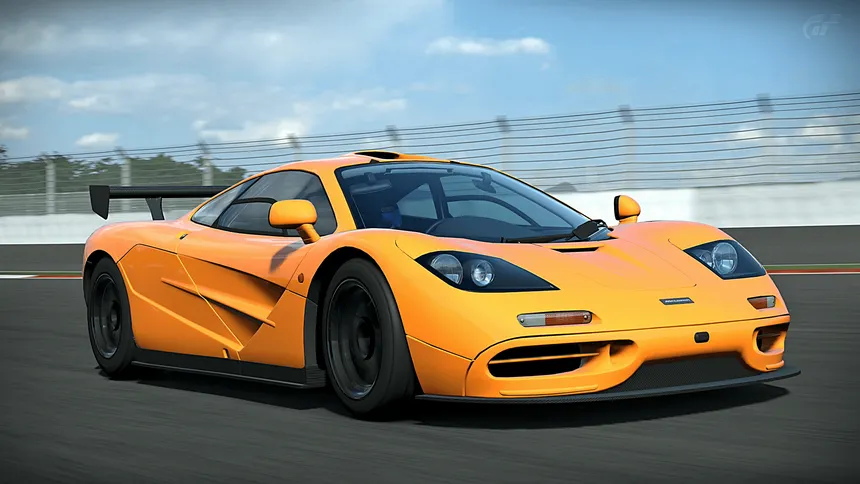
McLaren F1: How a Napkin Sketch Became the Purest Car Ever Built
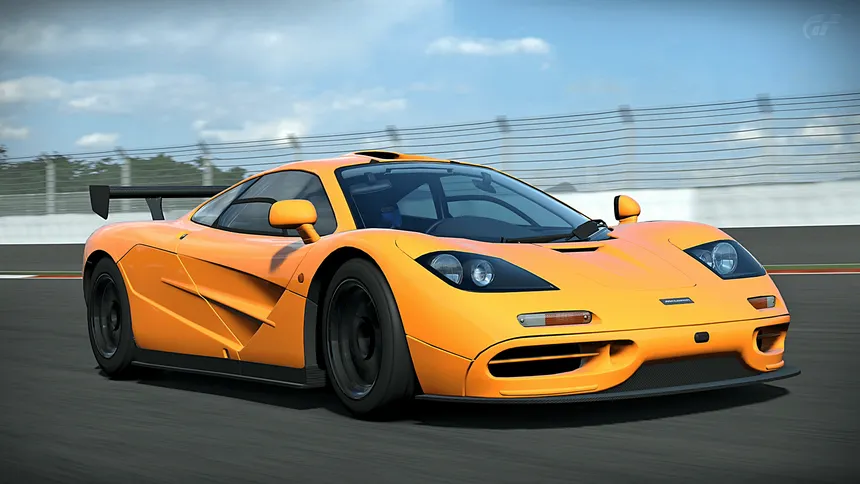
In 1988, after the Italian Grand Prix at Monza, Gordon Murray was waiting for a flight home. He was bored. He grabbed a notepad and sketched a three-seat car with the driver in the center. Mid-engine. No compromises. The fastest, purest car in the world.
That sketch became the McLaren F1. And over thirty years later, it still has no real successor. Not because nobody has built a faster car — they have, several times over. But because nobody has built a car with the same philosophy of absolute purity: no turbo, no hybrid, no electronic assists, no compromises of any kind.
The origin: Murray, Dennis, and the impossible idea
Gordon Murray was not a dreamer. He was the technical designer who had won Formula 1 championships with Brabham and McLaren. When he presented his concept to Ron Dennis, McLaren’s chief, he was not proposing a fantasy — he was proposing an engineering statement. Dennis agreed, and McLaren Cars (now McLaren Automotive) was created specifically to manufacture the F1. Peter Stevens was hired to design the exterior and interior.
Murray established the rules from the start: the car would be mid-engined, rear-wheel drive, with three seats and the driver positioned centrally and slightly forward, a carbon fiber monocoque, and the lightest, most powerful engine possible — but mandatorily naturally aspirated. No turbo. No supercharger. Murray demanded instant throttle response and total driver control over the mechanicals. A turbocharger introduced latency, complexity, and loss of feedback. For Murray, that was unacceptable.
And then he added: no ABS. No traction control. No power steering. The driver would feel everything, control everything, be responsible for everything. The McLaren F1 did not protect you from yourself. It demanded that you rise to its level.
For American enthusiasts who grew up with the F1 as an unattainable poster car, the context matters: when the F1 launched in 1993, the fastest American sports car was the Corvette ZR-1 making 405 hp. The Dodge Viper made 400 hp. The F1 made 618 hp from a naturally aspirated V12 in a car that weighed less than a Mazda Miata. It was not just ahead of its time — it was from a different timeline entirely.
The engine hunt: Honda says no, BMW says yes
Murray wanted a V10 or V12 from Honda. The relationship between McLaren and Honda was intimate — together they dominated late-1980s F1. Murray visited Honda’s Tochigi Research Centre with Ayrton Senna. He requested a 550 hp engine with a maximum block length of 600 mm and maximum weight of 250 kg (551 lbs). Honda said no.
Isuzu, planning an F1 entry, offered a 3.5-liter V12 being tested in a Lotus chassis. But Murray’s team wanted a proven design with racing pedigree. They rejected Isuzu.
Then Murray went to Munich. Paul Rosche, the legendary BMW M engineer responsible for some of the finest competition engines in history, accepted the commission. BMW Motorsport would design and build a V12 exclusively for the F1. Rosche had relevant experience: he was working on the S70/1 for BMW’s secret M8 prototype (which never reached production). The McLaren F1’s S70/2 was born from that foundation, but as an entirely different engine.
The engine: BMW S70/2 — 6,064 cc of perfection
The result exceeded every one of Murray’s expectations. And that detail matters: Murray did not ask for more power — he received more than he specified, yet the engine stayed within the dimensional requirements.
The BMW S70/2 is a 60-degree V12 with all-aluminum block and heads. Displacement of 6,064 cc (86 mm bore × 87 mm stroke — slightly undersquare). Dual overhead cams per bank (DOHC), four valves per cylinder, chain-driven camshafts. Double VANOS variable valve timing. Twelve individual throttle bodies with a carbon fiber intake manifold. Dry-sump lubrication with magnesium system. Nikasil-coated cylinder bores. TAGtronic electronic management with dual ECUs. Compression ratio of 11:1.
The numbers: 618 hp (461 kW / 627 PS) at 7,400 rpm and 480 lb-ft (651 Nm) at 5,600 rpm. Rev limiter at 7,500 rpm. The engine was 14% more powerful than Murray’s specification (550 hp) and only 35 lbs heavier (586 lbs vs 551 lbs target), maintaining the same 600 mm block length.
Rosche’s team used exclusively proven technology — no titanium valves, no titanium connecting rods, no variable intake geometry. The decision was deliberate: reliability above all. BMW used an E34 M5 Touring as a test mule to develop the engine before installation in the F1.
And then there is the gold. The F1’s carbon fiber monocoque required significant thermal insulation in the engine compartment. Murray’s solution was to line the engine bay with gold foil — the most efficient heat reflector known to science. It was not decoration. It was pure thermal engineering.
The chassis: first production carbon monocoque
The McLaren F1 was the first production car with a full carbon fiber monocoque. The structure was extraordinarily rigid and light — total weight of the road car was approximately 2,509 lbs (1,138 kg). For context: a current Toyota GR86 weighs 2,800 lbs. The F1, with a 6.1-liter V12, weighed less.
The central driving position — with the driver’s seat slightly forward and two passenger seats flanking and behind — was the car’s visual and functional signature. It provided visibility superior to any conventional seating arrangement and centered the driver’s mass on the car’s longitudinal axis. Doors were dihedral (butterfly). Transmission was a six-speed manual with a carbon triple-plate clutch, delivering power exclusively to the rear wheels.
The road car’s aerodynamics used no fixed wings for downforce. Instead, the flat underbody and rear diffuser exploited ground effect, assisted by two electric Kevlar fans that reduced pressure beneath the car. At the rear, a small dynamic spoiler adjusted automatically to balance the center of gravity under braking.
One little-known influence on the F1’s development was the Honda NSX. Murray stated that when he drove the NSX, every benchmark car he had been using — Ferrari, Porsche, Lamborghini — vanished from his mind. The F1 needed to be faster than the NSX, but the NSX’s ride quality and handling became his new design target.
The numbers: world record and 240 mph
On March 31, 1998, the XP5 prototype with a modified rev limiter set the Guinness World Record as the fastest production car: 240.1 mph (386.4 km/h). That record stood until 2005, when it was surpassed first by the Koenigsegg CCR and then the Bugatti Veyron. The F1 remains the fastest naturally aspirated production car ever built. That record has never been broken.
0-60 mph: 3.2 seconds. In 1992, that was from another planet. In 2026, it remains respectable for a car with no electronic aids and a naturally aspirated V12.
Le Mans 1995: the road car that beat prototypes
Gordon Murray never designed the F1 to race. It was a road car — the ultimate road car. But when teams in the newly created BPR Global GT Series saw the F1’s potential, they pressured Murray to create a competition version. He eventually agreed, and the F1 GTR was born.
Modifications from road car to GTR were relatively modest: stripped interior with roll cage, carbon-ceramic brakes, aerodynamic improvements, weight reduction. Ironically, the GTR’s engine produced LESS power than the road car — air restrictors mandated by racing regulations limited output to approximately 600 hp, versus the road car’s 618-627 hp. But the GTR was lighter and generated more downforce.
On June 17, 1995, seven McLaren F1 GTRs lined up at the 24 Hours of Le Mans. It was McLaren’s first entry. The car had never been tested over 24 hours. And it was competing against purpose-built racing prototypes.
Rain fell for 17 of the 24 hours — one of the wettest Le Mans races in history. The conditions equalized the field. And the F1 GTR — a modified road car — demonstrated astonishing reliability.
JJ Lehto, Yannick Dalmas, and Masanori Sekiya won the race in car #59, entered by Kokusai Kaihatsu and run by Lanzante Motorsport. F1 GTRs led for all but 13 laps and ultimately filled four of the top five positions: 1st, 3rd, 4th, and 5th.
McLaren won Le Mans on its first attempt. Only Ferrari had accomplished the same, in 1949.
Lehto’s performance during the overnight rain and fog was described by the team as astonishing. When asked to slow down, he replied that he already had and was having fun. He was spinning wheels on the Mulsanne Straight shifting gears and going sideways rally-style through the chicanes. In a road car. In the rain. At Le Mans.
Engineer Graham Humphrys, who ran the winning car, attributed the victory to the rain — which eased stress on the F1’s relatively fragile transmission. Mark Blundell, who finished fourth, described the engine as the car’s saving grace: “You could be in sixth gear at 2,000 rpm and the thing would just pull like a train. In the wet, that’s great because you can run a higher gear and cut out some of the traction issues.”
The F1 GTR continued racing through 2005. A “Long Tail” version with extended bodywork was developed for 1997. BMW increased its involvement with factory-entered cars. But nothing matched the magic of 1995 — the year a road car won against the world.
To celebrate the victory, McLaren built 5 units of the F1 LM: the GTR’s engine without restrictors (680 hp), weight slashed to 2,341 lbs by removing sound insulation, audio system, fan-assisted ground effect, and the dynamic rear wing. Painted in Papaya Orange — a tribute to Bruce McLaren’s original racing colors. One for each F1 GTR classified at Le Mans.
The F1 LM had a lower top speed than the standard car (225 mph vs 240 mph) due to increased aerodynamic drag from its fixed wing, but it was significantly faster on any circuit. It remains one of the most valuable cars on Earth, with estimates exceeding $25 million for any of the five units.
Production: 106 units of history
Exactly 106 McLaren F1s were built between 1992 and 1998. Each car required approximately three and a half months of hand construction.
The breakdown: 5 prototypes (XP1-XP5), 64 standard road cars, 28 GTR race cars, 5 F1 LM (Le Mans commemorative edition with 680 hp, Papaya Orange paint, weight reduced to 2,341 lbs), 2 GT longtail road cars, 1 XP1 LM development prototype, and 1 XPGT prototype.
Of the 106 built, approximately 100 survive today. Only six are known to have been destroyed. The carbon monocoque saved a test driver’s life in a serious crash in 1993 — definitive proof of the design’s structural integrity. About 30 F1s are believed to be in the United States, making it one of the largest concentrations outside the UK.
The original price was £540,000 (approximately $815,000 at the time). Today, road-spec F1s sell for over $20 million. They are the most valuable 1990s cars on the market and among the most prized assets in global automotive collecting.
What remains: a car without equal
The McLaren F1 was not the fastest car of its era throughout its commercial life — the speed record was set in 1998. It was not the most successful in competition — it won Le Mans but did not dominate the decade. It was not the best seller — 106 units barely register as a statistic for most manufacturers.
What the F1 was — and remains — is the purest car ever conceived. A 618 hp naturally aspirated V12 with no assists. Central driving position. Carbon monocoque. Gold-lined engine bay. Manual transmission. Rear-wheel drive. Designed by an F1 engineer, powered by BMW Motorsport, influenced by the NSX, sketched on a notepad after a race at Monza, and capable of winning Le Mans with a lightly modified version of the road car.
No other car in history combines those elements. None ever will. Regulations prevent it, technology makes it unnecessary, and the philosophy that created it — one man’s obsession with building something without a single compromise — no longer has a place in an industry governed by homologation, focus groups, and emissions regulations.
106 units. A sketch in an airport. The GOAT.
Check you’re still alive.