

Nürburgring Nordschleife: 20,832 Kilometres of Unfiltered Truth

73 corners. 300 metres of elevation change. Over 70 racing drivers killed in competition. Between 3 and 12 fatalities per year in public sessions. And yet, anyone with a driving licence and €30 can drive it. Welcome to the Green Hell.
A Circuit Born from Unemployment
The Nordschleife was not built for racing. It was built to put food on the table.
In the 1920s, the Eifel region of Rhineland-Palatinate was one of the poorest areas in Germany. The forested mountains west of Koblenz offered no industry, no employment, and no visible future. Meanwhile, ADAC Eifelrennen car races were being held on public roads in the area, a practice already considered dangerous and impractical.
The solution was ambitious to the point of madness: build a permanent racing and testing circuit that would serve as a showcase for the German automotive industry, a proving ground for manufacturers, and an economic engine for an entire depressed region. A public works project disguised as a cathedral of speed.
On September 27, 1925, the first stone was laid. The design came from the Eichler architecture firm in Ravensburg, with the layout defined by Hans Weidenbrück, who used the hills, plateaus, and forests around the medieval Nürburg castle to create something that existed nowhere else on Earth: a racing circuit that behaved like a real mountain road, with real gradients, real weather, and real consequences.
Up to 2,500 workers — most of them unemployed locals — worked simultaneously for nearly two years. Four sections were built by four different contractors. The total cost reached 15 million marks, including 6 million in government funding and substantial contributions from the city of Cologne.
The result: a 28.265-kilometre layout split into two loops. The Nordschleife (North Loop) at 22.810 km and the Südschleife (South Loop) at 7.747 km, plus a 2.281 km warm-up loop called the Betonschleife.
On June 18, 1927, the Nürburgring opened with a motorcycle race. Tony Ulmen, on a Velocette, was the first winner. The next day, Rudolf Caracciola won the first car race in a supercharged Mercedes S. A month later, Otto Merz took the first Grand Prix.
From day one, the circuit was open to the public as a one-way toll road during non-competition hours. That tradition continues nearly 100 years later.
Anatomy of the Green Hell
Jackie Stewart gave it the name. After competing on the Nordschleife throughout the 1960s, the Scottish driver christened it “Grüne Hölle” — the Green Hell. It was not a compliment. It was a warning.
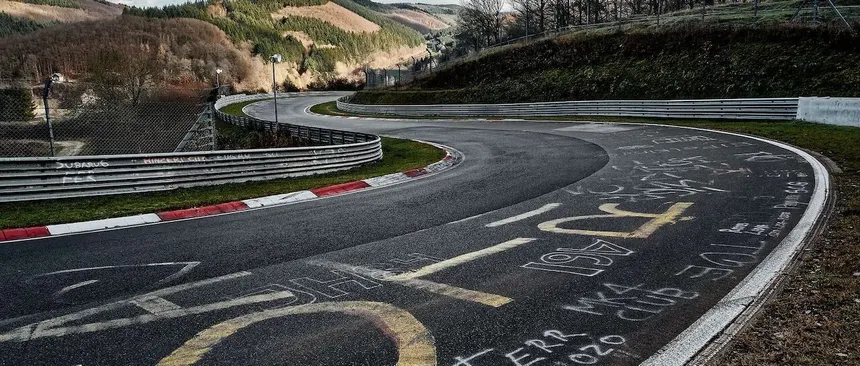
The current Nordschleife measures 20.832 kilometres (12.94 miles) following the 1982-83 modification that shortened the original layout to accommodate the new Grand Prix circuit. It has 73 corners, approximately 300 metres of cumulative elevation change, gradients of up to 17% uphill and 11% downhill, and an average width of 8 to 9 metres.
Those numbers mean nothing until you put them in context.
A lap of Monza is 5.793 km. A lap of Spa-Francorchamps is 7.004 km. A lap of the Nordschleife is 20.832 km. When you complete one lap of the Nordschleife, you would have done three and a half at Monza. A driver who makes a mistake at kilometre 3 must maintain absolute concentration for another 17 kilometres before crossing the line again. And those 17 kilometres include jumps where cars go airborne, blind crests where the road vanishes, sections where the surface goes from dry to soaked in 200 metres because Eifel weather follows no logic, and zero-runoff zones where the only thing beyond the kerb is trees, metal barriers, or embankments.
The most famous sections are part of every car enthusiast’s vocabulary:
Hatzenbach — the first fast sequence after the start, with blind linked corners demanding total commitment from the opening lap.
Flugplatz — “the airfield.” A jump where cars literally leave the ground at racing speeds. The name comes from a nearby former airstrip, but the irony is perfect.
Fuchsröhre — “the foxhole.” A fast, narrow descent through the trees ending in a violent compression. Sabine Schmitz named her restaurant in Nürburg after this section.
Adenauer Forst — a technical, forested section that local spectators love for the sheer volume of mistakes it generates. This is where regulars bring their folding chairs and coolers.
Karussell — a banked concrete corner built in 1933 after Rudolf Caracciola discovered he could gain two seconds per lap by hooking his inside wheel into the gutter. The Nürburgring formalised it by paving the gutter with concrete. It is the most photographed corner on the circuit.
Pflanzgarten — a sequence of crests and jumps that at racing speeds turns the car into an aircraft for fractions of a second.
Brünnchen — one of the favourite spectator zones, with good visibility and parking. Also one of the sections with the most Touristenfahrten crashes.
Döttinger Höhe — the longest straight on the circuit, where race cars exceed 300 km/h before the Antoniusbuche braking zone. During public sessions, this straight serves as the circuit exit.
The Formula 1 Era: Glory, Blood, and the Lauda Crash
The German Grand Prix ran on the Nordschleife regularly from 1927. When the Formula 1 World Championship began in 1951, the Nürburgring became one of the most feared and respected dates on the calendar.
The 1961 German Grand Prix remains the longest F1 race in history by distance covered: 346.159 kilometres over 15 laps of the full layout. Each lap took over 9 minutes for the fastest cars.
But speed increased faster than safety. In 1954, Onofre Marimón died during practice. In 1958, Peter Collins was killed when his Ferrari Dino 246 left the track, went airborne, and hit a tree. Collins was thrown from the car and suffered fatal head injuries. Drivers began speaking openly about the danger.
Jackie Stewart was the most vocal. During the 1966 Grand Prix, his BRM left the track due to a steering failure, rolled, and became wedged in a ditch, surrounded by fuel. Emergency services took minutes to arrive. He was rescued by fellow drivers using a spanner borrowed from a spectator. There was no adequate medical infrastructure across a 22-kilometre circuit. Stewart led the charge for safety improvements at circuits worldwide from that day forward — and he was the one who gave the Nordschleife the name that would define it forever: Grüne Hölle, the Green Hell.
Improvements came in 1970-71: runoff areas were widened, safety barriers installed, and some obstacles removed. But the Nordschleife was still the Nordschleife: 22 kilometres of road impossible to cover with television cameras, with insufficient runoff areas, and a length that meant medical services took far too long to reach any point on the track.
On August 1, 1976, everything changed.
Niki Lauda — who ironically was one of the circuit’s most vocal opponents — crashed at Bergwerk during the German Grand Prix. His Ferrari 312T2 hit an embankment, burst into flames, and Lauda was trapped in the cockpit engulfed in fire. Fellow drivers stopped to pull him out. He suffered severe burns to his face and lungs, and received last rites in hospital. He survived. He returned to racing 42 days later. But Formula 1 never returned to the Nordschleife.
The New GP-Strecke and the Nordschleife’s Survival
Between 1981 and 1984, a new short circuit — the GP-Strecke — was built at 4.5 km (later extended to 5.148 km), partially on the former Südschleife. It was designed to meet every FIA requirement: paved runoffs, impact-absorbing barriers, modern pits, press centre, medical facility, and full television coverage.
The opening on May 12, 1984 was an event in itself: a race with 20 identical Mercedes-Benz 190 E 2.3-16 cars and nine former F1 world champions among the drivers. The winner was a 24-year-old Brazilian named Ayrton Senna, in one of his earliest public appearances on European soil before his F1 debut that same year with Toleman.
Formula 1 returned to the Nürburgring in 1985, but to the new circuit. The Nordschleife, meanwhile, continued operating as a public toll road, an automotive industry test bed, and a venue for endurance racing. The Nürburgring 24 Hours, the VLN series (now NLS), and the Touristenfahrten sessions kept the circuit alive and relevant. While F1 moved to sterile Tilke-designed circuits, the Nordschleife remained what it had always been: 20 kilometres of unpadded reality.
In the 1930s, the Mercedes and Auto Unions of Bernd Rosemeyer, Rudolf Caracciola, and Tazio Nuvolari had turned the Nürburgring into the stage for European motorsport’s most epic battles. In the 1950s and 60s, F1 consecrated it as the calendar’s most feared circuit. But it was the post-F1 era that proved the Nordschleife did not need Formula 1 to remain relevant. F1 left. The Nordschleife stayed. And the motoring world kept coming to Nürburg.
The Death Toll
There is no official fatality count for the Nordschleife. The circuit does not publish mortality statistics. But the estimates, based on police reports and press coverage, are stark.
In official competition, an estimated 70 to over 100 drivers have died at the Nürburgring since 1927. In public sessions (Touristenfahrten), police-report estimates place the figure at between 3 and 12 deaths per year.
In 2015, a spectator died during a VLN race. In 2017, a man was struck and killed while on foot warning other drivers of a fluid spill. In 2021, a driver died when his Mazda MX-5 hit a recovery truck during a public session.
Since 2025, motorcycles have been banned from Touristenfahrten sessions.
These numbers are not an argument for closing the Nordschleife. They are a reminder of what it is. A circuit that does not pretend to be safe. A place where consequences are real.
Touristenfahrten: The Most Democratic Circuit on Earth
This is what makes the Nordschleife absolutely unique: anyone with a valid driving licence and a road-legal vehicle can drive it.
No competition licence required. No special equipment. No prior experience. Just a legal car, a licence, and the entry fee.
In 2026, a Nordschleife lap costs €30 Monday to Thursday and €35 Friday to Sunday and holidays. A season pass with unlimited laps costs €3,000.
Normal traffic rules apply: no overtaking on the right, keep right, and police patrol with helicopters. There is no general speed limit, although restrictions exist in certain zones.
The season runs from March to November. On the busiest days, hundreds of vehicles circulate simultaneously: family hatchbacks alongside supercars, first-timers alongside veterans with thousands of laps under their belts.
This format generates its own economic ecosystem: specialist car hire, Ring-Taxi rides, driving schools, workshops, hotels, restaurants, and a YouTube content industry generating millions of views with onboard footage, crash compilations, and lap records.
It is also why people die there. When you open a 20-kilometre circuit with 300 metres of elevation change and blind corners to anyone with €30 and a car, accidents are not a possibility — they are a statistical certainty.
The Ultimate Proving Ground
The manufacturer obsession with Nordschleife lap times has become one of the automotive industry’s most powerful marketing tools. If your production car can perform well on the Nordschleife, it can handle any road on Earth. The circuit tests everything — brakes, suspension, aero, cooling, high-speed stability, crest behaviour, wet traction. No simulator can replicate it.
All-time record: Porsche 919 Hybrid Evo — 5:19.55 (Timo Bernhard, 2018). Average speed 233.8 km/h. 1,160 bhp. Broke Stefan Bellof’s 35-year-old record.
Production car record (2024): Mercedes-AMG One — 6:29.09 (Maro Engel).
Bellof’s record (1983): Porsche 956 — 6:11.13. Bellof was 25. He died two years later at Spa. He was 27.
F1 Nordschleife record (1975): Niki Lauda — 6:58.6 (Ferrari 312T). The only driver to break 7 minutes on the 22.8 km layout. A year later, he nearly died on the same circuit.
Bankruptcy
In 2004, the Rhineland-Palatinate government approved an expansion plan: a theme park, shopping centre, hotels, and a themed “Eifel village.” The idea was to transform the Nürburgring into a 365-day tourist destination.
The project was a financial catastrophe. Costs exceeded €330 million officially, with total estimates reaching €524 million including unexplained government aid. The EU investigated and declared the state aid illegal. The “Ring-Racer” roller coaster barely functioned. Visitor numbers disappointed. The debt became unpayable.
In July 2012, the government declared insolvency. A world motorsport heritage site, built as a public works project to employ the Eifel’s unemployed in 1925, was technically bankrupt because of a theme park nobody asked for.
The “Save the Ring” campaign — led by fans, drivers, and local residents including Sabine Schmitz — pushed to keep the Nordschleife operational. In March 2014, the Capricorn Group bought the complex for over €100 million. The theme park was shut down. The roller coaster was dismantled. The Nürburgring went back to being what it was always meant to be.
The Numbers
| Fact | Figure |
|---|---|
| Opened | June 18, 1927 |
| Current length | 20.832 km (12.94 mi) |
| Original length | 22.810 km (14.17 mi) |
| Corners | 73 |
| Elevation change | ~300 m |
| All-time record | 5:19.55 — Porsche 919 Evo (2018) |
| Production record | 6:29.09 — AMG One (2024) |
| Bellof record | 6:11.13 — Porsche 956 (1983) |
| F1 record | 6:58.6 — Lauda, Ferrari (1975) |
| Competition deaths | 70-100+ (since 1927) |
| Public session deaths/yr | 3-12 (est.) |
| Lap price (2026) | €30-35 |
| Season pass | €3,000 |
| Last F1 on Nordschleife | 1976 |
| Bankruptcy | 2012 |
| Capricorn sale | 2014 (~€100M) |
Why It Matters
There is no circuit in the world that does what the Nordschleife does: expose the truth about a car, a driver, and the relationship between them over 20.832 kilometres with no filters and no excuses.
A car that works well on the Nordschleife works anywhere. A car that fails here reveals its weaknesses with a brutality no simulator can replicate. A driver who is fast here is fast for real. A driver who thinks they are fast discovers the difference between speed and control at the first blind crest.
The Nordschleife does not lie. It does not negotiate. It does not adapt to you. You adapt to it, or you learn the hard way. It has been doing this since 1927. Cars have changed. Drivers have changed. Engineering has changed. The circuit is still there, with the same crests, the same blind corners, the same trees beyond the barriers.
That is why the manufacturers keep coming. That is why Porsche, BMW, Mercedes, Ford, Hyundai, Toyota, and dozens more maintain permanent development facilities in the area. That is why camouflaged prototypes lapping the Nordschleife remain one of the automotive press’s primary sources of scoops. And that is why YouTube keeps filling up with Touristenfahrten footage: 280 km/h onboards, spectacular crashes, hatchbacks overtaking supercars, supercars hitting barriers.
The Nordschleife is the most dangerous reality show on Earth. And admission is €30.
Nearly 100 years after it was built, it remains the most honest test in the motoring world.
Check that you’re still alive.