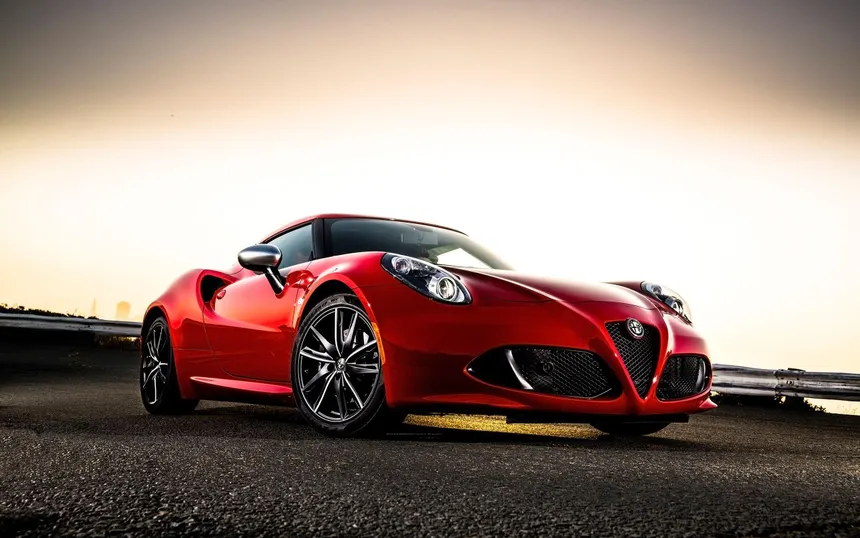
Alfa Romeo 4C: 895 Kilograms of Carbon Fiber and the Last Time Alfa Romeo Was Alfa Romeo
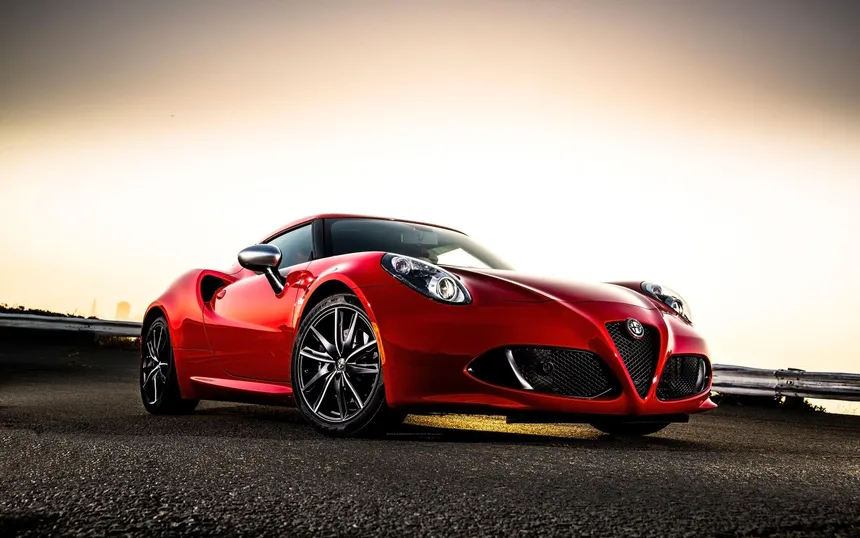
The mid-engine sports car that proved four cylinders are enough — and that the market wasn’t ready
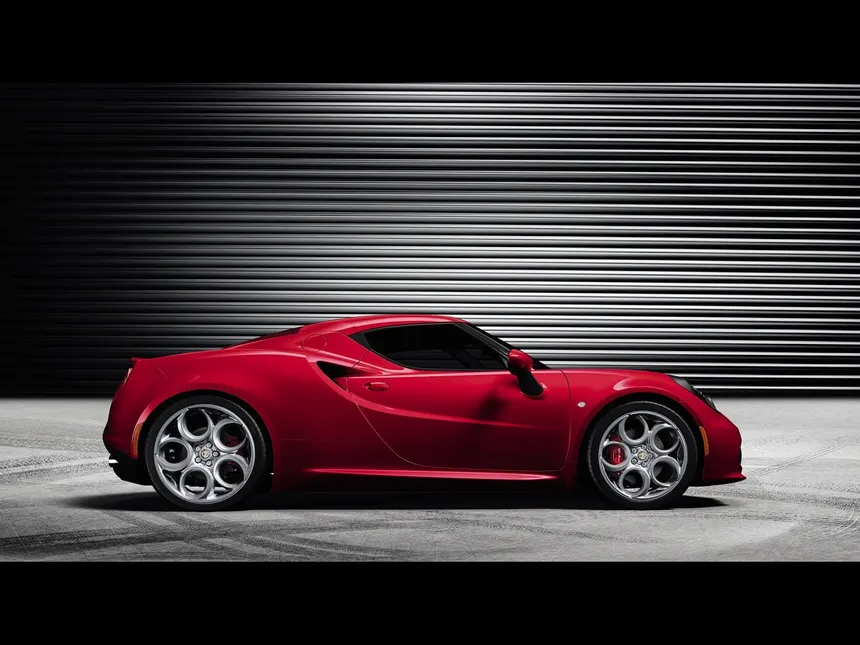
In 2013, after years of diesel sedans, shared-platform SUVs, and broken promises, Alfa Romeo did something unexpected: they built a two-seat, mid-engine sports car with a carbon fiber monocoque tub.
Not a concept. Not a motor show prototype. A production car manufactured at Maserati’s plant in Modena. With a turbocharged four-cylinder engine. Rear-wheel drive. No power steering. And a dry weight of 895 kg — 1,973 lbs.
The Alfa Romeo 4C wasn’t designed to compete with Ferrari or Lamborghini. It was designed to compete with the Porsche Cayman and the Lotus Elise. And in many ways, it beat both of them at what matters most: raw, unfiltered driving connection.
The tub: where everything starts
The defining element of the 4C isn’t the engine. It’s the tub. A carbon fiber monocoque weighing just 143 lbs (65 kg). For context: a conventional steel monocoque chassis weighs between 550 and 770 lbs.
The tub was manufactured by TTA (Tecno Tessile Adler), a joint venture between Adler and Lavorazione Compositi. It wasn’t a decorative panel or a marketing gimmick. It was the primary load-bearing structure of the car. Everything mounted to it: engine, suspension, steering, bodywork.
Front and rear crash structures were aluminum, bolted to the tub. The rear subframe — carrying the engine, gearbox, and rear suspension — was also an aluminum hybrid. The result was an extraordinarily light and rigid structure that allowed the 4C to weigh under 2,000 lbs dry.
For the North American version, federal safety regulations required additional structural reinforcements that added 342 lbs (155 kg). The US-spec 4C weighed 2,315 lbs dry — 2,487 lbs with fluids. Still light by any standard, but the difference from the European version was substantial and affected the car’s character.
That 342-lb penalty is worth understanding. It’s the weight of an adult passenger, added permanently to the chassis by regulation. American 4C owners drive a fundamentally different car than their European counterparts. Both are special. One is more special.
The engine: the aluminum 1750
The 4C’s engine was the 1,742 cc turbocharged inline-four with direct injection that Alfa Romeo already used in the Giulietta. But it wasn’t the same engine.
The 4C’s block was cast aluminum, 48.5 lbs (22 kg) lighter than the Giulietta’s cast-iron block. The cooling system was redesigned. Engine electronics were reprogrammed. The turbocharger was different, with response optimized for a mid-engine application where thermal management is more demanding.
Engine specs:
- Type: inline 4-cylinder, DOHC, 16 valves
- Displacement: 1,742 cc (106.3 ci)
- Forced induction: turbocharger with intercooler, direct injection
- Power: 237 hp at 6,000 rpm
- Torque: 258 lb·ft (350 Nm) between 2,200 and 4,250 rpm
- Torque curve: flat from 2,200 rpm. Full accessibility in the midrange
- Block: cast aluminum
- Position: mid-rear, longitudinal
The engine didn’t chase headline horsepower. At 237 hp, it was below the Cayman S (325 hp) and the Exige S (345 hp). But at 1,973 lbs, the power-to-weight ratio was 8.32 lbs/hp — competitive with cars producing twice the output.
Torque delivery was the key. 258 lb·ft available from 2,200 rpm meant the 4C responded immediately on corner exit without waiting for the turbo. It wasn’t a turbine-launch engine where power arrives in a violent rush at 4,000 rpm. It was an engine that pushed from the bottom and didn’t stop until the 6,500 rpm redline.
Transmission and dynamics
The gearbox was Alfa Romeo’s TCT (Twin Clutch Transmission): a dual dry-clutch, 6-speed unit with steering-wheel paddle shifters. There was no manual option with a clutch pedal. TCT only. It was one of the project’s most criticized decisions — purists wanted a three-pedal manual.
The Alfa DNA selector controlled engine, transmission, steering, throttle, suspension, and brake behavior. Three standard modes (Dynamic, Natural, All Weather) plus a fourth exclusive to the 4C: Race. In Race mode, stability control was fully disabled and the gearbox allowed more aggressive shifts.
Front suspension was a high quadrilateral (double-wishbone variant). Rear was MacPherson strut. Steering was mechanical — no electric or hydraulic assist. Direct. Unfiltered. No artificial smoothing. What you felt in the wheel was exactly what was happening at the tire contact patch.
That lack of power steering was a statement. In a market where even economy hatchbacks have electric power steering with fake “sport” modes, Alfa Romeo decided their carbon fiber sports car didn’t need it. At low speed, parking was an arm workout. At high speed, road communication was pure.
Verified performance data:
- 0-62 mph: 4.5 seconds (4.2 with launch control per Quattroruote testing)
- 0-124 mph: 16.9 seconds (Quattroruote)
- Quarter mile: 12.5 seconds at 111 mph (Quattroruote)
- Top speed: 160 mph (157 mph measured by Quattroruote in 5th gear at 6,500 rpm)
- Nürburgring Nordschleife: 8:04 (September 2013, Pirelli P Zero Trofeo tires, driver Horst von Saurma)
An 8:04 Nürburgring time for a 237 hp four-cylinder is extraordinary. For context, it’s faster than a BMW M3 E46 (8:22) and within striking distance of the Porsche 911 Carrera S 997 (8:00). The carbon tub’s torsional rigidity, the low weight reducing brake and tire degradation, and the mechanical grip from the wide rear rubber made the 4C a silent assassin on technical circuits.
After the Ring, the 4C also served as the official safety car for the Superbike World Championship (WSBK) from 2013 onward. A turbocharged four-cylinder production car escorting race-spec motorcycles. Alfa Romeo didn’t do it for marketing. They did it because the car was fast enough for the job.
Production and special editions
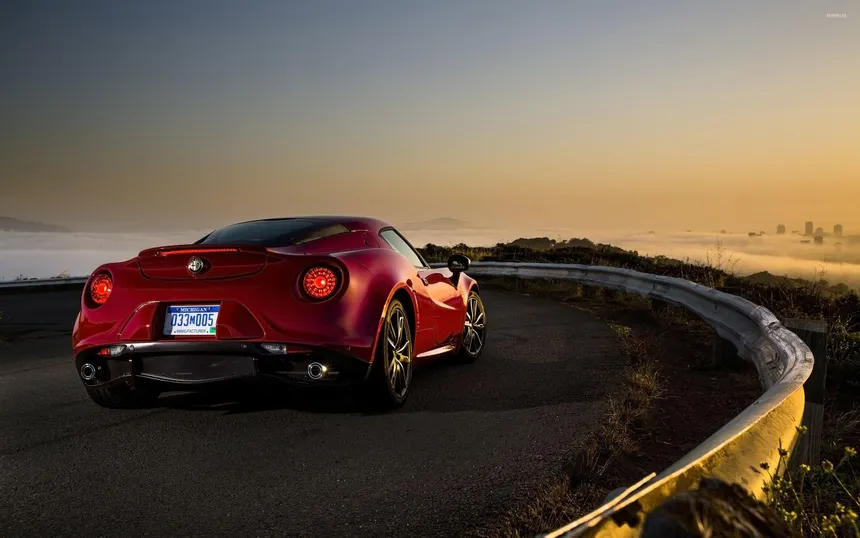
Production began in May 2013 at Maserati’s plant in Modena. Planned capacity was 2,500 units per year, though actual figures never reached that target.
Launch Edition (2013): Numbered edition in four colors (Rosso Alfa, Rosso Competizione tri-coat, Madreperla White tri-coat, Carrara White matte). 500 units for Europe/ROW, 500 for North America, 88 for Australia, 200 for Japan, 100 for the Middle East.
4C Spider (2015): Convertible with removable roof panel. Different headlights, exhaust, and engine cover from the coupe. Only 22 lbs (10 kg) heavier than the coupe in US spec. Same mechanicals.
4C Spider Italia (2018): Limited edition in Misano Blue Metallic. 108 units initially (15 for Japan), expanded to 124 with 16 additional North American units in 2020.
4C Spider 33 Stradale Tributo (2020): The final edition. A tribute to the legendary Alfa Romeo 33 Stradale of 1967. 33 units for North America (22 US, 10 Canada, 1 FCA executive). Red carbon fiber tub — a first for the 4C. Akrapovič exhaust, carbon halo, Club Italia flag mirrors, race-tuned suspension. Every available option included as standard. Numbered plaque and exclusive book. Starting MSRP was approximately $80,000.
The Alfa Romeo lineage: from the 33 Stradale to the 4C
The 4C didn’t arrive from nowhere. It’s the last link in a tradition of lightweight mid-engine sports cars that Alfa Romeo inaugurated with the 33 Stradale in 1967 — arguably the most beautiful car ever made. 2.0-liter V8, 230 hp, 1,543 lbs. Only 18 built.
After that came the 33 competition cars (TT12, SC12), the 8C Competizione (2007, 4.7L V8, 450 hp, 500 units), and finally the 4C. The philosophy was consistent across all of them: mid or rear engine, minimum weight, performance disproportionate to displacement.
The decision to name the final edition “33 Stradale Tributo” was deliberate. Alfa Romeo was closing a circle. From the 33 Stradale to the 4C: 46 years of history compressed into a red carbon fiber tub and 33 numbered examples.
The interior: intentional spartan design
Getting into a 4C was like getting into a first-generation Lotus Elise — but with visible carbon fiber weave instead of bare aluminum. The glossy carbon tub sills were the first thing you saw when opening the door. The cabin was narrow, low, and deliberately stripped.
No glovebox. One storage compartment behind the seats. Two cupholders on the center tunnel. Gearbox buttons, handbrake, and DNA selector on the console. And a flat-bottomed steering wheel with paddle shifters.
No touchscreen. No integrated navigation. No drive modes explained with animated graphics. The 4C communicated through the steering wheel, the pedals, and the seat. If you needed more feedback, you were in the wrong car.
Why it failed commercially — and why that doesn’t matter
The 4C didn’t meet sales expectations. The reasons are multiple and well-documented: the lack of a manual transmission alienated purists. The US version, with 342 lbs of extra weight, lost some of the European car’s magic. The interior was too spartan for the price point (from $53,900 in the US). And competing against the Cayman — a more refined, more livable, more premium product — was an uneven fight in volume.
The TCT gearbox, specifically, was a sore point. In an era where the Porsche Cayman offered both PDK and a six-speed manual, and the Lotus Elise came exclusively with a manual, the 4C’s paddle-shift-only approach felt like a missed opportunity. The TCT was competent — fast shifts, reasonably smooth in normal driving, aggressive in Race mode. But it lacked the mechanical engagement that a car this focused on driver connection deserved. A heel-toe downshift into a fast corner in a car with no power steering and a carbon fiber tub — that’s an experience the 4C was built for but could never fully deliver.
Alfa Romeo discontinued the 4C in 2020. Total production over seven years fell well short of the 2,500 annual unit target. Exact global production numbers were never officially published, but industry estimates place total output across all variants (coupe, Spider, special editions) at roughly 10,000-12,000 units worldwide.
But the 4C was never designed to sell. It was designed to prove that Alfa Romeo still knew how to build a real car. A car where every gram of weight was justified. Where engineering served the driving experience, not the equipment list in the brochure.
The 4C was the first Alfa Romeo production car to return to the US market. Not with a crossover. Not with a diesel sedan. With a mid-engine two-seater made of carbon fiber. That decision — commercially absurd, impeccable from a brand perspective — says more about what Alfa Romeo truly is than any marketing campaign they’ve run before or since.
1,973 lbs. Four cylinders. No power steering. No excuses.
The Alfa Romeo 4C is a car that polarizes. It’s not comfortable. It’s not practical. It’s not refined. It’s not a Cayman. It doesn’t try to be.
It’s 1,973 lbs of carbon fiber with a turbo engine behind the seat and a steering wheel that tells you exactly what’s happening under the tires. No filter. No electronic intermediary. No illusion that technology is protecting you from reality.
If you need more cylinders to feel something, the problem isn’t the car.
It’s the carbon fiber they should have used to build your spine.
The 4C in the collector market
The 4C is entering a fascinating phase in its lifecycle. For years after discontinuation, used 4Cs were available at significant discounts from their original MSRP — the car’s commercial underperformance meant dealers were motivated to move inventory, and the secondary market reflected that.
But the trend is reversing. Limited editions like the Launch Edition, the Spider Italia, and especially the 33 Stradale Tributo are appreciating. The Tributo — with its red carbon tub, complete option list, and run of just 33 units — is already a collector piece that commands prices well above its original sticker.
Even standard 4C coupes and Spiders in good condition with low miles are stabilizing. The car’s fundamental appeal — carbon fiber tub, mid-engine layout, naturally aspirated character (through the turbo’s broad torque curve), and no-power-steering purity — becomes more distinctive every year as the industry moves further toward electric drivetrains and digitally mediated driving experiences.
The 4C didn’t need to sell well to be significant. It needed to exist. And for seven years, it did.
Check you’re still alive.