Peugeot 306 Ecosse Sedan Coupé: The Peugeot That the Factory Never Dared to Build

Introduction: A four-door sedan with the soul of a beast
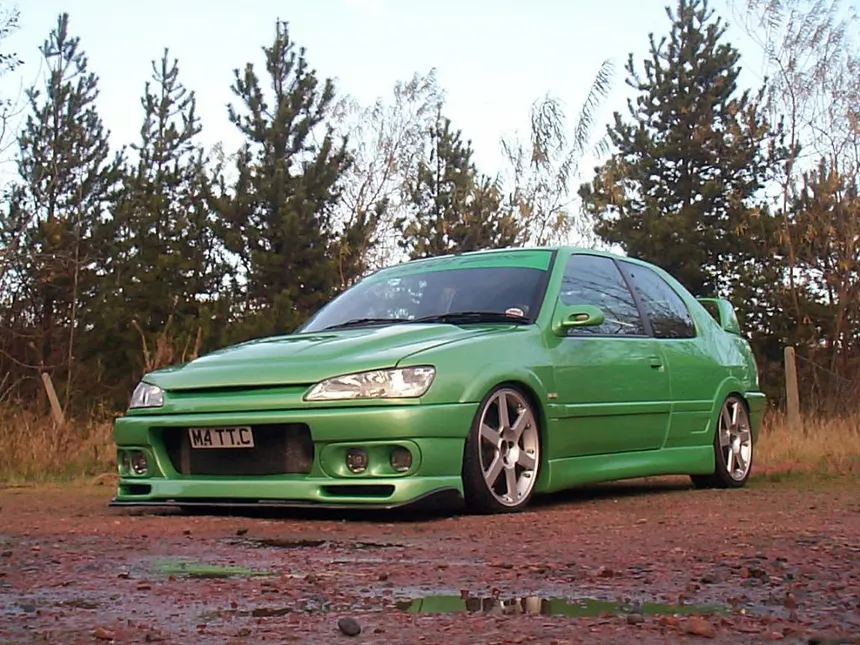
Some cars are born on an assembly line. Others are born in a workshop, with an angle grinder in one hand and a clear vision in the other. The Peugeot 306 Ecosse Sedan Coupé belongs firmly in the second category. A four-door sedan — the most unremarkable car in Peugeot’s 1990s catalogue — transformed into a two-door coupé packing 350 bhp that was faster than a Ferrari 355 from 100 to 150 mph.
That’s not hype. That’s not marketing. That’s Scottish engineering with French blood.
This car graced the cover of Max Power in July 1998, served as pace car for the British Touring Car Series, starred in a Sony Records music video and even appeared in the Ali G movie. But before all of that, it was a wild idea that came out of a small workshop in Bo’ness, Scotland, called Ecosse Automotive.
And “Ecosse,” by the way, is the French word for Scotland. That detail is no accident. It’s a statement of intent.
Ecosse Automotive: The workshop that spoke French from Scotland
Ecosse Automotive was born from frustration. Matt Collins and Diane Paterson, its founders, were Peugeot owners who were fed up with the lack of serious options for modifying French cars in the UK. There were no quality parts, no genuinely specialized workshops, and Peugeot tuning on the British Isles was years behind what existed in France.
So they decided to build what didn’t exist: a comprehensive workshop specializing exclusively in Peugeot, with direct connections to French component manufacturers. They chose the name deliberately — “Ecosse” is Scotland in French, the language of Peugeot’s heartland. A bridge between two worlds.
From the outset, Ecosse didn’t limit themselves to fitting bodykits and swapping exhausts. They launched into engine conversions nobody had attempted before: the first 406 turbo engine into a 306, a 24-valve V6 into a 306 Cabriolet, turbocharged 106 GTi 1.6 16V builds, supercharged 306 GTi-6 conversions… Each project was a world first that opened doors in specialist magazines and in the UK modified car scene.
In October 2002, success forced them to build purpose-built premises: a prep shop, their own paint booth, multiple workshop bays. Everything under one roof. Everything held to their exacting standards.
But the car that launched them into legend was one that made no sense on paper: a 306 sedan.
The base: The Peugeot 306 Sedan, the most improbable starting point
To understand the madness of this project, you need to understand what the 306 sedan was in the context of the 1990s. The Peugeot 306, launched in 1993, was a massive success for the brand. Sharing its platform with the Citroën ZX (and later with the Xsara, Berlingo and Partner), the 306 offered an extensive range: three and five-door hatchback, cabriolet, estate and sedan.
The hatchback was the star. The S16 and later the GTi-6, with its 167 bhp XU10J4RS engine and six-speed gearbox, became segment-defining hot hatches. The Rallye, 65 kg lighter than the GTi-6, was a no-compromise pocket rocket. Even the French National Gendarmerie bought 80 Phase 2 S16 units for their Rapid Intervention Brigade.
And the sedan? The sedan was the quiet sibling. Four doors, conventional boot, SN/SL/SR/ST trim levels. A car for anyone who needed a practical, unpretentious Peugeot. The parents’ car. The taxi. The company vehicle.
Matt Collins looked at that car and saw the exact opposite of what everyone else saw. He saw a blank canvas. The most improbable base imaginable for creating a car that would confuse Peugeot fans, tuning enthusiasts and even Peugeot themselves when the car visited the factory.
The conversion: Structural two-door surgery
The transformation from four-door sedan to two-door coupé was no cosmetic hack. It was serious structural surgery that required careful planning, precision welding and a deep understanding of the 306’s architecture.
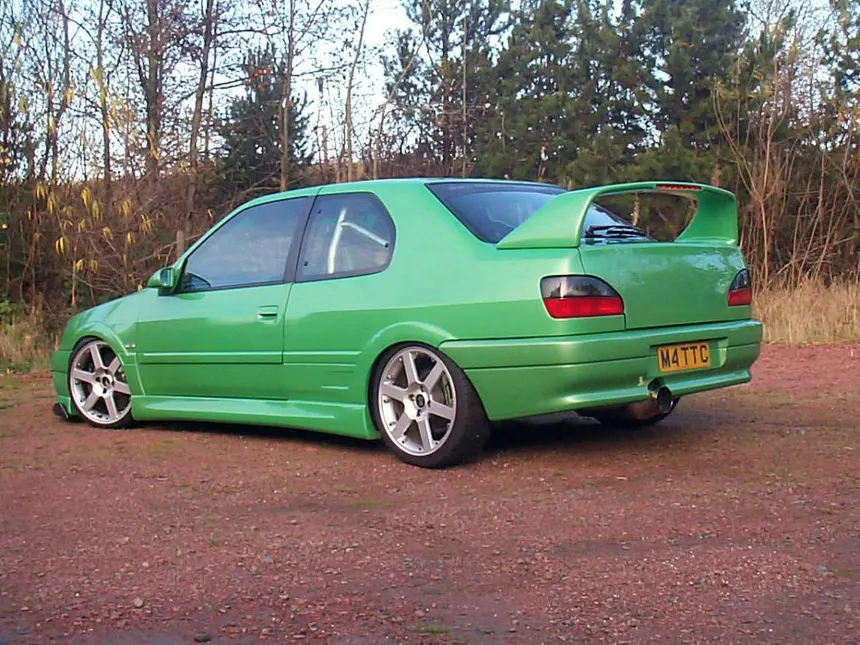
The process went like this: the rear doors were removed and the original B-pillars were cut out. The B-pillars were then repositioned rearward and welded into their new location. The sedan’s front doors were replaced with the longer doors from the three-door 306 hatchback, and the hatchback’s rear side windows were grafted into the rear panels.
The result didn’t look like a garage bodge. It looked factory-built. As if Peugeot had produced a coupé version of the 306 that simply never made it to dealerships. That level of finish was Ecosse’s calling card: it wasn’t enough for it to work — it had to look like it came straight out of Sochaux.
The engine: T16 on steroids
Under the bonnet, Matt Collins wasn’t going to settle for a stock engine. The choice was the 405 T16 block — the XU10J4TE 2.0-litre, 16-valve turbocharged unit that Peugeot had developed for its four-wheel-drive performance sedan. The standard 405 T16 produced between 200 and 220 bhp (with an overboost function lasting 45 seconds) and only 1,061 were ever built, ten of them for the Gendarmerie. It was an engine with competition pedigree: the T16 name connected directly to the Group B 205 Turbo 16 and to the 405 Turbo 16 that won Pikes Peak and the Paris-Dakar.
But 200 bhp wasn’t enough for the Ecosse vision. The engine was rebuilt from scratch with a parts list that read like a racing catalogue:
- Turbocharger: Garrett T3 with Group A actuator
- Internals: Forged pistons, one-off Sodemo cams, gas-flowed cylinder head
- Fueling: GTi-6 inlet manifold with revised flow, 803 injectors, uprated fuel pump
- Engine management: Pectel P8 — a programmable competition ECU
- Cooling: Spec-R intercooler, Samco silicone hoses
- Intake: Pipercross air filter
- Exhaust: One-off stainless steel system by Concept
The result: 350 bhp. In a Peugeot 306. With front-wheel drive.
Transmission and chassis: Taming the beast
Putting 350 bhp into a front-wheel-drive car that originally ran engines between 75 and 167 bhp requires more than a powerful engine. It requires everything around the engine to be up to the task.
Transmission: Six-speed gearbox conversion with a cermetallic paddle clutch and Racelogic traction control. The Racelogic system was essential — without it, 350 bhp through the front wheels would have been unmanageable.
Suspension: Avo height and damping adjustable coilover units at the front, Avo adjustable shocks at the rear, 23 mm rear anti-roll bar, and a 70 mm drop from standard ride height. The goal was to preserve the 306 chassis’s natural agility (already excellent from factory thanks to its passive rear-wheel steering via compliance bushes) without making the car undriveable.
Brakes: Brembo four-piston calipers with 330 mm discs at the front, disc conversion at the rear (the standard 306 used drums on many versions), fast road pads, braided steel hoses and DOT 5.1 fluid. For a car that could reach 155 mph, brakes were non-negotiable.
Wheels and tyres: CSA Hurricane 7.5×17-inch wheels fitted with hubcentric adapters, running Yokohama A510 tyres in 205/40 R17.
The look: France speaking through Scotland
The bodywork didn’t just undergo the two-door conversion. Ecosse fitted the car with components from French manufacturer Esquiss’Auto, a company specialized in Peugeot bodykits that produced in France to fitment standards far above the generic tuning parts of the era.
The kit included a modified Esquiss Mygale front bumper to house the oversized intercooler, Esquiss sideskirts with integrated wheel arch extensions, and an Esquiss Scandal bonnet vent. At the rear, the boot lid was fully smoothed and topped with a BMW E36 Evo spoiler — a choice that might seem eclectic today, but in the context of the late nineties fit perfectly with the aggressive aesthetic Ecosse was aiming for. The rear bumper was hand-modified because nothing on the market fitted a two-door sedan that was never supposed to exist.
The French connection was deliberate. Ecosse didn’t want generic British parts. They wanted French components for a French car, modified in Scotland with a French name. Total coherence.
The numbers: Faster than Maranello
The Ecosse 306 Sedan Coupé’s figures speak for themselves:
| Specification | Data |
|---|---|
| Engine | 2.0L 16v XU10J4TE turbo (405 T16 base) |
| Power | 350 bhp |
| Turbocharger | Garrett T3, Group A actuator |
| Management | Pectel P8 |
| Transmission | 6-speed, cermetallic paddle clutch |
| Drivetrain | FWD + Racelogic TC |
| 0-60 mph | Under 6 seconds |
| Top speed | 155 mph (250 km/h) |
| Front brakes | Brembo 4-piston, 330 mm |
| Suspension | Avo coilover (fr.) / Avo adjustable (rr.) |
| Wheels | CSA Hurricane 7.5×17″ |
| Tyres | Yokohama A510 205/40 R17 |
The stat that sums it all up: from 100 to 150 mph, the 306 Ecosse was faster than a Ferrari 355. A converted Peugeot sedan, front-wheel drive, with a four-cylinder engine, pulling away from a mid-engined Italian V8 in the upper reaches of the rev range. That’s engineering without apologies.
The legacy: From Max Power to history
The 306 Ecosse Sedan Coupé debuted on the cover of Max Power in July 1998. Its maiden voyage was being driven to Max Power Live, arriving at 6 AM to headline the show. From there, the car toured Europe appearing at major modified car events, with special presence at French shows where the Peugeot connection was especially appreciated.
The résumé is as diverse as it is unlikely: pace car for the British Touring Car Series, a starring role in the Ali G film, appearances in Sony Records music videos, winner of the Magny-Cours Top 20 (alongside Ecosse’s other creation, Diane Paterson’s mint green 306 V6).
Over time, Matt Collins moved into racing and the sedan changed hands — first to John Owen, a declared fan of Ecosse’s creations, and then to Julian. But the car remains an absolute icon of the 1990s modified car scene. Not just for what it was technically, but for what it represented: proof that you don’t need a noble base to create something extraordinary. Sometimes, all you need is the most improbable car in the catalogue and the vision to see what nobody else sees.
NEC reflection: Why this car matters
At Not Enough Cylinders, we cover builds that defy logic. Cars that shouldn’t work on paper but work brilliantly in reality. The 306 Ecosse embodies that philosophy completely.
It’s not just a car with a lot of power. It’s an exercise in vision and complete artisanal execution: structural body conversion, engine swap with full-race preparation, bespoke chassis setup, a coherent aesthetic using components from the car’s country of origin, and a finish that fooled Peugeot’s own factory.
Matt Collins and Diane Paterson didn’t have a factory behind them. They had a workshop, tools, contacts in France, and an obsession with doing things to the level that Peugeot should have done. And with that, they built a car that beat a Ferrari on the motorway.
If that’s not the spirit of Builds & Swaps, nothing is.
Did you know about the 306 Ecosse? Do you think body conversions are underrated compared to pure engine swaps? Drop your thoughts below.